Dark Shadows fans like to make jokes about the inefficiency of law enforcement in the fictional town of Collinsport, but in this episode we see that the sheriff and his men really never had a chance. The ancient and esteemed Collins family controls everything in the area, and they will go to any lengths to keep the police from obtaining the information they need to do their job effectively.
Stuffy Edward Collins invokes the police when he demands that broad ethnic stereotype Magda Rákóczi vacate the Old House on the estate of Collinwood. Magda laughs and says that if the police show up, she will tell them that Edward’s distant cousin Barnabas is a vampire. Horrified at the damage it would do to the Collins family name were word of Barnabas’ condition to get out, Edward backs down. Barnabas is at large and has been responsible for at least six homicides since traveling through time to the year 1897, including the murder of Edward’s brother Carl in the drawing room of their home just the other day. But evidently that is a small matter to Edward compared to the danger that the sheriff might be indiscreet.
Barnabas materializes at the police station, where a werewolf is being held in custody. A deputy is startled to see Barnabas in front of him all of a sudden. For only the third time in the series, Barnabas says “Look into my eyes!” and induces an hypnotic trance in someone not his blood thrall. It is the first time he has exercised this power on someone other than Edward’s nine year old daughter Nora. Barnabas tells the deputy that once he has completed his task, he will remember nothing. So he is following the family policy with regard to keeping the police in total ignorance.
Edward shows up and sees Barnabas. Edward is wearing a cross and holding a revolver loaded with six silver bullets, which on Dark Shadows are as effective against vampires as they are against werewolves. Barnabas hides behind the deputy and tells Edward that he is acting in the interests of the future of the Collins family. Edward says that he belongs to the past, not the future. Barnabas doesn’t explain anything; he vanishes.
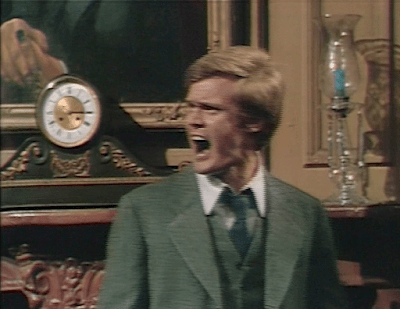
Not exactly an heroic look for ol’ Barney. Screenshot by Dark Shadows Before I Die.
Barnabas’ post-hypnotic suggestion has its effect, and the deputy is bewildered to find himself face to face with Edward. Edward tells him that they must watch the werewolf. The deputy starts to say something about the sheriff, and Edward replies “The sheriff doesn’t realize what this animal is!” Of course he doesn’t, no one will tell him anything about it.
Back in the Old House, Barnabas and Magda lament their failures. He could not take the werewolf from the cell in the police station to the cell in the basement of the house; she could not persuade lawyer/ Satanist Evan Hanley to return a severed hand he stole from them. They wanted to do these things because the werewolf is Edward’s brother Quentin, whom Magda is trying to free from his curse by means of the hand’s magical powers. Barnabas knows that if they do not succeed, terrible consequences will ensue in 1969.
Closing Miscellany
It is a serious mistake to show the werewolf when he is not in the act of committing a spectacular homicide. They didn’t have the budget to put him in full-body makeup, so he wears a tidy little suit, complete with a watch fob. He is so well put together that it is difficult to imagine him inspiring any fear other than the fear that one will not meet his apparently rather exacting standards of attire.
There is a noteworthy blooper in this one. Magda confronts Evan, declaring “The book, I know you took it from the Old House!” Usually actors roll with each other’s bobbled lines, but this is far enough out that Humbert Allen Astredo obviously has no idea where Grayson Hall is in the script. All he can do is ask “The book?” “The hand!” she corrects.
They also make a goof in the closing credits. This is one of three consecutive days when Louis Edmonds is billed not as Edward, but as Roger Collins, the role he plays in the parts of Dark Shadows set in the 1960s. He’s been identified correctly throughout the first seventeen weeks of the 1897 segment and everyone else is identified correctly in these episodes, so it is not clear what happened.
Danny Horn’s posts at Dark Shadows Every Day are often laugh-out-loud funny, and the one for this episode is especially so. His description of the scene between Magda and Evan has some big laughs, and when he imagines the sheriff’s deputies trying to catch the werewolf by “putting on their alluring lady-werewolf disguises a la the Warner Brothers cartoons,” well that’s just super how could anyone improve on it.
Act One consists of recovering vampire Barnabas and mad scientist Julia standing around Barnabas’ front parlor recapping various ongoing storylines.
Danny Horn devotes his post about this episode to a detailed analysis of this scene. He shows that Jonathan Frid’s performance and Grayson Hall’s are open to many objections. They fall short in such technical categories as “knowing their lines” and “standing on their marks” and “having the slightest idea what is going on.” But they are fascinating to watch nonetheless. Danny declares that “[t]he point of these scenes is to see how long two adults can stand around in a room saying preposterous things to each other.” Frid and Hall operate at such a high level of tension that the prospect of either of them breaking character generates enough suspense to keep us on the edge of our seats.
Patrick McCray wrote two separate posts about this episode. In the one that went live 13 September 2017, he too focuses on the performances in Act One. He writes:
Poor Jonathan Frid. He must have had a rough night. I am usually oblivious to his infamous (and completely understandable) line trouble, but in this one, it is so palpable that I totally understand why he retired from TV after DARK SHADOWS left the air. In his early dialogue with Grayson Hall, you can see sheer terror in the eyes of both performers as Barnabas haltingly recalls a trip to the hospital. This is followed by the “Frid Surge,” where Barnabas becomes far more committed and energetic when he turns to face the teleprompter. Of course, this gives him that great sense of vulnerability that was the secret to Barnabas’ success.
This is the only post on the Collinsport Historical Society tagged “Frid Surge”; that’s too bad, I’d like to see that phenomenon tracked throughout the series. I should also mention that Patrick goes on in this post to express his “confidence that Frid could have acted the doors off the collected ensemble had the poor guy just been given another frickin day to study his sides.”
Barnabas and Julia’s recap scene ends when an unexpected visitor barges in. He is an unpleasant man named Peter, who prefers to be called Jeff. Peter/ Jeff is fiancé to well-meaning governess Vicki, whom Barnabas and Julia know to have been abducted by Frankenstein’s monster Adam. Adam came to Barnabas’ house yesterday and threatened to kill Vicki unless Barnabas and Julia created a mate for him.
Peter/ Jeff was assistant to Eric Lang, the mad scientist who created Adam, and he knows that Barnabas and Julia were connected to the experiment. He does not know for sure that Adam is Lang’s creation, that Barnabas and Julia brought Adam to life after Lang’s death, or that Adam has abducted Vicki. He does, however, have grounds to suspect that each of these things might be true. In this scene, he announces his suspicions to Barnabas and Julia. They huddle in one corner of the room while he shouts his lines in his singularly irritating voice. They deny all three of his points. One of the commenters on Danny’s post, “Straker,” summed up their reaction admirably:
Frid and Hall were too professional to show it but I sensed they were both annoyed when Roger Davis marched in and started yelling. It’s kind of like how you feel when you’re at a party and the host’s five year old son throws a tantrum. Sort of an embarrassed tolerance.
Comment left by “Straker” at 6:21 am Pacific time 31 July 2020 on “Episode 557: A Race of Monsters,” by Danny Horn, Dark Shadows Every Day, 1 January 2015
Roger Davis as Peter/ Jeff, in one of the most subtle moments of his performance. Screenshot by Dark Shadows Before I Die.
After Peter/ Jeff’s scene, it is Barnabas’ turn to be an unwelcome guest. He calls on occult expert Timothy Eliot Stokes. Barnabas and Julia suspect that Stokes may be the evil mastermind who has turned the previously gentle Adam toward evil plans. When Stokes hears Barnabas knocking on his door, he looks up and rasps to himself “Go away… No one is home…” This is one of my favorite lines in the whole series. Stokes was quite cheerful when he first involved himself in the strange goings-on, but as he has found himself drawn deeper and deeper into the unholy world of Collinsport he has come to regret his decisions.
Stokes is quite impatient with Barnabas’ demands that he tell him what he knows and his refusal to reciprocate with information about himself. It is only because Vicki is in danger that Stokes tells Barnabas anything at all.
Stokes already knows how Adam came into being, and Barnabas tells him about Adam’s conversation with him. This brings up a question about the scene with Peter/ Jeff. Why couldn’t Barnabas and Julia have trusted Peter/ Jeff with as much information as Barnabas here gives Stokes? Peter/ Jeff can no more go to the police than Stokes can, he will not tell Vicki anything about Lang’s experiment, and Barnabas and Julia have no reason to suspect him of being behind Adam’s turn to evil. These questions don’t come to mind during the scene with Peter/ Jeff, partly because he is so disagreeable a presence that we want him off screen as soon as possible, and partly because it has long been Barnabas’ habit to tell his enemies everything he knows while he zealously guards his secrets from potential helpers.
Patrick McCray’s second post about this episode, published 30 July 2018, includes an analysis of Thayer David’s portrayal of Stokes:
Professor Eliot Stokes gains fascinating dimension in 557. Normally, jovial and helpful, we see his protectiveness of Adam reveal an irascible and sternly just man within. Anton LaVey extolled “responsibility to the responsible,” and there are few other places where Barnabas gets both barrels of that. Stokes is perhaps the most inherently good man in Collinsport since his fellow freemason, Bill Malloy, took his last diving lesson. (Ironically, at the hands of Thayer David’s first character.) Stokes’ prime reason for siding with Adam and not Barnabas? The former vampire and Julia have withheld vital information for months. Yes, they have necessary trust issues, but this is Stokes we’re talking about. Adam may be a wildly unpredictable man-beast, capable of leveling Collinsport to sand before breakfast, but he’s also (until later in the episode) a prime graduate of Rousseau’s Finishing School for Noble Savages. He’s nursed greedily on the milk of morality that spurts abundantly from the ripe and straining teat of of Eliot Stokes’ moral tutelage. It takes a Nicholas Blair — so often Stokes’ foil — to teach him the less savory lessons in humanity. Stokes knows that there’s only so much danger in which Adam can find himself… Victoria Winters is another matter.
Barnabas passes the baton to Stokes, who becomes the third character in the episode to pay an unwelcome visit. He goes to Adam. He asks the big guy who has taught him to be cruel and amoral, and gets nothing but lies in return. He tries to persuade him that he must not hurt an innocent person, and Adam angrily declares that it is “fair” for him to make Barnabas watch him kill Vicki if Barnabas will not make a mate for him.
In Patrick McCray’s 2017 post, he praises Robert Rodan’s performance as Adam:
Robert Rodan issues a highly cerebral, emotionally packed performance. Rodan never receives the credit he deserves. Much of Adam’s stint on the show finds him equipped with an eloquent, even sesquipedalian command of the language. His inner conflict is as existential as it gets… Where do you turn? Rodan balances this absurd chimera of conflicts with effortless aplomb that makes Cirque du Soleil look as clumsy as a Matt Helm fight scene.
Robert Rodan is an unsung hero of an actor, delivering his existential angst with passion and truth. It’s a shame that his identification with an eventually unpopular character was probably a factor in Rodan not being recycled by Dan Curtis, despite being the dark-haired, blue-eyed “type” that typified the ruggedly handsome, DS norm (such as Selby, Lacy, Crothers, George, Ryan, Prentice, Storm, Bain, etc.)
While I always found the sight of Conrad Bain a guarantee of a fine performance, I can’t say it ever occurred to me to class him as “ruggedly handsome” in the way that one might class the other men Patrick lists. There’s no accounting for taste, I suppose.
Recovering vampire Barnabas Collins is dead, and this time it seems like he might stay that way. At least it seems so to his friend Julia Hoffman, MD, and his servant Willie Loomis; they’ve buried him, and are talking about what to do next. Julia decides they should tell people Barnabas went on a long trip, and that they themselves should leave the area before dawn. They will go to a sanitarium called Windcliff. Julia will resume her duties as its chief, while Willie will take a job there doing whatever he can handle.
Julia orders Willie to pack his things; he asks if he should pack Barnabas’ things also. Julia is impressed that Willie thinks of this. Perhaps he is remembering his onetime friend Jason McGuire, whom Barnabas killed in #275. Jason was hated by all and was under orders from the sheriff to leave town when he fell afoul of Barnabas, and so it was easy for everyone to assume he had simply gone away. Still, in #277, sarcastic dandy Roger wondered why Jason hadn’t taken his clothes or his shaving kit. No one ever tried to tie up that loose end, but perhaps Willie learned of the problem and made a note of it for the next time he had to conspire to conceal a death.
Willie goes directly from Barnabas’ freshly dug grave to Maggie Evans’ house. Willie has an unwholesome preoccupation with Maggie. Longtime viewers will remember Willie’s menacing approach to her in #202 and #207, before Barnabas got hold of him and turned him from a dangerously unstable ruffian into a sorely bedraggled blood thrall; those who are mindful of the period when Dark Shadows first became a hit will remember May and June of 1967, when Maggie was Barnabas’ prisoner and Willie tried desperately to lessen her suffering; and first time viewers will be startled by the beginning of the scene, when we see Willie peeking through the window at Maggie. When Barnabas’ vampirism went into remission, his former victims tended to return to the personalities they had before he bit them. Willie has not quite become the rapey goon he was in his first two weeks on the show, but neither is he the first man a woman would choose to be alone with.
Willie!
Since she is The Nicest Girl in Town, Maggie has long since forgiven Willie what he did when he first came to Collinsport. And Julia used a magical version of hypnosis on Maggie to induce amnesia covering the whole period of her involvement with Barnabas and to leave her with warm feelings of goodwill for him. But it’s late at night, so when Willie knocks, she is reluctant to let him in. He insists, and she relents.
Willie tells her he will be going away soon to take an exciting new job. Maggie says that she is sure everyone will miss him. At first he repeats the story that Barnabas is going away on a long trip, but then he starts crying. When Maggie asks why, he tells her Barnabas has died. He asks her to keep this secret, but the most she will agree to do is to wait until he leaves town to start talking about it.
Meanwhile, Julia has gone to the great house of Collinwood, where she has been a houseguest for about a year. Before she goes upstairs to pack, she stops and tells Roger’s wife Cassandra that Barnabas is dead.
Julia knows that Cassandra is actually Angelique, the wicked witch responsible for Barnabas’ woes. It would seem that the whole point of covering up Barnabas’ death would be to keep Angelique/ Cassandra from finding out about it. Yet Julia not only goes out of her way to tell her, she also declares to her that she will continue to fight against her.
Angelique/ Cassandra spits out that Julia is in love with Barnabas, to which Julia replies “Not nearly as much as you are.” For some time, the show has been developing the theme that Julia would like Barnabas to be her lover. In their post about the episode on Dark Shadows Before I Die, John Scoleri said “So Julia’s true feelings are finally on the table.” To which Christine Scoleri replied, “Where have you been? Julia’s feelings have been on the table, the wall, the floor…pretty much everywhere for a long time.”
Willie’s visit to Maggie and Julia’s to Angelique/ Cassandra mark a difference between the first year of Dark Shadows and its later phases. When the show started, the characters were too good at keeping secrets, with the result that very little happened. They took this to such an extreme that one of the two principal storylines with which the show began- well-meaning governess Vicki’s attempt to find out who her parents were- died out altogether because reclusive matriarch Liz and her lawyers, the only characters who knew anything about it, would never talk.
Now, the characters involved in the action don’t keep secrets from each other at all, with the result that events comes thick and fast, but it is hard to build complex alliances or to explore nuanced relationships. They still conceal information from Vicki, Liz, Roger, and other characters left over from the early days, rendering them background figures with little to contribute to the story. Video game enthusiasts might call them “NPCs”- non-player characters.
Professor Timothy Eliot Stokes, occult expert, enters. Stokes tells Julia that a man named Adam appears to be dead. Julia goes with him to an abandoned shack in the woods where she examines Adam’s body and pronounces him dead. When Stokes tells her that Adam exhibited sharp pains in his neck starting at about 11 PM, that he called out for Barnabas, that his strength appeared to ebb for no apparent reason, and that he then died, Julia’s eyes widen. Suddenly Adam comes back to life. He starts gasping for air and miming a struggle against an invisible barrier just above his face. Julia tells Stokes she will have to go. He protests that she must stay with her patient. What she says next doesn’t mean much to Stokes, and would mean less to a first-time viewer:
JULIA: He is suffocating- I may know why. No, it’s impossible! But it may be that they are the same. Experiment- perhaps Adam is why-
STOKES: What are you talking about?
JULIA: Barnabas- I buried him- alive!
Regular viewers know that Adam is a Frankenstein’s monster created in an experiment begun by mad scientist Eric Lang. Shortly before he died of wounds inflicted by Angelique/ Cassandra, Lang recorded an audiotape in which he explained that as long as Adam lives, Barnabas’ vampirism will remain in remission. Julia has not heard that tape, but the audience has, time without number. We also know that when Barnabas was sealed up in a wall from #512 to #516, Adam experienced the pains that Barnabas suffered. In these lines, we see Julia for the first time beginning to understand the true nature of the connection between Adam and Barnabas.
Stokes’ approach to Julia is as indiscreet in its own way as were Willie’s to Maggie and Julia’s to Angelique/ Cassandra. Adam hates Julia and Barnabas, because they abused him shockingly in his first weeks of life, and forbade Stokes to bring her. Julia’s closing outburst is also an extreme indiscretion, as Stokes is basically a law-abiding person who could not be expected to help Julia and Willie cover up their many crimes. Again, we have come a long way from the days when the show would drop a major story rather than have a recurring character breach attorney-client privilege.
Like the Scoleris, Danny Horn was in good form when blogging about this part of the show. His post on Dark Shadows Every Day about this episode makes a number of penetrating observations about the connections between Julia and Willie’s opening scene at the grave and absurdist plays like Waiting for Godot and Rosenkrantz and Guildenstern are Dead.
In #473, we saw that wicked witch Angelique had traveled from the eighteenth century to the year 1968 to reimpose the vampire curse she had once placed on old world gentleman Barnabas Collins. In a single day, Angelique met Barnabas’ distant cousin Roger, bewitched him, and married him. This secured her a home in the great house on the estate of Collinwood. Barnabas lives in the Old House on the same estate. Calling herself Cassandra and wearing a black wig, she pretends not to understand why Barnabas doesn’t like her.
In #477, Angelique appeared to Barnabas in a dream and told him and the audience how she would go about turning him back into a vampire. Her approach would essentially be a distributed malware attack on the wetware inside the heads of the people of Collinsport. One person after another would have the same basic nightmare. Each nightmare would begin with a visit from a person who had not yet had it, and after the dreamer awoke they would feel an uncontrollable compulsion to describe the dream to that person. Once they had done so, that person would have the nightmare, and the cycle would repeat. When the dream got back to Barnabas, he would become a vampire again.
Yesterday, heiress Carolyn Collins Stoddard had the dream. Carolyn met with occult expert Timothy Eliot Stokes and mad scientist Julia Hoffman at the Old House. Stokes managed to insert himself into Carolyn’s dream as the person to whom she must tell it. Today, Stokes has the dream. He sets out to function as an antivirus program. He has learned what the dreamer usually does, and consciously makes himself defy all those rules. His hack-back works sufficiently to force Angelique/ Cassandra to appear in the dream herself and get into an argument with him.
Angelique/ Cassandra addresses Stokes by the name of his eighteenth century ancestor Ben, an indentured servant whom she ensorcelled and used for her own nefarious purposes. She refuses to believe that Stokes is not Ben, and does not react strongly when he tells her that he knows her name is Angelique. When he later addresses her as Cassandra Collins, she is horrified and vanishes. It’s a staple of stories about magic that the act of calling adversaries by their true names can defeat them; Mrs Acilius brought up the story of Rumpelstiltskin. That the name “Angelique” has no effect while “Cassandra” drives her away suggests that she was using a pseudonym when we first knew her, and she really is Cassandra.
The power of naming also explains what Barnabas may have been thinking when he kept confronting Angelique/ Cassandra and telling her exactly what he did and did not know about her. Perhaps he hoped that simply by addressing her as “Angelique” he would make her vanish.
When Stokes awakens, he tells Julia he is confident that he has stopped the curse. That confidence is put to the test immediately when a knock comes at the door. Stokes opens it, and sees the man from his dream. He does not know the man, but we do. He is Sam Evans, an artist recently blinded by one of Angelique/ Cassandra’s spells. He is accompanied by Joe Haskell, fiancé to Sam’s daughter Maggie. They mention that Maggie is spending the evening in the nearby city of Bangor, Maine. Sam says that he heard the name “Stokes” in his head earlier in the evening, and that he also felt an urge to come to the Old House. He has a strong feeling that Stokes has something to tell him, and insists that he do so.
Stokes is disquieted to see Sam, but feels no compulsion to tell the dream. Sam is furiously dissatisfied. It is unclear whether his frustration at not hearing the dream will be as intense or as persistent as is the upset previous dreamers felt when they resisted telling it.
Sam and Joe leave. In front of Sam’s house, Joe reaches to open the front door. Sam is irritated with him. He not only insists on opening the door himself, but won’t do so until Joe leaves. Joe explains that Maggie made him promise to keep an eye on him, to which Sam replies with a threat to forbid their marriage unless he backs off. Joe mentions that a strange, very tall man who recently abducted Carolyn might still be at large; Sam replies that the man jumped off Widows’ Hill, which means certain death to “anything human.”
Inside the house, Sam finds that a window Joe had closed before they left is open. He hears someone in Maggie’s room. It turns out to be the strange, very tall man, badly cut from his recent fall and wielding a kitchen knife.
They don’t explain what Maggie is doing in Bangor. From episode #1 until she was attacked by Barnabas in #227, Maggie was the principal waitress at the restaurant in the Collinsport Inn. After some time as Barnabas’ prisoner and a longer period as a patient in Julia’s hospital, she returned to town in #295. For all they’ve told us since then, Maggie may have got her job back or taken another one. But if she had, they would have told us today that she was working the night shift, not that she was on some unexplained trip out of town. So now we know that nobody in the Evans house is gainfully employed.
Mad scientist Julia Hoffman has summoned sage Timothy Eliot Stokes to the Old House on the great estate of Collinwood, home of her friend, recovering vampire Barnabas Collins. Julia and Stokes talk about the ongoing Dream Curse, a distributed attack on the mental software of a series of people who are more or less connected with Barnabas. The curse takes the form of a nightmare that afflicts one person after another. When Julia declares that Stokes must stop the dreams, he says that she makes it sound like he is responsible for them. She replies that in a way, he is- he was the one who introduced Cassandra Blair to Roger Collins. Roger married Cassandra, giving her a home in the great house on the same estate. Stokes does not dispute the assumption that Cassandra set the curse, but he does deny that he had any influence over Roger’s decision to marry Cassandra.
In #488, Barnabas told Stokes that Cassandra is the witch, and his reaction to Julia’s remark shows both that Julia knows that Stokes is aware of this fact and that he has accepted it. Yet when Julia refers to the witch as “she” later in the episode, Stokes responds as if this were jumping to a conclusion.
Stokes puzzles us again when he says that in the eighteenth century, Josette DuPrés was “a love of Barnabas Collins.” We’ve known that for some time, since Barnabas keeps dwelling on his experiences in the 1790s. But Barnabas doesn’t let on about his past when Stokes is around, nor did his relationship with Josette make it into any written records or any of the legends that circulate in the town of Collinsport. How does Stokes know about it?
The obvious explanation would be that Stokes has been talking with well-meaning governess Vicki. Vicki came unstuck in time in #365 and was marooned in the 1790s until #461. She saw in those days that Barnabas and Josette had been lovers, a fact which Barnabas had inadvertently revealed to her in #233. Neither Vicki nor Stokes has been on the show much lately, leaving them plenty of time for off-camera consultations.
Vicki could also be a source of another piece of information Stokes surprises us with. So far as Stokes knows, the Barnabas of the 1960s is a descendant of another man with the same name. Vicki believes this too, even though she has seen a great deal of evidence that he was a vampire, as for example when he used to bite her on the neck and suck her blood. She did notice that the Barnabas of the 1790s looked, sounded, and moved exactly like his namesake of the 1960s. Today Stokes says that the two Barnabases are “interchangeable” in appearance and behavior, just what Vicki would have told him.
Vicki might possibly have contributed to another bewildering proclamation of Stokes’. He tells Julia that when Barnabas is under great stress, the dream comes to a person who is very close to him, while it settles on people who have no particular connection to him when he is relaxed.
This theory doesn’t work at all. The dreamers whom Stokes classifies as “comparative strangers” to Barnabas are Maggie Evans, The Nicest Girl in Town; Mrs Johnson, housekeeper in the great house; strange and troubled boy David; and an annoying man named Peter who keeps insisting people call him “Jeff.” Of these, only Peter/ Jeff is less than essential to Barnabas. Maggie was the first victim Barnabas sought out. It was his abuse of Maggie that defined Barnabas as a monster the audience should fear, as a lonely guy the audience can feel sorry for, as a bridge between past and present who is pulling the show deeper into the supernatural and towards time travel, and as a figure who will drive stories that bring the residents of Collinwood together with the townsfolk of Collinsport. Mrs Johnson was the first person we saw speak to Barnabas and was the one who invited him into the great house, at a time when the show was putting heavy emphasis on the idea that vampires can enter only where they are invited. David was the first we heard speak Barnabas’ name, and Barnabas was obsessed with killing him for eleven weeks, an obsession that led directly to Vicki’s trip back in time.
Vicki doesn’t know anything about the vital roles these three characters have played in shaping Barnabas’ relationship to the audience and to the structure of the show’s universe, so if Stokes were dependent on her for his information he may have believed they were “comparative strangers” to him. The most puzzling thing is Julia’s reaction. Julia has taken over the function Vicki had at the beginning of the series as the audience’s point of view. She knows what we know and learns what we need to learn. Julia is also supposed to be super-smart, so that when she reacts to Stokes’ theory with excited agreement the show is telling us that he is right.
Barnabas’ servant Willie had the dream the other night, and is supposed to pass it on to heiress Carolyn. He was foiled in his effort to do so yesterday, when Carolyn bit him before he could tell her how it went. Willie got off easy- the last time he was aggressive with Carolyn was in #204, when she pulled a loaded gun on him. He did manage to get enough through to her that she has the first minute of the dream, and she is filled with dread of it from the time she wakes up.
Today, Carolyn is in the Old House with Julia and Stokes. She doesn’t want to have the dream, Stokes believes that if she does he can take control of it and break the curse, and Julia mediates between them. Carolyn goes along with the plan, and it looks like it might succeed. That’s the whole story, which doesn’t add up to much, but Nancy Barrett, Grayson Hall, and Thayer David are all superb actors, and they maintain a fierce intensity that makes it work.
Haughty tyrant Joshua Collins goes to the basement of the Old House on his estate and finds his son Barnabas rising from a coffin. Barnabas explains to his father that he has become a vampire.
This scene prompts considerable discussion in fandom about gay subtext. In his post about the episode on Dark Shadows Every Day, Danny Horn points out that actors Jonathan Frid and Louis Edmonds were both gay, and speculates that this fact might have had some influence on the way they play Barnabas’ coming out to his father. “I’m not suggesting that this situation is intended to be a metaphor for a gay child talking to his father about his terrible, shameful secret life… But the ‘keep the secret, don’t tell my mother’ part — there’s some resonance, isn’t there? At least, it’s a hook into the story that helps us to get closer, and really feel some of the horror of this moment. A father hands a gun to his son, and says, Kill yourself, so that your mother never finds out.”
Even this tentative raising of the question, with its “I’m not suggesting” and “some resonance” and “at least,” is too much for Patrick McCray. In his Dark Shadows Daybook post about #446, he concedes that “homosexuality is the obvious choice” for an interpretive lens through which to read the scene, but goes on to flatly assert that “this isn’t a veiled metaphor for something like homosexuality.” For him, as for Danny, Barnabas figures in the scene as a murderer first and last, and Joshua as a man finding himself irrevocably severed from the world of rationally explainable phenomena.
For my part, I think that we have to remember that intentionality is always a more complicated thing in a work of art than it is when lawyers are interpreting a contract or cryptographers are cracking a cipher. Certainly the scene is not simply a coming-out scene played in code. Barnabas’ murders do not map onto any metaphor for sexual encounters. While the vampire’s bite is often a metaphor for the sexual act, Barnabas presents his acknowledgement in this scene that he has murdered three women in terms of the secrets he calculated he could keep by killing them and maintains a cold, matter-of-fact tone while doing so. When in the course of the scene Barnabas exasperates Joshua by attempting to murder him, there is nothing erotic between the men. No doubt the scene is at one level meant to be what Danny Horn and Patrick McCray say it is, the point when Joshua realizes he is part of a supernatural horror story and the audience realizes that Barnabas is a cold-blooded killer. As such, it is one of the key moments that defines the 1795 flashback as The Tragedy of Joshua Collins.
But there are other levels of intentionality here as well. One has to do with the word “vampire.” When Barnabas is trying to tell his story to Joshua, his first approach is to give him the facts and leave it to him to apply the correct label. But the facts are so alien to Joshua that they only deepen his confusion. Seeing his father’s bewildered reaction, Barnabas’ frustration mounts until he finally shouts “I am a vampire!”
We have heard this word only once before on Dark Shadows, when wicked witch Angelique mentioned it in #410, but it figured in the show as a metaphor for outness long before it was spoken. In #315, Barnabas’ associate, mad scientist Julia Hoffman, urges him not to murder strange and troubled boy David Collins. She catches herself, breaking off after saying that David deserves better than “to die at the hands of a-” Barnabas grins and teases her, asking “At the hands of a what, doctor?” He dares her to say the word and taunts her for her faux pas in coming so close to using it. Julia and Barnabas have a tacit understanding that they will discuss his vampirism only in euphemisms and circumlocutions. To say the word would be to push beyond the limits of Barnabas’ outness to Julia.
When he tries to avoid calling himself a vampire, Barnabas is trying to establish a relationship in which his father will know enough that he is no longer inclined to ask questions, but not enough to achieve any real understanding of his feelings. When he realizes that he cannot keep from using the embarrassing, ridiculous, utterly necessary word, Barnabas is forced to come out to Joshua in a way he had desperately wanted to avoid.
Moreover, Jonathan Frid’s performance as Barnabas departs starkly from anything else he does on Dark Shadows. After he calls himself a vampire, Frid’s whole body relaxes. His neck, shoulders, and hips are looser than we have ever seen them; even his knees bend a little. His voice shifts a bit away from the old-fashioned mid-Atlantic accent he typically uses as Barnabas, a bit toward twentieth century Hamilton, Ontario. At that point, he is not playing a murderer or a creature from the supernatural or an eighteenth century aristocrat- he is playing himself, enacting a scene from his own life.
Barnabas’ coming out to his father is not today’s only story about information management. Joshua rules his corner of the world by parceling out just that information he thinks people ought to have. We have seen this habit lead to disaster after disaster. In his scene with Barnabas, we see another such instance. Joshua has come to the basement because naval officer/ sleazy operator Nathan Forbes told him that he had seen Barnabas at the Old House, and that Barnabas had attacked Joshua’s second cousin Millicent. After Barnabas admits to his various murders, Joshua brings up the attack on Millicent. Barnabas denies that he had any involvement in that attack, sparking an angry response from Joshua. When Barnabas later asks Joshua why he came to the basement, he swears that Barnabas will never know why.
Had Joshua told Barnabas that Nathan sent him to the basement, the two of them might have figured out that Nathan faked the attack on Millicent as part of his scheme to trick her into agreeing to marry him and to blackmail Joshua into consenting to the marriage. That in turn might have helped Joshua find a way to prevent Nathan from carrying out his evil schemes. But his parsimony with information leaves Joshua believing Nathan’s story about the attack, and therefore puts him and the rest of the Collinses entirely at Nathan’s mercy. When we see the effect that the radical honesty of coming out as a vampire had on Barnabas, we can’t help but wonder how many misfortunes the Collinses might have avoided if they had not lived according to Joshua’s code of truthlessness.
A voice comes from the upstairs. Naomi Collins, wife to Joshua and mother to Barnabas, has entered the house. Joshua leaves his gun with Barnabas and tells him to do the honorable thing, then hastens up to meet her.
Naomi tells Joshua that she he came to the Old House because Nathan told her he had gone there. She insists that Joshua explain what is going on; he pleads with her not to ask. She tells him to think of her; a quiver in his voice, he says “I am thinking of you now.” Naomi is as mystified and as frustrated by Joshua’s refusal to explain himself as Joshua had been with Barnabas’ story, but even as she plays these reactions Joan Bennett also shows us Naomi softening towards her husband. She catches a glimpse of the lover hidden beneath the lord of the manor, peeking out from below the massive superstructure of his pride.
Back in the great house, Nathan is sprawled on the sofa, his boots resting on a polished table, guzzling the Collinses’ fine liqueurs. When Joshua and Naomi return, Nathan offers Joshua a snifter of brandy and invites him to drink it with him in the drawing room. Joshua reacts indignantly, protesting that he is not accustomed to a guest offering him the hospitality of his own house.
This exchange is familiar to longtime viewers. From March to June of 1967, when Dark Shadows was set in contemporary times, the great house was dominated by seagoing con man Jason McGuire, who was blackmailing reclusive matriarch Liz. Several times, most notably in #200 and #264, Jason poured himself a drink and invited Liz’ brother, high-born ne’er-do-well Roger Collins, to join him. Roger would protest that he was not accustomed to being offered a drink of his own brandy in his own house, often drawing the rejoinder that it was Liz’ brandy and Liz’ house, and that he was as much her guest as Jason was.
Roger and Joshua are both played by Louis Edmonds. Roger represents the final stage of decay from the height Joshua represents. He has squandered his entire inheritance, committed acts of cowardice that cost the lives of two men, and let a more or less innocent man go to prison in his place. In #4 he tried to sneak into well-meaning governess Vicki’s room while she slept, and when Liz caught him he told her he didn’t want to be lectured on his “morals,” leaving no doubt that he was looking for some kind of cheap sexual thrill at Vicki’s expense. He openly scorns his responsibilities as a father, cares nothing for the family’s traditions, and the one time we see him working in his office at the headquarters of the family’s business all he does is answer the telephone and tell the caller to contact someone else instead. He drinks constantly, is always the first to give up on a difficult task, makes sarcastic remarks to everyone, and backs down whenever he faces the prospect of a fair fight. In #273, he even admitted to Liz that, had he known what Jason knew about her, he probably would have blackmailed her too.
Joshua’s relentlessly dishonest approach to life may be rooted in fear, and it is never difficult to see that its end result would be to produce a man as craven as Roger. But Joshua himself is as strong as Roger is weak. It is impossible to imagine Roger shaking off an attempt on his life as Joshua shakes off Barnabas’ attempt to strangle him today. While Roger is prepared to sacrifice any member of his family for his own convenience, Joshua will go to any lengths to protect Naomi from the truth of Barnabas’ horrible secret. Nor does Joshua take the easy way out even when he is knuckling under to Nathan. In their scene today, Nathan makes it clear that he is willing to accompany Joshua back to the Old House. Had Roger known what Joshua knows about that basement, he would never have missed an opportunity to send Jason there and let Barnabas do his dirty work for him. But Joshua cuts Nathan off the moment he raises the subject.
Joshua does go back to the coffin room, and he finds Barnabas standing around. He is disappointed that his son has not killed himself. Barnabas tries to explain that he cannot die by a gunshot, but Joshua dismisses his words. He takes the gun himself and, with a display of anguish, shoots Barnabas in the heart. Only thus, he believes, can he keep the unbearable truth from coming to light.
In Dark Shadows Version 1.0, well-meaning governess Vicki represents our point-of-view. In the 1930s and 40s, radio soap operas would often have a character to whom they would assign that role, one person to whom everything has to be explained so that the audience can be brought into the story. That may have worked on a show in a 15 minute time slot, but it’s a stretch to build a 30 minute daily drama around one character, and today’s hour-long daytime serials couldn’t possibly keep one person on the spot the whole time. In part, that’s because you’d wear the actor out. More importantly, it’s because soap operas are usually about abruptly disclosing secrets to the audience and gradually leaking them out to the characters. A character who has no secrets from the audience can’t generate that kind of action, and will sooner or later turn into dead wood.
Today, we start with reclusive matriarch Liz recruiting Vicki to help her keep one of her secrets. Vicki found Liz in the basement late last night, a fact which Liz has made her promise she will not share with anyone. Vicki does not see why anyone should care whether Liz goes into the basement of her own house at night or any other time, and indeed no one does care. But Liz insists she keep quiet about it, and when Liz’ daughter Carolyn mentions having heard her up in the middle of the night, she makes Vicki lie and say that she was the one who was up.
Since Vicki can have no secrets from us, she cannot be particularly good at keeping secrets from the other characters. If she were able to tell a convincing lie, a person just tuning in to the show might be deceived by Vicki. She has tried her hand at lying a few times so far, always with disastrous results when the lie immediately collapsed. This time, Carolyn doesn’t catch on, and there don’t seem to be any ill effects, but that’s just because it’s a topic Carolyn doesn’t care about. Vicki changes her whole demeanor when she’s getting ready to tell these lies, stiffening her spine, plastering on a smile, and speaking a little bit too loudly. On previous occasions she had different tells, looking down and taking a breath before she speaks, or looking around and stammering while she speaks, etc. A supercut of those scenes might serve as a catalog of the various types of inept liars. Alexandra Moltke Isles renders each type convincingly enough that such a video could be useful to students of acting, of psychology, and of poker. But it would also show why Vicki is facing a limited future as a soap opera character.
We’re supposed to be saddened that Vicki has had to damage her friendship with Carolyn by lying to her, but I was on Liz’ side, rooting for the lie to work and Carolyn to stop asking questions. Otherwise, we’ll have to hear more about Liz’ attitude towards her basement, and that is such a stupefyingly dull topic it makes us yearn for the days when they spent 21 episodes showing people wondering where Burke Devlin’s fountain pen might be. Besides, Liz is an accomplished liar. If Vicki can study under her and learn her skills, she might be able to continue as a major character.
While Vicki is struggling with the rules of the genre in which she exists, another character is comfortably embodying one of the most familiar stock figures of soapdom. That’s Jason McGuire, a con man who has a history with the matriarch of the powerful family. He’s in the restaurant at the Collinsport Inn having a breezy chat across the counter with Maggie, The Nicest Girl in Town, who is impressed by his habit of putting lemon peel in his coffee. Hey, you work for tips, you find ways to be impressed by the customers.
Vicki comes into the restaurant and chats with Maggie about Liz’ recovery from the mysterious illness that recently put her in the hospital. Overhearing Liz’ name, Jason sidles up to Vicki and questions her about the residents of the great house at Collinwood. He won’t give Vicki his name, but gets her to tell him about everyone who lives there. She describes her own duties as “governess… companion… tutor,” to which Jason replies that she sounds busy.
Coupled with the fact that we first saw her today sorting Liz’ mail, the word “companion” suggests that the show is changing Vicki’s job so that she will be the first involved, not only in stories that center on strange and troubled boy David, but also in those centering on Liz. That’s promising- not only would it give Vicki a chance to learn how to lie, but it also suggests that they might have figured out how to mirror the one consistently interesting relationship on the show so far, that between Vicki and David. Perhaps it will be as much fun to watch Vicki as Liz’ pupil as it has been to watch David as Vicki’s.
After Jason questions her, he tells Vicki that he will definitely be seeing her again soon. He then leaves, still not having told her his name. Vicki asks Maggie who he is. She tells Maggie that Jason made her uncomfortable with his questions about the residents of Collinwood, and that the theme of those questions was “not so much how they are… as where they are.” Dark Shadows has been heavy with recapping, but this may be the first example of a conversation in which two characters recap the conversation immediately preceding it, without even a commercial break in between.
Back at Collinwood, a knock sounds at the front door. Carolyn comes downstairs to answer it. As she does so, we see a mirror in a spot by the door. For some time, the mirror has been alternating on that spot with a metallic decoration. We saw the metallic decoration most recently, but now the mirror is back.
Carolyn opens the door to find Jason. He claims to be an old acquaintance of the family, but refuses to give his name. Carolyn eventually gives in and admits him to the house. While Jason is saying that nothing in the house has changed in many years, the mirror is filled with the reflection of a portrait. When we were watching the episode, this brief glimpse led us to believe that the mirror had been replaced with a portrait. We haven’t seen this effect before, and it is so striking that it is hard to believe it was an accident. Indeed, precisely the same image will be used under the closing credits of an episode coming up four years from now, suggesting that it is something they’ve given a great deal of thought.
The portrait by the door
In the drawing room, Jason continues to withhold his name, telling Carolyn that he doesn’t want to spoil the surprise he has in store for her mother. He charms Carolyn with his claims to have gone ten times each to Hong Kong, Naples, Madagascar,* and every other place that pleased him the first nine times he visited.
When Liz comes downstairs, Carolyn tells her that an old acquaintance of hers is waiting to see her. Liz smiles at this news, but when she sees Jason her expression turns to one of utter despair.
*In 139, David’s mother, blonde fire witch Laura Murdoch Collins, mentioned that when he was a little boy he was interested in Madagascar. When Carolyn brings up Madagascar today, we wonder if the Collinses have some connection to the island.
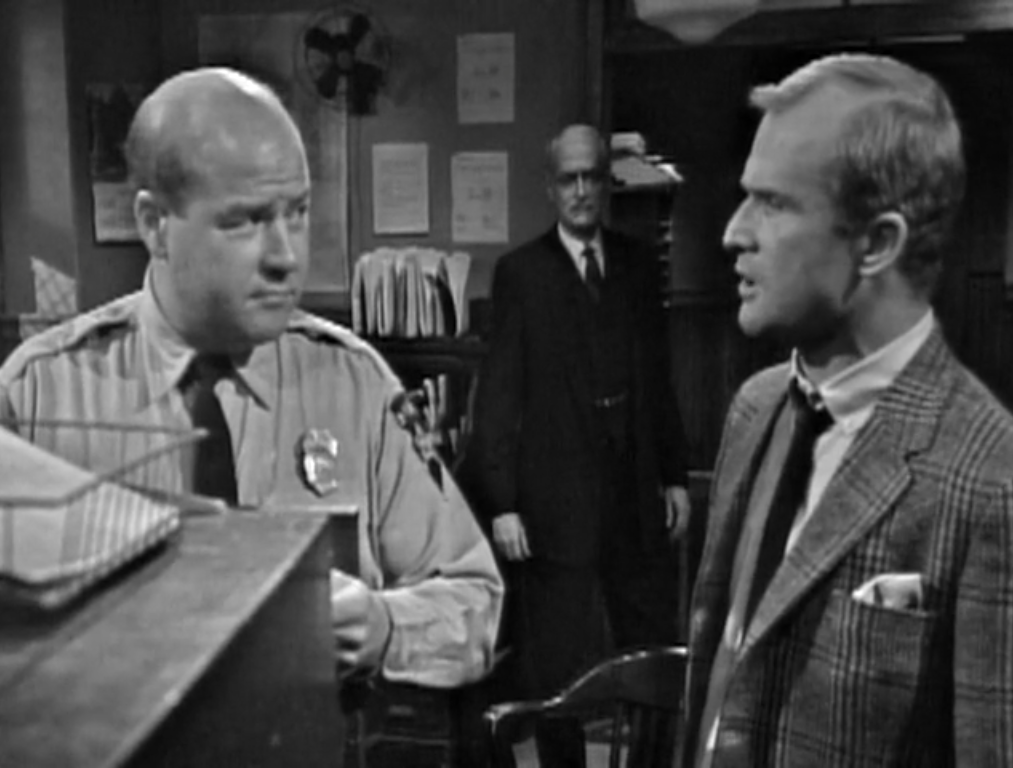
At the end of Friday’s episode, dashing action hero Burke Devlin and the sheriff caught high-born ne’er-do-well Roger Collins digging up a fountain pen from under a rock. It appears to be the fountain pen Roger had stolen from well-meaning governess Vicki. Some think that Roger stole the pen and hid it because it is evidence implicating him in the death of beloved local man Bill Malloy. Today, Roger is in the sheriff’s office.
Accompanied by Richard Garner, the Collins family’s lawyer, Roger talks and talks, admitting that he saw Bill that night, badly injured and face-down in the water. He jumped to the conclusion that Bill was dead, and left the scene without notifying anyone. He also admits that he concealed evidence that he believed the police would find relevant to the investigation. As if that weren’t enough, he admits that he lied to the police time and again, most recently the night before, and is caught in yet another lie when he gives a nonsensical explanation of his plan to meet Bill that night.
Roger begins his confess-a-thon
Garner makes only one feeble attempt to interrupt Roger’s torrent of self-incriminating remarks. When the sheriff questions Vicki, Garner takes the opportunity to ask her some questions of his own, questions which produce even more information that is adverse to his client’s interests. On their site Dark Shadows Before I Die, John and Christine Scoleri feature commentary on Garner’s performance from a lawyer friend of theirs. Setting aside the utter hopelessness of Garner’s work from a real-world perspective, this friend analyzes his conduct by contrast with the standards set by other TV lawyers:
This brief addendum will review the competence of Garner using a “TV Lawyer Competency Rating” (TVLCR) scale. This WAG scale is based on my estimation of how a general audience might rate a TV Lawyer’s performance. I have supplemented these TVLCR scores with some comments reflecting real-world practices.
Even by those standards, Garner doesn’t come out very well:
Garner strikes me as the go-to civil attorney for the Collins family who got dragged into this murder case just because they are familiar with him. Based on Garner’s poor competency rating as a TV Lawyer, Roger Collins should fire him and instead reach out to Raymond Burr or Andy Griffith.
Soap operas typically generate suspense by sharing information with the audience that some, but not all, of the characters have. We wonder when the secrets will be revealed, and how those to whom they are revealed will react when they finally get the news.
By the end of today’s episode, all of the characters will know almost everything the audience knows. Even what the characters don’t know, they’ve heard of. For example, Roger and drunken artist Sam Evans have not confessed the guilty secrets they share to any of the other characters, but everyone seems to have figured out more or less what they’ve been up to. Not everyone believes in ghosts, but it’s all over town that Vicki and her charge, strange and troubled boy David Collins, have seen ghosts in and around the great house of Collinwood, and even the most skeptical are not in a hurry to hang around the place after dark.
This is the next-to-last episode credited to writer Francis Swann. Swann will fill in for the new writers a week from Wednesday, but today is really the end of the Art Wallace-Francis Swann era of the show. From tomorrow, the new team of Ron Sproat and Malcolm Marmorstein will be holding the reins. By bringing all the characters up to at least our level of knowledge about the ongoing storylines, Swann is clearing the decks for Sproat and Marmorstein to set up their own crises and dilemmas.
Swann’s great strength is his ability to give actors room to show what they can do. Today’s episode is a case in point. Just when Garner’s disastrous intervention in the sheriff’s questioning of Vicki has led us to wonder if he’s all there, he has a moment when he opens his eyes wide and looks out the window. As Hugh Franklin plays it, that’s enough to make us wonder what’s on Garner’s mind, and to think he might be about to do or say something interesting.
Of course stage veteran Louis Edmonds thunders delightfully as the wildly indiscreet Roger, and of course TV stalwart Dana Elcar does an expert job of presenting the sheriff as a skilled professional firmly in control of the situation. There might be a crying need for a defense attorney to intervene when a suspect is blabbing as freely to the police as Roger is to the sheriff, but there is no need for a third actor to get in the way of Edmonds’ and Elcar’s interplay. Standing in the background between those two, Franklin occasionally gives a slight facial expression that underlines some point or other, but never upstages them.
In the first half of the episode, Alexandra Moltke Isles’ Vicki has to give some long speeches full of recapping, and in those she takes the character through several distinct shades of discomfort. She begins with diffident nervousness, builds up to frightened indignation, and ends with pure sadness.
Later, flighty heiress Carolyn comes into the sheriff’s office and pleads with Vicki to say that her beloved Uncle Roger couldn’t be a criminal. In front of the sheriff and Garner, all Vicki will say is that the two of them should leave. As Carolyn, Nancy Barrett makes the most of the melodramatic turn, but Mrs Isles takes possession of the scene with her few words spoken in a quiet, husky voice we haven’t heard before. Those brief remarks cap the progression we saw her making in her speeches earlier, and define the mood she is still in during a conversation between Vicki and Carolyn in Collinwood later. Vicki’s feeling for the pity of it all holds the episode together, and leads us back into the texture of the life of the family at the center of the story.
Most of this one consists of people worrying about each other’s attitudes towards Burke. Bill and Sam see each other, first in the Blue Whale, later in the restaurant, and in each place they share beverages while Bill needles Sam about Burke. In between these scenes, Joe and Carolyn are alone in the restaurant- completely alone, Joe apparently has to go behind the counter and prepare their meal himself- and they quarrel about Carolyn’s bold approaches to Burke before and during their date. At the end, Carolyn goes home, where her mother tells her about Roger’s wreck and about why she oughtn’t to be friendly with Burke.
Burke himself doesn’t appear in the episode, and none of the characters who do appear know as much about him as they think they do. What we get is a portrait of an isolated, gossipy little town, where rumors can start rapidly and grow in any direction. To the extent that “soap operas are approximately 90% information management,” as Danny Horn says, the typical setting of the gossipy little town, and its outgrowth, the false accusation, are the heart of the genre. As we watch these characters gossip and jump to conclusions, suspense forms as to how justice might miscarry if it isn’t stopped soon enough.