
Episode 1056: Clio’s squeaking skeleton

Wicked witch Angelique Stokes Collins has cast a spell on Maggie Collins, compelling Maggie to shoot her husband Quentin. Angelique herself dwells among the living because of another spell, one cast by her father, a wizard known as Tim. This spell drains the “life force” from a woman named Roxanne into Angelique, revivifying her after Quentin’s brother Roger drove a hatpin into her brain nine months ago. Angelique has kept her identity secret, in part because Quentin and a friend of his had a panic attack some time ago and destroyed her coffin, keeping the physical evidence from telling its tales. They were two loonies, quelling caskets.

Occasionally Roxanne manages to reclaim enough of her “life force” to make Angelique weak and cold. When this happens, Angelique can perk herself up by hugging a man and kissing him, thereby making all of his body heat flow into her, leaving him an icy corpse. The kiss appears to have become essential to this transfer; her kissing equates coolness. Yesterday she gave Roger this treatment, avenging her own murder.

The spell on Roxanne will break when she speaks, and her pushy ex-boyfriend Claude is about to make her do that. So Angelique has only moments to live. Quentin is on the run from the law, charged with the murder of a man named Bruno. Angelique’s enemy, Barnabas Collins, demands she sign a confession admitting that Bruno was actually killed by a spell she cast using a cravat of his. Quentin is innocent in these loose necktie squallings.

Angelique refuses to sign any such document. Later, Barnabas will tell the whole story to a police inspector whose incredulous response makes it clear that it would not have persuaded anyone had she done so. More urgent is a question he puts to her about the whereabouts of his faithful companion, Julia Hoffman. Angelique has locked Julia in a dungeon and left her to die of thirst. The door to this chamber swings shut silently, and apparently it does not let Julia’s cries for help be heard outside. Many of the places of confinement we have seen on Dark Shadows are the looniest squeaking cells you could imagine, but this one is grimly soundproof.

Roxanne speaks and Angelique dies, defiant to the end. Cloaking queenliest loss, her refusal to bend invests the character with a perverse grandeur.
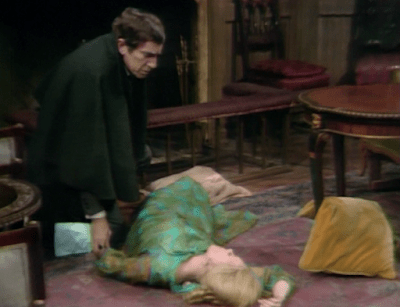
Barnabas remembers an Angelique who lived on the island of Martinique. For him, all the other Angeliques are just successors to what she brewed up there, Antilles cooking sequels, as it were. Screenshot by Dark Shadows Before I Die.

With Angelique’s death, her spell over Maggie breaks. Maggie collapses and drops the revolver she had trained on Quentin. One of the themes of the show has been that a person who casts a spell creates an alternate version of herself and that version takes possession of the person against whom they direct it. Lara Parker and Kathryn Leigh Scott play Angelique and Maggie’s collapses in the same way; seeing these back to back, we cannot miss the point that what we are really seeing is the simultaneous death of two Angeliques. Sometimes the alternate selves created by the spells outlive the spellcaster, and there is no telling where they will drive the victim. The accursed who wander about the earth, whether they became vampires like Barnabas or zombies like his uncle Jeremiah, are lockless antique legions, unrestricted in their physical movement, unlimited in the duration of their afflictions, uncounted in their numbers.

Miffed that Maggie pointed a gun at him, Quentin leaves the room. He finds Barnabas, who explains everything that has been going on. Quentin goes back to Maggie. She says that she realizes he could never love her or any other woman as he loved Angelique when she was alive. He tells her he never loved Angelique, but that he “hated the ground she walked on” and never shared a happy day with her because she was so cruel to him when they were married. When the same scene played out between Maxim de Winter and his second wife in Daphne Du Maurier’s Rebecca and in Alfred Hitchcock’s film based on the novel, we could take it as grounds for hoping that their marriage would take a turn for the better. But Quentin seems never to have loved Maggie, and we have never seen them share a happy day. They speak lovely words as they embrace; kissing allots eloquence. But Quentin’s declaration that he wasn’t any happier in his first marriage than he has been in his second comes only as confirmation of our suspicion that things will only go from bad to worse as long as he and Maggie stay together.

Barnabas and the inspector look for Roxanne. They don’t find her, and the inspector dismisses Barnabas’ whole story. The law moves a lot faster in Soap Opera Land than it does in our world, but only the looniest legal quickness could get Quentin out of trouble in the time that seems to be remaining in this storyline. Later, the inspector catches up to Quentin and arrests him, and Barnabas finds Claude stabbed to death in the woods.

This episode marks the final appearance of Angelique Stokes Collins. Lara Parker, that member of the queenliest looking class, will be back later as another witch named Angelique. It is also the final appearance of actor Brian Sturdivant and of the character Claude North. Sturdivant’s performance has many problems, most obviously his wildly uncertain accent. At times he manages to enunciate a few words in the old “mid-Atlantic accent” stage performers were trained to use in the first half of the twentieth century, but he never keeps it up for a whole line.
Episode 932: Just ourselves, and immortality

For most of 1969, Dark Shadows was a costume drama set in the year 1897. Among the characters we got to know were Quentin Collins, Charles Delaware Tate, Count Petofi, and Amanda Harris. Quentin was a rakish libertine and occasional murderer who was cursed to be a werewolf. Tate was an artist. Petofi was a sorcerer who had, for reasons of his own, given Tate the power to paint portraits with magical effects. Tate painted a portrait of Quentin that cured him of the effects both of lycanthropy and of aging. He painted a portrait of an imaginary woman, and she popped into being and became Amanda.

The story of Quentin’s portrait is borrowed from Oscar Wilde’s 1895 novel The Picture of Dorian Gray. The story of Amanda is borrowed from the story of Pygmalion and Galatea that Ovid told in Book 10 of his Metamorphoses. While Pygmalion’s statue of the ideal woman loved him when it came to life, Amanda can’t stand Tate. That’s understandable; like all characters played by Roger Davis, Tate had an intolerable personality. Amanda fell in love with Quentin, who is cruel and evil, but very charming.

Now it is 1970. Quentin has come back to the village of Collinsport, still young and handsome, but suffering from amnesia and unwilling to believe that he is a hundred years old. Amanda is back too. She is also young, not because of the painting, but because a god of death named Mr Best gave her several decades to reconnect with Quentin, get him to say he loves her, and then live with him ever after, perhaps happily.

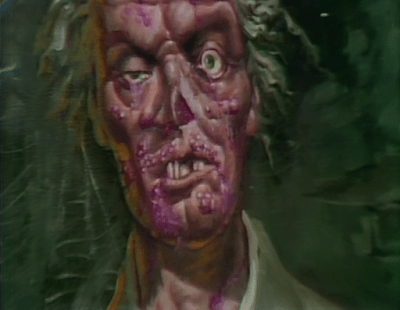
Mad scientist Julia Hoffman has been working with Amanda to restore Quentin’s memory. Julia, Amanda, and Quentin go to see Quentin’s portrait, which Julia has just had restored. It is suitably gruesome, and Amanda runs out screaming when she sees it. But Quentin examines it, and his memory comes back to him. Julia tells him about Amanda’s deal, and says that Mr Best is on his way. He could catch up with Amanda at any time. Quentin runs out to tell Amanda that he loves her, but gets to the scene a moment too late.

Quentin’s portrait, a face only a fan of EC Comics could love. Screenshot by Dark Shadows Before I Die.

Mr Best takes Amanda to a hotel lobby. She described this lobby to Julia in #922 when she explained her arrangement with Mr Best, but he has to explain it to her today. In #922 he called it “The Stopping-Off Place”; today he calls it “A Passing-Through Place.” He excuses himself, since he has other souls to harvest.

Amanda is alone for a moment with a bellhop in a white costume with an accent that is supposed to be sort of Cockney, or perhaps Australian. The bellhop makes it clear that he used to be alive, and that his current job makes him nostalgic for his days as a human. When he mentions things he can’t do anymore, he looks Amanda up and down for a half second. The wistfulness of his tone, the frankness of his look, and the sadness with which he turns away from her leaves no doubt what he misses. It’s a surprisingly lovely moment, and a much more adult one than we expect from the show at this point.

Back in the land of the living, Quentin and Julia have a scene in Amanda’s suite at the Collinsport Inn. Julia leaves, and Quentin tries to kill himself. Mr Best stops him. He tells him that he knows he is alive “by courtesy of Count Petofi”; this is the first time we have heard Petofi’s name since the show came back from 1897, and the first vague hint that Petofi might have survived the fire that appeared to have killed him in #884. He says that it is not Quentin’s time to die.

Quentin says he doesn’t want to live without Amanda, and Mr Best gets a bright idea. He says he likes experiments, and he has one he will run with the two of them. He takes Quentin to The Stopping Off/ A Passing-Through Place. He explains his idea. As befits Amanda, it is derived from the tale of Orpheus and Eurydice which Ovid tells earlier in Book 10 of the Metamorphoses. As Orpheus was allowed to bring his wife Eurydice back from the realm of the dead so long as they could make the long, arduous journey without looking at each other, so Quentin will be allowed to bring Amanda back so long as they do not touch each other until they return to the sunlight. The episode ends with Quentin deep in thought about this proposition while Amanda walks up behind him, stretching her hand towards him.

Mr Best tells Quentin that if he and Amanda can make their way through the countless traps and perils of the journey back to the upper world, they will be together “for eternity- whatever that means.” It’s intriguing he doesn’t know- he explicitly identifies himself as an immortal being today, and he has such a wide range of discretion that he can only be called a god. Apparently writer Sam Hall is imagining a cosmos where even the gods are left guessing about the answers to the big questions.

The story of Orpheus and Eurydice has long been a popular favorite. In the 1960s, Jean Cocteau’s 1950 Orphée and the 1959 Brazilian hit Black Orpheus were both staples of art cinema and would have been familiar to NYC theater people like the makers of Dark Shadows, so it is hardly surprising that when they start looking to classical antiquity as a source of material that was one of the first stories to come to mind.

This is Emory Bass’ final appearance as Mr Best, and Brian Sturdivant’s only appearance as the bellboy from Hell. Each will return in another small part later this year.

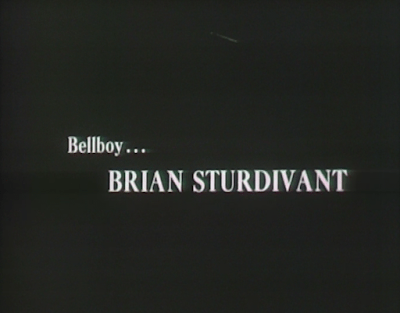
The closing credits roll over an image of Quentin’s portrait. Most of them do, anyway. Sturdivant’s was cut into the middle of the roll over a black background. Apparently they forgot about him until the last minute.

Better late than never. Screenshot by Dark Shadows Before I Die.