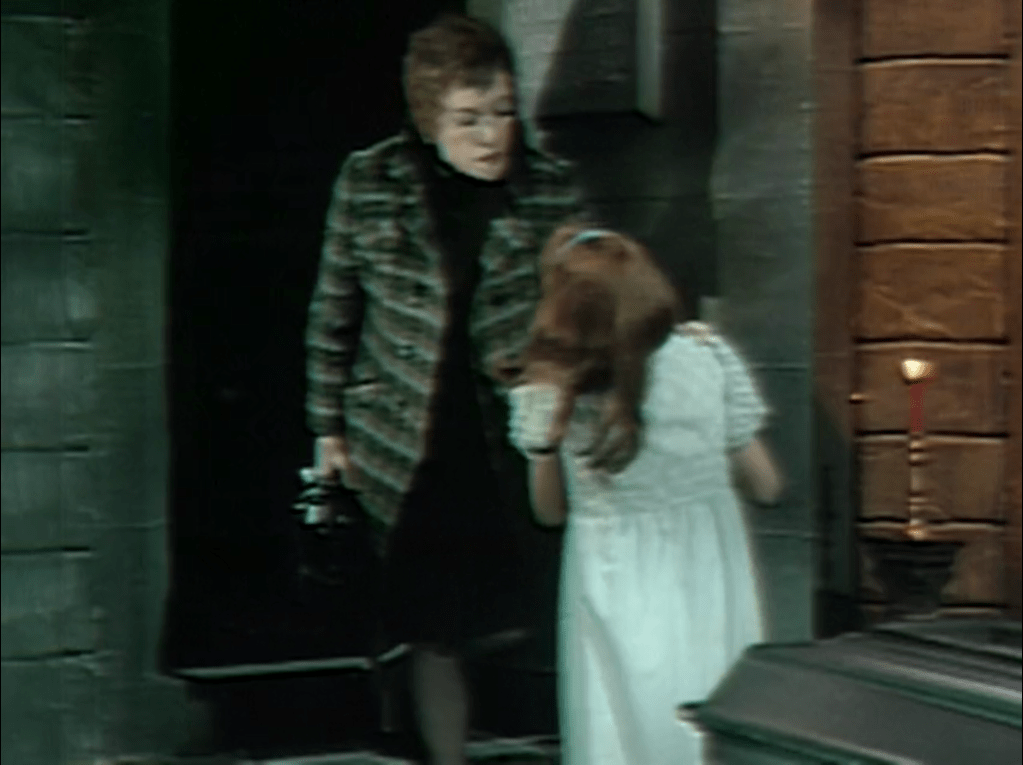
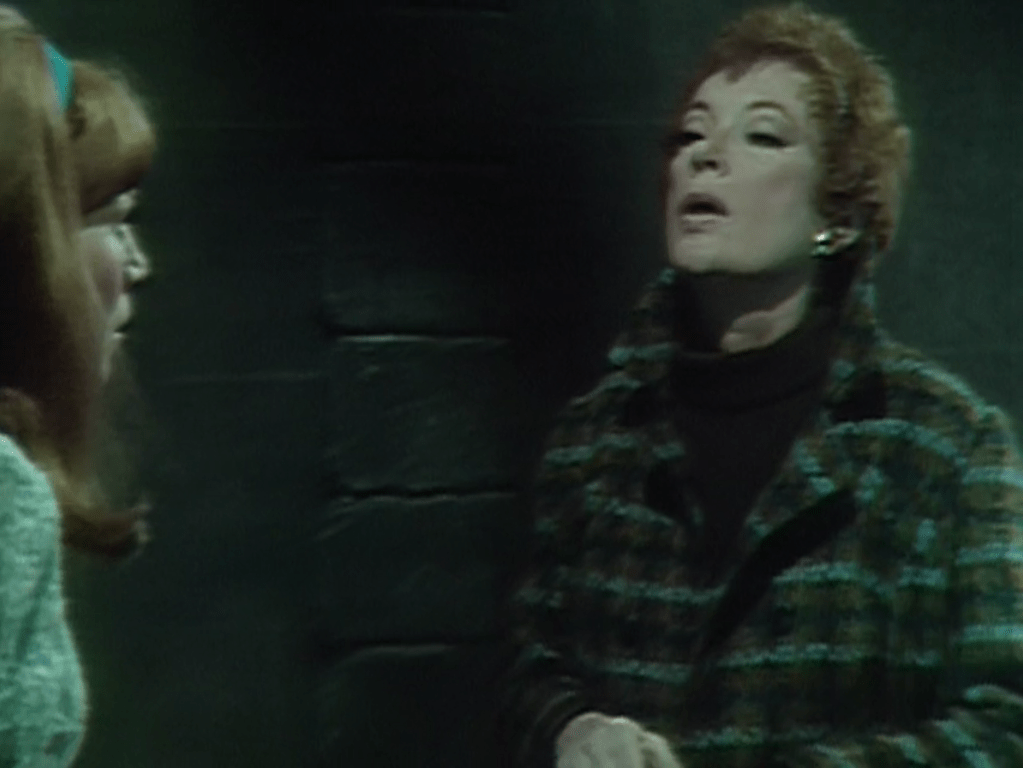
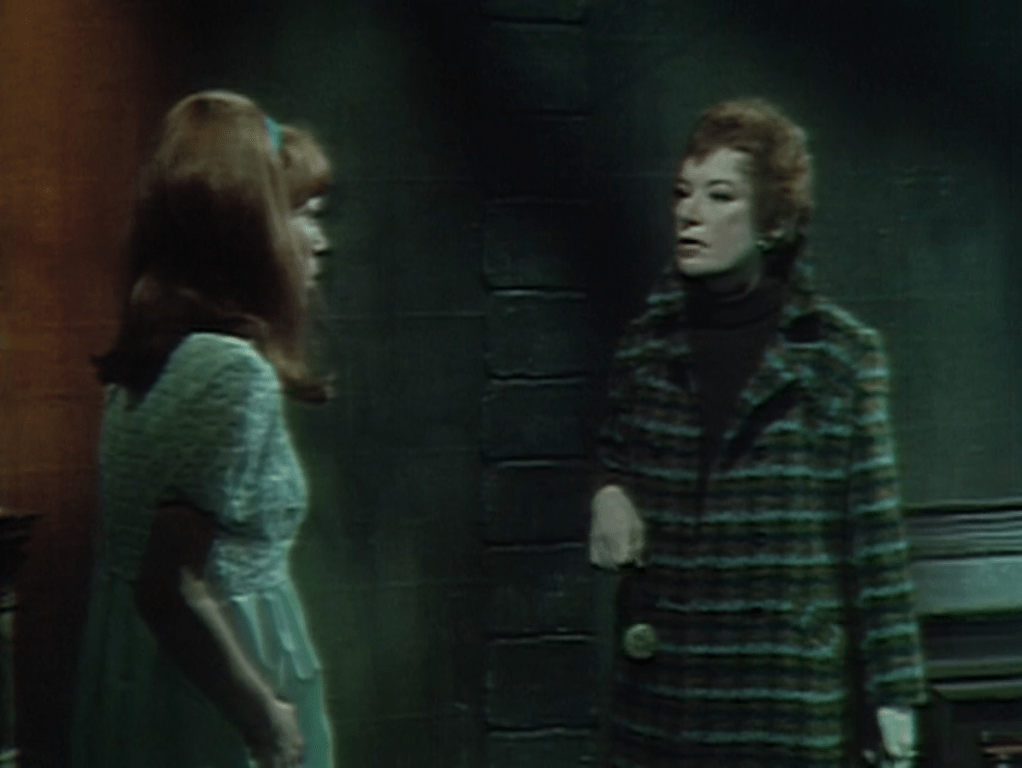
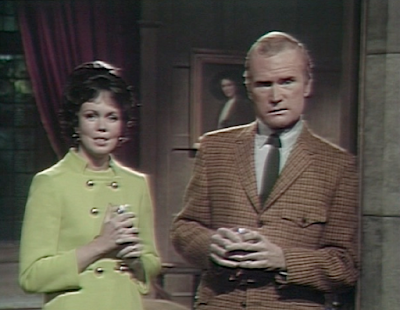
Episode 780: Carl was not mad

In yesterday’s episode, inveterate prankster Carl Collins told his brother, the rakishly handsome Quentin, that their distant cousin Barnabas was a vampire. Quentin has problems of his own, and he is counting on Barnabas to help him. So he locked Carl up in Barnabas’ hiding place, expecting that when night came Barnabas would prune one more branch off the Collins family tree.

Today, Quentin finds that Carl has escaped. He goes to Barnabas and tells him what has happened. Carl’s practical jokes annoy Barnabas intensely, and Barnabas has never bothered to conceal his disdain for him. He reacts to Quentin’s news with fury and a lot of orders. When Quentin later finds Barnabas standing by Carl’s corpse in the drawing room of the great house of Collinwood, he is really torn up about his brother’s death for almost a whole minute.
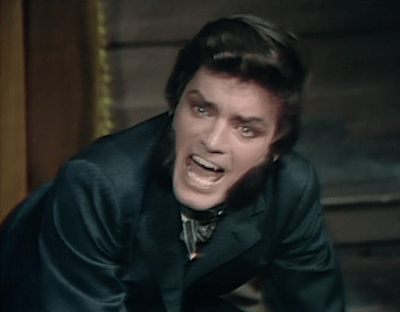
Quentin mourns for Carl- blink and you’ll miss it. Screenshot by Dark Shadows Before I Die.

A knock comes at the door; it is the oppressively evil Rev’d Gregory Trask. Quentin keeps Trask in the foyer for a bit while Barnabas hides Carl’s body. When Trask forces his way into the drawing room, Barnabas is gone. Carl’s body is cunningly hidden… behind the curtains, propped upright. Of course it falls out almost immediately. Earlier in the episode, Carl took Trask to Barnabas’ hiding place, and we saw that Barnabas had single-handedly lugged his coffin and the structure on which it rests some distance away. If he is strong enough to do that, surely he could have tossed Carl’s body out the window. And regular viewers know that there is a secret panel in this room, of which Barnabas has repeatedly shown that he is well aware. They would probably have expected him to hide the body there. That he just stashes it behind the curtains where it is certain to come into Trask’s view suggests that he isn’t even trying to get away with this particular murder.

Closing Miscellany

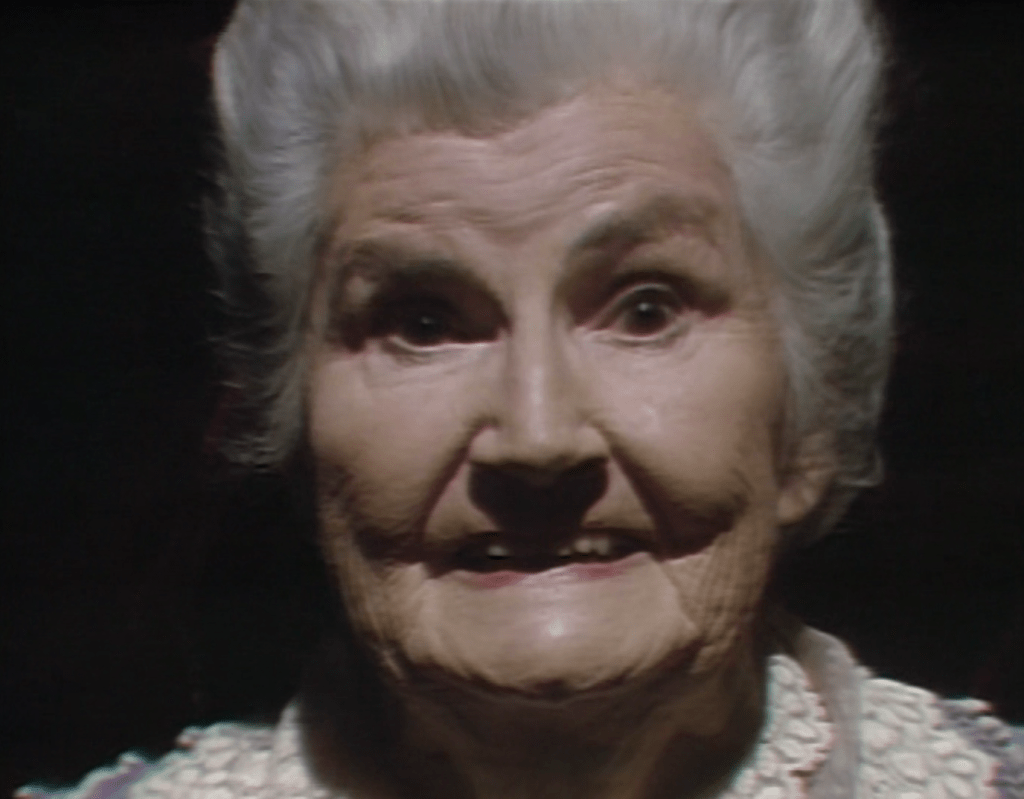
John Karlen is breathing pretty deeply during Carl’s big closeup as a corpse. It’s really confusing, I thought they were telling us he wasn’t dead yet.

I don’t know what the writers planned for Carl in the flimsies they sketched out six months before this episode was made, though there is so little room for him in subsequent plot-lines that I suspect he was supposed to die at about this point in the story. Still, his death was accelerated because Karlen had other things to do. He won’t be back on the show until #956, in February of next year.

The creaky little waltz that Quentin listens to obsessively was released as a single in June of 1969 and would hit #13 on the Billboard Hot 100 in August. Regular viewers may be sick of it already, and the characters certainly wish Quentin would get another record. It’s Trask’s turn to complain about it today, giving him something in common with Barnabas.

Trask wears a cross which he uses as a weapon against Barnabas. The show is oddly inconsistent about the effect of the cross on vampires. We’ve seen other characters use crosses against them, and at one point it was said that a cross inside the lid of Barnabas’ coffin immobilized him. But his hiding place is in the middle of a cemetery full of grave markers in the shape of huge crosses, and we see several of them today. Barnabas just walks right past those with no problem. You might think that since the show was made in the USA, where sincerity is so highly regarded, that the cross might be effective against him only if it is wielded by the pure of heart. But Trask is every bit as evil as are Barnabas and Quentin, and it works for him. It’s a puzzlement.

In a long comment on Danny Horn’s post about this episode at Dark Shadows Every Day, I responded to a discussion about whether there is a point in thinking of Barnabas as someone possessed by demons:

I think of the climax of the Iliad. As Achilles moves in to kill Hector, Athena takes hold of his spear and drives it in, delivering the fatal wound herself.

For modern readers, this may ruin the story. The whole poem has been leading up to this moment; we’ve spent a lot of time with Achilles, listening to him try to figure out what it would mean for him to kill Hector. So why have the goddess take over at the last minute? Isn’t it an evasion of Achilles’ responsibility for his actions, and a cheat for us as we’ve been observing his psychological development?

For the original audience, it was not. They actually believed in their gods. Athena really existed, as far as they were concerned. When an event was important enough, they took a interest. If it was really huge, they would get involved. Moreover, the gods worked closely with each other. So much so that you didn’t pray to one at a time, but always to groups of them. When Athena joins Achilles in his fight, it isn’t her pushing him aside- it’s him doing something so important it blurs the boundary between human and divine.

Something like that is at work in the traditional, pre-modern, conception of demonic possession. To say that a person is possessed is a way of looking at behavior that is reducible neither to moralistic judgment nor to psychological analysis. It isn’t individualistic in the way that those modes of discourse are. Rather, it suggests that the boundaries between the person and the spiritual forces of darkness have broken down. Perhaps the person is partly to blame for that breakdown, but the whole point is that s/he is no longer a distinct being, but is merging into those supernatural forces.

So, imagine a version of Dark Shadows where Elizabeth Collins Stoddard really was the main character. Her whole approach to life is denial. So, you could have had a story with a beginning, middle, and end. In the beginning, we see the lengths she has gone to in her quest to keep from ever having to have an embarrassing conversation. In the middle, we see various horrors take place around her, each worse than the one before, each more obvious than the one before, and each time she finds a way to convince herself it doesn’t exist. At the end, a couple of innocent characters go to her in the drawing room of Collinwood to rescue her from the monsters who are running rampant there. She looks at them placidly and tells them she sees nothing wrong. Why ever do they think she would want to leave her home? All the while leathery-winged demons are fluttering about her head. She doesn’t see them, and they have no choice but to flee.

Comment left 10 November 2020 by “Acilius” on “Episode 780: The Establishment Vampire,” posted 2 December 2015 by Danny Horn at Dark Shadows Every Day
Episode 756: A bizarre activity for a beautiful woman

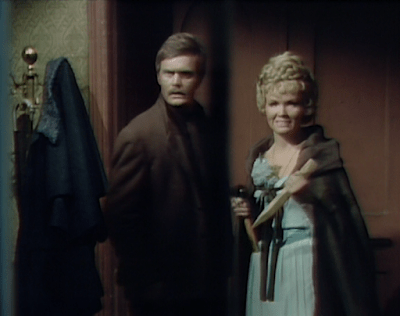
Undead blonde fire witch Laura Murdoch Collins realizes that Barnabas Collins is a vampire, and that when he was alive he was the “strange, dreamy boy with sad eyes” she was fond of in the 1760s, when she was married to his uncle. Laura and Barnabas confront each other in a graveyard at the beginning of the episode; she tells him he is not human. He passes up the opportunity to reply “So few people are, these days.” At the end of the episode, Laura and her witless henchman Dirk let themselves into Barnabas’ house after dawn. She has a mallet and stake, he has a pistol to ensure no one interferes.

It means something to longtime viewers that we end today with Laura poised to destroy Barnabas. It was Laura who cleared the way for Barnabas’ first introduction. She was the show’s first supernatural menace when she was on from December 1966 to March 1967, and her story was structured very much like Bram Stoker’s Dracula. That was successful enough that the following month they introduced Barnabas as Dracula Mark II. That Laura knew Barnabas in the 1760s when she was already what she is and he was still a boy also nods to this history.

Laura went up in smoke in March 1967, when the show took place in a contemporary setting, and reappeared in April 1969, when it was a costume drama set in 1897. In the interval, Dark Shadows changed from a slow-paced, moody Gothic drama meant for an audience largely consisting of people who were fans of Joan Bennett’s in the 1930’s to a slam-bang supernatural thriller with a huge following among preteens. In her first tour as Laura, Diana Millay could focus on her strengths in dry comedy and subtle psychological drama. This time around, she recognizes the new demographic and plays Laura like a villain on Batman. At times it seems odd that Dirk isn’t wearing a jumpsuit with his name stenciled on it.

Perhaps when she hits the stake with the mallet, the word “Whack!” will be printed in a bubble on the screen. Screenshot by Dark Shadows Before I Die.

Meanwhile, Barnabas materializes inside a classroom at a school where Laura’s nine-year old daughter Nora is alone. Nora tells Barnabas that she is not happy at the school and that she and her twelve year old brother Jamison want to leave with their mother. Barnabas tells her to “Look into my eyes!” and he puts the zap on her. When he is done, he tells her that their conversation will be their secret. She smiles, looks directly into the camera, and tells the audience “I like secrets!” Denise Nickerson had a talent for delivering lines to the camera, and ever since she joined the show in November 1968 they’ve had her do that quite often. Rather too often, I’m sorry to say- it can chill the audience to see a character who is so disconnected from everyone else that they just start talking to us if the effect is used sparingly, but they have her do it so frequently that it has lost its force by now.

Nora and Jamison’s school is a miserable place, less a center of learning than a dungeon where the sadistic Rev’d Gregory Trask gleefully inflicts unwarranted and cruel punishments on both children and teachers. Trask’s daughter Charity is a member of the faculty, and since #727 she has also been Barnabas’ blood thrall. In #753, we saw Charity acting as her father’s second in command at the school, enforcing a particularly vicious sanction against Jamison. It did not then seem that her subjection to Barnabas had modified her role in her father’s operation at all.

When Charity enters and finds Barnabas with Nora, her two enslavements come into conflict. Barnabas tells her that Laura will be coming to the school to see Nora soon, and orders her to let her in. Charity is very confused and starts talking about her father and his rules. Barnabas bites her, leaving her more tranquil but quite weak.

Laura knocks on the door. Charity finds that Barnabas has vanished, and lets her in. She demands to see Nora, saying that she will take her away. Charity says that no relatives are allowed to visit the children at night, and that she will need permission from others to allow Laura to take Nora. Laura insists, and eventually Charity complies. She sends Nora down, and brings her packed suitcase. But Nora has told her mother that she does not want to go. We saw in 1967 that Laura’s children must go with her willingly if she is to perform her evil mission, and so she has to yield. She looks at the collar Charity has drawn up to cover her neck, and says that she will not tell her father that two of Nora’s relatives have visited her tonight.

Some of the actors have trouble with the names “Laura” and “Nora” today. It really was a mistake to give Nickerson’s character a name that rhymes with “Laura.” In #354, set in 1967, matriarch Elizabeth Collins Stoddard told her daughter Carolyn that “Aunt Catherine” would be overjoyed to host her in her home in Boston, and that this never-before mentioned aunt gives wonderful parties attended by men Carolyn’s own age. Catherine cannot have been Elizabeth’s sister or a member of Carolyn’s father’s family; she must be Elizabeth’s own aunt. Nora is the only one of Elizabeth’s aunts we ever hear about, and she would have been 79 in 1967. As a grande dame of Boston society, she might still have been giving big parties featuring people of all ages, and so naming the character “Catherine” would have closed that loop.

It would also have opened the door for another story to add some action to the rather slow period leading up to the 1897 flashback. Aunt Catherine could have come to Collinwood from Boston in 1969 and met the evil ghost of the roguish Quentin Collins. Recognizing her favorite uncle but knowing that he came to a dark and mysterious end, that would have set up a confrontation that might have led to an enigmatic conclusion. Quentin killed other adults who knew about him, but his relationship with Catherine would have made it maladroit to bring their encounter to so straightforward a climax. Better to have her disappear inexplicably. That disappearance would be followed by signs that the disturbances in the house had suddenly grown far more dangerous. We would wonder if Catherine had joined with Quentin as another evil spirit, or if the two of them were doing battle in some unseen realm and inflicting collateral damage in the world of the living.

I have an idea who they should have cast as Aunt Catherine. Isabella Hoopes played dying matriarch Edith Collins at the beginning of the 1897 segment, and she was great fun. Had we been introduced to Hoopes as the spry and sophisticated Aunt Catherine, her turn as Edith would have been even richer. When Quentin chokes and threatens to kill Edith, we would try to read their interaction as a clue to what happened between him and Catherine before her disappearance. When Edith haunts Quentin after her death, we would look for clues as to what happened to Catherine after her disappearance. And of course Nickerson’s role as Catherine’s younger self would have gained another dimension, not only as we watch her interactions with Quentin, but also as we compare her personality at the age of nine to that of the octogenarian we had met previously.

I even have some dialogue Catherine could have exchanged with the Collinses of 1969:

Catherine: Roger, I hear you have married again. Will you present me to your wife this time? I must admit I took it rather personally that I could never meet Laura.

Roger: I’m sorry, Aunt Catherine. Cassandra and I have already gone our separate ways.

Catherine: Oh, I’m the one who should be sorry- it was tactless of me not to know… We Collinses have never have had much luck in marriage, have we?

Elizabeth: You and Uncle Ambrose were happy.

Catherine: Yes. Happy… But there wasn’t much luck to that. After all, he was my fourth husband and I was his third wife. We simply applied the lessons of experience.

Carolyn: So there is hope. After your disappointments, you found your grand passion.

Catherine (a look of frank disbelief on her face): Not exactly. (Pause.) Carolyn, your mother told me some time ago you were the one involved in a grand passion. His name is- what- Bud?

Carolyn: Buzz?

Catherine: Yes, Buzz. I should have remembered that, I once knew a Navy flyer who went by that name. If your Uncle Roger won’t be introducing me to anyone, will you at least present me to Buzz?

Carolyn: Oh, it ended between me and Buzz some time back. He’s left town.

Catherine: Ah, too bad. I’d have liked to meet another Buzz, the one I knew was so elegant.

Elizabeth: This one was hardly elegant. He rode a motorcycle, and that was his whole life. He always wore leather clothing and dark glasses, with a long beard and a ragged mop of hair. You never saw the like, Aunt Catherine.

Catherine: On the contrary, I have seen the like every often. Just such men make up your cousin William’s preferred milieu.

Carolyn (laughing): I once told mother I was going to marry Buzz, but that was an empty threat. Buzz isn’t the sort of man who really wants a wife.

Catherine: Neither is William.

(Elizabeth, Roger, and Carolyn fall silent. After a moment, they all start talking at once.)

Elizabeth: Have you seen-

Roger: How is old Mr-

Carolyn: Was your trip-

(They fall silent again. Another awkward pause ensues.)

Elizabeth: Do you know that there is another Collins at Collinwood?

Catherine: Oh?

Elizabeth: Yes, a distant cousin of ours, from England. His name is Barnabas Collins.

Catherine (furrows her brow): Barnabas Collins? Named for the man in the foyer?

Elizabeth: Yes, the portrait is of his ancestor.

Catherine: How odd. When I was a girl, I asked the old people around here about all of the portraits. They were happy to go on at length about all the others, but they were always tongue-tied when we got to that one. Left me with the impression there was something exceptionally sinister about it, or about the man. Of course that only piqued my curiosity.

Carolyn (suddenly defensive): There is certainly nothing sinister about our Barnabas!

Catherine: Nothing sinister? Are you sure he is a Collins?

(Roger and Elizabeth chuckle, Carolyn flushes.)

Elizabeth: Oh, he is a Collins, all right. He’s quite an expert on the family’s past. I’m sure the two of you would have a great deal to talk about.

Catherine: I’m sure. But I would rather choose another topic. At my age I can’t forget that I will soon be part of the past. I would like to keep my eyes on the future while I still have one.

This scene would have left longtime viewers with some suspense-generating questions. Why did Roger’s wife Laura go out of her way to avoid Catherine? Who were the “old people” at Collinwood in Catherine’s childhood? What did they know about Barnabas? Further, Laura and Buzz were so emblematic of two of the early phases of Dark Shadows that involving Catherine in a conversation referring to both of them would promise that she will be woven in with the whole narrative structure of the show.

Moreover, seeing a Collins who had spent decades far from Collinwood might give us a fresh perspective on the main characters. We see only those whose minds and hearts have been deformed by the many curses that loom over the estate. Meeting one who has been outside their influence for so long would suggest what it has cost the others to stay on the estate. We might then feel anew the tragedy that we have been taking for granted.

Episode 710: The raven and the viper and all the dark creatures

Libertine Quentin Collins has stolen his late grandmother Edith’s will, intending to forge a substitute that will give him control of her vast estate. His distant cousin, the recently arrived and thoroughly mysterious Barnabas, has warned Quentin that Edith’s ghost will haunt him if he persists in this plan. Quentin hears a loud pounding emanating from the walls of the great house of Collinwood. He goes to the study, where Edith lies in her coffin. He sees her there, grinning at him. Quentin returns to his room; the still-grinning Edith sashays in and taunts him. He tells her she is dead; this does not seem to bother her. She just keeps on grinning.

Edith may be dead, but she is clearly having a blast. Screenshot by Dark Shadows Every Day.

Quentin strangles Edith. She falls into an armchair in his room, unmoving but still grinning. He buries her somewhere on the grounds of the estate; her hand sticks up from the earth. He wakes up.

Quentin’s friend, unethical lawyer Evan Hanley, comes calling. Evan asks Quentin to give him the will so he can take it to a forger of his acquaintance. Quentin tells Evan about the dream, and how shaken he is. He also tells him about Barnabas, and his concern that Barnabas is a formidable enemy who may have uncanny powers. When Evan tries to dismiss Quentin’s worries, Quentin responds that he is the last person who should make light of the supernatural. When Quentin speaks of Evan’s “devil-callings,” we learn that the clandestine “meetings” they spoke of the other day are Satanist ceremonies. Evan agrees to meet Quentin at 8:00 that night in the groundskeeper’s cottage on the estate to summon one of the spiritual forces of darkness to fight Barnabas.

Returning viewers know that Quentin is right to fear Barnabas’ connections to the supernatural. Barnabas is a vampire, and his powers include the ability to send hallucinations to torment people with guilty consciences. He is also a time-traveler, who has come to 1897 from 1969 on a mission to prevent Quentin from becoming a ghost who will drive the Collins family of that year out of the great house and plague strange and troubled boy David Collins to the point of death.

First time viewers will not learn that today; aside from the opening voiceover, this episode tells us nothing about Barnabas. It does tell us something about Quentin and Evan. They are super-racist against Romani and Sinti people.

Evan has decided to hire Sandor Rákóczi to forge the will. Sandor and his wife Magda have been staying at the Old House on the estate for some time as Edith’s guests. Quentin’s brother Edward and sister Judith are offended by the presence of these “gypsies” in their midst. Unknown to Evan and Quentin, and unmentioned in today’s episode, Barnabas has bitten Sandor, enslaving him. Presumably Sandor has no secrets from Barnabas, making him a bad choice to be Quentin and Evan’s henchman.

Three times today, Evan addresses Sandor as “Gypsy.” When he is putting it to him that he wants him to forge the will, he barks at him with “Now, one moment, Gypsy.” He insists Sandor fix his price in advance. When Sandor tells Evan he is sad that he does not trust him, he replies “Well, then, be sad, Gypsy, but give me your price, now!” Later, Sandor will express curiosity about Quentin and Evan’s plans, to which Evan will reply “Well, don’t be curious, Gypsy, just do as you’re told.”

Evan told Quentin that the “devil-calling” at the cottage should involve twelve year old Jamison Collins as a “sacrificial lamb.” Quentin sincerely cares about his nephew Jamison, and he protests that he won’t do anything to hurt him. Evan assures him that Jamison will simply be a symbol of the innocence that their dark lord exists to despoil and that the boy himself will not be harmed. When Quentin is talking Jamison into joining him and Evan for a secret meeting that night, he tells him they will look into the future. Jamison asks”How, with a crystal ball?” Quentin replies “No, of course not. That kind of thing is for gypsies. It’s not for men, like you and me.” Scripted television in the US in the 1960s rarely gave such flagrantly racist remarks to recurring characters, not only because the audience included members of minority groups, but also because they are so unattractive that they limit the utility of the characters who make them. In this case, Quentin and Evan are already in league with the Devil, and Quentin is on track to die soon and become a ghost. So we know that they are due for a comeuppance. Moreover, their prejudices may lead them to underestimate Sandor, both on his own account and as a tool of Barnabas, so it is useful to the plot that they are in the grip of such ugly attitudes.

Sandor is in the cottage, preparing to forge a new will for Edith, when Jamison drops in. Jamison does not see what he is doing. He and Sandor spend a couple of minutes sparring verbally. Sandor ends the match when he points out to Jamison that it is getting dark. The boy looks alarmed and runs home while Sandor laughs.

In #701, Sandor and Magda mentioned that the Collinses were afraid of the night. Shortly after, they found out about Barnabas, and learned that they had good reason to be. But Sandor can still laugh when he sees that a boy as old as Jamison runs away at the news that the sun is setting.

Sandor is still in the cottage when Quentin brings Jamison by. Evidently Evan plans to let Sandor participate in the ceremony. Regular viewers will remember that in 1969 the first place Quentin manifested himself outside the little room in the great house where David and his friend Amy discovered him was in the cottage, and that he showed considerable power there. That he and Evan have their Satanic “meetings” in the cottage suggests that the evil he did in 1969 has its roots in what he did during them.

Evan directs Jamison to stare into the fire burning in the hearth. This will ring another bell for longtime viewers. Jamison is played by David Henesy, as is David Collins. From December 1966 through March 1967, David Collins’ mother Laura Murdoch Collins lived in the cottage. She was an undead blonde fire witch, and her plan was to lure David to join her in a fiery death. She would rise from the dead as a humanoid Phoenix, as she had done at least twice before. On each of those previous occasions, she went into the flames with a son named David; the Davids did not rise again, as becomes clear when one of them is available to speak in a séance in #186. Laura often urged David to join her in her favorite pastime, staring into fire. So when Evan urges Jamison to do the same, we wonder if Jamison, too, is in danger of being consumed by its fascination.

As the ceremony goes on, Jamison becomes alarmed. He runs out, and Evan orders Sandor to follow him. Quentin, too, runs to the door and protests that they have gone too far. He points to the flames, in which the likeness of a skull wearing a wig takes shape. We may wonder if more will be added to the skull, perhaps so much as to make up a whole woman, and if this woman will be someone we have met before.

Edith’s role in Quentin’s dream unfortunately marks Isabella Hoopes’ final appearance on Dark Shadows. She was just terrific. I wish they had done a parallel time story set around the period of the Civil War in which Hoopes played an aged Sarah Collins. Her nose, chin, and cheekbones resembled those of Sharon Smyth sufficiently that you can imagine an elderly Sarah looking like her, and she had a playfulness that would make longtime viewers remember the nine year old ghost we met in June 1967.

Episode 648: Her name is Madame

This is the second of three episodes featuring Cavada Humphrey as Madame Janet Findley, a medium called in to investigate the strange goings-on at the great house of Collinwood. Humphrey’s performance so utterly dominates the segment, and I have so little to add to what I said about her style in yesterday’s post, that all I can do is make a series of more or less miscellaneous observations about its other aspects.

Today Madame Findley meets children David Collins and Amy Jennings. Amy and David are coming under the influence of evil spirit Quentin Collins. She questions them in the drawing room, and finds a hidden panel that leads to the long-abandoned west wing of the house. Over the children’s objections, she enters the secret passage. As soon as she is in, they hurriedly close the panel, locking her in. Evidently their objections were part of a ruse designed to lead her to Quentin’s stronghold. All too often on Dark Shadows, the audience knows too much about what characters are trying to do. This scene stands out, because they really do keep us guessing whether the children want Madame Findley to go into the secret passage. We don’t really know what their goals are until we see them shut her in.

Madame Findley goes into the darkness. Screenshot by Dark Shadows Before I Die.

Earlier in the episode, Amy’s brother Chris dropped in. He was very eager to see permanent houseguest Julia Hoffman, MD. Amy mentioned to Chris that there was another visitor in the house. When Chris asked who it was, Amy replied, “Her name is Madame- Madame something- at least that’s what they call her.”

I heard these lines in the voice of T. S. Eliot. The rhythm is reminiscent of a section of his poem The Waste Land, which in 1968 was an extremely familiar text to people with literary ambitions:

Madame Sosostris, famous clairvoyante,

Had a bad cold, nevertheless

Is known to be the wisest woman in Europe,

With a wicked pack of cards. Here, said she,

Is your card, the drowned Phoenician Sailor,

(Those are pearls that were his eyes. Look!)

Here is Belladonna, the Lady of the Rocks,

The lady of situations.

Here is the man with three staves, and here the Wheel,

And here is the one-eyed merchant, and this card,

Which is blank, is something he carries on his back,

Which I am forbidden to see. I do not find

The Hanged Man. Fear death by water.

I see crowds of people, walking round in a ring.

Thank you. If you see dear Mrs. Equitone,

Tell her I bring the horoscope myself:

One must be so careful these days.

It was indeed a mysterious Tarot card that prompted matriarch Elizabeth Collins Stoddard to call for help, and that call brought Madame Findley to the house. The card she interprets is the Tower of Destruction, which unlike the cards Eliot’s Madame Sostris describes actually appears in existing Tarot decks. She doesn’t have a cold, and she isn’t in the business of selling horoscopes door to door. On the contrary, as Humphrey plays her she is a dazzling presence.

Liz did not call Madame Findley directly. She telephoned occult expert Timothy Eliot Stokes, who introduced her to La Findley. At first sight, Stokes appears to be a stuffy academic with an impossible Anglophile manner, but as we get to know him he turns out to be very much at home in the bizarre netherworld in which the show takes place, so much so that his supernatural adversaries fear that he may have powers surpassing theirs. T(homas) St(earn)s Eliot was so much like T(imothy) Eliot St(oke)s in the first impression he made, so highly regarded by the sort of people who wrote Dark Shadows, and so generally famous in the 1960s that it is very likely that Stokes’ name was at least partly inspired by him.

It’s true that Madame Findley’s name lacks the exotic glamour Eliot gave his character. I suppose if you have all of Europe to choose from, you can take your stray Tarot cards to someone named “Madame Sosostris,” but if you are limited to central Maine, you have to settle for “Janet Findley.”

I made a remark about Madame Findley’s name in the comments on Danny Horn’s post about episode #647 on his great Dark Shadows Every Day:

It’s just delightful that they introduce an otherworldly, mystical character, played with an actress who brings a genuinely eerie note to her performance, and her name is… “Janet Findley.” It’s like Monty Python and the Holy Grail, when they meet the wizard who is known as “Tim.”

I wonder if there’s any connection between the name “Janet Findley” and the name “Janet Fisher,” whom Carolyn mentioned as a friend once of twice in the first season. Seems like a lot of Janet Fs. For that matter, I wonder if there’s a connection between Tim the Wizard from Monty Python and Tim(othy Eliot) Stokes, who a couple of episodes back had to tell Vicki that he isn’t a wizard.

Comment left by Acilius, 8 October 2020, on Danny Horn, “Episode 647: The Wire,” Dark Shadows Every Day, 12 May 2015

That remark drew a response from a commenter who posts as “Mary”:

Findley is a popular name on Dark Shadows. In addition to Janet, Margaret Findley is one of the ghostly widows, Thomas Findley is one of Jeb’s zombies in the Leviathan storyline and Findley’s cove is the location of Carolyn’s cottage in 1995.

Comment left by “Mary,” 18 February 2021, on Danny Horn, “Episode 647: The Wire,” Dark Shadows Every Day, 12 May 2015

When Madame Findley asks about the closed-off parts of the house, Liz tells her about both the west wing and an east wing. The phrase “east wing” had come up a couple of times in the first year of the show, but it always seemed to be either a case of the writers not having made up their minds which side of the house the deserted wing was on or a slip of the tongue by the actors. This is the first time the show makes it clear that the house really does have two deserted wings.

Humphrey was too perfect for Dark Shadows to play only one role. In a comment on Danny’s post about this episode, I indulged in a little fanfic about another part that would have been right for her:

Cavada Humphrey looks quite a bit like Jonathan Frid. I wonder what 1795 would have been like if Barnabas had had an older sister who bossed him around, stood around during his ridiculously childish fits of petulance, occasionally acted as his conscience, and time and again serve as his enabler and protector. It would have been funny to see Grayson Hall’s Countess express disapproval of such a relationship.

Heck, that older sister could have been Sarah. Just because she’s a child in her ghost form doesn’t mean she has to have died at that age. Maybe she comes back in the form in which her relationship to her brother took its permanent shape, when she was about nine and he was about seven. Of course, that possibility is foreclosed at Sarah’s first appearance, when she tells Maggie not to let her “big brother” know she saw her, but I suppose they could have retconned that away with a phony flashback where she says “little brother.”

Comment left by Acilius, 8 October 2020, on Danny Horn, “Episode 648: Astral Disturbances,” Dark Shadows Every Day, 14 May 2015.

I’m very fond of Sharon Smyth, and Sarah’s last appearance in the 1795 segment was so poignant it would have been a substantial loss for her not to have been in it. On the other hand, she had so much less to do when she was playing a living being than she did in the preceding months when Sarah was a ghost, and so much of what she did get to do was outside her rather sharply limited range, that it is not difficult to imagine a different kind of Sarah making the eighteenth century insert a more compelling drama.

Episode 622: A position to help each other

Well-meaning governess Vicki is on the terrace of the great estate of Collinwood. A man known variously as Peter and Jeff keeps clutching at Vicki’s arms so sharply that her biceps pulse, then holds her with one hand and paws her with the other as she stands rigidly still. First time viewers, knowing only that Dark Shadows features stories of monsters and crime, would think that the man had some power over the woman and that they were seeing him abuse that power. They would be right. Unfortunately, the man and woman are not Peter/ Jeff and Vicki, but actors Roger Davis and Alexandra Moltke Isles. Vicki is supposed to be in love with Peter/ Jeff and reluctant to part from him, but the instant she has spoken her last line she turns her face from him and runs away, without the slightest attempt to suggest that she wants to linger.

Roger Davis has his fun.

After Vicki escapes from Peter/ Jeff’s repellent attentions, a woman named Eve emerges from the bushes. Peter/ Jeff is angry with her. He grabs her roughly and throws her out of the frame. Peter/ Jeff then stalks off. Eve comes back into the frame. It’s a relief to see her upright and well-put-together- Mr Davis shoved Marie Wallace so hard she had to struggle to right herself as she spun out of view. It looked like she might have slammed her head against the floor.

Marie Wallace using her arm to regain her balance and keep from sustaining a serious injury.

In a comment on Danny Horn’s post about this episode on his blog Dark Shadows Every Day, Marc Masse reports what happened when this scene came up at a panel discussion at a Dark Shadows convention many years later:

This was the episode where Grabby Davis got so overly excited in his scene with Marie Wallace on the terrace that he grabbed her by the arms and threw her completely out of frame. You see her struggling to remain on her feet as she stumbles off to the right. Some 20 years later at a fan convention (it’s in Dark Shadows 25th Anniversary Special from the disc set that has the last episode of the series), Marie Wallace brought this up as Roger Davis was telling the audience of how they (or rather he) would cut up and laugh and have fun while they were making the episode, and of how they would just laugh off their flubs. Wallace then broke in to remind Davis of episode 622 as she recalled, “Hey, Roger? I didn’t laugh when you threw me out of frame in that scene, on camera. Remember that? Several times?” She explained to the audience how all during dress rehearsal he’d never touch her and then when he’d done it on camera he’d come up to her and apologize profusely, but Wallace told him then and there at the convention that she never believed him.

Marc Masse, as “Prisoner of the Night,” in a comment left 8 April 2015 on “Episode 622: Heated Conversations on Somebody Else’s Lawn,” Danny Horn, Dark Shadows Every Day, 8 April 2015.

In a response to another post of Danny’s, Marc added that in the same video you can see actress Donna Wandrey’s appalled reaction to Mr Davis’ statement, and her increasingly visible disdain for him as Miss Wallace makes her case against him.

After Peter/ Jeff is gone, another visitor comes and addresses Eve by name. She is Angelique. Angelique is not a Roger Davis character, she is merely a vampire, so everyone can relax.

Regular viewers have been wondering what would happen when Angelique shared a scene with Eve. Marie Wallace’s style as Eve relies on many of the same techniques Lara Parker uses as Angelique. Both use an elevated style with many catches of breath, changes of volume in mid-sentence, and striking of oratorical poses. Each was capable of making this exaggerated method work, but no one could conceal its profound silliness, and a scene consisting of two characters both using it would be too ridiculous even to make a good joke in a cartoon. What actually happens is that Parker demonstrates the quietest possible version of the style, while Miss Wallace shows a more typically brassy version. Recognizing their approaches as two poles of the same axis, we are not only interested in their encounter, but also in what they show us about the craft of acting.

Angelique persuades Eve to join her in an alliance against warlock Nicholas. This might be an exciting development. Nicholas is the show’s chief villain at the moment, and between them Angelique and Eve just might be able to bring him down. It is also the first alliance we have seen take shape in a long time. Many characters have tried to control other characters, to deceive them, to imprison them, to enslave them, to brain-wash them. But the only group working towards a common end is made up of old world gentleman Barnabas, mad scientist Julia, occult expert Stokes, and servant Willie. That team formed long ago, has not managed to get anywhere lately, and is, at the moment, immobilized by Barnabas’ absence. Yesterday Julia tried to form an alliance with Nicholas against Angelique, but at the last minute his inability to talk with her forthrightly aborted that effort. So it is refreshing to see that the show is still capable of imagining a new alliance.

Danny’s post about this one is one of his very best, a composition in free verse weaving together quotes from the dialogue with retellings of the overarching narrative with meditations on a number of topics that the episode touches on. If you are a Dark Shadows fan and haven’t read Dark Shadows Every Day, this is a fine post to start with. It’s like a song- you may not understand all the lyrics the first time you hear it, but the sound of it will carry you along.

The comments below it include some great stuff too. I’ve already mentioned Marc Masse’s remark about Marie Wallace’s confrontation with Roger Davis. There are also two fanfic ideas about how the show might have resolved the question of who Vicki’s parents were. Someone posting under the name “William” had this plausible one:

My own theory: Victoria the daughter of Jamison Collins and Betty Hanscomb. So she’s Roger and Liz’s half-sister. Liz knows and Roger doesn’t.

Jamison aggressively seduces Betty, on whom Roger had teenage crush. He makes her pregnant and then coldly casts her out. A pregnant Betty shows up at Collinwood and tells Liz and Roger about what happened.

Roger confronts his father in a fit of rage in the Tower Room during one of Collinwood’s famous storms.

Jamison Collins has a heart attack during the confrontation, and Roger leaves him in the room to die. Roger staggers out, and Liz finds her father dead.

Roger has a complete breakdown and is sent to Windcliff, where Dr. Julius Hoffman, uncle of Julia Hoffman, wipes out his memory of that night in the summer of 1946.

Liz, with the help of new guy in town Paul Stoddard, pays off Betty Hanscomb to leave town and arranges for her half-sister to be raised at the foundling home in New York. Grateful to Paul for his help, Liz starts to fall for his charms …

(And this is why Liz is so fond of Victoria, but not like she is with Carolyn. And this is why she refuses to tell Roger anything about why she brought Victoria back).

–“William,” in a comment left 22 August 2016 on “Episode 622: Heated Conversations on Somebody Else’s Lawn,” Danny Horn, Dark Shadows Every Day, 8 April 2015.

That has a lot of potential. Liz doesn’t seem ever to have loved Paul, she did marry him shortly after her father’s death, and Roger’s attitude towards Vicki in the first months of the show was a strange mixture of extreme hostility and obvious attraction. “William’s” story would account for all of those things. But it doesn’t hold a pale blue candle to this theory posted by Pedro Cabezuelo:

Everybody, we’re missing the obvious! Vicki IS Betty Hanscombe!!!!! Somehow she managed to time travel AGAIN and ended up in Collinsport circa the 1940s and adopted the Betty Hanscombe identity, working her way as a servant at Collinwood. She had an affair with Paul Stoddard, gave birth to herself (at which point the adult Vicki ceased to exist) and THAT’S what caused all the irreperable harm to the time stream/parallel time/anything else you want to blame on Vicki.

Pedro Cabezuelo, in a comment left 10 April 2015 on “Episode 622: Heated Conversations on Somebody Else’s Lawn, Danny Horn, Dark Shadows Every Day, 8 April 2015.

I have my own fanfic idea about Vicki’s origin. I’ve shared it here before, and will again. But Pedro’s is so good I want it to be the last word today.

Episode 599: If you open it, something terrible will happen

Maggie Evans, The Nicest Girl in Town, is wandering in the woods. She is wearing her nightgown and staggering for lack of food. She has just escaped from the hidden chamber in the old Collins family mausoleum, where Willie Loomis had been holding her prisoner for some days.

Maggie in the woods.

Willie had abducted Maggie because he wanted to protect her from the evil plans of his master, recovering vampire Barnabas Collins, and Barnabas’ friend, mad scientist Julia Hoffman. Because of his choice of hiding place he found that he had a new problem on his hands even after Barnabas and Julia had moved on to another victim. When Barnabas was in the full grip of the vampire curse in May and June of 1967, he had preyed upon Maggie, and the hidden chamber was one of the places he had taken her for torture.

After Maggie escaped from Barnabas, she was taken to a mental hospital. Julia was her psychiatrist, and in August 1967 she abused her position to hypnotize Maggie into forgetting her ordeal. When Willie took her to the hidden chamber, Maggie’s memory quickly came back. Willie is hopelessly dependent on Barnabas and Julia, and could see no alternative to keeping Maggie locked up once she became a threat to them. Yesterday, young David Collins found Maggie and freed her, and now she is trying to find her way to the sheriff’s office to tell her story.

It occurs to Maggie that the sheriff might not believe her once she starts accusing a member of the family that owns the town of being a vampire. He might be particularly skeptical when her psychiatrist comes along and tells them about how she behaved while she was an inmate in the mental hospital. Maggie decides that her ex-fiancé, the lately unemployed Joe Haskell, will believe her story and protect her, so she sets off for his apartment.

Maggie opens Joe’s door to find a blonde woman with her mouth on his neck. She faints. When she comes to, the woman is gone and Joe is apologizing for his inability to explain what is going on. Maggie tells him he doesn’t have to explain. She understands perfectly what has been happening to him, since the same thing happened to her. The woman is a vampire, and Joe has been showing the same symptoms Maggie showed when Barnabas started feeding on her.

Maggie urges Joe to leave town with her, right now. They should get in his car and drive, just drive until they are far, far away. Joe’s eyes are bright and he repeats the key words, clearly excited about the idea. It seems for a moment they might give it a try. A knock comes at the door. Maggie begs Joe not to answer it, but he is compelled to do so. Perhaps this is a symptom of being under the vampire’s power. Or perhaps it may just be a sign that he is a character on Dark Shadows, which usually devotes about 10% of its screen time to people answering doors. At the end of the scene, it is clear that Joe will answer the door, but we do not see what happens next.

Later that evening, Maggie Evans, The Nicest Girl in Town, is at home looking at some sketches her late father made. She is wearing a red dress under a smart blue jacket, her hair well-styled. She seems quite=the comfortable. She answers the door, and finds old world gentleman Barnabas Collins and Barnabas’ servant, the high-strung Willie. They tell her that Joe had stopped by their house and brought them a message that Maggie wants to see them.

Maggie happily invites her old friends in. She shows them the sketches, and tells them her late father made them the year before while he was preparing to paint a portrait of Barnabas. She says it occurred to her Barnabas might want the sketches. He accepts them gratefully, and asks if that was the only reason she wanted to see them. Smiling, she says that it was. She mentions that she hasn’t seen Willie for three or four weeks. Willie agrees that she has not seen him in that time. Barnabas says they will have to be going; Maggie is disappointed they can’t stay for a cup of coffee.

Maggie wishes her friends Barnabas and Willie could stay longer.

Returning viewers will already know what Barnabas and Willie figure out in the final scene, that suave warlock Nicholas wiped Maggie’s memory. Unlike the, we are familiar with the plot mechanics that would have motivated Nicholas to do this.

The contrast between the frantic urgency of the scene between Maggie and Joe and the subsequent placidity of the scene in Maggie’s house makes for an effective single episode. The gold standard of anthology series, The Twilight Zone, often drew just that contrast as people would struggle more and more desperately for freedom, that struggle would mount to a fever pitch in a scene that seemed like it just might lead to something, then an event we don’t quite see thwarts them and all of a sudden everything is calm and peaceful and utterly hopeless. Three of my favorite examples are “Number Twelve Looks Just Like You,” “It’s a Good Life,” and “The Lateness of the Hour.” It’s especially piquant to see that scenario play out so much of the story is presented to us from the viewpoint of the villains. Barnabas and Julia generate so much of the show’s interest that none of its fans really wants to see them get their just deserts, and so it makes us squirm a bit when we see that they can evade punishment only by a triumph of evil over good. Writer Ron Sproat deserves credit for developing this structure expertly.

But Dark Shadows is not an anthology series, and as a segment in an ongoing serial, the whole thing is quite frustrating. When Maggie understands what is happening to Joe and can talk to him about it, there is a chance they will be able to make plans and take action that might have consequences for the story. But the mind-wipe just takes the last several weeks of the show and throws them in the trash. All that time we spent cooped up with Maggie and Willie in the hidden chamber? Never mind, it wasn’t important.

In a comment on Danny Horn’s Dark Shadows Every Day, “Mark Perigard” wonders what might have been:

The scenes between Maggie and Joe are just brilliant. For viewers, it’s like we’re being treated to a seven-course meal we’ve been promised for over a year – and then they snatch the tray away and tell us to suck on crumbs.

How incredible – how daring would it have been to show Maggie fighting for Joe’s sanity and life against the supernatural forces of Collinwood? DS would have a truly proactive heroine. One can imagine Maggie ultimately, reluctantly forming an alliance with Barnabas and Julia against Angelique and Nicholas.

Instead we got another mind-wipe. We was robbed.

Comment left at 11:46 Pacific time, 6 March 2015 by “Mark Perigard,” on “Episode 599: Live, Die, Repeat,” Danny Horn, Dark Shadows Every Day

I can see how that might have played out. Maggie gets to the sheriff’s office and tells him her whole story. He listens intently and instructs his assistant to take notes. When she finishes, he says “Bring her in.” The assistant goes to the door and ushers Julia in. “It’s just as you said, doctor,” the sheriff says. “She has lost her mind completely.”

Maggie would then go back to the mental hospital. While she was there, Nicholas would try to get at her. He would overplay his hand and reveal that he is a warlock. Maggie would realize that Nicholas is responsible for the vampire attack on Joe and that he is at odds with Barnabas and Julia. That’s when she makes her uneasy alliance with her old tormentors and the story really gets going.

Laramie Dean’s Shadows on the Wall posted a scan of the script for this one in August 2016, it’s interesting to see it side by side with a transcript of the dialogue that was actually delivered.

Episode 593: To face reality

Our story so far…

Frankenstein’s monster Adam has threatened to kill everyone in the great house of Collinwood unless old world gentleman Barnabas and mad scientist Julia create a mate for him. They are to do this by building a woman out of parts scavenged from corpses and draining someone’s “life force” into her. Adam has a crush on heiress Carolyn, so he insisted she be the “life force” donor. Under the influence of suave warlock Nicholas, Carolyn volunteered to serve in that capacity. On Monday, Adam figured out that Carolyn is in love with him, so he told her there was no need to complete the procedure. They could just marry each other. She reacted to that with evident confusion, her own feelings competing with Nicholas’ spell. Nicholas’ influence won out, and Carolyn insisted on going through with the experiment.

The experiment failed to bring the mate to life, and left Carolyn badly injured. After a soulful conversation with Adam in the upstairs bedroom, she lost consciousness. Julia pronounced her dead. Adam then went to Barnabas and declared that he would make good on his threat. He knocked Barnabas down and stalked out of the house. When Julia saw how badly Barnabas was hurt, she went back up to the bedroom to get her medical bag. She found that Carolyn’s body was gone.

Barnabas and Julia wonder where Carolyn’s remains could be and how they can prevent Adam killing everyone. Barnabas’ servant Willie returns to the house to tell them about another crisis. In May and June of 1967, when Barnabas was a vampire, Maggie, The Nicest Girl in Town, was his victim. He imprisoned and tortured her. In August of that year, Julia abused her position as Maggie’s psychiatrist to hypnotize her so that she would forget all about her ordeal. Now Maggie’s memory has come back, and Willie is keeping her locked up in the hidden chamber of the old Collins family mausoleum. Willie tells Barnabas and Julia that Maggie has figured out how to get out of the chamber, and that she is staying there now only because he knocked her out with chloroform. It’s just a matter of time before she gets away.

Willie also says that he saw Adam a few minutes before. Adam was sitting quietly under a tree. He did not have Carolyn’s body with him. Julia wonders if that means that Adam has decided not to go through with his threats, but Barnabas is not so optimistic.

In the Mausoleum

We see Maggie awaken in the mausoleum. She goes to open the door, only to find Julia standing behind it. Julia blocks the exit and enters. Maggie is afraid Barnabas has sent Julia to kill her. Julia can deny that, but denies nothing else Maggie says. Maggie confronts her as Barnabas’ accomplice and walks toward her; Julia backs away, and Maggie chases her around the coffin in the center of the little space. Julia tells Maggie that she will never get out of the chamber unless she cooperates. Julia tries to hypnotize Maggie, but that only succeeds in reminding her of how Julia erased her memory before. Julia admits that she did that, and tells Maggie her only hope for survival is to let her do it again. Maggie says she would rather die than submit to such a thing. When we first met Julia, she was a doctor whose ambition to treat a vampire led her to betray a patient’s trust, but who could still tell herself that she was serving a greater good. Now, we see that she has lost her moral compass completely. This scene is a showcase for both Grayson Hall and Kathryn Leigh Scott.

A Fanfic Interlude

Julia has been inseparable from Barnabas long enough that it is possible for daily viewers to forget that she was introduced in scenes with Maggie, and that it was by betraying Maggie’s trust that she earned her place as a main character. This scene reminds us of that history, but it doesn’t really make sense. Julia must know that if she calls on Maggie in the hidden chamber where she is being held prisoner, it will be obvious to her that she is in league with her captors. If she wants Maggie trust her so that she can hypnotize her, she will have to deceive her in some way. Julia is the show’s most fluent and plausible liar, so you might assume she would have come up with an effective stratagem.

Mrs Acilius and I came up with a method that might have worked. Imagine an episode that opens with Maggie alone in the hidden chamber. The door opens, and Willie enters. Maggie confronts him with enough information to bring the audience up to date with her situation. Maggie hits him with something, stunning him momentarily. She is opening the door when he grabs her and puts a cloth over her nose. She passes out.

After the opening titles, Maggie comes to in her old prison cell in Barnabas’ basement. She finds that Julia is also there, chained to the wall. Julia tells her that she has only recently discovered the full truth about Barnabas, and that he locked her up to keep her quiet. Maggie knows how close Julia and Barnabas have been for the last year, and is skeptical. At the end of Act One, Maggie is still unsure whether she can trust her.

In Act Two, Barnabas comes in and threatens both women. He lets slip that Maggie found a way to escape from the cell in June 1967. By the time he leaves, Maggie believes that Julia is on her side. In Act Three, Julia asks Maggie how she escaped the year before. That part of Maggie’s memory hasn’t come back, so Julia offers to hypnotize her so that she will remember. Maggie agrees. Julia produces her medallion, and Maggie goes under. We dissolve to the aftermath of the hypnosis. Maggie is asleep on the cot in the cell; she is smiling. Julia is taking the fetter off; it was never locked. Barnabas and Willie open the door; Julia says that Maggie’s memory has been wiped clean again. She will be asleep for an hour, so they should take her home now.

That would not only remind us how Julia began, show us how she has turned out, and explain how Maggie lost her memory, but it would also give us a glimpse of the old, evil Barnabas who first made the show a hit. Barnabas spent his first year as a bloodthirsty ghoul pretending to be a kindly cousin from England; it would be interesting to see the humanized Barnabas pretending to be his old self.

Meanwhile, In the Episode They Actually Made…

Julia leaves the mausoleum and goes back to Barnabas’ house. She tells him the hypnosis failed. At that, Barnabas decides the time has come for him to go to the surviving members of the family in the great house and tell them the truth. Julia tries to talk him out of it, and he says he will do what he can to “exonerate” her from responsibility for the crimes they have committed together. But with Adam and Maggie both at large, he feels he can no longer keep secrets. Just as Julia has lost her conscience it seems that Barnabas, who earlier this week told Julia he would murder Maggie if she couldn’t keep her quiet, may at last have found his.

At the door of the great house, Barnabas wrestles with doubts:

I can’t go through with it. I can’t tell them Carolyn is dead. I’d be forced to tell them about the experiments, Adam, everything Julia and I have done. And if the truth starts to come out, where will it end? Where?… No. I can’t think about that. The family has to know that Carolyn is dead–how she died! I have to tell them no matter what happens to me. No matter what happens. I must tell them!

He finally knocks on the door, and is thunderstruck when Carolyn opens it, looking the picture of health. This might have been an effective surprise if Barnabas’ voiceover soliloquy hadn’t given us ninety seconds to think about who might open the door, and realize there is only one possible candidate.

Episode 563: A kind of magician

Beverly Hope Atkinson

This episode features the first appearance on Dark Shadows by an actor of color, and the only speaking part any non-White performer ever had. (CORRECTION: Mr Nakamura, played by Sho Onodera in #903, has a couple of lines.) This fact is made even more depressing because that performer fits so perfectly into the show that a first time viewer would assume she had been a major player from episode #1.

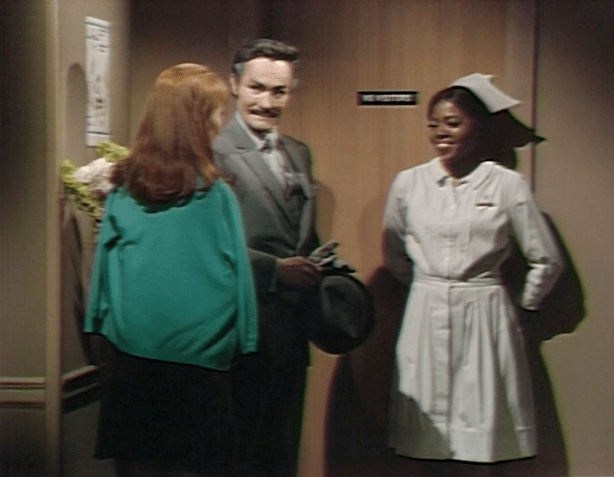
Beverly Hope Atkinson plays an unnamed nurse who meets suave warlock Nicholas Blair when he is trying to make his way into a hospital room occupied by Tom Jennings, a victim of one of Nicholas’ evil schemes. She firmly refuses him admittance. When Maggie Evans, The Nicest Girl in Town, enters and asks to see Tom, the unnamed nurse smiles brightly and says “Of course, Maggie!” in a tone that makes it sound like they’ve been friends all their lives. She then shuts the door before Nicholas can follow. He asks her why Maggie can go in and he cannot, and she tells him sternly that Maggie has permission from the doctor.

Unnamed nurse is happy to see Maggie. Screenshot by Dark Shadows Before I Die.

I have a fanfic idea about Atkinson’s nurse that I originally posted as a comment on Danny Horn’s Dark Shadows Every Day. I can’t find it there, but here is a copy of it:

In the first 42 weeks of the show, when the supernatural was in the background and the stories were slow, it would have been easy to have a couple of tea party scenes at the Evans cottage where Maggie and her lifelong friend, Unnamed Nurse, recap whatever is going on. Those scenes could have led to a whole exploration of the tension between the working-class people in the village and the jerks in the big house on the hill. That in turn could have led to the introduction of Unnamed Nurse’s family, headed by Unnamed’s parents, Mr and Mrs Nurse, including her brothers, Young Mr Nurse and Master Nurse, and her sister, Moody Miss Nurse. We could then have seen the ancestors of the Nurse family in each of the flashback segments and analogues of them in Parallel Time.

At some point in my musings about this idea, I decided the family should be named “Wilson” (if I had a reason for this, I’ve forgotten it, but I now think of Atkinson’s character as Nurse Wilson,) and that in a flashback segment we should learn that they are descended from free persons of color who settled in Collinsport before the Civil War and were the first proprietors of the Collinsport Inn. Some wicked deed by a member of the Collins family knocked them out of the entrepreneurial class long ago, and they’ve been working their way back up the socio-economic ladder ever since.

We met Maggie in #1 as the waitress at the diner in the Collinsport Inn. She, her late father Sam, and her fiancé, hardworking young fisherman Joe Haskell, have been Dark Shadows‘ main representatives of the people in the village. Her house, the modest counterpoint to the mansions on the Collins family’s great estate, has been familiar to us from the beginning, and is the place where we have seen most vividly what the Collinses’ doings have meant for the people who work for their businesses and live in their town. So, as a frequent visitor there, the nurse could have given a whole new dimension to the drama, showing that it isn’t just one family whose lives hang in the balance, but that a whole community is exposed to the consequences of what happens on the hill.

The Blue Whale

Joe is sitting alone at a table in the Blue Whale tavern, and he looks terrible. He’s pale and fidgety, looking around and periodically jumping up to peek out the window.

Maggie comes in and joins Joe. At first she is angry with him- he stood her up last night, without so much as a telephone call. She sees how upset he is and her anger is mixed with worry. He pounds on the table while the camera is tight on her. Her startled reaction reminds us of the early months of the show, when Sam was a self-pitying drunk and Maggie was a sophisticated portrait of an Adult Child of an Alcoholic.

Maggie startled. Screenshot by Dark Shadows Before I Die.

After that moment, Maggie gets very quiet. When Joe says with alarm that it is getting dark, she responds that “It usually does, at this time of day.” It’s inherently funny to hear someone make that kind of matter-of-fact statement in response to an inexplicably intense remark, but also poignant to those of us who remember Maggie’s early interactions with Sam. From childhood on, simple rationality must have seemed to Maggie like a joke in the face of the overpowering irrationality at the center of her life.

As it happens, Joe is indeed exhibiting addicted behavior. But he isn’t hooked on alcohol. Instead, he is under the power of a vampire. Angelique, who was once the wicked witch who first made Barnabas Collins a vampire, found herself reduced to bloodsucker status when she displeased Nicholas. At Nicholas’ direction, she bit Joe the other day, and now Joe is desperate to hear her summons and report for another bite. She does call, and he does dash out, leaving a bewildered Maggie behind.

It was at the Blue Whale that we first met Joe, back in #3. Then, he was an upstanding young man who indignantly rejected the attempts of one of the Collins family’s sworn enemies to bribe him into spying against them. We’ve seen him in the tavern many times since then, always as the doughty representative of the wholesome and intelligible world against the sinister and supernatural. For example, in #215 it was a deeply troubled Joe who brought the news to Maggie and others at the Blue Whale that the cows on his uncle’s farm had been somehow drained of blood, news which turned out to be the first sign of vampirism in the area. This is the first time we’ve seen the Blue Whale since #358, back in November, and the first time a scene has closed with the formerly very familiar Blue Whale jukebox dance tunes in even longer than that. Longtime viewers see a loop closing. Joe leaves the place where he has most often shown himself as one who dwells in the daylight and goes down to the deepest dark.

Once Joe is gone, Nicholas enters. He engages Maggie in conversation, and talks his way into the seat Joe vacated. Soon he is doing magic tricks for her and she is agreeing to have dinner with him. He brings up the idea of staying out all night, and she seems amenable. Where is her old friend the nurse when you need her?

The Fix

Joe lets himself into Nicholas’ house, a place by the sea that he is renting from the Collinses. Angelique is there. Joe laments his dependency on her, and asks if she was the one who attacked Tom, whom he identifies as his cousin. Perhaps the son of the uncle whose cows fell victim to Barnabas long ago! She doesn’t bother to deny it. She tells him that they will both visit Tom tonight. She bites Joe.

Joe visits Tom, who has emerged from the coma in which Angelique’s first bite left him. He tells Joe all about Angelique’s attack on him. He says he knows how bizarre the story sounds, but that he hopes that if he has Joe to vouch for him he will be able to make the police take it seriously. Joe gives Tom a few perfunctory assurances, then opens the window. Joe explains that he is doing this because it is hot in the room. Tom does not agree that it is hot, but Joe insists, and Tom is too ill to argue long.

Joe leaves, and we jump forward to 2 AM. The window is still open- apparently no nurse was on duty. Perhaps the hospital thought Beverly Hope Atkinson’s character did such a good job on the day shift that the patients could just cruise along through the night. We hear a bat squeaking, and Angelique appears. She bites Tom.

In Barnabas’ first weeks on Dark Shadows, the show made heavy use of the idea that vampires can enter a lodging only when they have been invited. For example, he went to the diner after hours so that Maggie would have to invite him in, and later went to her house and stood just outside the front door for a noticeably long time before she explicitly asked him to enter. They haven’t done anything with that idea in a long time, but neither have they very clearly contradicted it. Perhaps Joe’s opening of the window is the invitation Angelique needs to make her way into the hospital.

Episode 496: A walking dead man

In the 1790s, wicked witch Angelique turned scion Barnabas Collins into a vampire. When Barnabas realized what she had done to him, he killed Angelique.

In 1967, Barnabas was freed from a long captivity once more to prey upon the living. In 1968, Angelique also returned. Wearing a black wig and calling herself Cassandra, Angelique met sarcastic dandy Roger, ensorcelled him into marrying her, and thereby established herself as a resident of the great house of Collinwood. Wiggéd witch Angelique/ Cassandra found that Barnabas’ vampirism had gone into remission as a result of treatments he had received from mad scientist Eric Lang. She killed Lang before he could complete the process meant to make the cure permanent, but the senior mad scientist in the area, Barnabas’ friend Julia Hoffman, finished his work.

Angelique/ Cassandra and Julia know these facts about each other, but it is unclear how much Angelique/ Cassandra knows about Lang’s process. In particular, when today’s episode begins we do not know whether she has figured out that the main part of it was building a Frankenstein’s monster named Adam and trying to transfer Barnabas’ “life force” into him. Still less do we know whether Angelique/ Cassandra is aware that when Julia took over the experiment she brought Adam to life without killing Barnabas, and that as long as Adam is alive Barnabas will be free of the effects of the vampire curse.

Julia lives at Collinwood as a permanent guest. Today’s episode opens with her and Angelique/ Cassandra coming home, both smiling and chirpy, talking about an exciting conversation they had while they were out together. They had visited Angelique/ Cassandra’s former professor, Timothy Eliot Stokes. Stokes is an expert on paranormal phenomena. In #488 Barnabas told Stokes that Angelique/ Cassandra was a witch and he resolved to join Julia and Barnabas in the battle against her. Julia tells Roger that the exciting conversation she and Angelique/ Cassandra had at Stokes’ home was about the occult.

Considering what these three people know about each other, this conversation would have been fascinating to watch. Julia and Stokes want to probe for Angelique/ Cassandra’s weaknesses; she wants to make sure neither of them has any powers she doesn’t know about, to find out their plans, and if possible to bring them under her influence. Properly written and played by actors as accomplished as Grayson Hall, Lara Parker, and Thayer David, that scene might have been one of the highlights of the whole series. But it doesn’t happen. They just tell us about it in the first 30 seconds of the episode, then move on. It’s one of the major what-ifs of Dark Shadows.

Yesterday Adam escaped from the cell in the basement of Barnabas’ house where he has been confined and met several members of the family who live in the great house. They spend the day recapping that incident. Roger tells Cassandra that Adam seemed to know Barnabas, and she is all ears. It quickly becomes clear that Adam’s existence is news to her, that she is putting everything together, and that Adam is now in grave danger from her.

Angelique/ Cassandra takes in the news Roger has brought her. Screenshot by Dark Shadows Before I Die.

Episode 470: Nonsense about names

Part One. Roger/ Joshua

Much to her surprise, well-meaning governess Vicki Winters came unstuck in time in #365 and found herself in the year 1795. She spent the first few weeks of her sojourn in the past telling all the characters she met about the other roles that their actors played in the first 73 weeks of Dark Shadows, thereby puzzling them and irritating the audience. After a few months, the people of Collinsport had decided to try Vicki on a capital charge of witchcraft. There were no laws against witchcraft in Massachusetts or anywhere else in the English speaking world in the 1790s, but Vicki had got on so many people’s nerves by that point that they were willing to overlook that technicality and sentence her to hang. She was whisked back to 1968 in #461, with so little time to spare before she died on the gallows that she came back with rope burns on her neck.

Throughout the first year of Dark Shadows, the writers used Vicki more than any other character to move the action. Unfortunately, they sometimes moved it by having her do things that served the plot, but that the character had no reason to do. That gave rise to “Dumb Vicki,” and Dumb Vicki was very much on display throughout the whole segment set in 1795-1796.

Now, emigrés from the late eighteenth century are starting to join Vicki in her time. We open today as the clock chimes midnight. Vicki, wearing her nightgown, is coming down the grand staircase in the foyer of the great house of Collinwood, roused by the sound of an unexpected voice in the drawing room. It is the voice of haughty overlord Joshua Collins, master of Collinwood in 1795. Vicki enters the room to find sarcastic dandy Roger Collins carrying on a lively, albeit one-sided, conversation with a portrait. Roger is convinced that he is Joshua, and deals with Vicki in just the lofty way Joshua dealt with her during the costume drama segment. He even brings up Vicki’s frequent confusion with names, something Roger could not possibly have known about. This, therefore, is no mere delusion of Roger’s- Joshua’s ghost really is taking possession of him, manipulated by a force with its own malign intentions.

It is no secret from the audience what that force is. Roger has become obsessed with a portrait depicting wicked witch Angelique, who in the 1795 segment wrought terrible harm to the Collins family. Angelique was responsible, in one way or another, for the deaths of both of Joshua’s siblings, both of his children, his wife, and many other people. Too late, Vicki learned that Angelique was the witch for whose crimes she was being condemned to hang. As we have seen other supernatural beings do on Dark Shadows before, Angelique is using her portrait as a means of projecting her powers into the world of the living.

Roger/ Joshua’s remark about the name trouble reminds us of Dumb Vicki, but that is not the version of the character we see today. Instead, we have a visit from Smart Vicki. When Roger keeps insisting that he is Joshua Collins, Vicki picks up a telephone and shows it to him, declaring that it is something that did not exist in Joshua’s time. Roger looks at the receiver in silence for a moment, then groggily asks “Is it for me?”

Vicki says that she will take the portrait back to the antique store where she bought it so that it can be sold to Professor Timothy Eliot Stokes. This is a bit jarring for returning viewers- in #464, Stokes offered Vicki $200 for the painting, and Roger countered with a bid of $50o. Evidently Roger didn’t actually pay Vicki the money, because he doesn’t say that it is his when he urges her to leave it in the house.

Vicki and Roger leave the drawing room. Roger slips back in, takes the painting, and marches out of the house with it. While he does so, a nice little bit of music featuring the harp plays on the soundtrack. I don’t know that it is new, but I didn’t recognize it.

Part Two. Peter/ Jeff

Angelique not only killed Joshua’s son Barnabas, but cursed him to rise at night as a vampire. Barnabas returned to the great estate of Collinwood in 1967. He has been passing himself off to the living Collinses as their distant cousin from England. When Barnabas found that Vicki had visited his native period of history, he bit her in an attempt to keep her from revealing his secret.

Vicki and Barnabas were on their way to spend eternity together when she crashed her car to avoid hitting a pedestrian. In the hospital, the physician on duty when Vicki and Barnabas were brought in, Dr Eric Lang, turned out to be exactly the right sort of mad scientist. He has apparently cured Barnabas of vampirism. It is unclear whether Vicki remembers that Barnabas bit her and sucked her blood, and quite clear that she doesn’t think of him as a monster.

In the 1790s, Vicki met and somehow fell in love with an unpleasant man named Peter. Peter has returned to the present with her; in fact, he was the pedestrian Vicki had to crash her car to avoid hitting. They have seen each other several times since, and for no worthwhile reason Peter keeps insisting he is named Jeff. Peter/ Jeff shows up at Collinwood today. Vicki ushers him into what she alone calls “the living room,” and everyone else calls “the drawing room.” Peter/ Jeff asks Vicki if she loves Barnabas and plans to marry him. She tells him she does not. She says that she doesn’t want to hurt Barnabas’ feelings, but that she will have to break the news to him as soon as possible.

Part Three. Barnabas, Barnabas

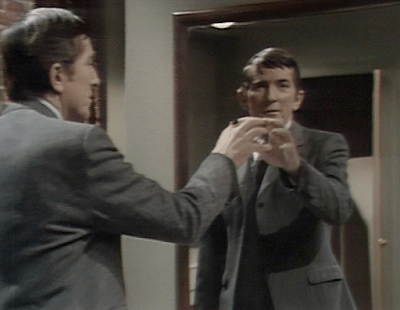
Barnabas is still in the hospital. We see him in his room, in the daylight, looking at himself in the mirror. He can’t resist touching his reflection. It is a genuinely beautiful little moment, and an eloquent image. In the contrast between the solidity and familiarity of Barnabas’ standard right profile shot and the fragile little image slightly distorted in the mirror, we see a point of decision. The ghoul has not been destroyed, but a new and very vulnerable human life now co-exists with him in the same body. Wallace McBride says that “On Dark Shadows, your reflection always tells the truth“; this reflection tells a deep enough truth to keep the show going for years.

Barnabas meets Barnabas. Screenshot by Dark Shadows Before I Die.

Vicki visits Barnabas in his hospital room to tell him that she cannot marry him. She thinks that she and Peter might be meant for each other. She also tells Barnabas that there are signs Angelique is making her influence felt at Collinwood again.

Vicki knows that her news about Peter will hurt Barnabas, but she understands that if they are to fight against Angelique, there can be no secrets between them. Barnabas understands this as well. Therefore, he decides to surrender immediately. Right after his scene with Vicki, we see him telling Lang he has decided to revert to vampirism.

That reaction is absurd, but it goes to the heart of the character as we came to understand him in the part of Dark Shadows set in the years 1795 and 1796. He did not believe that gracious lady Josette could love him, so he had a casual fling with her maid, Angelique. He did not believe Angelique cared very deeply about him, so he cast her aside once it became clear Josette was willing to marry him. He did not believe Josette could forgive him for having come to her from a dalliance with Angelique, so he did not tell Josette when Angelique vowed vengeance on them both. At each point, Barnabas’ underestimation of his own lovableness led to disaster. If only Barnabas could have read Jonathan Frid’s fan mail, he and Josette would have had a happy, quiet life and died in obscurity in the first half of the nineteenth century.

Part Four. Vicki

For her part, Vicki spent the first 38 weeks of Dark Shadows growing close to strange and troubled boy David Collins, who tried to kill her more than once, tried to kill his father Roger and frame her for it, who talks to ghosts, and whose mother is an undead fire witch. In the same time, she fell in love with a man named Burke, who spent years in prison for a killing in which Roger had a part but for which he was also very much responsible. While in the 1790s she fell in love with Peter, who committed many crimes and would doubtless have become a killer had Vicki not killed his man before he got to him. So Barnabas’ weird nature and career of homicide hardly guarantee that Vicki will spurn him.

I often wonder what might have been had the show decided to initiate Vicki into Barnabas’ secret. Alexandra Moltke Isles and David Henesy triumphed over some stunningly bad writing to make the story of Vicki’s bonding with David the one consistently interesting thread of the first year of Dark Shadows. Now that there are good writers and other stories that are working, I can only suppose she and Jonathan Frid would have given us something for the ages if they had been allowed to show Vicki coming to accept the true Barnabas.

There are several ways they could have done that. Maybe she gradually learns the horrible truth, can’t go to the authorities right away because she needs Barnabas as an ally against a more immediate threat, and by the time that threat passes decides he’s a good risk. Or maybe she becomes a vampire herself and finds out about his past in the process of being cured.

Or, most daring of all, maybe it turns out Vicki knew that Barnabas was a vampire all along. Sure, she was upset when she thought he’d killed her friend Maggie- why do you think she invited herself to spend the night at his house during that period? She had the guilts because she had failed to save Maggie and wanted him to bite her as punishment. Sure, there were some sleepless nights when it looked like he might be planning to kill David in order to silence him- why do you think she kept making herself available to Barnabas in that period as well, if she wasn’t offering herself as a tool he could use to keep the boy quiet without hurting him?