
The highlight of today’s episode is a confrontation between two of Dark Shadows‘ most effective villains.
Laura Murdoch Collins (Diana Millay) was on Dark Shadows from December 1966 to March 1967, when the show took place in a contemporary setting. She emerged from the supernatural back-world behind the action, and at first she was as vague and indefinite as are the beings who lurk out of our sight there. Eventually she took on a forceful enough personality that Diana Millay could display her gift for dry comedy, but that personality was only a mask that Laura wore. The real Laura was something entirely different, unreachable, unknowable. The visible Laura marks the boundary between the world we can hope to understand and one where humans would find no points of reference, no standards of comparison. As such, she represents the danger that we might lose our way and find ourselves in a place where our minds will be useless to us. That is to say, she inspired the fear that comes from a well-told ghost story.
Now the dramatic date is 1897, and another iteration of Laura is the mother of twelve year old Jamison and nine year old Nora. Laura’s estranged husband, the stuffy Edward Collins, and Edward’s sister, spinster Judith, have sent Jamsion and Nora to Worthington Hall, a boarding school which doubles as a particularly cruel cult. Laura’s plans for Nora and Jamison require them to be home on the estate of Collinwood, and so she sets out to release them from Worthington Hall.
The headmaster/ cult leader of Worthington Hall is the vile Gregory Trask (Jerry Lacy.) Trask is at the opposite pole from Laura. She is terrifying because we can never understand her or the realm whose existence she implies; he is an overpoweringly oppressive presence because he is so thoroughly comprehensible. It is perfectly obvious what Trask has done, what he plans to do next, and why he wants to do it, but knowing all that is of absolutely no use in stopping him.
In today’s opening scene, Trask confronted fugitive teacher Rachel Drummond, whom he is extorting into coming back to work at Worthington Hall. He kept sidling up to Rachel and touching her, telling her that perhaps the two of them were destined to change each other. He could not make it clearer that he wants to exploit his power over Rachel to coerce her, not only into returning to her old job, but into a sexual relationship.
Trask has been in a position of authority over Rachel since she was a small child, suggesting that his unrelentingly punitive approach to his students and the undisguised joy he takes in being cruel to them are also sexual in their origin. Rachel even used the word “sadist” to describe Trask the other day, a word coined only in 1892. Someone using it in 1897 would certainly have seen it in its original clinical context, and the neurotic intellectual Rachel undoubtedly understood it very well in its technical sense.
We see Laura on a dark set. She looks at a candelabra. She points at its three candles, one by one. As she points at each candle, it lights. Thus first time viewers learn that Laura is a supernatural being with a relationship to fire.
At Worthington Hall, Nora wanders into a room where a fireplace is alight. Nora can hear her mother’s voice urging her to look into the flames, but cannot see her. She is afraid until she looks into the flames and sees Laura’s face. Nora begins to enter a deep trance. Before she can, a teacher finds her and interrupts her. We cut back to Laura, who is pleading with Nora not to look away from the fire. Nora does, and the candles on Laura’s candelabra go out.
We see Trask in his study, browsing through a Bible. He returns that to his bookshelf and finds more congenial reading. He picks up a ledger and brightens. We see its cover, on which is taped a label reading “PUNISHMENT BOOK.” Trask smiles blissfully and sits down to examine its contents.
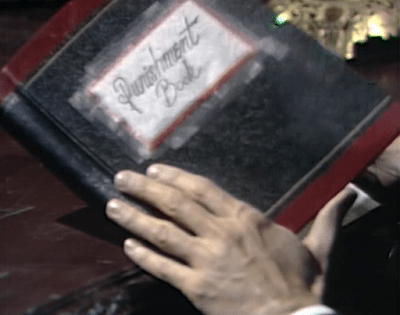
A knock comes at the door, pulling Trask out of his sun-kissed dream of past cruelties. Irritated, he demands to know who it is, but receives no answer. When the knocking continues, he opens the door and sees Laura.
LAURA: Are there no servants at Worthington Hall? I’m not accustomed to letting myself in.
Longtime viewers will remember that when Laura was first on the show, they made a big deal out of the fact that she never ate or drank. So much so that they had the next uncanny menace, Barnabas Collins, drink a cup of coffee in #221. Even though Barnabas was a vampire and Laura was not, they had used up the traditional indicator of vampirism. non-consumption of food or drink, on Laura. Laura’s inability to open the door herself may be another borrowing from the same stock of imagery, from the idea that the vampire cannot cross a threshold without being invited.
TRASK: Who are you?
LAURA: I am Laura Collins and I come for my children. You are Mr. Trask, of course.
TRASK: Reverend Trask!
LAURA: Anyone can call themselves anything. I knew a woman in Brooklyn, once. Insisted she was a countess.
This is an inside joke. There was quite a well-known fashion correspondent-turned-executive in Brooklyn in 1969 named Mabel Wilson Gross. Mrs Gross’ first husband was a Danish nobleman named Count Carl Adam von Moltke, known to his friends as “Bobby.” Mrs Gross was known professionally as “Countess Mab Moltke.” She and “Bobby” were the parents of Alexandra Moltke Isles, who appeared in 333 episodes of Dark Shadows as well-meaning governess Vicki. I don’t believe Mrs Isles has ever used the title “Countess” herself, though under the laws of Denmark she would have the right to do so. Since it was Vicki who led the battle against Laura in 1967, a remark from Laura twitting Mrs Isles and her family might raise quite a laugh from longtime viewers who get the reference.
LAURA: (Goes to Trask’s desk and leafs through the “Punishment Book.”) But you are Trask. Yes, there’s no doubt about that.
TRASK: But you could be anyone as far as I’m concerned, anyone at all. I have too much respect for the defenseless souls in my charge.
LAURA: Oh, please, don’t be dreary.
TRASK: Dreary, Madam?
LAURA: Surely you know the word. Simply have my children brought down here, if there’s anyone to bring them.
TRASK: And how am I to know that you are their mother?
LAURA: Oh, what a trusting man you are.
TRASK: There is no question of the children leaving the school.
LAURA: Jamison possibly. Nora will leave here tonight. I’m willing to take them one at a time.
TRASK: As far as I know, Madam, their mother is away.
LAURA: You should keep more in touch.
TRASK: My wife returned from Collinwood this afternoon. She made no mention of your return.
LAURA: Hmm. How odd. I thought her a great gossip.
TRASK: Minerva? Madam.
That Minerva appeared to be “a great gossip” will also amuse longtime viewers. She is played by Clarice Blackburn, who in the parts of Dark Shadows set in the 1960s played housekeeper Mrs Johnson. After a brief period in which Mrs Johnson was supposed to be a spy planted in the house by an enemy of the Collins family, she settled into the role of a benevolent but excitable woman whose chief function was to blab everything she knew to the character likeliest to use the information to advance the plot.
LAURA: Now, will you have Nora sent down.
TRASK: I will not. Not without proper orders from Miss Judith Collins or Mr. Edward Collins. I shall call Collinwood and verify your strange appearance.
LAURA: Do.
(TRASK picks up the telephone receiver. Shows pain and drops it.)
LAURA: What’s wrong, Mr. Trask?
TRASK: It burned my hand.
LAURA: I’ve always thought the telephone an instrument of the devil, haven’t you?
TRASK: I have not!
Many times on Dark Shadows, as recently as this week, we have seen men forcibly intervene to stop a woman from talking on the telephone. I believe this is the first time we have seen a woman turn the tables and do this to a man.
TRASK: What a ridiculous conversation. I don’t know what I could have been thinking of to call Mr. Edward Collins. We have rules at Worthington Hall, Madam.
LAURA: Ah, rules are made to be broken.
TRASK: Not here. The children are asleep. They shall remain asleep. We do not encourage visits even from members of the immediate family unless of course it’s an emergency.
LAURA: Then you won’t reconsider?
TRASK: No.
LAURA: Not wise. Not wise at all.
TRASK: Are you threatening me?
LAURA: My children will not spend one more night in this school.
Laura remains perfectly calm throughout this conversation. Even her closing threat is delivered in a light tone, with an easy smile. Trask is agitated at the outset, and becomes ever more so as he realizes he cannot intimidate Laura. Since Diana Millay and Jerry Lacy are two of the most capable comic actors on Dark Shadows, the result is hilarious.
We first saw the effect of Laura’s imperturbability on an earnest interlocutor in #183 and #184, when she confronted a profoundly different character. In those installments, visiting parapsychologist Peter Guthrie called on Laura at the same cottage where she is staying in 1897. He introduced a new word to Dark Shadows‘ lexicon when he told her that he had concluded that she was “The Undead.” He said that he knew of her evil intentions, and said that if she abandoned them and turned to good, he would make every effort to help her live a different kind of life. Guthrie’s offer meant exactly nothing to Laura, and she responded to it with the same sardonic indifference Trask elicits from her today. Her next act was to cast a spell that caused Guthrie to crash his car and die in a ball of flame.
Trask gets off easier. Laura just sets his school on fire. The closing shot shows Nora apparently surrounded by flames. Laura does not want to burn Nora to death, at least not yet, but she is not one of your more detail-oriented otherworldly menaces. It will not surprise longtime viewers that she is blithely assuming that her children will somehow escape alive from the blaze she has started.
 Dark Shadows Commentary