
Mrs Acilius and I did our first watch-through of Dark Shadows on streaming starting in the spring of 2020, when there was no live theater to attend. When we got to the episodes introducing Barnabas Collins the vampire, I found Danny Horn’s Dark Shadows Every Day, which picks up with those and follows the series to its conclusion. I enjoyed Danny’s blog very much, and soon became one of his regular commenters. When we started this watch-through to coincide with the 56th anniversary, I looked for someplace to leave my comments on the episodes Danny didn’t cover, and found that all I could do was to start this blog of my own.
In his post about #412, Danny wrote: “This actor, Roger Davis, plays five roles on Dark Shadows, and they just get more and more angry. By the time we get to Harrison Monroe in late 1969, his character is literally an automaton sitting behind a desk, who yells at people nonstop until his head falls off. That is actually true.” I remember reading that in 2020 and doubting that it was actually true, but by the time we got to this episode and saw it happen, we had learned not to underestimate Dark Shadows. It is far and away the best Roger Davis moment on Dark Shadows. In fairness to Mr Davis, he is a highly trained actor who can do good work, but he chose to do so only a handful of times on the show. When we see that the writers are as sick of his obnoxiousness as we are, it’s an occasion to stand up and cheer.
Much of the episode is taken up with some business about whether matriarch Elizabeth Collins Stoddard and her thirteen year old nephew David Collins are going to murder permanent houseguest Julia Hoffman. Liz and David have been absorbed into a secret cult devoted to unseen supernatural beings called the Leviathans, and Julia, who cannot be absorbed into the cult, is on track to uncover its existence. Liz takes a pistol and aims it at Julia’s back. Julia is absorbed in another crisis, and by the time she notices that someone else is in the room, Liz has put the pistol down.
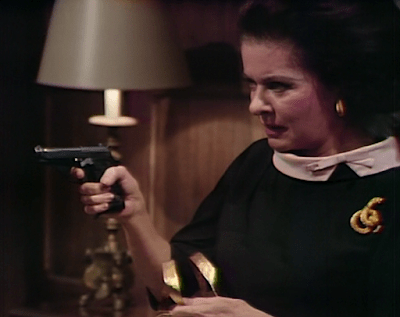
Liz tells David she can’t bring herself to kill Julia, who has been very helpful to the family in the past. David sternly tells her that they must put aside all such considerations and think only of their duty to the Leviathans. They consult a sacred book the Leviathans have entrusted to them, and read that they must not kill anyone, since the ghosts of their victims are more formidable to them than are living people. Since most of the principal characters on the show, including Julia, Liz, and David, have committed or at least attempted homicide, this prohibition would seem to imply that the Leviathans are the good guys.
There is also a story about Quentin Collins and his great-grandson Chris Jennings. Quentin was a werewolf in the nineteenth century and Chris has inherited that curse. In 1897, a repellent little man named Charles Delaware Tate painted Quentin’s portrait. The portrait had magical powers, relieving Quentin of the effects both of lycanthropy and of aging. Quentin recently came back to town, suffering from amnesia and refusing to listen to Julia or Chris when they try to tell him he is 99 years old. Julia and Chris hope that Tate will be able to do for Chris what he did for Quentin, and they have figured out that he is still alive and using the name Harrison Monroe.
The moon was full enough last night to trigger the werewolf transformation, and will be again tonight. Chris turns up. She had taken him to a mental hospital she controls, to be locked up securely while he is in his lupine form; he checked himself out, and says he can’t stand being caged. Since the alternative is killing at least one person at random, it is rather difficult to sympathize with Chris’ insistence on letting himself out.
For her part, Julia was already afraid that a werewolf was on the loose before she knew Chris had left the hospital. She suspects Quentin may have reverted to lycanthropy. She goes to the apartment of the woman who has been keeping Quentin and finds him there, his face soiled and his clothing tattered as it might be the morning after a fit of werewolfery. It turns out that he did not transform- he simply got into a bar fight. When she tells Chris about this, he goes to his great-granddad and demands he accompany him to Tate/ Monroe’s house. Quentin isn’t interested in Chris or his problem or Tate/ Monroe, but he is too drunk to hold his ground for long.
Tate/ Monroe doesn’t want to let anyone in, but when Quentin announces himself he opens the door. Chris and Quentin see a young man sitting at a desk in a darkened room. The young man sees Quentin’s apparent youth and yells “Liar!,” shouting that he is too young to be Quentin. Quentin points out that Tate/ Monroe looks just as young as he does, and Tate/ Monroe responds by shouting something about being a genius. Within seconds, he is shouting that of course he recognizes him as Quentin. Confusing as this transition is, I don’t think it is a flaw in the writing, but in the acting. I suspect Mr Davis was supposed to put some sort of inflection on the lines in between to show that Tate has figured something out, but doing that would not be compatible with his technique of delivering all of his lines in an unvarying petulant shout.
Quentin can’t take Tate’s personality any more than the audience can. He throws a vase at him and runs out of the room. It’s when the vase hits the automaton that the head falls off.
The Leviathan story is based on some of H. P. Lovecraft’s stories. Chris and Quentin do not appear to have a direct connection to the Leviathans, but Harrison Monroe, and today’s closing revelation that he is a pile of junk arranged to look like a person, are taken from Lovecraft’s novella The Whisperer in Darkness. So perhaps werewolves and Leviathans have something to do with each other after all.
 Dark Shadows Commentary