
For the first 20 weeks of its run, Dark Shadows developed its story at a stately pace. When writers Art Wallace and Francis Swann were replaced by Ron Sproat and Malcolm Marmorstein, stately became glacial, and at times ground to a halt altogether. For the last few months, Joe Caldwell has been making uncredited contributions to the writing. While Caldwell is probably responsible for some of the glittering moments of witty dialogue and intriguing characterization that have cropped up, everything is still taking a very long time. And this is the second episode in a row in which nothing at all happens to advance the plot.
There are a few interesting moments. We begin with well-meaning governess Vicki entering the long-abandoned Old House on the grounds of the estate of Collinwood in search of her charge, strange and troubled boy David Collins. The doors swing shut, and she cannot open them. The recently arrived Barnabas Collins comes down the stairs, startling her. He opens the doors easily.
This may not sound like a big thrill, but regular viewers will remember that doors swung open at the approach of the previous supernatural menace, blonde fire witch Laura Murdoch Collins. When characters who did not know that Laura was anything other than a woman saw that happen, they didn’t react- it was a small enough thing that they could fail to notice it, and a weird enough thing that it didn’t register. So we have been prepared to watch for tricks with doors as a sign of the uncanny.
Barnabas’ big challenge today is a job of acting. He has to convince the residents of Collinwood that he is a living man from the twentieth century, not a reanimated corpse come to prey upon the living. He has trouble staying in character. When he tells Vicki that once, centuries ago, a father and son had a quarrel in the Old House that led to the son’s death, he starts laughing and repeats the word “death.” Vicki looks at him like he’s a lunatic. He gets it back together fairly quickly, but when Vicki goes back to the great house on the estate she will tell flighty heiress Carolyn that Barnabas is kind of strange.
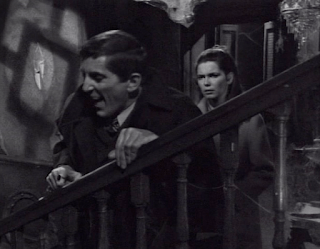
Barnabas gives Vicki a long, flowery speech about the building of the house, one with no apparent motivation and many logical stopping places. Marmorstein has been giving these overheated orations to actor after actor, defeating them all. As Vicki, Alexandra Moltke Isles came the closest to selling one of them, at the beginning of #167, but she needed maximum support from the director in the form of close-up shots and lighting effects, and even then it was a relief when it was over.
Barnabas’ entire part consists of such speeches. Jonathan Frid stumbles over his lines quite a bit today, as he will do henceforth. No wonder- not only was he dyslexic, but at this point they were shooting seven days a week to make up for production time they lost in a strike late in March. That left him with precious little time to memorize the pages and pages of purple prose they kept dumping on him.
Listening to Frid struggle through his dialogue today, we discover the first reason why Barnabas became such a hit. In his voice, through his mannerisms, Marmorstein’s gibberish sounds gorgeous. Sometimes Frid’s struggle to remember what he’s supposed to say is a problem for the character. Since Barnabas is himself an actor essaying a demanding role, it gets confusing to see Frid’s own difficulties laid on top of his. But even at those times the sound of his voice is so appealing that we root for him to recover and deliver more of his ridiculous lines.
In his speech to Vicki about the building of the Old House, Barnabas mentions that the foundations were made of rocks deposited by glaciers. Any reference at all to glaciers is pretty brave, considering the rate at which the story has been moving in the Sproat/ Marmorstein era. It also raises a question about Barnabas. He is the man who posed for a portrait done in an eighteenth century style, and David told dangerously unstable ruffian Willie Loomis stories about Barnabas’ mother Naomi that would place her towards the middle of the eighteenth century. We’ve also glimpsed a plaque on Naomi’s tomb that gives her dates as 1761-1821, but that prop hasn’t received anything like the screen time the portrait of Barnabas has had, and must have been made long before David’s lines to Willie were finalized. So the trend is to regard Barnabas as someone who was confined to a coffin from the eighteenth century until Monday night. When he starts talking about the rocks laid down during the Ice Age, an event unknown until the mid-nineteenth century, we wonder which night this week he spent updating his understanding of geology.
In the great house, high-born ne-er-do-well Roger comes home from a business trip to Boston. Before updating him and the audience on recent plot developments, Carolyn reminisces about her childhood, when he used to bring gifts to her when he would come home from business trips. She tells him he was the only father she knew. This is a retcon- up to this point, they’ve taken pains to make it clear that Roger and David only moved into the house a few weeks before Vicki’s arrival in episode 1.
Vicki and Barnabas enter the great house. She introduces him to Carolyn and Roger. Roger quickly escorts Barnabas to the study where the two of them talk alone. Roger mentions that a vineyard in Spain that had been in the family in the eighteenth century was still theirs until shortly before World War Two. Barnabas does not react to the phrase “World War Two” at all. Whether this is because he has been studying history as well as geology, or because he was simply overwhelmed with so much new information, is not explained.
While Roger and Barnabas are in the study, Vicki tries to explain to Carolyn why she thinks Barnabas is a bit odd. Carolyn doesn’t want to hear it. She explains the basis of the Collins family’s attitude towards Barnabas when she says it’s a relief just to meet someone friendly after the rough time they’ve had lately. Viewers who have been watching from the beginning will understand how strong that sense of relief must be, and will know that Barnabas is in a position to ride it right into a permanent billet on the estate.
Barnabas leaves, and Roger shows Vicki and Carolyn the portrait. He points out that Barnabas is wearing the same ring as its subject. He does not point out that he is also carrying the even more distinctive wolf’s-head cane.
While those three talk about the wealthy and genial visitor from England Barnabas appears to be, we wonder what he really is. Barnabas first appeared as a hand darting out of a coffin, he has shown up only at night, he lived hundreds of years ago, and he is played by an actor who bears a noticeable resemblance to Bela Lugosi. So we assume that he is a vampire. But so far, there hasn’t been any direct evidence of blood-sucking. During the months Laura was on the show, they made a point of not assimilating her to any familiar mythology. So for all we know, he might be something we’ve never heard of.
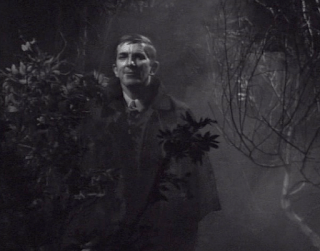
The final shot before the credits roll is in the outdoors, where Barnabas is standing perfectly still, surrounded by shrubbery, and with a big smile on his face. Perhaps that shot is telling us that Barnabas is not the vampire we might assume he is, but that he is in fact an undead garden gnome.
 Dark Shadows Commentary