
Episode 763: An afternoon of cards, a night of murder

Schoolteacher Tim Shaw was introduced in #731. The name “Shaw” is common enough that few viewers are likely to have found any significance in it at the time. It is true that Dark Shadows is at this point a costume drama set in 1897 and that George Bernard Shaw was coming into his own as a playwright in that year. The show was written, acted, and directed largely by theater people, and is so self-consciously stagy that it is possible there might be a reference of some kind to Bernard Shaw in a character’s name. But there doesn’t seem to be anything especially Shavian about Tim.

Today we learn the reason Tim was called Shaw. Satanist Evan Hanley gives Tim a potion that robs him of his will. He holds up a deck of playing cards and tells him that when he sees the Queen of Spades he will know it is time for him to murder someone. In Richard Condon’s 1959 novel The Manchurian Candidate, soldier Raymond Shaw was brainwashed into becoming an assassin when he saw the Queen of Hearts; in the John Frankenheimer’s 1962 film based on the novel, Raymond’s trigger was the Queen of Diamonds.

Frankenheimer’s film is one of the supreme examples of a movie that shouldn’t have worked, but did. No part of the plot stands up to rational analysis for one second, but when the tale is told through stark black and white imagery that puts us deep in the world of a nightmare it is spellbinding. Unfortunately, the irrationality of the plan the villains carry out and of the other characters’ responses to their evil deeds in The Manchurian Candidate are on full display in this homage, without the paranoid verve that makes the movie compelling. All by itself the potion puts Tim so deep in Evan’s power that he gladly goes to witch Magda Rákóczi to buy poison and insists she sell it to him even after she has pointed out that it is useful for nothing but murder. It doesn’t seem there is anything left for the card to add to the control Evan has over him.

It gets worse. Evan is acting as the agent of the evil Rev’d Gregory Trask. Trask is unhappily married to a woman named Minerva, and is blackmailing Evan into sending an assassin to kill her. When Evan shows Tim the card today, he confirms that the intended victim is a woman. But why not have him kill Trask? As my wife, Mrs Acilius, points out, if Trask dies, Evan will be free of the threat of blackmail. So if he is prepared to be a party to murder, you’d think he would forget Minerva and commit the crime he has a motive to commit.

The highlight of today’s episode doesn’t have anything to do with Evan, Tim, Minerva, or Trask. It is a scene between Magda and sometime maidservant Beth.

Beth has come to the Old House on the great estate of Collinwood to plead with Magda to lift a curse she has placed on Beth’s boyfriend, rakish Quentin Collins. Quentin murdered his estranged wife, Magda’s sister Jenny, and as revenge Magda turned him into a werewolf. Magda is unimpressed with anything Beth says until she tells her that in spite of everything, she will marry Quentin and go away with him. Magda marvels at this and asks Beth if she will really go through with it knowing that any son Quentin might have will suffer from the same curse. Shocked, Beth asks Magda if she means what she has said, and she repeats that Quentin’s son will also be a werewolf. Beth replies that in that case, Magda has laid a curse upon her own kin.

Magda dismisses this, saying that Jenny had no children by Quentin. Beth says she is wrong, that Jenny bore twins, a boy and a girl. Beth lays the story out systematically, and it dawns on Magda that she is telling the truth. Magda calls out to Jenny’s spirit and begs forgiveness, saying she did not know. Beth says that it is time to lift the curse, and Magda tells her to get a pentagram and make sure the boy wears it all the days of his life. Beth has her own moment of horrified realization. “And… you can’t end it? Can you?”

Beth realizes Magda does not know how to undo the curse.

Terrayne Crawford had some weaknesses as an actress that severely undercut her in her first weeks as Beth. But this scene is right in her wheelhouse. She is flawless as she portrays Beth’s progression from weepy begging to methodical explanation to utter shock. And Grayson Hall of course brings great power and vivid color to Magda.

We’ve been waiting for this scene since #642, months before Magda first appeared in #701, let alone before she placed the curse on Quentin in #750. In that episode, back in December 1968, the show took place in a contemporary setting. The characters had noticed some strange goings-on, and held a séance as part of their inquiry. The spirit they reached was Magda, who spoke regretfully of “my currrrse!” It’s taken more than 24 weeks, but Magda has finally learned what she already knew when we first heard from her.
Episode 762: You called the Devil, and you got me

In December 1967, Dark Shadows was a costume drama set in the 1790s. In that month it introduced the Rev’d Mr Trask, a witch-hunter from Salem, Massachusetts, came to central Maine* to drive witchcraft out of the village of Collinsport and off the estate of Collinwood. Trask was bad at this job; wicked witch Angelique easily deceived him into blaming well-meaning governess Victoria Winters for her own crimes, leading to Vicki’s hanging and exacerbating the consequences of Angelique’s evil spells.

Now the show has relocated to the year 1897, and a descendant of Trask is among the villains. He is the Rev’d Mr Gregory Trask, and he runs a boarding school along lines dictated by his own sadistic delight in punishing innocent children.

Fans often say that while the original Trask** was a sincere believer who did harm because of his fanaticism, Gregory is a hypocrite who uses a pretense of religion to enable his perversions and his greed. I think the truth is more complicated, and more interesting, than this. In #441, the original Trask found the strangled body of a professionally agreeable lady named Maude Browning in his bed; it had been placed there to frame him for Maude’s murder. Trask’s principles, were he to follow them, would seem to imply that he should go directly to the authorities. If the worst happened and they hanged him, to the extent that he was targeted because of his Christian witness his death would win for him an everlasting crown of martyrdom. But fear got the better of Trask. He enlisted a man named Nathan Forbes to help him hide Maude’s remains, and went on from there to expand his conspiracy to suborn Nathan’s perjured testimony against Vicki. Considering the emphasis the Reformed movement put on the Ten Commandments, Trask could not have been unaware of the sinfulness of bearing false witness against a neighbor.

I think Trask’s fanaticism led him to overestimate the importance of the success of his mission in this world. It is not enough that he will be vindicated in the courts of God; God must be vindicated through Trask’s success in the courts of Massachusetts. Thus it is his very sincerity that turns Trask into a hypocrite. Eric Hoffer’s book The True Believer was one of the most influential publications of the 1960s; Trask, the fanatic-turned-hypocrite, could easily have found a home in its pages.

Gregory Trask is certainly a hypocrite. Today we hear Gregory’s wife Minerva talk about women he has dallied with over the years. Gregory comes upon Satanists Quentin Collins and Evan Hanley in the act of summoning the Devil; Gregory’s response is to blackmail Evan into using his command of the black arts to cast a spell to brainwash hapless schoolteacher Tim Shaw into murdering Minerva. We have seen in previous episodes that Gregory has plans for spinster Judith Collins and her enormous fortune; Minerva’s death, if it can be arranged just so, will leave him well-positioned to marry Judith and become the Master of Collinwood.

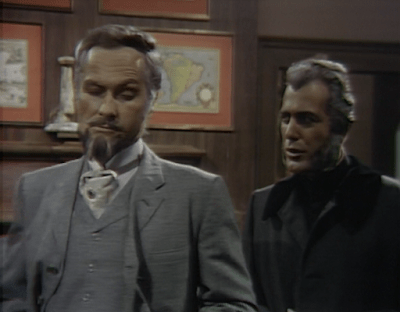
Trask tells Evan the price of his silence. Screenshot by Dark Shadows Before I Die.

As his ancestor’s very sincerity turned him into a hypocrite, so Gregory’s hypocrisy occasionally turns him into a sincere believer in his own powers, if not exactly in God. We saw in #735 that Gregory does not take the same pleasure in reading the Bible that he does in leafing through his “Punishment Book,” a ledger which evidently details his abuse of the children attending his school. But he does read it and quote it, and when in #726 he encountered a case of possession, he immediately and with untroubled self-assurance set to work performing an exorcism. The possession was real, and so far as Gregory could tell his exorcism was successful. He reacted to that apparent success with a serenity that betrayed no suggestion that he had ever doubted that he was the right person to cast out the spiritual forces of darkness.

As the original Trask was a stranger to the routine play-acting that makes ordinary social life bearable and therefore gave himself permission to become a party to the most horrendous deceptions, so Gregory wears his mask so tightly that his face grows to fit it. Dark Shadows was often very self-conscious about showing characters who were acting; its greatest success, vampire Barnabas Collins, won over the audience when they saw him trying desperately hard to play the role of a living man native to the twentieth century. In the Trasks, we see men who do not know that they are acting and therefore cannot manage the effect that the parts they play in everyday life have on their personalities.

Gregory does have a tight mental focus on his projects. When he goes to Evan with his blackmail demands, Evan has learned of his eye for the ladies, and is hoping to use that information to lower his price. So his opening gambit is to describe himself as a man who drifts from one idea to another as other men drift from one woman to another. Three times he says the word “woman,” in each case as the last word of a sentence, in each case about twice as loudly as the words before it. Gregory is unimpressed, and Evan realizes he doesn’t have anything definite to use against Gregory. He crumbles and agrees to Gregory’s extreme demand.

Gregory’s academic standards seem considerably less exacting than are his expectations of his co-conspirators. He mentions to Tim today that when he was a young teacher, the first class he ever taught was in elementary Latin. He challenges Tim to translate the words amo, amas, amat; Tim wearily replies “I love, you love, he loves.” “Very good!” exclaims Gregory. Traditionally the first words students learned on the first day of Latin class were amo, amas, amat, amamus, amatis, amant– I love, you love, s/he loves, we love, you (plural) love, they love. “Very good!” would seem to be an outrageously inflated appraisal to apply to someone who has merely recognized the first three of those six words.

Gregory sends Tim to Evan’s house to read a Latin document that has some bearing on a legal matter that has come up in Evan’s work as an attorney. As it happens, I went to graduate school in ancient Greek and Latin at the University of Texas at Austin, and local attorneys would sometimes call our department asking for someone to help them translate Latin they had found in old Spanish legal documents. They would usually refer those calls to the ablest Latinists among us, since the legal Latin used in the Spanish Empire in the days it ruled Texas was rather a specialized form of the language. Tim can virtually speed-read Evan’s document, suggesting that “amo, amas, amat” was not a particularly stringent test of his abilities.

*Maine was part of Massachusetts until 1821.

**Who is never given a first name. One of the Big Finish audio dramas refers to him as “Vilorus Trask” and actor Jerry Lacy once said he thought his name should have been “Orville.” Neither of those sounds like a very plausible name for a junior-grade Puritan divine of the late eighteenth century. So we are left calling him “the original Trask.” My wife, Mrs Acilius, points out that this seems to suggest that Gregory should be “the extra-crispy Trask.” Maybe he will die by fire, as others have done.