
At the end of last week, reclusive matriarch Liz left the estate of Collinwood for an extended stay in a hospital. It would seem that she took all of Dark Shadows‘ plot points with her. This is the third episode in a row in which we see nothing but characters reprising conversations that didn’t advance the story the first time we heard them. Writers Ron Sproat and Malcolm Marmorstein have been in charge of the scripting for twelve weeks, and they are clearly in big trouble.
This one has a bizarrely dumb opening. Yesterday, strange and troubled boy David took Dr Peter Guthrie, visiting parapsychologist, to the long-abandoned Old House on the grounds of the great estate of Collinwood. Dr Guthrie told David that he would leave him alone in the parlor for a few minutes to try to summon the ghost of Josette Collins. David stared at the portrait of Josette over the mantelpiece until it transformed. It became a painting of David and his mother, blonde fire witch Laura Murdoch Collins, in flames.
Today’s episode picks up at that point. Dr Guthrie finds David standing on what returning viewers will recognize as the exact spot where he had left him two or three minutes before. Even someone who had never seen Dark Shadows before will look at the set and see that David occupies what must be the most conspicuous location in the entire house, between the foot of the staircase, the fireplace, and the front door. Inexplicably, Guthrie comes downstairs calling “David! Da-a-a-vid!” and announces “I was looking for you!” In a later scene, David will tell Laura that Dr Guthrie is nice but not very smart. After this senseless exchange, that line draws a laugh from the audience.
A conversation between Laura and her estranged husband, high-born ne’er-do-well Roger Collins includes a couple of interesting remarks. Roger wonders whether Laura will succeed in what they both want and persuade their son to leave with her after their divorce becomes final. Laura’s assurance that she can win David over after a single night alone with him (“That’s all I need, Roger–one night…one night alone with him and you’ll never be troubled by him again…because he’ll belong to me…completely”) is delivered in the same jarringly sensual tone she had used talking to David in #159. Considering that David has already tried to kill his father, the suggestion that the danger Laura presents to David is something to do with Freud’s theory of the Oedipus complex is not far to find.
Roger says that when they lived together, Laura’s receptiveness to other men’s attention made him jealous. She contradicts him, saying that the only reason he ever wanted her was that his nemesis, dashing action hero Burke, wanted her. We’ve seen time and again that neither Roger nor Burke is ever as excited about anyone else as they are about each other, and we’ve been invited to wonder what exactly went on between them before they became enemies.
When David comes to Laura’s cottage, the two of them talk about the idea that he might leave Collinwood and live with her. He brings up a point he hasn’t in their previous discussions of this matter, saying that well-meaning governess Vicki will lose her job if he does that. When Laura says that Vicki can get another job, and will probably get married and have children of her own soon, David insists that Vicki loves him more than she does anyone else. This is a touching moment for regular viewers, who saw David move from hatred of Vicki to friendship for her in the one narrative arc of the first several months of Dark Shadows that worked every time we saw it. The Laura story, whatever else it may be, is the grand finale of that theme, and therefore the logical conclusion of the show as we have known it so far.
Mrs Acilius and I agree that the best part of the episode comes in the four seconds after Laura hears someone knocking on her door. As we’ve seen several times, she is sitting motionless, staring into the fire, and only after the second knock does she stir. This time Diana Millay does a particularly good job of looking robotic while Laura tears herself away from the flames.

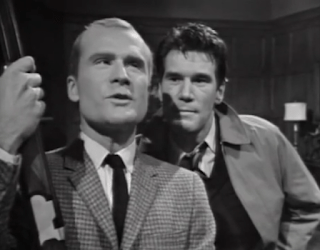
The best thing about the last two weeks has been the addition to the cast of John Lasell as Dr Guthrie. As of this writing,* it would appear that Mr Lasell is still alive; I’ve found addresses for John Whitin Lasell, Jr, aged 95 years, in both Los Angeles and Orange, New Jersey. Oddly enough, there’s also a Post Office Box in his name in Franklin, Maine. Franklin is about 40 miles from Bangor, down towards the coast where Collinsport would have been.
IMDb says that Mr Lasell was born 6 November 1928 in Worcester, Massachusetts. Wikipedia agrees about the date, but says that he was born in Williamstown, Vermont. The 1940 US Census records the 11 year old John W. Lasell, Jr, as a resident of Northbridge, Massachusetts and gives his birthplace as Massachusetts. There is a memorial to John W. Lasell, Sr, in Northbridge, commemorating his heroic death in the Second World War. So I think we can be confident that John Junior was a Bay Stater by birth. I’m inclined to think Wikipedia’s claim that he was born in Vermont is the result of confusion with dairy farmer John Elliot Lasell. John E. Lasell actually did live in Williamstown, Vermont, and does not appear to have been any relation to the actor. Also, Mrs. John W. Lasell, Sr, the former Frances Sumner, lived into her 97th year, so it shouldn’t be too much of a surprise that her son is still around in his mid-90s.
*3 February 2023




 Dark Shadows Commentary