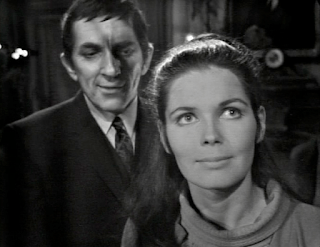
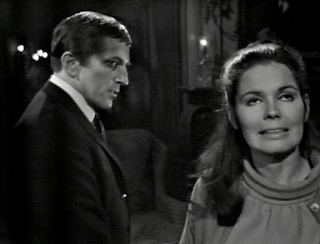
Episode 292: I know who’s dead and who isn’t

Mad scientist Julia Hoffman is hanging around her new base of operations, the Old House on the great estate of Collinwood. She is getting ready to perform an experiment which, if successful, will convert vampire Barnabas Collins into a real boy. She learned of Barnabas’ existence when treating his former victim Maggie Evans, The Nicest Girl in Town. Julia answers a knock on the front door, and sees her old acquaintance, addled quack Dave Woodard.

Woodard has no idea what Julia is up to. So far as he knows, she is still on board with his own idiotic scheme, in which he, along with Maggie’s father Sam and her fiancé Joe, has told everyone in town that Maggie is dead in hopes that her captor would forget about imprisoning girls and draining their blood. In fact, Julia has told Barnabas that Maggie is alive and has lured him into cooperating with her project by promising to keep Maggie in a state of amnesia so that she will not represent a threat to him.

In yesterday’s episode, Sam and Joe called on Woodard and complained that Julia is staying at Collinwood while Maggie is a hundred miles away. They demanded that Woodard take her out of Julia’s care. Woodard tells Julia today that her conduct is growing “more and more unethical.”

Last week, Julia was able to forestall Woodard’s threat to take her off the case by playing dumb. This time, she has to take him partly into her confidence, telling him that Maggie encountered the supernatural and that her case represents an opportunity to find a crossing point on the boundary between life and death. She dangles the possibility of great fame before him, saying that the doctors who make the breakthrough she sees coming will go down in history. When he presses for details, she says that there is great danger in what she already knows, and that she must not tell him more.

Woodard has been on the show for months, and has been stuck in just two modes the whole time. When he’s with a patient, he makes a show of brisk dissatisfaction, as if trying to convince them that they oughtn’t to take their disease so seriously that they give up. This mode was as far as Richard Woods, the first actor to play Woodard, got in his two appearances (in #219 and #229.) When he is talking with someone else, Woodard struggles to find the words to express his bafflement at the terrible case he is treating. These two modes didn’t make Woodard a source of suspense. They were just filler between his announcements of what the script called for him to do next.

When Julia asks Woodard if, when he was in school, he dreamed of making a major contribution to the science of medicine, he gets a thoughtful look and says “Well, of course.” This is the first moment we have seen Woodard outside his two modes. When Julia tempts him with the idea that he will go down in history as the co-discoverer of the most fundamental truth imaginable, he displays an emotion that might lead to him to any of a number of exciting, story-productive actions. The first scene in the first episode credited to writer Gordon Russell manages the astounding feat of turning Dr Woodard into an interesting character.

We cut to the woods on the estate. We see the ghost of Barnabas’ nine year old sister Sarah sitting on a rock crying. All of Sarah’s previous scenes started with some other character on camera, then proceeded to Sarah making a mysterious entrance. That’s what we would expect of a ghost, after all. This time, Sarah is all by herself at rise. The first time we saw a ghost was in #70, when the ghost of Josette Collins emerged from her portrait and danced around the columns of the Old House. That was a solo appearance as well, but people had been in the Old House talking about Josette immediately before, so she was manifesting herself in response to attention from the living. Here, we see a ghost on her own, processing her emotions, hoping someone will come and hang out with her.

Strange and troubled boy David Collins shows up and asks Sarah why she is crying. She says she can’t find Maggie. David breaks the news to her that Maggie is dead. Sarah laughs, and assures David that she is still alive. When David insists that Maggie is dead, Sarah tells him that he may know “about leaves and everything,” but she knows “who’s dead, and who isn’t.”

Sarah laughs at the idea that Maggie is dead. Screenshot by Dark Shadows Before I Die.

Less than a week ago, in #288, David saw a portrait of Sarah and wondered aloud if the girl he has met is her ghost. In the first 39 weeks of the show, he was on intimate terms with Josette and some of the other ghosts. When he first met Barnabas in #212, he asked him if he were a ghost, and was disappointed to hear that he was not. So returning viewers expect David to ask Sarah the same question. Indeed, David has always interacted with ghosts as if they were people with whom he could pass the time of day, share thoughts and feelings, and get to know better from one encounter to the next. Seeing Sarah crying by herself should validate this attitude. But instead, David has developed Soap Opera Goldfish Syndrome, forgetting information which everything we have seen has led us to expect he will remember.

David insists Sarah come home with him to the great house of Collinwood and have dinner with the family. She tries to decline politely, but he will not take “I’ve been dead for centuries” for an answer. He gets Sarah into the foyer, then goes to the drawing room to announce her presence. He finds Julia there, with well-meaning governess Vicki and Vicki’s depressing boyfriend, fake Shemp Burke Devlin. By the time David gets the adults into the foyer, Sarah has disappeared.

Vicki is suffering from an even more frustrating version of Soap Opera Goldfish Syndrome. She had had extensive dealings with the ghosts of Collinwood on many occasions between #85 and #191, and that had been the basis of her bond with David. Vicki’s interactions with the supernatural reached a climax when she led the opposition to David’s mother, undead fire witch Laura Murdoch Collins, from #126 to #191. Since then, Josette has spoken through Vicki at a séance and she has seen Sarah.

But lately, Vicki has started to deny that there are ghosts. This is in response to Burke’s demands. Burke lost his connection to the story months ago, and he’s been trying to gaslight Vicki into dismissing all of her spectral encounters as signs of mental illness so that she will join him on the show’s discard pile of useless characters. In Friday’s episode, Vicki had apparently decided to give in to Burke and make herself believe that there were no supernatural beings at work around Collinwood. As a result, her scenes in that episode were unbearably dreary.

Before David brought Sarah home, Vicki had been dreary again. She’s excited about some old house she saw, and wants Burke to go look at it with her. As David’s governess, Vicki’s compensation consists largely of room and board, so as long as she has her job her interest in any particular piece of real estate isn’t going to lead to story development. If she quits the job and marries Burke, she will be giving up on ever being part of the action again. So her rambling about “the house by the sea” is suspenseful only to fans of Vicki who are afraid she will vanish into the background of the show.

When David starts telling the adults about Sarah, Vicki launches into the same garbage Burke has been giving her, talking down to him about imaginary friends and insinuating that anyone who believes in ghosts is soft in the head. Burke, who had previously been David’s great friend, joins in this abusive behavior. After David indignantly stalks away, Julia gets very uptight and lectures Vicki and Burke about the need to stifle David’s imagination and discourage him from telling them things they don’t already know. This scene is effective, but the effect is claustrophobic- by the end of Julia’s little speech, we feel like the mad scientist is holding us prisoner.

Vicki and Burke decide to leave to look at the house, and Vicki finds Sarah’s cap on the floor. That’s such a great moment that not only do we leave the episode no longer disappointed in David’s goldfish memory, we can even forgive Vicki’s.

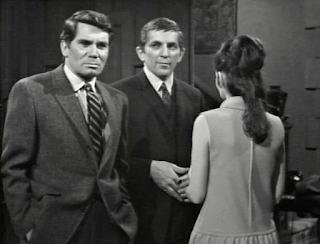
The closing credits run over an image of the foyer with Sarah’s cap on the table. My wife, Mrs Acilius, thought it would have been hilarious if Sarah had marched in and taken the cap while the credits were rolling. I’d have liked to see that too, especially if, after putting it back on, Sarah had turned to the camera and put her finger to her lips, telling the audience to keep quiet about what we had seen.

Sarah’s cap on the foyer table. Screenshot by Dark Shadows Credits.

Episode 285: The storm has already started

Well-meaning governess Vicki says that she would like sit alone in her room “forever” listening to an antique music box. This may seem extreme, but consider the alternatives. Heiress Carolyn comes in and asks her to recap the last couple of episodes; Carolyn responds to every sentence Vicki speaks by asking her to repeat it. Fake Shemp Burke Devlin is downstairs waiting to take Vicki on a date; they went out yesterday, and he spent the time angrily telling her she must be crazy because she believed things he knew to be true. When she meets him today, he’s even angrier, and Carolyn joins in his gaslighting project.

The one bright spot in Vicki’s evening is the courtly Barnabas Collins. He has dropped by the house to give her a book that he thought she might like. By the time Vicki gets downstairs, Burke and Carolyn have come at Barnabas with a lot of free-floating hostility about Vicki’s interest in history. He responded to them affably, and when Vicki arrives he makes a show of not giving her the book.

Vicki sees the book and insists Barnabas let her look at it. When she sees that he inscribed it to her, she asks what is going on. Burke admits that he talked Barnabas out of making the present. Vicki becomes upset with him. Barnabas apologizes for having come and hastens back to his house. Burke is left looking like an absolute fool, which was no doubt Barnabas’ plan.

Burke plays into Barnabas’ hands. Screenshot by Dark Shadows Before I Die

Burke keeps banging on about how it is unhealthy to “live in the past.” He means that he doesn’t want Vicki to learn about the history of the people she works for and of the house they live in, and that Barnabas is a big nerd because he restored the Old House on the estate to its condition as of a previous century and that he lives there.

This is an eccentric way of using the phrase. Usually when people say that someone “lives in the past,” they are accusing them of being stuck in a bygone period of their own life. Burke doesn’t know that Barnabas is a vampire, or that he lived in the house when it was in the condition to which he has restored it. So that isn’t the charge he has in mind. So far as Burke knows, Barnabas is a creative person who imagined a new project, committed himself to it, and with great effort and great skill made it a reality. Nor does he know that Barnabas wants to turn Vicki into a vampiric version of his lost love Josette, or that her interest in history is partly inspired by Barnabas’ supernatural influence over her. So far as Burke knows, Vicki has taken up a scholarly hobby that would be wholesome for anyone and that is particularly appropriate for a teacher.

If any character is “living in the past,” in the sense in which that expression is typically used, it is Burke. When he was Vicki’s age, he was a member of the local working class, presumably living in a rented room in the town of Collinsport. Since then, he went to New York, became a corporate raider, and grew so rich he could live anywhere he chooses. The place he has chosen is another rented room in Collinsport. He is dating a woman half his age, and regularly drops in on the Collinses, who were acquaintances of his in his youth. In all these ways, he has turned his back on his current life and created a fantasy version of the life he lived long ago.

Burke is also an echo of the past of Dark Shadows. When the show started, he was the driving force of many storylines. But those storylines all fizzled, and what remained of them was wrapped up in the story of his ex-girlfriend, undead fire witch Laura Murdoch Collins. Shortly after Laura’s story ended, Burke formally renounced the quest for revenge that had been his chief motive, and there’s been no reason for him to be on the show since. Making matters worse, he was recast last month as actor Anthony George, who is completely lost in the part. So we can sympathize with Vicki’s reluctance to keep spending time with him.

Burke demands that Vicki come with him. He barks at her that he needs a drink. He’s already so angry and so insulting that we can only hope he isn’t a mean drunk. After he issues several more declarations and commands, Vicki tells him she will be staying home with a book. He leaves.

Staying in and reading doesn’t seem to be Vicki’s real plan. Vicki goes to Barnabas’ house, ostensibly to apologize for the unpleasant reception Burke and Carolyn gave him, and for her failure to thank him for the book. He accepts her apologies most graciously.

A storm is starting, and Vicki has neglected to wear the raincoat and headscarf we’ve seen her in several times. When they look outside, she and Barnabas say that it is raining too heavily for anyone to go anywhere. She apologizes for getting caught at his house, and Barnabas says that he is happy to have her. He suggests she spend the night in the restored bedroom of Josette Collins. She is delighted by this idea.

Barnabas invites Vicki to stay in Josette’s room. Screenshot by Dark Shadows Before I Die

Yesterday, Victoria had said she could stay in Josette’s room “forever.” So it seems obvious that she fully intended to be at Barnabas’ house when the storm started raging, and to spend the night there. Of course this fits very well with Barnabas’ scheme, so he is quite happy to oblige her.

Vicki doesn’t hold this expression for very long… Screenshot by Dark Shadows Before I Die

Episode 283: The shock of recognition

Four and a half weeks ago, Maggie Evans, The Nicest Girl in Town, escaped from vampire Barnabas Collins. Barnabas managed to scramble Maggie’s brains sufficiently that she has amnesia covering her time as his victim and much of the rest of her life as well. She is now a patient at a mental hospital called Windcliff, where her care is supervised by Dr Julia Hoffman.

Maggie’s family doctor, addled quack Dave Woodard, is an old friend of Julia’s. He had recommended Maggie be sent to Windcliff. He had also come up with a cockamamie scheme to protect her from her captor by hiding her there and telling everyone in and around the town of Collinsport that she was dead. If he had known that the captor was a vampire, this might have made some kind of sense- no character on Dark Shadows has ever heard of Dracula, so they don’t know how to fight against vampires. But he doesn’t know that, so his plan is just a way for the writers to stall while they try to come up with more plot points.

Today we open with Woodard in Julia’s office, complaining that she isn’t communicating with him about Maggie’s case. She tells him that there have been no developments worth reporting. Returning viewers know that this is a lie, because in a session we saw yesterday Maggie remembered a lot of sense impressions from her time of captivity and Julia told her that they represented tremendous progress. Woodard tells Julia that a lack of new information is no excuse for her failure to return any of his last six phone calls. He says that she seems to be intent on hoarding any information she may glean from Maggie as her own private possession, an impression he describes as frightening.

Julia responds to this characterization with a display of offense, and Woodard apologizes. She then brings up an idea that occurred to her at the end of yesterday’s episode. She says that Maggie’s memory might improve if she takes her to visit Eagle Hill Cemetery, where she was found wandering early in her illness. Woodard objects strongly that Maggie’s condition, as Julia has described it, is so delicate that such a visit might do her permanent harm. Julia retreats and promises she won’t actually take Maggie to the cemetery. This is such a flagrant lie that the camera momentarily goes haywire, focusing on Woodard’s chair rather than his face.

Woodard leaves, and Julia calls Maggie in. She’s already wearing her coat. She asks where Julia is going to take her, and she tells her not to worry about that.

On the great estate of Collinwood, well-meaning governess Vicki is staring vacantly into space while listening to an antique music box Barnabas gave her as part of his plan to subject her to the same treatment he inflicted on Maggie. A knock comes at the door. Vicki closes the music box and goes to answer it. It is her boyfriend, fake Shemp Burke Devlin.

Burke is waging a determined battle against the story, and he is fighting dirty. He doesn’t want Vicki to have anything to do with Barnabas, or with the ghost of Josette Collins. When Vicki says she wants to lay flowers on Josette’s grave in the cemetery, where we know she will cross paths with Maggie and Julia, he resists furiously. When she reminds him that she has had dealings with Josette’s ghost, he says “Or you think you have.” In previous episodes, including yesterday’s and Monday’s, he knew she had, and in an earlier period of the show he knew that several other characters, including some of the most level-headed ones, had also encountered Josette’s ghost. When he starts belittling Vicki for believing in “the spooks of Collinwood,” it therefore comes off as an especially crude instance of gaslighting. The Mrs and I aren’t much for profanity, but we both cussed at the screen when Burke was disgracing himself this way.

Julia and Maggie are in the cemetery. I believe it is the first time we’ve seen the set in a daylight scene. You can see the shadows of the foliage on the soundstage walls, and the corners where the walls meet. I can’t believe the director meant for us to see those things, but I kind of like it- the situation needs a touch of unreality, and the obvious falsity gives it the feeling of a black box theater.

Some of the shadows on the wall that Art Wallace spoke of
Corner of the soundstage

Maggie is agitated. Julia tells her to calm down and that everything is all right. I’m no expert, but I kind of doubt that talk therapy involves a lot of “Calm down!” and “Everything is all right!” It reminded me of this Saturday Night Live sketch from the 90s, in which Patrick Stewart plays “Phil McCracken, Scottish Therapist,” a psychologist who won’t stand for any emotionalism from his patients.

Vicki and Burke see Julia and Maggie in the distance. When Maggie turns to face them, Vicki recognizes her. Julia whisks her away before Burke can see her. When Vicki tells Burke she saw Maggie, he immediately unloads on her with the same garbage he handed her at Collinwood. He declares that Maggie is dead, that Vicki knows she’s dead, that she can’t possibly have seen her, that “there is a resemblance, THAT’S! ALL!” When he asks “What’s wrong with you?” I stopped the streaming and shouted at the screen “She’s wasting her time with you, you ******* ********, that’s what’s wrong with her!” To that, Mrs Acilius said that we should just restart the show and get through the scene.

Part of what makes Burke’s behavior so infuriating is the writer’s fault. A first-time viewer, unaware that what Burke is telling Vicki are delusions that suggest she is crazy are in fact things he knows to be true, might think that he is being reasonable in dismissing ideas about ghosts and the like. But even that viewer will realize that a person ought to be nicer about it. When Vicki says she saw Maggie, Burke could easily have suggested that they go up to the woman and introduce themselves, thinking that a closer look will disabuse her of the notion. But actor Anthony George must also bear part of the blame.

George C. Scott famously told Gene Siskel that there are three things to consider in evaluating an actor’s performance: first is to make the audience believe that the person they are looking at is the sort of person who might do the things the character does. This is in turn dependent on casting- put the wrong person in the part, and all is lost. Second are the choices the actor makes in the key emotional moments. Performers have any number of options as to how they will use their faces, voices, and limbs to show a character’s feelings, and those who make a lasting impression are those who make choices that are at once totally unexpected and perfectly logical. Third is the zest of performance, the actor’s joy in the opportunity to create a character. If that doesn’t come through, nothing else is worth much.

As Burke, Anthony George fails all three of these tests. Burke would have been a difficult part for anyone to take over, both because the originator of the role, Mitch Ryan, was so memorable, and because the character had lost all connection to any ongoing storylines by the time Ryan left. And by his own admission, George knew nothing about soap operas and had no idea how to play a romantic interest on one when he joined Dark Shadows. That’s where he fails the casting part of the believability test.

As for the skill part, George has something going for him. He is always mindful of his physicality, moving only those parts of his body he needs to show us who he is and keeping the rest of himself admirably still. He also keeps his voice remarkably consistent, both by holding a steady level of volume and maintaining a simple, precise pitch. In these and other ways, he shows impressive levels of technical proficiency as an actor, but the result is a mannered, unconvincing performance. His Burke doesn’t seem to be a real person. As a cardboard figure, he becomes an abstract symbol of whatever he’s doing, and when he’s doing something bad he’s hard not to hate.

Since he makes one choice for each resource available to him and sticks with it unvaryingly throughout the episode, he doesn’t give the audience any surprises. Nor does he yield anything to his scene-mates. They always know exactly what’s coming from him. George’s eyes are always watching another actor intently, as he watches Alexandra Moltke Isles intently today, but nothing in her performance can divert him from his plan, not in the smallest particular. When Burke isn’t listening to the other character, as he isn’t listening to Vicki, George’s disconnection from the other actors makes Burke seem like an irredeemable jackass.

Nor does George show any zest for the part. He covers his discomfort with soap acting by plastering on a smile whenever the script allows it, but he is stiff when Burke ought to be loose, cool when he ought to be warm, and loud when he ought to speak with a quiet, nuanced voice. The result is just sad and awkward. When Burke is being pleasant, we can feel sorry for George, but when he has to play the scenes like the ones Burke gets today we just want him to get off the screen and leave us alone.

Compare George’s Burke with Grayson Hall’s Julia, and you will see how an actor can determine an audience’s reaction to a character. Julia is a terrible therapist. She lies repeatedly to Woodard in the beginning, denying the severe breach of ethics and disturbing disregard of public safety involved in covering up what she knows and suspects about Maggie’s experiences and running an unconscionable risk with Maggie’s mental health by taking her to the cemetery. She lies again to Maggie at the end, promising that they will duck into the Tomb of the Collinses only for a moment and then refusing to let her leave there when she starts to show a violent emotional reaction. Her methods are so unorthodox and so harsh that we suspect she is not interested in helping Maggie at all. Because we have known Maggie since episode #1, and Kathryn Leigh Scott’s performance as Maggie renews our fondness for her every time she appears, we ought to feel deep hostility towards Julia.

But we don’t. In fact, Julia quickly becomes (almost) every Dark Shadows fan’s favorite character. The George C. Scott tests tell us why. Hall’s manner is so intense that we can believe her as a mad scientist; her uninhibited use of every facial muscle, of the full range of her vocal output, and of subtle tricks of movement she learned from choreographers when she appeared in musicals may have produced a style that no acting teacher could recommend as a model, but they do mean that every moment she is on screen she is doing something we wouldn’t have predicted; and she’s clearly having a blast. She can do things vastly worse than what makes us hate Burke today, and we will still want her to come back again and again.

Closing Miscellany

The opening voiceovers aren’t usually the best-written parts of the show, but there is a particularly bad bit in today’s: “Hidden deep in the cliffs of Collinwood, the majestic, ancient rocks that separate the Earth from the sea, there is a tiny cove carved by a long-ago sea. No one at Collinwood has seen it, and no one will ever see it.” If no one ever will see it, why bother telling us about it? The narrator tells us that it is because “the Earth knows how to hide its secrets well. Sometimes men, too, must hide secrets.” Does this mean that “no one ever will” discover the secrets the characters are hiding from each other? That isn’t a very promising thing to tell the audience of a soap opera, a genre which is all about unsuccessful attempts to keep secrets and their aftermath.

Maggie tells Julia that she doesn’t recognize the name Collins. She has lived her whole life in the town of Collinsport, where most people are employed by Collins Enterprises, which is owned by the Collins family who live at Collinwood. That’s some pretty widespread amnesia she has.

The show has been going back and forth on the dates when Barnabas and Josette Collins originally lived and died. Today we get a long look at Josette’s tombstone, giving her dates as 1800-1822, and another at the plaque on Barnabas’ little sister Sarah’s resting place in the mausoleum, with the dates 1786-1796. Those dates fit with a remark Barnabas made to his sorely bedraggled blood thrall Willie in #271, that Sarah lived long before he met Josette, but not with his remark in #281 that Josette had been dead for “almost 200 years,” much less with a book we saw in #52 that gave her dates as 1810-1834.

Josette’s tombstone
Sarah’s marker