Episode 240: Don’t look for her there

Vampire Barnabas Collins has taken up residence in the long-abandoned Old House on the grounds of the great estate of Collinwood and restored two rooms, leaving the rest of the mansion a shambling ruin. That image captures the current state of Dark Shadows. This episode, like many others we’ve seen recently, contains some scenes that are all right by themselves, but that do not contribute to any structure. The result is continual frustration and disappointment.

From its introduction in #70 until Barnabas claimed it in #212, the Old House was the stronghold of the ghost of Josette Collins and the playground of Josette’s darling, strange and troubled boy David Collins. We’ve seen Josette appear several times, and characters including David, well-meaning governess Vicki, and artist Sam Evans have interacted with her. Now, Barnabas not only seems to have silenced Josette’s ghost, but is holding Sam’s daughter Maggie and trying to turn her into a resurrected Josette by following the procedures Boris Karloff’s character Imhotep demonstrated in the 1932 film The Mummy. Regular viewers are growing impatient to see Josette emerge from her portrait and lead the battle against Barnabas, as she led the successful battles against crazed handyman Matthew Morgan in #122-#126 and against blonde fire witch Laura Murdoch Collins in #126-#191.

Today, David reflects our impatience. We see him at the Old House, knocking on the door, then peeping through the window. He sees a veiled figure in Josette’s white dress walking down the stairs. He returns to the door, which opens for him. No one is in sight.

We have assumed that the woman in white was Maggie wearing the dress Barnabas gave her, but the fact that she was out of sight by the time the door opened suggests that it might have been Josette’s ghost after all. David calls to Josette. When she does not answer, he goes upstairs to look for her.

David finds Josette’s restored bedroom, where her portrait now hangs. He talks to the portrait, not in the easy conversational tone he had used with it in #102, but in awkward shouts. He pleads and protests that he can’t sense her presence. When he came to the house in #223 and saw that the portrait was not in its old place above the mantle in the front parlor, he had wandered around whining that the portrait is lost and Josette is lost with it. Now that he has found the portrait, his perplexity deepens- she is still nowhere near.

Barnabas enters, and demands to know what David is doing deep in his house. After a moment, he sits and talks with the boy. He tries to present the idea of ghosts as absurd on its face, but David has seen too much to find that convincing. When Barnabas tells him that the door probably opened because of the warping of the wood, we know that it must have been the work of a paranormal being- a villain cannot say something so plausible unless it is false. Even if the figure David saw was Maggie, there is definitely some spectral presence in the house that Barnabas does not know about and cannot control.

Barnabas and David have a man-to-man talk, or should I say ghoul-to-boy.

Barnabas finally tells David to take a long, deep look at the portrait, and asks him if he still feels that Josette is there. David says that he does not have that feeling. Barnabas triumphantly declares that Josette is really gone.

Now, at last, we expect everything will start to come together. David will talk to Vicki, they will compare notes about their encounters with Josette, and will try to figure out how and why she has changed. There will be images building on the ambiguity about who David really saw through the window and who really opened the door for him. David’s father, high-born ne’er-do-well Roger, will try to revert to his usual denials that anything peculiar is going on, but will grudgingly admit that the events of the last several months have proven that Josette’s ghost is real, and will not be able to resist wondering what is going on with it now. That in turn will lead to a new understanding between Roger and Vicki, allowing Roger’s relationships with both her and David to become more dynamic. Barnabas will realize that, even if he can keep Josette from manifesting herself again, she has already revealed enough to the characters about the supernatural back-world behind the settings in which they operate that she has created a dangerous situation for him, and he will have to scramble to keep them from discovering that he is a vampire.

The script brings us right up to the brink of every one of those events, only to whisk us away and instead show us something dull and pointless. David does tell Vicki that he saw Josette’s ghost, that Josette is in some way he cannot explain different than she was when he saw her before, and that he could not feel Josette’s presence in her portrait. But Vicki does not draw on her many experiences with Josette and join David in trying to unriddle these mysteries. Instead, she behaves as she did in the first twelve weeks of the show, and treats David as if he is having a neurotic episode.

David tells Vicki that Josette’s face, as he saw it through Barnabas’ window, was “exactly the same” as it was when he saw her ghost before. We don’t see the face at all today, and when we’ve seen Josette before, the only look we had at her face were brief glimpses in #149, #165, and #184. In each of those episodes, she was played by stand-in Rosemary McNamara. Today, the performer wearing the dress is Dorrie Kavanaugh. Casting Miss McNamara and letting a bit of her face peep out for a fraction of a second would seem to be way of building on the ambiguity, especially since she resembles Kathryn Leigh Scott strongly enough that she could easily be taken for Maggie.

Though Miss Scott played Josette’s ghost in #70 and #126, this is the first we’ve heard that Maggie resembles Josette. Perhaps Barnabas chose Maggie, not only because she is an attractive young woman who works late and often has to walk home alone after dark, but because she really does look like Josette. If so, the parallel with The Mummy is stronger- Helen Grosvenor looked just like the Princess Ankh-esen-amun, and the movie hints that Imhotep may have been right to believe that she was her reincarnation.

Vicki doesn’t react at all to David’s observation. She simply grows more exasperated with him for his persistence in believing in ghosts and intruding on Barnabas’ privacy, and warns him that “your father and I” will have to become stricter with him if his behavior does not improve.

Meanwhile, Barnabas and Roger are talking in the drawing room. Roger speculates that David has gone back to his preoccupation with ghosts because everyone is so worried about the missing Maggie, then remarks that it is strange that the boy’s behavior should have created a connection between Maggie and the portrait of Josette. This line doesn’t make any sense in the script as written, but if we could believe that Roger remembers what he recently knew to be true about Josette’s ghost, its powers, and its connection to Maggie’s father, it would be a sign that he is on his way to making a crucial discovery. In that situation, Barnabas’ mounting dread as he listens to Roger would carry considerable dramatic force, as opposed to the meaningless throwaway it in fact is.

Barnabas absorbing what Roger has said

Vicki’s amnesia is especially depressing, because the only story that consistently worked in the first 39 weeks of the show was the relationship between Vicki and David. At first David hated Vicki and wanted to kill her. After he found out she’d seen a ghost, David proclaimed his love for Vicki, but that was a love that might quickly transform itself into a violent hostility. Gradually, a true friendship grew between them. The Laura arc was the climax of that story, ending with David turning away from the biological mother who wanted to kill him and embracing Vicki as a more acceptable mother figure.

Once David had adopted Vicki as his new mother, their story was complete. Alexandra Moltke Isles and David Henesy made so much of Vicki and David’s scenes together, often in spite of very bad writing, that we are eager to see a sequel to that story that will give us more victories over the stuff that dribbled out of the typewriters of Ron Sproat and Malcolm Marmorstein. One possible sequel would have been an arc in which Vicki and David have to work together to defeat the vampire. If Vicki has forgotten everything that’s happened on the show since October of 1966, when she saw the ghost of Bill Malloy in #85, she won’t be able to do that, or much of anything else for that matter. The show has been primarily a supernatural thriller for months now, and if Vicki is excluded from the supernatural stories her future on it is very limited indeed.

A possible non-supernatural storyline might have been a romance between Vicki and Roger. After all, if Vicki is acting as David’s mother and she lives in the same house as his father, it only makes sense that the two of them should become a couple. And indeed, there are moments today when that seems to have happened. She hesitates for a fraction of a second while delivering the line about “your father and I,” which does sound so much like something an impatient mother would say. She then goes on to have a quarrel with Roger about how to discipline David and what emotions it is proper to display in front of him, sounding like they’ve been married for years. After a lot of raised voices, they apologize to each other and leave together.

We’ve seen Vicki and Roger in date-like situations a few times, for example in #78 and #96, and each time it has immediately become clear that the two of them are wrong for each other. Besides, Roger has been turning into the actor who plays him, the obviously gay Louis Edmonds. So a relationship between Vicki and Roger would be doomed from the start.

Still, it would reactivate some dead storylines. The series started with Vicki on a quest to learn who her parents were, a theme that went nowhere. They’ve been hinting very heavily that Roger’s sister, reclusive matriarch Liz, is Vicki’s mother, so that an engagement between Vicki and Roger would put Liz in a position where she could hardly keep that secret any longer. Moreover, Vicki has gone on some dates with dashing action hero Burke Devlin, who is not directly connected to any ongoing storylines. Burke hates Roger and is attracted to Vicki, so a love triangle involving the three of them might bring him back into the show. But that fizzles out just as the other potentially interesting situations do, leaving us without much to look forward to.

Episode 180: She’s out there somewhere

Yesterday, we saw four men visiting a crypt. They are parapsychologist Dr Guthrie, hardworking young fisherman Joe, instantly forgettable young lawyer Frank, and the unnamed Caretaker of the old cemetery. They witnessed an uncanny event when the ghost of Josette Collins opened the coffin of Laura Murdoch Stockbridge, who died (by fire!) in 1767.

The ghostly intervention was disturbing enough in itself, but when the four men saw that the coffin was absolutely empty they had to change their ideas. Before Josette took action, the Caretaker had vowed that he would die rather than let a grave be disturbed. After they have seen the empty interior of the coffin, Guthrie asks him about another grave he wants to dig up and the Caretaker gives him directions. Frank had shouted at Joe and Guthrie that they would go to jail if they didn’t immediately stop disturbing the crypt, but now he agrees to go to the other grave and help dig. Joe had joined Guthrie only with utmost reluctance and had wanted to stop when the Caretaker first showed up, but now he is the one who points out a toolshed from which he volunteers to grab some shovels.

The second grave is that of Laura Murdoch Radcliffe. In 1867, just one hundred years after the fire that killed Laura Murdoch Stockbridge, Laura Murdoch Radcliffe died the same way. What’s more, a woman initially identified as Laura Murdoch Collins died (by fire!) in Phoenix, Arizona earlier in 1967 and her body inexplicably disappeared from the morgue some weeks after her death. Evidently Guthrie’s hypothesis is that graves will both be empty, because the body of each Laura Murdoch disappeared after death. He also surmises an otherworldly connection between these three dead and vanished Laura Murdochs and the apparently alive Laura Murdoch Collins who has been hanging around the great estate of Collinwood for a couple of months.

Back in the crypt, the Caretaker is delivering a soliloquy. He thinks Guthrie, Joe, and Frank are wasting their time trying to learn secrets from the dead. He has information he could share if they would stay and listen to him. He remembers that there was something strange about the death of Laura Murdoch Radcliffe, and that a book about the Radcliffes is on the shelves in the crypt. He looks through the book and finds the information. “The child!” he exclaims.

Laura Murdoch Collins materializes in a dark corner and strikes up a conversation with the Caretaker. As her talk grows more and more mystifying, the Caretaker looks confused, as if he has never before been the least weird person in any room.

Laura’s appearance gave us (Mrs Acilius and I) two grounds for fear. Our first fear was that Laura might kill the Caretaker. We could easily imagine Guthrie, Joe, and Frank coming back to the crypt to find it in flames, the records kept there in ashes, and the Caretaker dead (by fire!) We like the Caretaker, and want to see him in future episodes.

Our second fear was that Laura would go to the grave of Laura Murdoch Radcliffe and interrupt the exhumation. What we dreaded about that prospect was that it would slow the story down. Yesterday’s show moved at a nice clip, and while today does not match it, at least some things are happening to advance the plot. In the last several weeks, the pace has alternated between glacial and dead stop. So the idea of yet another delay is well worth a shudder.

Laura Murdoch Collins examines the coffin of Laura Murdoch Stockbridge

There is a moment when it seems that Laura will go to stop the men. The Caretaker tells her that they have gone to the grave of Laura Murdoch Radcliffe, and starts to give her directions. She tells him not to bother explaining where it is. Laura doesn’t speak the line “I’ve been there before,” but Diana Millay’s eyes communicate the thought to the audience. Having already seen her inspecting the inside of Laura Murdoch Stockbridge’s empty coffin, we know that she is on a tour of her old neighborhood.

Laura Murdoch Collins doesn’t need directions to the grave of Laura Murdoch Radcliffe

For whatever reason, Laura does not interfere with Guthrie, Joe, and Frank. They dig up the coffin of Laura Murdoch Radcliffe. They open it and look inside. Guthrie asks “What do you see?” Frank replies “What you thought we’d see.” There it is, a bullfrog in a top hat singing “Hello, My Baby.” Oh no wait, I changed the channel there for a second. On Dark Shadows, the answer is “Nothing. Absolutely nothing. An empty box. It’s almost like it’s always been empty.” No wonder we’re still watching the show after all these years, where else can you find thrills like that.

Hello, my ragtime gal

The Caretaker is talking to Laura and looks down for a second. When he looks up, he is baffled. We cut back to the spot where she had been standing, and it is vacant.

Guthrie, Joe, and Frank return to the crypt. They apologize for having been away for so long. The Caretaker tells them they have only been gone for a minute or two. They are puzzled. They find the book about the Radcliffes, and discover that a portion of a newspaper clipping containing an account of Laura Murdoch Radcliffe’s death has been erased, as by an intense light generated by a fire. This leaves us wondering why Laura erased only that section of the clipping, calling attention to it, when she could just as easily have set fire to the book and destroyed the whole thing.

It’s a relief that the Caretaker survives to dodder another day, and a relief that Guthrie, Joe, and Frank complete their business in the cemetery and free us to move on to the next story point. As Guthrie, John Lasell was visibly bored yesterday; today his part is smaller, but he is back on his game, and the others are good too.

Daniel F. Keyes has some particularly good moments as the Caretaker. Yesterday he struck the heroic note when he told Guthrie and Joe that they would have to kill him before they could open the graves, and he made that a powerful moment. Today, he shows us both how lonely the Caretaker is, and why he cannot escape that loneliness. The feeling is painfully raw in his soliloquy about the information he could give if only the others would listen, and his exaggeratedly careful movements and other mimicries of a fragile old age give that rendition of helpless, desperate loneliness an extra punch. His interaction with Laura is even more interesting- while he lives too much in the world of ghosts and taboos to be at home with the living, he is too much a part of the this-world institution of the cemetery and of its rational, bureaucratic routines to know what to do when he encounters an otherworldly being face to face. He is entirely alone, caught in the interstices between the natural and the supernatural, unable to communicate with the denizens of either realm.

Today is the last time we will see actor Conard Fowkes and his character, Frank. I call him “instantly forgettable young lawyer Frank” because, while Fowkes consistently does an excellent job of embodying whatever Frank supposed to be at any given moment, he never gives the feeling that there is anything else under the surface. I keep wishing Frederic Forrest, who danced at the Blue Whale in #137, had been cast as Frank. Forrest could have created a convincing character while also giving a sense of a goofy, engaging personality inside whatever Frank is in any given scene, so that you not only appreciate each turn but also wonder what is coming next. Each time you see Fowkes, you can recognize that he presented exactly what he was supposed to present, but he never drops a hint that anything different might be coming. Still less does he leave you wanting more.

Today, Frank is supposed to be chastened by the sight of what Josette did and willing to join Guthrie and Joe in their exhumation. He is the very image of “Chastened.” Yesterday, he was indignant about Guthrie and Joe’s lawless behavior. A still of him from that episode would have been a fine illustration for a dictionary definition of “Indignant.” In #169, he was haggard and concerned about the mysterious illness gripping reclusive matriarch Liz. Again, he was a faultless model for “Haggard and Concerned.” When we first saw him in the offices of his firm in #92, he was so much the fellow you would expect to meet in a law office in Bangor, Maine in 1966 that you felt like you were reading a writ of replevin.

In a way, Fowkes was an excellent actor. Unfortunately, it wasn’t the way in which a regular member of the cast of a scripted television series ought to excel. The proper medium for him would be something more static, such as filmstrips or View Master reels, in which we could stop and look at him as he demonstrated various moods and personality types. I suppose he might also have been an outstanding mime. Fowkes was always pleasant, and in her scenes with him Alexandra Moltke Isles has a chance to show aspects of the personality of well-meaning governess Vicki that we never see in any other setting. So I’ll miss him, but I’d have missed Forrest a whole lot more.

Episode 159: No absolute values

Strange and troubled boy David has tried to murder his father, is in danger because of his fascination with his mother, and has dreams which, if interpreted correctly, will explain his problems. Today, his mother tells him with coquettish gestures and a purring voice that a man should know how to tend a fire, and tells him he can put a log in her fireplace any time he wants. There is something somehow familiar about this storyline, as if it were making a reference to a theory that was influential among highly literate New Yorkers in 1967.

By the fire

The episode begins with well-meaning governess Vicki and her boyfriend, instantly forgettable young lawyer Frank, recapping recent events that suggest to them that David’s mother, blonde fire witch Laura, is a creature of the supernatural. Frank thinks of Dr Peter Guthrie, a professor at Dartmouth College who specializes in the paranormal. He identifies Dr Guthrie as a parapsychologist, suggesting that he would be housed in Dartmouth’s Department of Psychology and Brain Science. Evidently that department was known in those days for its faculty members’ adherence to the thought of someone called Sigmund Freud. I suppose I should look that Freud fellow up and see what his ideas were.

As Conard Fowkes plays him, Frank is utterly believable as someone you would meet in a lawyers’ office in central Maine in the mid-1960s. He is so much a citizen of the daylight world of facts and logic and the recognized laws both of nature and of the state that it is surprising that he is willing to acknowledge evidence suggesting that he is in the presence of supernatural forces. Surprising, but not interesting- Fowkes shows us Frank simply accepting the facts once he has seen them and agreeing with Vicki’s interpretations once he has heard them. He does nothing to suggest that any particular emotional process is making it difficult for Frank to take a place in a world with ghosts and witches, still less that there is any unknown side of his personality that has prepared him for this information. In the hands of a livelier actor, the fact that Frank has the name and phone number of a parapsychologist at his fingertips would be a revelation that would leave us wanting to know just what else Frank knows that Vicki might find exciting. As it is, Frank generates all the dramatic interest of a search through the Yellow Pages.

Episode 148: A sane and adult level

Writer Ron Sproat stayed with Dark Shadows too long, and fans of Danny Horn’s great blog Dark Shadows Every Day will have fond memories of his frequent denunciations of Sproat. It is true Sproat had many glaring weaknesses. For example, he was pretty bad at inventing stories to tell, which you might think would get in the way of building a career as a fiction writer. But one strength Sproat undoubtedly had was a sense of structure. There might not be anything happening in one of his episodes, but you can count on him to make it clear why it isn’t happening, where it isn’t happening, to whom it isn’t happening, and who isn’t making it happen. Today there are some events, and between Sproat’s script and the work of the actors, it is plain to see what purpose each of those events serves in keeping the story on track.

As the episode opens, Lieutenant Dan Riley of the Maine State Police is visiting instantly forgettable young lawyer Frank Garner in an office. Regular viewers will be confused; we’ve seen this set several times, with exactly these decorations, as high-born ne’er-do-well Roger Collins’ office at the headquarters of Collins Enterprises. We haven’t seen the set since #69, and Roger wasn’t there at that time. So apparently Frank has moved in.

Frank hasn’t even moved the portrait of the Mustache Man from the spot where Roger had it when he was in the office. Screenshot by Dark Shadows Before I Die

Lieutenant Riley wants to pass along to Frank the information that the Phoenix, Arizona police have given him about a fire in Laura Collins’ apartment in that city. Laura is Roger’s estranged wife, and Frank is representing Roger in their upcoming divorce. It isn’t clear why Riley wants to tell Roger’s lawyer what he has heard about Laura. Later in the episode, Frank will tell well-meaning governess Vicki that Riley came to him because he is a “lawyer for the Collins family.” Perhaps that means he believed that Frank represented Laura. Throughout their conversation, Frank repeatedly protests that no one has any grounds for accusing Laura of anything, encouraging Riley in such a belief. I suppose it’s a lawyer’s job to collect damaging information about the opposition, but Frank does seem to be pushing an ethical boundary here.

The charred body of a woman was found in what was left of Laura’s apartment. Since the woman appeared to be the same age, height, and build as Laura, the room was locked from the inside, and everyone associated with the building other than Laura was accounted for, the body was initially identified as hers. Riley now tells us that the police have determined that the fire started in Laura’s apartment, and that a witness claims to have seen Laura in the building the day of the fire.

Laura checked into the Collinsport Inn the day of the fire and has been in and around town ever since, as many witnesses can testify. Riley says that there is no indication that Laura has been on an airplane recently, and it would seem impossible to travel from Phoenix, Arizona to central Maine in a few hours any other way.

The lieutenant goes on to say that because the room was locked from the inside and the woman who died in the fire made no attempt to escape, the police suspect murder. This is nonsense. An attempt to escape might have been evidence of murder, not the lack of such an attempt. And if the room was locked from the inside, how did the murderer get out?

Frank doesn’t raise these objections, but just blusters through a lot of verbiage as he protests against any suggestion that Laura should be suspected of murder. The lieutenant keeps pointing out that Arizona isn’t his jurisdiction, so he doesn’t have anything to do with it. He’s just a messenger.

Some scholar of acting really ought to make a frame-by-frame study of Conard Fowkes portrayal of Frank in this scene. He has plenty of dialogue, he’s challenging statements made by a policeman, he raises his voice, makes gestures, moves around the room, looks down moodily and up excitedly. Yet he is still so bland that it is difficult to remember a word he says. It is far beyond my understanding of the actor’s craft to explain how Fowkes manages to be so consistently dull no matter what the character is doing.

When Frank is a small part of an episode, I think of his blandness as a note of pure realism. He is just the sort of person you would expect to meet in a small-town law office in 1967, and indeed it is reassuring to think that someone who has obviously never thought of putting himself in the spotlight would handle your sensitive legal affairs. The last person anyone should want as a lawyer is some guy who habitually makes himself interesting to watch on television.

Today, Frank is the leading man of the first half of the episode, and comes back with a key part in the second half. Giving that much time to a performer with such a bland screen presence does serve a purpose. None of the characters has really committed to the notion that they have to worry about crimes and physical danger, much less that they are facing a challenge from the realm of the supernatural. As far as they know, the whole story today is about a couple of romances and a child custody matter. That’s the right speed for dull, amiable Frank Garner.

That the characters don’t yet know the true dimensions of what they are facing in the storyline is one of the points this scene has to make. The other is that we will be hearing more about the investigation in Phoenix, and that it will advance the plot.

I think an acting problem muddies this second point. Today Vince O’Brien takes over the part of Lieutenant Dan Riley from John Connell, who played him in #143 and #144. As Connell played him, Riley was an out-of-town cop, not the least bit awed by the Collinses of Collinsport. His matter-of-fact speaking and impatient listening made it clear that the family’s connection to the case in Phoenix was not going to result in the discreet, abbreviated treatment that the local authorities have given them. But O’Brien’s version of the character is noticeably quick to agree when Frank makes a statement. When Frank does a TV lawyer “may I remind you” about the elements of a murder charge (elements which he gets wrong, but hey, it’s TV, not law school,) O’Brien’s Riley is agitated. He shows defiance by declaring “You don’t have to remind me” in a harrumphing voice, but his wide eyes and trembling legs show that he is intimidated to be in a discussion with the representative of the mighty Collinses. There’s no point in bringing in an out-of-town character if that’s what you’re going for- the residents of Collinsport can show you what it’s like to live under the thumb of the people in the big house on the hill. And it introduces a doubt as to whether anything will come of the investigation, a doubt which leaves us wondering why we just spent so much time watching these two guys talk to each other.

Meanwhile, Vicki is visiting dashing action hero Burke Devlin in his hotel suite. Burke has asked her to come. Yesterday, she told him that she was suspicious there was something sinister about Laura, and he had listened attentively. Later, he met with Laura and the love he once felt for her had flared back into life. So today, he wants to tell Vicki that Laura is A-OK and she should do everything she can to help her.

Like the scene with Frank and Lieutenant Riley in Roger’s office, this scene has two points to make. First is to establish Vicki as a credible protagonist for the rest of the storyline about the danger Laura presents to her son, strange and troubled boy David. Second is to show that Burke is so smitten with Laura that he won’t be much help in protecting David.

Burke guides Vicki into his kitchen, a cozy space where people can confide in each other. Last time they were in this space, she made coffee for him; this time, he makes coffee for her. He’s remarkably dainty about it, sifting cream and sugar in separate cups. He makes a pitch about how remarkable Laura is, how he’s rethought everything they said yesterday, and how a fine woman like her deserves Vicki’s trust and support.

Burke making coffee for Vicki. Screenshot by Dark Shadows Before I Die

Vicki is unimpressed. She was in the room when Laura telephoned Burke yesterday, and heard him agree to meet her at one of their old places. She presses him to explain what has changed his mind, and he won’t give a clear answer. She asks how well he really knows Laura, and he looks dreamily off into space and says that he knows her better than anyone else. She asks if his feelings for Laura might be clouding his judgment, and he demands she change the subject. When Burke urges her to persuade David to grow closer to his mother Laura, Vicki replies “I’ll do what I can for David.” Burke says “You’re hedging.” Vicki replies coolly, “I can’t help it.” When he repeats his urging, he tells her she doesn’t look convinced. She replies, “I can’t help how I look, either.”

Vicki’s strength and intelligence and Burke’s dreamy infatuation should impress anyone watching this scene, but especially viewers who just saw yesterday’s episode. When Vicki is asking Burke what happened between yesterday and today to change his mind, she is waiting for him to talk about the meeting he arranged with Laura while she was right next to him. He never mentions it, and his repeated statements that all he has done is think more deeply implies that he does not remember that Vicki heard him talking to Laura. He is so captivated with Laura that the sound of her voice erases his awareness of everyone else, even of someone he is trying hard to persuade of an important idea.

Shortly after Vicki leaves, Burke receives another visitor from the great house of Collinwood. Flighty heiress Carolyn shows up. Carolyn is pouting because Burke hasn’t been paying attention to her since her Aunt Laura showed up.

This scene has one major point to make, which is that the budding Burke/ Carolyn romance is not going to be blooming this winter. Nancy Barrett’s Carolyn bursts off the screen as she bounces from one extreme to another, trying to attract Burke by pushing her breasts at him, trying to anger him by suggesting that her mother Liz and her Uncle Roger were right when they said he was just using her to get at them, trying to embarrass him by bringing up the obstacles between him and Laura, trying to break through his reserve by flinging her arms around his neck and pleading with him to love her.

Carolyn flings herself at Burke. Screenshot by Dark Shadows Before I Die

Burke tries to let Carolyn down easy, smiling at her, caressing her face, hugging her, kissing her on the forehead. But signs of boredom and irritation keep slipping out. He tells her that the time has come for them not to see each other any more, and there can be no doubt he means it.

Burke, bored with Carolyn

Vicki goes to visit Frank. Frank blabs everything to her that the lieutenant had told him.

Vicki and Frank in Roger’s office. Screenshot by Dark Shadows Before I Die.

Vicki is deeply concerned about the idea that Laura might be a murderer. Frank keeps telling her that there’s probably nothing to that idea, but Vicki resolves at the end of the episode to do whatever she can to keep Laura away from David. Having established Vicki as a character strong enough and smart enough to square off with Laura in her previous scene, this scene shows us her decision to do just that.

Episode 137: The one with Frederic Forrest

Drunken artist Sam Evans is slamming down the booze at Collinsport’s tavern, The Blue Whale. The sheriff asks him if he’s seen high-born ne’er-do-well Roger Collins. After the sheriff leaves, Sam goes to the pay phone and calls Roger at home, leaving us wondering why the sheriff didn’t think to do that. Sam asks Roger to come and meet him.

Before Roger can get to the tavern, dashing action hero Burke Devlin invites himself to sit at Sam’s table. Sam and Roger have a tense conversation about Roger’s recently returned wife, the mysterious and long-absent Laura. Roger comes, and he and Burke have another tense conversation about Laura and her plans. Later, Roger and Sam leave, and Roger’s niece, flighty heiress Carolyn, joins Burke at the table. They have a scattered and confused conversation about what Laura is up to.

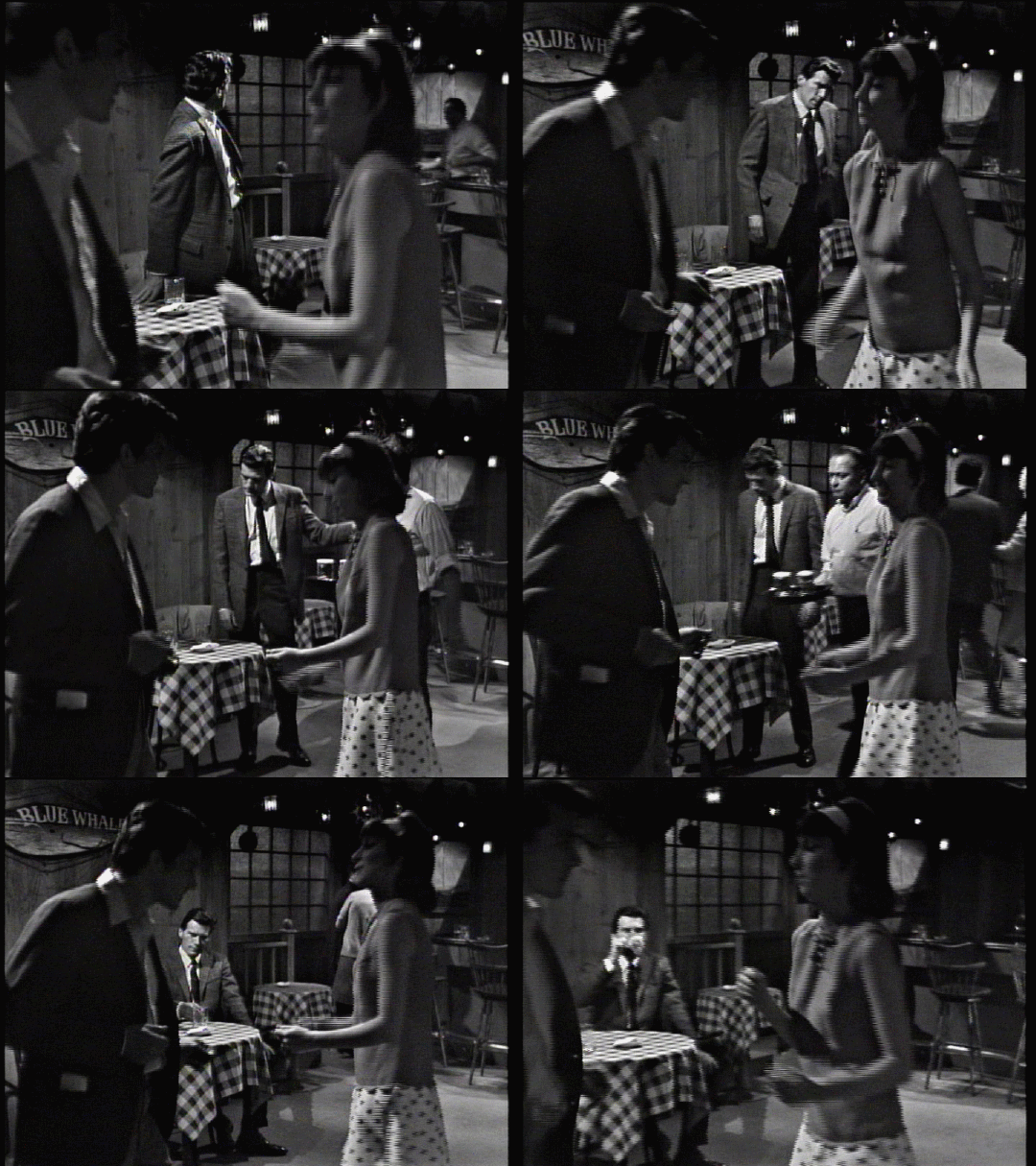
The most important thing about all of these scenes at The Blue Whale is that one of the background players is future movie star Frederic Forrest, making his first screen appearance. He is in quite a few shots. The camera work is ambitious in this one, and Forrest’s face is one of the elements director Lela Swift and the camera operators work hardest to capitalize on. Indeed, after the episode opens with establishing shots of the exteriors of the mansion and the tavern, Forrest’s face is the first thing we see:

The first shot with actors.

As Sam makes his way to the telephone, he has to cut in on the dancing couple. As he does so, Forrest’s face is again emphasized:

Sam finds that the dancing couple is blocking his access to the pay phone
Sam makes his way through the dancing couple

When Roger comes into the tavern, the couple is at first startled to see the biggest snob in town in such a place. When Roger seems uncomfortable, they play it cool. Their body language seen from behind conveys the startle, but it is on Forrest’s face that we see the pretended nonchalance:

Is that Collins of Collinsport!?
We’re being casual.

We catch another glimpse of the couple. Burke has been staring off into space thinking about Roger and Laura while Carolyn struggles to get his attention. He takes a break from that and tries to be charming to Carolyn. As he does so, we see the couple in the background, showing what two people look like when they are actually interested in each other. Forrest keeps moving and changing expressions, while the woman holds a smile. It really is his face that sells the moment:

Frederic Forrest talking to his date

That so much emphasis was placed on a background player who later proved himself to be a remarkably capable screen actor makes it hard not to wonder what might have been. Well-meaning governess Vicki is in the early stages of a relationship with instantly forgettable young lawyer Frank. Conard Fowkes, the actor who played Frank, seems to have been a nice guy and all, but perhaps if Forrest had taken the part the character’s full name wouldn’t have started with “instantly forgettable.”

I think of the goofy sincerity Forrest brought to the part of Chef in Apocalypse Now, and I see the perfect companion to Vicki as she wanders into a world of ever-more bizarre supernatural beings. Vicki always seems very innocent at the beginning of a scene, but quite often in these early months she makes tart little remarks that remind us that she is supposed to have grown up as a street kid in NYC. Forrest would have been ideal to both emphasize Vicki’s sweetness and to set her up to show her incisive side. Maybe it’s just as well that didn’t happen- I suspect that if Forrest had played Frank, the Vicki/ Frank romance might have been popular enough that the show might never have got round to the wild experiments that eventually made it such a hit that it is still available today.

Forrest’s skill at playing quiet men who can explode into fury when provoked would have turned many characters we haven’t met yet into fan favorites. Elsewhere, I’ve mentioned Forrest as the actor who should have played Charles Delaware Tate; I suspect that if I keep this blog up through episode 1245, Forrest’s name will come up in connection with several more.

Also, this is the episode where we first learn that authorities in Phoenix, Arizona have identified a charred corpse as the remains of Laura Collins. Since we have by this time begun to suspect that Laura might be a ghost, or an inhuman impostor, or two separate beings, one of them a ghost and the other an inhuman impostor, this news seems less ridiculous to us than it does to the characters.

For the first months of the show, the set representing the foyer of Collinwood ended a few inches from the front door. When they expanded that, they at first decorated the wall with a metal device resembling a coat of arms. Today, we see a mirror there. Throughout the rest of the interior, portraits of Collins ancestors adorn spaces of comparable prominence. The metal thing looked cheap and silly compared to the portraits. The mirror looks better, serves an obvious practical purpose for the characters, and figures in several of the complicated shots Lela Swift and her crew pull off today. But still, there really ought to be a portrait there.

Indeed, this episode explicitly tells us that portraits are terribly important. Sam takes Roger to his home and shows him a portrait of Laura surrounded by flames that some mysterious force has possessed him to paint. Sam hates the painting, and Roger is appalled by it. So it would seem unlikely to be hung next to the front door of Collinwood, but we might suspect that a portrait will eventually land there that will be associated with some kind of weird power.

Episode 92: It’s hard to believe there was ever any gaiety at Collinwood

The only episode of the series to take place entirely outside of the town of Collinsport and the great house of Collinwood, this one is set in Bangor, Maine.

Well-meaning governess Vicki has gone to that town in search of information about herself. When she asks her employer, reclusive matriarch Liz, even the most basic questions about why she decided to hire her and how she knew she existed, Liz becomes evasive, then flatly and transparently lies to her. Vicki has found an old document in the house that may shed light not only on the matters Liz has already refused to discuss, but even on her questions about her birth family. Sure that Liz won’t give her any information about the document, she decides to take it to Liz’ lawyers, the firm of Garner and Garner.

Vicki meets Garner and Garner. Screenshot by Dark Shadows Before I Die

Lawyers on soap operas don’t always follow the rules that bind their counterparts in our universe, but at least in this episode Garner and Garner are not going to tell Vicki anything their client does not want her to know. Indeed, the Garners are realistic enough to present a problem. One of them is Frank Garner, a young lawyer who is going to date Vicki for a few months. As played by Conard Fowkes, Frank is very much the sort of fellow you would expect to meet in a law office in Bangor, Maine. In this phase Dark Shadows still has some room for low-key stories and naturalistic acting, but no TV series this side of C-SPAN would be able to accommodate a character like Frank.

It’s a shame Frank isn’t more suited to Dark Shadows. The show urgently needs more young men in the cast. At this point, the only male actors between the ages of 11 and 40 they have who have appeared more than once are Joel Crothers as hardworking young fisherman Joe Haskell, Mitch Ryan as dashing action hero Burke Devlin, and Dana Elcar as Sheriff Patterson. Sheriff Patterson is supposed to be older than the 39 year old Elcar, and is coded as an authority figure who is unavailable for dating. So Joe and Burke have to provide the male points on all of the love triangles.

I think Frank could have been saved had he been played by a different actor. However dull the dialogue the writers might give him, he is on screen enough that a sufficiently charismatic performer could have grabbed our attention. And maybe stimulated the imagination of the writers, so that he would have had interesting things to say and do. Harvey Keitel had danced in the background at The Blue Whale in episode 33, and so must have been available for a speaking part on the show. Keitel’s quiet, brooding intensity always convinces an audience that a character who is saying very little is thinking deeply and feeling strongly and planning mighty things. Keitel would have been quite powerful as Frank.

Fowkes brought a light tone to his performance, and that is welcome. Dark Shadows always struggled to maintain a bit of sparkle against the background of a setting so gloomy that in this episode Vicki finds it “hard to believe there was ever any real gaiety at Collinwood.” If that line is meant to raise our hopes that a Vicki-Frank relationship will create a bright new mood, it sets us up for instant disappointment. Frank is cheerful and pleasant enough, but he doesn’t project enough personality to change the feeling even of the shots he is in, let alone of the entire series.

Keitel has never been known for lightness. If you wanted that, you could have turned to another Blue Whale dancer- Frederic Forrest, whom we will see in episode 137. Thinking of the goofy charm that Forrest’s character maintained throughout a movie as heavy as Apocalypse Now it’s easy to imagine a breeze of fresh air running through Dark Shadows. Not only would Forrest himself have been fun to watch as Frank, but he might well have brought out some of the most under-utilized aspects of Vicki’s character. A handful of times in these early months, Vicki is allowed to make jokes, usually in her scenes with strange and troubled boy David. David will not be amused, but the audience can see that Alexandra Moltke Isles is capable of being extremely funny. A relationship between a character played by Forrest and one played by Mrs Isles might have given the writers abundant opportunities to showcase that side of her. A pairing with the earnest, cheerful, but entirely humorless Frank represents a death sentence for Funny Vicki.

Episode 33: The one with Harvey Keitel

At Collinwood, Liz tells Carolyn that David won’t be going away just because he tried to murder his father. “Things will go on just as before.” On the other hand, Carolyn should marry Joe and leave the house, because “You’re the only one of us who can have a sane, happy life.” I suppose we’ve all seen that in real life, someone swinging wildly between deep denial and exaggerated despair. Two forms of learned helplessness, I guess.

At the Blue Whale, Joe is getting well and truly sloshed. Burke joins him at his table, interrupting a conversation between Joe and his whiskey glass. Joe tells Burke that he doesn’t like him, expresses his frustration with Carolyn’s refusal to get married, then goes to Collinwood, roaring drunk, and tells Carolyn, Liz, and Vicki what he thinks of them.

One thing Joe thinks is that Carolyn is doomed to be a spinster. Considering that she’s supposed to be about seventeen, that does call to mind Barnabas’ line to Carolyn in the 2012 Dark Shadows movie, “Fifteen? And no husband?

Marc Masse brings this point out well on his Dark Shadows from the Beginning, and argues that the depiction of Carolyn may be one of the things that sunk the show with young viewers between the end of the first month and the introduction of the vampire:

You have to wonder what kind of impression the character of Carolyn Stoddard would have made to young viewers in 1966. Here she is having grown up in a mansion with forty rooms and her only option in life is to be married off before her eighteenth birthday to a local fisherman, or else face a life of lonely spinsterhood. In that respect, Dark Shadows seems to belong to the sensibilities of previous decades.

This paragraph is part of an in-depth discussion of Dark Shadows’ place on ABC’s schedule, its ratings, the show that preceded it in its time-slot, and Art Wallace’s rather antiquated view of the world. It’s all very informative, highly recommended.

When Joe passes out on the couch, Vicki goes to town. She goes to the Blue Whale, where Burke asks if she’s looking for someone. “I just found him,” she replies. Obviously, she’s talking about Harvey Keitel, who is dancing a few feet away from her.

That Harvey Keitel was once an extra on Dark Shadows is pretty interesting. If he took that job, clearly he would have taken a speaking part. I gave some thought to parts I wish he had taken in comments on Danny Horn’s Dark Shadows Every Day four times: here (on episode 470,) here (on episode 769,) here (on episode 1057,) and here (on episode 1137.)

My usual themes: Gay subtext

In 281 of the posts that follow, I link to comments I made on Danny Horn’s blog, “Dark Shadows Every Day.”

Not all of these comments were absolutely unique. Several times, I picked up on one of Danny’s favorite topics, gay subtext in Dark Shadows. Usually I claimed that there was even more of this in the show than he identified.

Danny writes intricate, deeply considered analyses of episodes 210 through 1245 of Dark Shadows. He does not cover episodes 1-209, and frequently claims that there are many episodes among them he has never seen. He does refer several times to a plot point that stretched across many episodes in those 42 weeks, the story of Roger Collins and his obsessive interest in where Burke Devlin’s pen is. Burke has sworn to expose the nature of his former relationship with Roger, exposure which Roger fears will lead to his disgrace and imprisonment.

Driven by that fear, Roger alternately takes and loses Burke’s pen. He keeps returning to where the pen is, and his obsessive attention to the pen, moving it from one hiding place to another, holding it in his hands, staring at it, shifting it between his coat pocket and his pants pocket, dropping it out of his clothes to a place where people can see it, putting it in darkened corners of his house, burying it in the soil of the grounds of his home, digging it up again to put it in yet another place, leads directly to his arrest. Danny does not appear to find any gay subtext in this, even in the post in which he gives synopses of 21 episodes where Burke’s pen is the main theme. Instead, Burke’s pen is, for him, a symbol of the dangerous boring-ness of the first 42 weeks of the show. For an audience in 1966, watching what was at that point a rather ambitiously literate show and living in a country where Freudianism was enormously influential, I suspect a man obsessed with where another man’s pen is would have seemed likely to be dealing with psychological issues concerning male genitalia, even if he weren’t played by Louis Edmonds.

Though there may not be any posts about the first 209 episodes, the comment threads range over the whole series and over topics far beyond it. So, the Burke/ Roger relationship came up in a thread responding to Danny’s post on episode 1008. In response to that discussion, I wrote the following:

There is a dispute among the characters as to whether Burke or Roger was driving when the car hit Hanson. This hardly matters. It was Burke’s car, and even if he gave the keys to Roger, he would have done so knowing that Roger was as drunk and as unfit to drive as he was. A fact like that wouldn’t necessarily have kept Burke out of jail even if it were known at the time, and ten years later, after witnesses’ memories had faded, physical evidence had been lost, and statutes of limitations had expired, the whole basis of the “Revenge of Burke Devlin” storyline is sheer nonsense.

But let’s look at another question about the identities of the people in that car. The public story is that the three people in it were a pair of lovers and their friend, and that after the collision the lovers broke up and one of them ended up married to the friend. Maybe that’s true- but maybe the lovers were Roger and Burke, and Laura was the friend who was along for the ride. That’s the secret Roger is so desperate to cover up when Burke comes back to town.

It also explains why Burke “investigates” the matter personally, rather than handing it over to the high-priced private investigating firms the show goes out of its way to tell us he is in the habit of retaining. He isn’t trying to uncover established facts about the past- he’s trying to fabricate a new past, in which will stand a different sort of relationship than the one he and Roger actually shared. Perhaps, as a deeply closeted 1960s guy, Devlin has it in mind to remake the past so that he and Roger did not have a sexual relationship at all; by rewriting his history with Roger, he may hope to free himself of his same-sex desires and the threat they pose to his macho identity. Perhaps, at another level of his mind, he wants to free himself, not of his desires, but of that macho identity, and of the social norms and personal inhibitions that keep him from living openly as a gay man. In that way, Burke is the first of Dark Shadows’ would-be time travelers, embarking on a quest to erase a past he cannot tolerate and to replace it with one that will enable him to have a sustainable set of intimate relationships.

This would also explain Burke’s attitude towards other major characters. Carolyn and Laura are nothing to him but weapons to use against Roger and instruments to use in inscribing a new past. His relationship with Vicki doesn’t really get started until there’s no reason for either of them to be on the show anymore; it’s boring for that reason, but if we think of Burke using Vicki as a beard we can find an interest in its very lifelessness.

Moreover, we can connect Burke’s closeted homosexuality to his weirdly feckless efforts against Barnabas. He never figures out what Barnabas is, but he immediately sees what Barnabas is not- that is, he is not trying to be a perfect example of Heterosexual Male, 1960s edition. He responds to Barnabas with undisguised loathing, but not with any real jealousy about his attentions to Vicki. It’s Barnabas’ freedom from convention that he envies. Once we postulate a B/R sexual relationship before the crash that killed Hanson, we can draw a direct line from Burke’s return to town in episode 1 to the night he spent hiding behind a tree near the Old House waiting to see Barnabas come and go in episode 304.

I suppose there might be a reason they chose the name “Burke Devlin” for the character- not only was the actor who played “Burke Devlin” in the film “The Tarnished Angels” Rock Hudson, but that Burke Devlin is involved in a love triangle in which his strongest feelings seem to be for the husband of the woman with whom he is ostensibly involved. That Devlin is at first fascinated by the husband, has a falling-out with him, then turns his attentions to the wife.

Strong as the gay subtext in the whole development of Burke Devlin’s character is, there are other times when it is even closer to the surface. I wrote this about the beginning of the “Leviathans” storyline:

So far, this has been the gayest storyline the show has taken on yet.

In 899, the sailor offers to buy Paul a drink, and Paul shouts “I buy my own drinks!” This isn’t subtext- any man getting that reaction in a bar will know that the other fellow has interpreted his offer as including more than the drink. Paul apologizes and becomes friendly, indicating that he is willing to abandon that interpretation and set aside the hostility that accompanied it.

In this episode, we’re back in the same bar. Barnabas beckons Paul to his table with his index finger. I invite any man who doesn’t think we are intended to read this as a reference to a sexual come-on to try that move on a homophobic tough guy in a bar.

Paul’s face shows his inner struggle as he tries to resist Barnabas’ advances, but he can’t. Barnabas coaxes him into reminiscing about yet another night in the same bar, when a casual encounter with yet another guy led to something that seemed at the time like a little harmless tomfoolery, but that has now grown into a threat to his relationship with his family, his standing in the community, his physical well-being, and everything else.

Indeed, there are moments in the Leviathans story when the gay men in the cast seem to be having a bit of fun with the barely-coded gay themes:

Every time Barnabas addresses Philip as “Philip,” I see a little twinkle in Jonathan Frid’s eyes. By 1969, female impersonators had been imitating Bette Davis’ commands to Leslie Howard in OF HUMAN BONDAGE, where his character’s name is “Philip,” for thirty years. I knew gay men who were still making each other laugh as late as the 1980s by quoting lines beginning “Philip!” If Bernau hadn’t stayed so perfectly in character, I doubt Frid would have been able to keep from a giggling fit that would have brought the house down.

Christopher Bernau’s decision to play an antique dealer using a voice and mannerisms derived from a Jack Benny imitation led many of Danny’s commenters to bring up Bernau’s own sexuality and wonder whether he was simply incapable of staying in the closet. As it sometimes does in discussions of obviously gay actors playing men partnered with women on American TV in this period, The Paul Lynde Show (1972-1973) came up. I had altogether too much to say about this:

The reference to Paul Lynde in the original post reminds me of THE PAUL LYNDE SHOW, a sitcom which aired on ABC in the 1972-1973 season. It’s a fascinating artifact. Lynde’s character has a wife and two daughters. The opening sequence sets the tone- it flashes through several readily identifiable scenario (falling off a bicycle, etc) which end with Lynde falling into one or another kind of trap. Lynde plays each of those little vignettes with the same series of expressions on his face, the first a grim look of deep-seated misery, the last an explosion of panic. Each episode focuses on Lynde’s character stumbling into some kind of excruciatingly awkward situation, suffering through a rapidly escalating series of embarrassments, and finally escaping from it with his dignity annihilated but his wife and daughters feeling sorry for him.

It’s routine for people to cite that show as an example of how clueless the entertainment industry and the public who consumed its products were about gay people in the old days, but it is so plausible a version of what it might have been like for Paul Lynde to have married a woman that can’t imagine it wasn’t intentional on some level. You can read it as an exploration of a gay man and a woman who’ve ended up married to each other for whatever reason, and who have resolved to do what they can to make a marriage work. After all, they like each other, they want their daughters to know where home is, and they have a position to maintain within the community. They show the result as something that’s pretty nearly tolerable for all concerned, but at no point does it look like something great. Lynde’s daily frustrations, confusions, and humiliations are the basis of the comedy, but they could just as easily have been explored in a drama that makes their source explicit. It certainly gives academics interested in Queer Theory a lot to write about.

If the public wasn’t in fact as oblivious to gayness as is sometimes suggested, it would have been even more daring- or more clueless- to cast Christopher Bernau as a married man than you suggest. Especially so considering that he’s supposed to be an antique dealer, an occupation often stereotyped as a province of gay men. His performance in this episode is not as obviously gay as was his performance in episode 890- even if you were in an all-male porn video, it would be a challenge to be as obviously gay as Bernau is in episode 890- but it’s pretty darned flamboyant.

Maybe they had seen so many other gay actors play heterosexual characters convincingly enough that it didn’t occur to them that he would have a problem. Joel Crothers has been mentioned several times, but I would also bring up Louis Edmonds. As Edward Collins, he is perfectly credible in his scenes with Kathryn Leigh Scott’s Kitty Soames. And as Roger in 1966, he was credible both as a slimy guy coming on to Vicki and as the estranged husband of Laura.

The reference at the beginning of the last paragraph above to the late Mr Bernau having “a problem” is rather silly, and I regret it. It hadn’t struck me yet that he was doing a Jack Benny imitation, or that he would have expected a Jack Benny imitation to read in something like the way Jack Benny’s own performances did in his heyday. That the Jack Benny type shifted from an image of a rich, ineffectual man to an image of a gay man, and that Bernau was not thinking in terms of that shift at the end of the 1960s, is itself an interesting topic, far more so than my crude underestimate of Bernau’s acting ability (ability with which I was quite familiar!)

The Leviathans storyline was followed by the 1970 Parallel Time storyline, to which I usually refer as “Meet Another Angelique.” The A-story throughout that segment is an adaptation of Daphne Du Maurier’s Rebecca. I engaged in a bit of imaginary recasting concerning that story:

Daphne du Maurier was bisexual, and a lot of people have written a lot of criticism of REBECCA based on the idea that what drove de Winter to kill his wife was that she was sleeping with women as well as with other men.

I’m skeptical about that interpretation. Maybe du Maurier had planned to put that in the book, but once the story turned out to be about the second Mrs de Winter’s struggle with feelings of inadequacy, the events that actually took place between Rebecca and Maxim during their marriage are relegated to a secondary importance. As for Mrs Danvers, the most important thing about her in the novel is her ambiguity. The second Mrs de Winter is terrified of her, but she would be terrified of anyone. Since she is the narrator, we have no way of knowing what Mrs Danvers is actually thinking or doing.

Of course, Hitchcock and Judith Anderson made Mrs Danvers’ erotic attachment to Rebecca the central theme of the movie. The second Mrs de Winter finds that Maxim has become unavailable to her as soon as they arrived at Manderley. The only powerful emotion she encounters anywhere in her new environment is Mrs Danvers’ passionate attachment to Rebecca. That passion is just one more thing she can’t understand.

Grayson Hall is good as Hoffman, but I wish Clarice Blackburn had played the housekeeper. First, because she joined the cast thinking that Mrs Johnson would be based on Mrs Danvers, so that she had spent a few years preparing for the role. Second, she was in real life partnered with a woman, so it would have been good to see an actual lesbian play a homoerotic-inflected role.

My usual themes: Imaginary Recasting

In 281 of the posts that follow, I link to comments I made on Danny Horn’s blog, “Dark Shadows Every Day.”

Not all of these comments were absolutely unique. One of my most frequent themes was “Imaginary Recasting.” I explain what I mean by this in a comment on Danny’s post for episode 470:

During the slow moments, I recast the show in my head. Harvey Keitel was a background player on the show once, a dancer at the Blue Whale in #33. So I imagine him in Roger Davis’ place. And several Dark Shadows cast members (David Ford, Virginia Vestoff, and Daniel Keyes*) were in the original Broadway cast of 1776. So other members of that cast would have been available for parts on DS. I imagine Howard Da Silva in place of Addison Powell. With those changes, the version of the Jaff Clark**-Dr Lang scenes that plays in my head is quite good!

For the game to be fun enough to keep me going through the dire bits, it has to be plausible to me that the makers of Dark Shadows could actually have landed the actor in question. No doubt Laurence Olivier or Bette Davis or whoever would have been a valuable addition to the cast, but they were so unlikely to take such a part that I can’t make myself believe in the scenario strongly enough to distract from whatever it is I don’t like about what I’m actually watching.

The categories from which I draw imaginary cast members, then, include sometime non-speaking players like Keitel. In that group are also to be found Fredric Forrest, David Groh, Henry Judd Baker, and Susan Sullivan. A second category is people who appeared on the show in speaking parts but only briefly, such as Marsha Mason, Gail Strickland, Cavada Humphrey, Beverly Hope Atkinson, and Philip R. Allen. It’s easy enough to believe that people who accepted small parts on the show would also have taken bigger ones.

There are also several people who appeared on the show in major parts, but not enough for my liking. Among these I often mention Clarice Blackburn, Jerry Lacy, Alexandra Moltke Isles, Virginia Vestoff, and Robert Rodan.

There are also three categories of people who didn’t actually appear on the show, but who might well have. The first of these is the one I mention above, the cast of 1776. In addition to da Silva, I also mention Ken Howard, who was Thomas Jefferson in 1776 and who would have been an interesting choice for Morgan Collins in the dying days of Dark Shadows.

The other two categories each include just one person. If they could get Harvey Keitel and Fredric Forrest to dance in The Blue Whale, surely they could also have landed Robert de Niro to play a speaking role. I’m just as glad they didn’t- had he been cast as Carolyn’s motorcycle-riding boyfriend Buzz, the character might have been a big enough hit they would never have got round to making the spook show we all know and love.

The second one-person category is actors whom we know series creator Dan Curtis wanted to have in particular parts. The one person in that category is Bert Convy, Curtis’ first choice for the part of Barnabas Collins. I am glad Jonathan Frid was cast instead, but I do try to imagine what the show might have been like with Convy. I also try to imagine how Jonathan Frid might have done in Convy’s place as a game show host:

Which raises the further question of how Jonathan Frid would have done as the host of Tattletales. “Ladies, suppose you your fella, you- the two of you! Suppose you went to a kind of, well, a resort, a vacation place. And the beaches- multiple beaches, one of them as it happens a nude beach. A beach of nudeness! Suppose further that it was your choice and only yours- what I mean is, you must choose which beach to visit! The nude, or the other! Don’t give me your answer, you must not! But when I call for it, then, you will tell me which beach you choose!”

*I should also have mentioned Emory Bass and Peter Lombard

**For “Jaff,” read “Jeff,” not that it really helps

Episode 470: Mad Men

In which I say that by imagining Howard da Silva in Addison Powell’s place and Harvey Keitel in Roger Davis’, I was able to sit through the whole Dr Lang/ Jeff scene without throwing up. 

Episode 470: Mad Men