
Three of the residents of the great house of Collinwood in the year 1897 are spinster Judith Collins, her brother, libertine Quentin Collins, and their grandmother, nonagenarian Edith Collins. At the opening of today’s episode, Judith walks in on Quentin strangling Edith in her bed. She tells him to stop it and leave the room. He complies, with a sulk. Edith shakes off her annoyance with Quentin, and she and Judith have a conversation about various matters.
One of Dark Shadows’ signature relationships is that between Bossy Big Sister and Bratty Little Brother. However serious the misconduct Bratty Little Brother commits in his disobedience to Bossy Big Sister, in the end she will cover it up and protect him from its consequences. Nothing at all will happen to Quentin as a result of his attempt on his grandmother’s life; Judith will just continue disapproving of him, as she has always done. Later in the episode, Quentin will remark to his recently arrived and quite mysterious distant cousin Barnabas Collins that Judith “gets carried away by delusions of authority. The fact is, she has no authority whatsoever.” Judith overhears this and objects to it, but Quentin’s presence in the house suffices to prove that her manner is not an expression of authority, but simply childlike role-playing.
Quentin’s motive for his attack on dear old grand-mama was his demand that she tell him the family’s “secret.” Edith has declared that she will pass this secret on only to Edward, who is Judith and Quentin’s eldest sibling. Edward is away, and Edith is terribly afraid she will die before he returns. After Judith shoos Quentin out of Edith’s room, she herself tries to wheedle Edith into telling her the secret. Edith tells Judith she is better off not knowing, but Judith does not seem to be convinced. Quentin has said in so many words that his only desire is to take control of the family’s wealth, and Judith is focused on preventing him from doing that. So we can assume that their frantic eagerness to learn the secret is rooted in the belief that the person who knows it will inherit the estate from Edith.
We see Edward. He is not at Collinwood, or even in the village of Collinsport. If I recall correctly, this is the first time the show has taken us anyplace out of town other than the mental hospital since we visited Phoenix, Arizona in #174, more than two years ago.
Edward is in a train station, impatient and irritable, talking with a young woman whose rigid posture and blank facial expression show that she is exceedingly uncomfortable. Her name is Rachel Drummond, and she is to be the new governess for Edward’s son and daughter. He says that he means for her to use her own judgment in making up their curriculum. Rachel says she will have a clearer idea of what her approach will be once she has met the children and Edward’s wife. Edward freezes, and says that he has no wife. Rachel apologizes for her assumption; he says that she has no need to do that, as he had given her no way of knowing about the situation. In a soft voice, Rachel asks about Mrs Collins’ death; Edward replies that “Mrs Collins no longer exists” and that is all he will be saying about the topic. Rachel asks how she should respond if the children ask about their mother; Edward tells her to say that she is away, nothing more.
Back at Collinwood, a recently arrived visitor named Barnabas Collins comes calling with a gift for Edith. It is a piece of jewelry that he inherited from Naomi Collins, whom he identifies as his great-great-great-grandmother. Judith accompanies him to Edith’s bedroom.
Meanwhile, Edward lets himself and Rachel in the front door. He is carrying their bags and grumbling about the lack of servants. Quentin enters. Edward is shocked that his ne’er-do-well brother has returned to the house from which he was banished a year ago, he hoped forever. He has little to say as Quentin teases him and Rachel, saying that she is too pretty to be either the new governess or Edward’s new wife. He asks if she is Edward’s mistress, angering him and making the already unhappy Rachel quite miserable. She says she is the new governess. Quentin asks if she is married. Edward erupts with “Would it make any difference to you if she were?” In the wake of the painful exchange about Edward’s wife no longer existing, this carries a suggestion that makes Rachel’s position even more difficult. Edward realizes what he has said and falls into a horrified silence.
Edward asks Rachel to excuse him and Quentin while they have a private talk. She has nowhere to go; she has not been shown around the house or told which areas she is free to enter, so all she can do is sit quietly in the foyer. Still, that would appear to be an improvement over the endless cascade of awkward exchanges she has had so far, and so she agrees without protest.
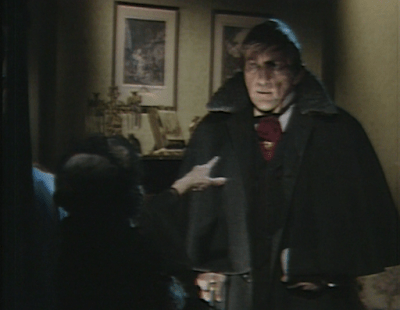
While Edward reads Quentin the Riot Act in the drawing room, Judith shows Barnabas into Edith’s room. The room is darkened so that only the outlines of their figures are visible. Judith opens the curtains to let the moonlight in, and sees Edward’s carriage outside. She hurries down to fetch Edward, leaving Barnabas alone with Edith.
Edith asks his name. When he says that he is called Barnabas Collins, she is startled. She sits up and uneasily asks him to step into the light so she can see his face. She reacts with horror. “You! You are the secret!” she exclaims. “Passed down from one generation to the other! You were never to be let out! We have failed! We have failed!” He approaches her. “Don’t come near me! I know what you are!”
When Dark Shadows premiered, the Collinses of 1966 had three big secrets. Matriarch Elizabeth Collins Stoddard had summoned a young woman who had never heard of her or of Collinwood, Victoria Winters, to be governess to her nephew David. Vicki was trying to find out who her biological parents were and why she was left at a foundling home as an infant; the show hinted heavily that Liz was her mother, but dropped that without any resolution. Also, Liz hadn’t left the house for 18 years. That turned out to be because she thought she killed her husband and that his body was buried in the basement. After 55 weeks of that story, it turned out she hadn’t killed him at all, and within days they forgot about the whole thing forever. The third secret was about Liz’ brother Roger. A man named Burke Devlin thought Roger had framed him on the manslaughter charge that cost him five years in prison, and vowed to destroy the Collinses in revenge. After 40 weeks, Burke forced Roger to confess that his suspicions were correct, but by that time Burke had decided to let bygones be bygones and that story also vanished with barely a trace.
With that record, all the talk about “the secret” that we hear when we first arrive in 1897 might make longtime viewers apprehensive that there will be another interminable guessing game that peters out with little or no resolution. But the show has changed. This secret is not only revealed to us within a week, it is a forceful and elegant solution to a major problem.
Barnabas is a time traveler from the 1960s. He has come back by means of some mumbo-jumbo to prevent Quentin’s ghost from haunting Collinwood and making life impossible for the Collins family in the year 1969. He is also a vampire. He originally lived in the 1790s, and Naomi was his mother, not his great-great-great-grandmother. A would-be thief accidentally freed him to prey on the living in April 1967; he managed to conceal his true nature from his living relatives, and in March 1968 he was freed from the effects of the vampire curse. When he came to this period, he found himself once more an undead abomination.
Barnabas has no idea why Quentin’s ghost has become such a problem in 1969, no idea how to investigate the question, and no idea what, if anything, he will be able to do to correct matters if he somehow does manage to find the answer. Since events are moving very fast in 1897, everyone there is deeply and intricately involved with everyone else, and Barnabas is a stranger, there is a distinct possibility that he will be sidelined. That happened to Vicki when she left November 1967 and found herself in the year 1795; by the time the show returned to contemporary dress four months later, she had been an ineffectual ninny for so long that she had lost the loyalty of the audience, never to regain it. As a vampire, Barnabas could make his way to the center of the story by killing everyone, but that would tend to create a narrative cul-de-sac. So Dark Shadows is taking an enormous risk with its star by putting him in this situation.
When Edith tells Barnabas that he is the secret, at one stroke she puts him at the center of the story, connects the part of the show set in 1897 with that set in 1795, and raises a whole set of questions about how the events of those two periods led to what we have seen in the parts set in the 1960s. She electrifies the audience with the promise of an entirely new kind of show.
She also answers a minor, but potentially nagging question. From #204 on, we saw that Barnabas’ portrait hangs beside the entrance to the great house, and we are repeatedly told that it has been there as long as anyone can remember. The Collinses know that the man who sat for it was a cousin of their direct ancestor, and believe that he left for England in the 1790s, never to return. Why display the portrait of so distant a relative in so prominent a place for so long?
Edith’s recognition of Barnabas tells us why. She has studied the portrait for as long as she has known the secret, and when he comes into the light she can see at once that he is its subject. The portrait was therefore meant to help the keeper of the secret defend the family against Barnabas. It actually had the opposite effect. In 1967 and again on his arrival at the great house this week, Barnabas appealed to his resemblance to the portrait as evidence that he was a descendant of “the original Barnabas Collins,” and so persuaded the living members of the family to let him make his home in the Old House on the estate.
The opening voiceover today is the same we heard yesterday and the day before. I do not believe they had ever replayed an opening voiceover even once prior to this; I’m sure they had never done so twice. This one just tells you that Barnabas has traveled back in time, and it is now 1897. Repeating it doesn’t hurt anything, but I do wonder what they were thinking. Were they considering changing the nature of the voiceover, making them so simple that they could be reused routinely? Or was there some kind of problem, say a technical difficulty with the equipment or an issue with the actors’ contracts, which kept them from recording fresh ones?
 Dark Shadows Commentary