This is the fourth episode credited to writer Ron Sproat. Sproat is making an inventory of the narrative elements available to him, and labeling each one with his plans for it.
In his first episode, #94, Sproat put two of Dark Shadows’ original storylines into a box marked “To Be Discarded.” Those were the quest well-meaning governess Vicki is on to discover her birth family and the relationship between flighty heiress Carolyn and hardworking young fisherman Joe. He put Vicki’s relationship with bland young lawyer Frank and Joe’s with Maggie, The Nicest Girl in Town, into the box marked “For Future Development.”
In #95, he put the whodunit surrounding the death of beloved local man Bill Malloy in the “For Future Development” box. He also noted the idea of a relationship between Vicki and high-born ne’er-do-well Roger Collins as a long-term possibility, depending on the outcome of the Bill Malloy story.
Yesterday, in #98, he reimagined Roger’s son, strange and troubled boy David Collins, not as the frantic and needy victim of his father’s abuse he has been hithertofore, but as an ice-cold sociopath who manipulates the adults around him. If he keeps that personality, David will be able to drive the story for longer periods than he has been able to do so far. We were also reintroduced to a ghost we haven’t heard from in months, suggesting that the supernatural themes will be getting a more detailed treatment.
Today, Sproat continues making his catalog. Dashing action hero Burke Devlin, sworn enemy of the Collins family, is key to the stories Sproat processes this time out. We see most of the events through the eyes of Burke’s secret agent in the great house of Collinwood, housekeeper Mrs Johnson. Using the housekeeper as the point of view character, Sproat suggests that his task in these episodes is primarily one of housekeeping.
In the middle of the episode, we have a couple of scenes about Burke’s attempt to hire staff away from the Collins cannery and fishing fleet. In #89, that attempt set up a visually interesting scene, where a larger than usual group of featured background players gathered in Burke’s hotel room to hear his plans. But the story about them never seemed likely to go anywhere. Today, actor Dolph Sweet appears as the spokesman for the loyal employees who refuse to leave the Collinses. Sweet brings a raw, immediate style to the part that makes a powerful impression. His job today is to drop the story point into the “To Be Discarded” box, and he does it memorably.
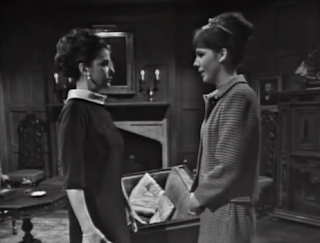
Carolyn has long been obsessed with Burke and jealous of Burke’s interest in Vicki. The episode opens with Carolyn making snide remarks to Vicki about a ride Burke gave her to the town of Bangor, Maine. Vicki, under the impression that a pen she has found is evidence pointing to Burke’s involvement in Bill’s death, tells Carolyn that Burke is the very last man in the world a woman should want to be involved with. Vicki has promised Roger not to mention the pen to anyone, so she can’t explain her feelings to Carolyn.
Vicki and Carolyn discuss Burke while Mrs Johnson listens in the background. Screenshot by Dark Shadows Before I Die.
At the end of the episode, Burke has called Carolyn and made a date with her. Elated, Carolyn apologizes to Vicki and is her best friend again. Vicki tries to talk her out of seeing Burke without mentioning the pen. That effort gives way to a conversation in which Carolyn mentions that Burke gave her a pen, that she gave the pen to Roger, and that Roger lost the pen the night Bill Malloy died. Hearing this and remembering Roger’s behavior when they were alone together in episode 96, Vicki concludes that Roger, not Burke, killed Bill.
These scenes mark Carolyn’s fixation on Burke and her fluctuations between unrestrained hostility and unreserved solicitude towards Vicki as themes that will continue. The ending of course advances the Bill Malloy story, and sets up a conflict between Vicki and Roger.
Well-meaning governess Vicki is in a hotel restaurant in Bangor, Maine. She is waiting for dashing action hero Burke to drive her the 50 miles to her home in the great house of Collinwood.
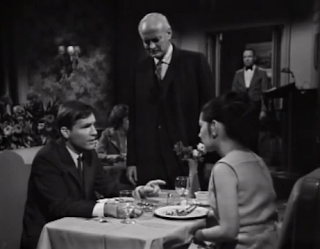
Vicki is sitting at a table with Burke’s lawyer, Mr Blair. Blair takes out a pen to mark up some contracts. Vicki tells him that his pen is identical to one she found on the beach at “a place called Lookout Point.” She had earlier told another lawyer, her new friend Frank, that beloved local man Bill Malloy was killed at Lookout Point. Blair doesn’t know that part of it.
Blair tells Vicki that she must be mistaken- there are only six such pens in the world. He has one, Burke has one, and the other four are in South America. Blair tells her that if she found one, it must be Burke’s. He goes on to say that the pen is very expensive, and that if it is Burke’s he would certainly want it back.
Blair hands Vicki the pen. She examines it. A look of alarm crosses her face. She hurriedly assures Blair that, looking at it close up, she can see that it is nothing like the pen she found.
Burke returns to the table. Blair gives him the contracts to sign. He asks Blair to lend him something to write with, saying “My pen is among the missing.” Focused on the contracts, the men do not notice as Vicki’s look of discomfort intensifies.
Burke asks Vicki if she’s ready to go. She excuses herself to make a telephone call. Unable to reach Frank, she calls Collinwood. High-born ne’er-do-well Roger answers. Vicki asks Roger to come to Bangor to get her. Appalled by the notion, Roger asks why he would ask him to inconvenience himself so seriously. She says she thinks she might be in danger. She explains her theory that the pen she found made its way to Lookout Point when Burke dropped it there while murdering Bill Malloy. Roger tells Vicki to wait for him, and rushes out of the house.
Over a period of several episodes, the sheriff questioned Roger, Burke, and drunken artist Sam Evans about Bill’s death. Roger is firmly outlined as the villain, so we suspect him. There were also a number of moments when the show gave us definite reasons to think Sam might be the culprit. At no point did they dwell on the idea that Burke may be responsible, but it would be an interesting twist.
Bill had told Burke he would find evidence to clear his name in connection with a manslaughter charge that sent him to prison years before, and it has never been clear just what Bill could do to deliver on that promise. Perhaps we will learn that Burke discovered that Bill couldn’t deliver on it, and, succumbing to the violent temper he has displayed many times, he reacted by shoving Bill off Lookout Point to his death in the waters below. For all we know, Vicki’s suspicions might be the first step towards exposing Burke as the killer of Bill Malloy.
It’s true that Roger had Burke’s pen and believes that the pen Vicki found will suggest that he was at Lookout Point. But it could easily be that Burke, who after all gave the pen away very blithely when he was having lunch with flighty heiress Carolyn in the same restaurant where he and Vicki are today, in fact owns another one, that Vicki found that other one, and that Roger lost the pen Burke gave Carolyn somewhere else. Roger’s frantic attempts to hide the pen would incline us to believe that he was at Lookout Point with Bill, but it is precisely that belief that would make the revelation that it was Burke who dropped the pen a twist ending.
The pen itself, as the only piece of physical evidence in a whodunit that has been going for ten weeks and shows no signs of ending, gets a great deal of attention. Dark Shadows fans often lament this, and rightly so. At times, the pen falls into Alfred Hitchcock’s famous category of a “MacGuffin,” the thing that everyone in the story is urgently trying to get hold of. In a 90 minute action movie, just about anything can be a MacGuffin- a cache of diamonds, a secret document, the Maltese Falcon, etc. But when the story goes on for months and it involves a mystery we’re supposed to be trying to solve, the thing people are trying to get their hands on can’t be just anything.
Of course, if we’re watching an inverted mystery where we see the case from the villain’s point of view, there will be excitement any time s/he suddenly realizes s/he left a piece of evidence unconcealed. Some of Roger’s scenes with the pen play this way, but since we didn’t see what happened to Bill Malloy and haven’t been told anything definite, they don’t quite close the loop.
There are two things a piece of evidence has to be if it is to work in the place the story gives to Burke’s pen. First, it has to be a clue that will solve the mystery. Roger’s behavior concerning the pen certainly reinforces our suspicions of him, but it is easy to think of many other ways it could have been left where it was. Even if we leave aside the possibility that it is a duplicate Burke dropped, we have to remember it was several days after Bill’s death that Vicki found the pen. Who knows what sort of creature might have been attracted to its shiny surface, carried it from wherever it was originally left, and deposited on the beach long after Bill was already dead.
Second, and more importantly, the object has to connect one substantive story element to another. The crucial piece of evidence in Dark Shadows’ first mystery story met this requirement. Strange and troubled boy David had tried to kill his father, Roger, by tampering with the brakes on his car. David had trouble getting rid of the bleeder valve, and was eventually caught with it in his possession. We’ve seen David reading a magazine about mechanics and playing with mechanical toys, and have seen Roger refusing to take an interest in machinery. So a piece of hardware in David’s possession reminds us of the estrangement between father and son. Moreover, while Roger is not interested in the workings of his car, he is avidly concerned with it as a marker of his status. Burke envies him that status, and hangs around the car. When Burke comes to be involved in the story of Roger’s crash, the prominence of a piece of the car brings that envy to mind. That the same object represents Roger’s conflicts with David and with Burke associates those conflicts with each other in our minds, and sets us up to expect them to merge, as indeed they do.
Burke’s pen has no such associations. It’s something he shares with Mr Blair, who is barely a character on the show, and with four other men whom we have never seen and whose names we’ve never heard. Neither Burke nor anyone else we’ve seen is a calligrapher, or a writer, or any other person who would come to mind when we hear about pens. So the story doesn’t establish a specific symbolic charge for a pen considered as a pen.
Of course, the show was made in 1966, so there is an inevitable symbolism associated with any cylindrical object. Zach Weinersmith explained this the other day in a Saturday Morning Breakfast Cereal comic:
I think the writers intentionally put their fair share of Freudianism into the scripts, and I can’t imagine Louis Edmonds didn’t expect some in the audience to watch his portrayal of Roger’s panicked obsession with where Burke’s pen is and think in those terms. Indeed, while Weinersmith talks about the period 1890-1970 and singles out the 1930s as a peak, it was in the 1960s, the age of Tennessee Williams, Edward Albee, and Peter Shaffer, that Freudianism peaked in its influence on the New York theater world where the people involved in making Dark Shadows were most at home. So this episode would be a case in point for Weinersmith’s hypothesis.
This is the first episode credited to writer Ron Sproat. Before long, Francis Swann will leave Dark Shadows, and for several months the only credited writers will be Sproat and Malcolm Marmorstein. Marmorstein will write 82 episodes and leave in August of 1967. Sproat will write hundreds and will stay with the show until 1969.
Today’s setup might remind us of the show’s first writer, Art Wallace. It’s shaped like one of Wallace’s diptych episodes, intercutting between two contrasting groups of characters. This time, we cut back and forth between, on the one hand, a dull but pleasant dinner date between well-meaning governess Vicki and instantly forgettable lawyer Frank at a restaurant in Bangor and, on the other hand, an extremely uncomfortable dinner date between hardworking fisherman Joe and flighty heiress Carolyn at the Blue Whale in Collinsport.
In Bangor, Vicki and Frank smile at each other while Vicki tells the sorts of stories she’s been telling all along. Vicki hopes Frank will be able to aid her in her effort to learn the identity of her birth parents, a quest she has been on since episode 1. Frank’s father Richard briefly joins him and Vicki at their table. Amid good wishes for the two of them, Richard delivers a cautionary message about Vicki’s research. Later, he talks privately with Frank. He strongly approves of Vicki as someone to date, but is chary of many aspects of the research Frank has volunteered to do for her.
In Collinsport, Joe and Carolyn are bickering about Carolyn’s obsession with dashing action hero Burke Devlin when Maggie Evans, The Nicest Girl in Town, enters the tavern with her father, drunken artist Sam Evans. Carolyn invites the Evanses to join them at their table. Carolyn eventually starts talking about Burke again, prompting Joe to ask her to dance. Away from the Evanses, Joe tells Carolyn he is tired of her falling bacxk on him when Burke isn’t available. Carolyn storms out. Joe takes her home, then returns to the tavern, and he and Maggie start a conversation they both seem to be enjoying hugely.
By intercutting scenes, Wallace’s diptychs usually achieve a contrast that brings into focus details of the psychology of the characters and their relationships to each other that we might not have thought about had we watched the scenes straight through. In Sproat’s hands, today’s episode doesn’t do that so much as it comments his own position as a new writer joining an established show.
Vicki has learned nothing about her origins since episode 1, and there is no prospect she ever will. In Frank, she has found a potential boyfriend. In the ears of the audience, Richard’s advice to Frank to pursue Vicki energetically but to pursue her inquiries only circumspectly is a recommendation that the show drop an old, unproductive old storyline and to develop a new one.
Carolyn and Joe’s relationship is another story element that has been in place from the beginning and that has not advanced in any way. We have never seen any reason for them to be a couple, and are simply impatient with scenes where they sit around and make each other miserable. Joe recently had a date with Maggie, and it was sweet to watch those two having fun together. So today’s scenes in the Blue Whale make it emphatically clear that the time has come to drop the Carolyn and Joe story and move on to a new phase where Maggie and Joe are together.
Sproat not only makes himself visible in this episode, he also provides mirrors for critics and commentators. When Richard shows up and interrupts the ten thousandth* sad story the audience has heard about the Hammond Foundling Home, Frank and Vicki seem to be having a pleasant enough time with each other. It is possible that viewers who weren’t watching on many of the days when Vicki told those previous stories are having a pleasant enough time with the episode. But on any given day, only so much of your audience will consist of new viewers and people with short-term memory loss. A time will come when you have to move on to something new, and Richard is the in-universe representative of those who would say that time is already upon us.
In the Blue Whale, the Evanses represent the critics. Joe and Carolyn leave the table twice to dance. The first time, they look happy, and Sam tells Maggie that there is no chance of Joe and Carolyn splitting up. Sam is a chronic pessimist. If he makes a prediction, we take it that it would be bad news for that prediction to come true. In this context, to say that Joe will never break it off with Carolyn is to say that the show will never become more interesting. The second time Joe and Carolyn dance, they are obviously giving up on each other. Maggie, almost as much the optimist as her father is a pessimist, gives a little smile. Joe and Carolyn’s quarrel is embarrassing for her to watch, but it’s good news for her that she’s getting a boyfriend, and maybe a storyline. It’s also good news for us that the show is open to exploring fresh topics.
I don’t think that Richard and the Evanses are so much Sproat’s attempt to impose particular readings on the audience as they are the results of his analysis of the reactions thoughtful viewers are likely to have. If so, I have one data point in support of his theory. In their discussion about this episode on their blog Dark Shadows Before I Die, John and Christine Scoleri actually find themselves playing the roles of optimistic and pessimistic critic as Sproat scripted them for the Evanses. Here are John as Maggie and Christine as Sam:
John: Have we finally seen the end of the Joe/Carolyn relationship? Now that it’s clear to Joe that Carolyn only comes running to him when she’s jealous, I think he’s had enough of her. The only offenses on Maggie’s record are the bad blonde wig she started with, and calling Vicki a jerk when they first met. But other than that, she’s far less maintenance than Carolyn, so hopefully the change will do Joe some good, provided his job working for the Collins fishery isn’t in jeopardy…
Christine: It’s a soap opera, so I expect the relationship to go through its death throes before the last gasp. Joe’s a glutton for punishment, so I don’t think it’s over yet.
The Scoleris always do a good job of pretending not to know what’s coming next even when they demonstrably do know. So there is a bit of role-playing to start with. But they are such patient and insightful critics that I don’t think they would just start imitating the characters, certainly not unintentionally. It’s more likely that this exchange represents evidence that Sproat was right about the ways people were likely to read the episode.
*A rough approximation. Could be the twelve thousandth, I haven’t counted.
Each episode of Dark Shadows begins with a voiceover. In this phase of the show, the voiceovers are all narrated by Alexandra Moltke Isles in character as Victoria Winters, well-meaning governess, and are brief passages of almost purely decorative prose, meant only to set a mood and to vanish from the audience’s memory as soon as the action starts. Art Wallace and Francis Swann, the writers credited for the first 97 episodes, were old pros who had been turning out scripts for decades, and were good at staying out of their own way. That’s why I haven’t yet said anything about any of the opening voiceovers- when Wallace or Swann set out to write something forgettable, they succeeded. By the time I started writing, I had no recollection of them whatever.
Today’s opening voiceover is unusually substantive, so much so that it threatens to leave a trace in the audience’s mind:
My name is Victoria Winters. Once again it is quiet in Collinwood. There is no sound but the ticking of the great clock in the entrance hall. And the lonely footsteps of a woman who hasn’t left its grounds in eighteen years. A woman whose life is limited to musty corridors and the endless beat of a grandfather clock. A beat that seems to ignore the vitality of the world around it.
Vicki names herself, names the estate where she lives, talks about how quiet it is, mentions the clock, tells the audience that the lady of the house is a recluse who hasn’t left home in eighteen years, complains about the air quality in the house, brings the clock up again, and assures us that interesting things are happening everywhere except here. It leaves us wondering why Vicki is so hung up on the clock, why she doesn’t run the vacuum cleaner herself, and why, if the entire world surrounding Collinwood is chock full of vitality, they don’t turn the camera in some other direction.
That’s the sort of thing we’re going to get from Wallace and Swann’s immediate successors, Ron Sproat and Malcolm Marmorstein. In writing their opening voiceovers, Sproat and Marmorstein fell between two stools. They didn’t write brief, deliberately forgettable passages as Wallace and Swann had done; nor did they integrate the opening voiceovers into the action of the show, as would happen in later years when the story is moving very fast and the episodes start with detailed recaps of events so far. Instead, Sproat and Marmorstein saw the voiceovers as vehicles for long passages of flowery, over-developed imagery. Those are certainly no more effective at setting a mood than were Wallace and Swann’s brief remarks, but they do both try the patience of the audience and linger as distractions. That’s one of the things that prejudices viewers against the character of Vicki- since so many episodes from the Sproat/ Marmorstein era start with Vicki rambling on about the weather or making vague remarks about “one small boy” or whatever, the first impression she leaves on viewers who start watching with episodes from that period is that of a prattling fool.
While Wallace and Swann are the only writers whose names have appeared in the credits thus far, it is very possible that others not credited contributed additional bits. I may be wrong, but my nose catches a whiff of Marmorstein in these six strange, distracting sentences. The description of the clock while we’re looking at it, the specified number of years since reclusive matriarch Liz has left the estate, the evocation of the “musty corridors,” the yearning glance at the eventful world outside, are all typical of Marmorstein’s attempts to turn the voiceovers into freestanding dramatic monologues, but without identifiable characters or plot development.
Today’s episode doesn’t shed much light on Vicki’s relationship to the clock or on the standards of cleanliness in the great house of Collinwood. Instead, it’s a kaleidoscope episode, in which each change of scene varies the combination of characters who interact on each set. The action plays out on two sets this time, the foyer/ drawing room representing the downstairs of the great house, and the Blue Whale tavern, representing the low and bustling life of the village. Because the sets typify the “musty corridors” inside the house and the “vitality of the world around it,” the episode is also a diptych of sorts- not Art Wallace’s usual diptych contrasting two pairs of people, but a diptych contrasting two places and the attitudes those places inspire in the people who spend time in them.
The five pieces tumbling about in today’s kaleidoscope are reclusive matriarch Liz, tightly-wound handyman Matthew, flighty heiress Carolyn, hardworking young fisherman Joe, and Maggie, the nicest girl in town. The regular bartender at the Blue Whale gets a fair bit of screen time as well. In the first 63 episodes, he’s answered to names including “Joe,” Andy,” “Mike,” and “Punchy.” Today, Joe the fisherman calls the bartender “Punchy,” a name he called him most recently in episode 56, the same episode where drunken artist Sam calls him “Mike.” Maybe we’re supposed to think that the young men know the bartender as “Punchy,” the older men as “Mike.” Eventually the show settles on the name “Bob” for him, perhaps because the performer’s name was Bob O’Connell. In one episode (#319,) Sam calls him “Ba-ba-roony,” giving rise to the idea that his name is Bob Rooney.
Liz appears only at Collinwood, of course; Joe and the bartender appear only in the bar. The others migrate back and forth between the two sets. We first see Carolyn with Joe in the bar, talking about what a flop their date has been and how pointless their whole relationship is. Maggie interrupts this thrilling conversation, looking for her father, Sam the drunken artist. After puzzling Carolyn and Joe with a number of cryptic remarks, Maggie gives up looking for her father and goes to Collinwood to look for high-born ne’er-do-well Roger. Roger isn’t home, so she winds up talking to Liz. This is the 63rd episode, and it’s the first time we’ve seen these two major characters together.
We first see Matthew in Collinwood, telling Liz how much he wants to help her. He then goes to the bar, where Carolyn and Joe see him. Matthew is looking for dashing action hero Burke Devlin, whom he hates. He implies to Carolyn and Joe that Burke is to blame for the death of beloved local man Bill Malloy. Joe doesn’t like Burke any more than Matthew does. The instant he hears Matthew’s idea, he is all in on it. Carolyn resists the suggestion.
Carolyn goes home to Collinwood. Maggie has explained to Liz that Burke has been saying terrible things about her father, that she can’t find her father to ask him about Burke’s allegations, and that Roger might know something about them. Liz urges Maggie to believe in her father, and to regard Burke as a dangerous, unscrupulous man capable of many dark deeds. Hearing the last part of this, Carolyn asks her mother if she believes that Burke is capable of murder. Yes, Liz says, she does believe that he is capable of that.




 Dark Shadows Commentary