
Know Yourself
In yesterday’s episode, Kitty Soames, the dowager countess of Hampshire, found a note on the dresser in the room where she has been staying in the great house of Collinwood. It read “Know yourself, be who you must be.” The dramatic date is 1897, 1504 years after the Delphic oracle went out of business, so it is unlikely that its management sent the message as a translation of and commentary on their motto γνῶθι σεαυτόν.* It was also 83 years before the US Army adopted the slogan “Be all you can be,” so we can rule out the idea that a recruiting sergeant was trying to get Kitty to enlist. The US Army didn’t even accept countesses in those days, not even if, like Kitty, they originally came from Pennsylvania and are now in Maine.
Ever since she arrived at Collinwood in #844, the ghost of the gracious Josette has been taking possession of Kitty from time to time. The note prompts another spell of Josettification. Kitty puts on Josette’s wedding dress and wraps a red cloak around it. She mutters that “He is waiting for me,” not specifying who “he” is. She goes to the top of Widows’ Hill, the precipice from which Josette flung herself to her death a century before.
Josette was married to Jeremiah Collins. Jeremiah’s ghost appears to Kitty/ Josette. He urges her to leave Collinwood at once, lest “he” kill her. By this time the possession has worn off, and Kitty has no more idea who Jeremiah means by “he” than anyone overhearing her earlier would have known who Kitty/ Josette meant when she said that “he” was waiting for her.

Be on Guard Against Your Enemies**
Jeremiah vanishes, and Kitty is joined by a man she believes to be Count Petofi, the sorcerer who drove her husband to suicide. She fears Petofi and hates him, and is unhappy to find herself standing next to him at the top of a cliff, especially when she is in a confused frame of mind.
In fact, the man is not Petofi. Two weeks ago, Petofi used magic to force the devastatingly handsome Quentin Collins to change bodies with him. Now Petofi occupies Quentin’s strong young form, while Quentin is trapped in Petofi’s aging and feeble one. While this predicament lasts, I refer to Quentin as played by Thayer David as P-Quentin, and Petofi as played by David Selby as Q-Petofi.
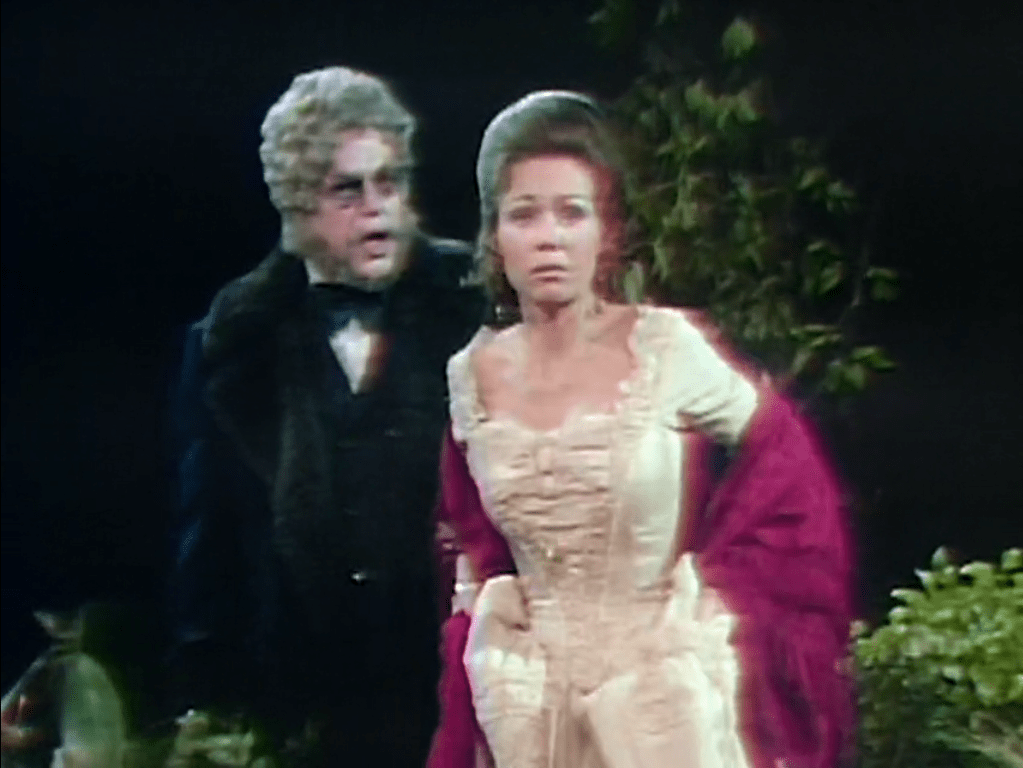
P-Quentin tells Kitty that he saw Jeremiah’s ghost and assures her he did not cause it to appear. He tells her he is going to Collinwood, and firmly recommends she accompany him. She waits a moment, but seeing no alternative, she goes his way.
Do Not Fight an Absent Foe***
When P-Quentin first found himself estranged from his own body and encased in Petofi’s, he was too stunned to show much tactical sense. He went around blurting out what had happened, earning nothing but a reputation as a lunatic. Now he has learned to let people believe he is Petofi and to conduct himself as befits that role. So yesterday, he found that his sister, Judith Collins Trask, had returned to the house after a long absence. She had not met Petofi, so he introduced himself to her by that name and used his memories of their childhood to befriend her.
Back at Collinwood, P-Quentin enters the drawing room and tells Judith that Kitty is resting comfortably upstairs. Judith is impressed with his thoughtfulness, and leaves him alone in the drawing room while she goes to Kitty’s room. He sees that she is preparing a note for her attorney, Evan Hanley. It occurs to him that Evan can be of use to him, and he sets out for his house.
Give the Advice the Time Calls For ****
P-Quentin knocks on Evan’s door. Evan never met Petofi, and does not recognize him. He and Quentin were for a long time close friends and fellow Satanists, and when he identifies himself as Quentin he does not gain credence. He pushes his way in, and eventually persuades Evan to take him seriously. Evan agrees to go to Collinwood and see if the man who appears to be Quentin knows him, and, if he does not do so, to trick him into participating in a ceremony to reverse the body-swap.
Judith comes. While P-Quentin hides on the terrace, she tells Evan that she wants to revoke the power of attorney she granted to her husband, the odious Gregory Trask, while she was away. Evan makes excuses, but she insists, and he agrees to follow her directions. She exits.
P-Quentin returns, and tells him that if he has involved himself with Trask’s evil schemes, it is time for him to disentangle himself from them.
Act Like a Stranger, If You Are One*****
Back at Collinwood, Q-Petofi opens the drawing room door and sees Judith. Petofi never met Judith, and Quentin has not seen her since she left more than thirteen weeks ago. Not knowing who she is, Q-Petofi simply apologizes, says he didn’t know anyone was in there, and leaves. Thinking he is her brother, Judith is of course indignant.

Judith goes to the foyer and says she expected a warmer greeting. Not having the faintest idea who she is, the best Q-Petofi can manage is “Welcome to Collinwood.” When she protests that even their rather distant brother-sister relationship entitles her to expect better than that, the light comes to him and he calls her by name. This does not appease her.
There is a knock at the front door. Judith is enraged to see Q-Petofi standing still, and orders him to answer it. He does, and lets Evan in. When he does not speak to his old friend, Judith demands to know if he doesn’t recognize Evan either. Q-Petofi pretends to know him, and is powerless to do anything but agree when Evan asks him if he remembers the meeting at his house tonight.
Q-Petofi had been cruising along unchallenged so far. How could he not, when the secret he is concealing is so bizarre? But his interaction with Judith, though it has not exposed his identity, has antagonized someone whose support would be useful to him, and now Evan knows that P-Quentin was telling him the truth.
Know Your Chance ******
Q-Petofi shows up at Evan’s. After some verbal jousting, Evan tells Q-Petofi to take a seat with his back to the room. He says that he has been chosen to preside over the festivities. P-Quentin sneaks up and chloroforms him. Evan says that he doesn’t know how long the chloroform will last, so they must proceed with the ceremony at once.
Honor Good Men *******
When Jeremiah’s ghost fades away, we see Timothy Gordon for the last time. Gordon was a frequent stand-in and background player starting in July 1966. His right hand, which he extends to Kitty in the screenshot above, was the hand that shot out of the coffin Willie Loomis was trying to plunder in #210. In mischievous moments, I think that makes him “Barnabas Collins #1,” in imdb terms. Then again, Jonathan Frid had posed for the face of the portrait of Barnabas some weeks before, and producer Robert Costello modeled for the portrait’s body before that. Many of his fellow extras went on to big careers, but Gordon’s turn as Jeremiah’s ghost made him the only performer to graduate from background player to credited member of the main cast of Dark Shadows. So I think of him as their representative.
*Greek for “Know yourself,” one of 150 maxims inscribed in the walls at the oracle. Γνῶθι σεαυτόν (gnōthi seauton) was one of two inscribed at the entrance, the other being Μηδεν ἄγαν (mēden agan,) “nothing in excess.” The maxims are preserved in a book by a fifth century CE author named Stobaeus; many of them appear on stones that archaeologists have found at Delphi. There’s a handy list of them on Wikipedia, pairing the Greek with some more or less OK translations. The eighth maxim on Stobaeus’ list is Σαυτον ἴσθι (sauton isthi,) “Be who you are,” which sounds a bit like the second half of the note on Kitty’s dresser.
**Stobaeus’ twenty-ninth maxim is Ἐχθρους ἀμύνου (ekhthrous amynou,) “Be on guard against your enemies.”
***Stobaeus’ 125th maxim is Ἀπόντι μὴ μάχου (aponti mē makhou,) “Do not wage a battle against one who is absent.”
****Stobaeus’ 103rd maxim is Βουλεύου χρόνῳ (bouleuou kronoi,) “Give the advice right for the time.”
*****Stobaeus’ twelfth maxim is Ξένος ὢν ἴσθι (xenos ōn isthi,) which we would translate word for word as “Stranger being, be.” The idiom plays on two senses of the verb εἰμί- the participle ὢν means “If you in fact are,” while the imperative ἴσθι is “assume the character of.” It is the same kind of play on words that you see in the word “like” in the English sentence “Time flies like an arrow, but fruit flies like a banana.”
******Stobaeus’ tenth maxim is Καιρον γνῶθι (kairon gnōthi,) “Know the proper time.”
*******Stobaeus’ sixty fifth maxim is Ἀγαθους τίμα (agathous tima,) “Give honors to the good.”
 Dark Shadows Commentary