
Two of the best blogs about Dark Shadows share the same web address. One is Dark Shadows Every Day, a series of more than a thousand well-crafted, insightful, often hilarious essays by Danny Horn about episodes #210 through #1245 and related topics. The other is the group blog that Danny’s readers maintain in the comment threads under each of his posts. The commenters outdid themselves in their remarks on Danny’s post about this episode.
At the beginning of the episode, addled quack Dr Woodard has figured out that the two victims of vampire Barnabas Collins, sorely bedraggled blood thrall Willie Loomis and missing local girl Maggie Evans, have something in common. He hopes that if he can compare a sample of Willie’s blood with Maggie’s he will figure out what that is. Willie is terrified that this will lead to the exposure of Barnabas. Puzzlingly, Barnabas is unworried and orders Willie to cooperate. Only after Willie has given the blood and the doctor has left do we learn that Barnabas switched Willie’s sample with a normal one. “DS Willie” comments:
Barnabas is seriously messing with Willie’s mind in this one. So much of what Barnabas says has double meanings, even triple. Of course he’s playing with Woodard too, but Woodard never realizes it.
For one thing, just after Willie’s blood is taken, Barnabas makes creepy blood comments, ending with “…surrendering your utmost self” and his next line “Now, you had no choice.” I suspect this is all meant more for Willie than for the doctor. Willie had no choice but to surrender his utmost self.
Barnabas delights in repeatedly demonstrating his control over Willie, all to the doctor’s approval. When Willie flares up momentarily at Dr. Woodard’s remark about understanding being frightened, Barnabas immediately brings Willie to heel with a harsh word and harsher look.
Later Barnabas jerks Willie’s chain some more, just because he can, and to tighten his control even more. It’s classic Stockholm syndrome type stuff. The victim is abused and in absolute fear for his life, and yet any lessening of the captor’s threats or violence can be perceived as mercy, bonding the victim to his captor.
His shirt in Barnabas’ menacing grasp, Willie swears he would never, never betray Barnabas. He is only thrown to the ground instead of being choked or beaten. Barnabas proceeds to make Willie feel stupid and disloyal and dishonorable and undeserving of future protection. Add enthrallment on top of that. Oh, and the police having Willie as their top suspect, and Jason having beaten and threatened to kill Willie, even though Willie was trying to protect him.
It is actually pretty amazing that Willie has held up under the strain. He is in full-on survival mode, and yet still has the decency to try to shield Maggie and others insofar as he can, given his powerlessness.
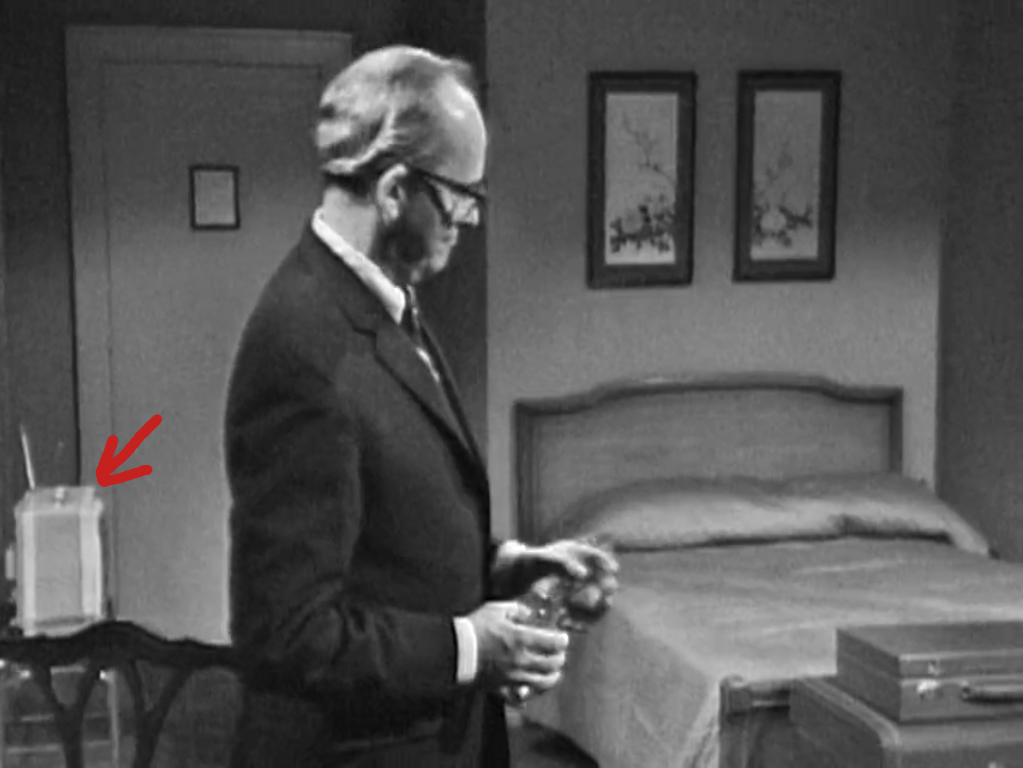
Hey, what was up with Barnabas saying Willie’s blood is a “delicate little flower painted on glass”? He says it twice (once to Woodard and once to Willie) while looking directly at the slide. That doesn’t come across as a remark about blood in general.
“DS Willie,” on Dark Shadows Every Day, 13 October 2018 at 12:38 AM Pacific time
He adds another comment:
Oh. Barnabas was using yet another method to get Willie under his thumb: verbally emasculating him with the “delicate little flower” reference to Willie’s blood on the slide. But I think Willie was so relieved that he missed the diss.
“DS Willie,” on Dark Shadows Every Day, 26 December 2018 at 5:57 PM Pacific time
I made a contribution of my own to the thread. In response to Danny’s unfavorable comparison of Dr Woodard with Bram Stoker’s Professor Van Helsing, I commented:

I don’t think Woodard is Van Helsing at all. He’s Dr John Seward, treating Lucy and Renfield and baffled by the whole thing until he calls in his brilliant old professor. The mysterious Hoffman, one of the best men in the field, that’s the expert who is going to shake things up.
Seward is young, dynamic, and ready for adventure, while Woodard is middle aged, pudgy, and ready for an afternoon tee-time at the local country club. But that change is necessary. Readers of the novel have plenty of time to think about the sort of group that might go on the expedition Van Helsing organizes, and will expect a bunch of high-spirited youths. On a soap, a character like Seward would be the heroine’s new love interest, and Dark Shadows is flailing about trying to figure out what to do with the love interests Vicki and Maggie have now. The last thing they want right now is another bold, handsome young man who is apparently under a vow of celibacy.
“Acilius,” on Dark Shadows Every Day, 19 May 2023 at 7:26 PM Pacific time
In response to Danny’s remark that Jonathan Frid’s bobbles make it hard to guess what lines the script originally gave vampire Barnabas Collins, commenter “TD” replies:
#1. “Now, in a way, isn’t that understandable?
#2. “After all, blood is the life force.
#3. “It reaches into the deepest recesses of both the heart, and the brain.
#4. “It is the familiar of our complete being.
#5. “To surrender even one drop of it is to suggest a partial surrender of one’s utmost self.”
I’m not so sure this is actual Fridspeak. Yes, it’s kind of gibberishy, but it does make grammatical sense and some sort of syntactical sense. Frid delivers it smoothly and with confidence, unlike his halting fumblings when he can’t remember his lines. When he says this, it’s in a close-up shot, and he’s looking down. My guess is that he is reading it directly from a script. Also, this is Joe Caldwell’s first script (or first credited script–he did some writing on earlier Ron Sproat scripts, if another website is accurate). Maybe this is Caldwell exhibiting the enthusiasm of a first solo outing. Dr. Woodard has a couple of hi-falutin’ and rhetorically “poetic” (and gibberishy) speeches of his own in this episode.
Also, might this episode be marked as the first one to demonstrate the “reluctant” or “sympathetic” vampire in Barnabas’s character? In this episode (in another speechy series of lines), when Dr. Woodard and Barnabas are discussing the “madman” who broke into Woodard’s office and stole the blood sample, we get this exchange:
Dr. Woodard: You know, it’s the peculiar magnificence of the human spirit that’s required to provide the potential for such corruption. [See? This is like the Barnabas “blood is the life force” speech–who talks like this???]
“TD” on Dark Shadows Every Day, 2 June 2017 at 11:06 AM Pacific time
Barnabas: Yes, I know what you mean. Whoever he is, he must certainly be, at one and the same time, more than a man…and less than a man.
Dr. Woodard: You seem almost sorry for him.
Barnabas: Sorry? No, I’m not sorry. The truth is, I loathe him. I loathe him very, very deeply.
I agree with “TD” that today’s dialogue is marred by purple passages; I would go so far as to say that none of the lines would have survived a rewrite. Not among the lines delivered by the human actors, anyway- our beagle was fascinated when the hound howled on the soundtrack.
I should mention that at least one perceptive critic of Dark Shadows disagrees with me and “TD” about the script. Patrick McCray’s Dark Shadows Daybook is in its own way the equal of the two blogs at Dark Shadows Every Day. Patrick wrote two posts about this episode. In one from 2016, he wrote that “The language is poetic and evocative. Barnabas has moments of self-loathing and ambiguity that are gorgeously, hauntingly phrased, and the same can be said for Woodard’s exploration of science and mystery.” In 2019, he went so far as to call it “the best written episode of the series.”
John and Christine Scoleri also include some interesting material in the post about this episode on their recap-heavy blog Dark Shadows Before I Die. I particularly liked the series of screenshots at the end of the post captioned with some of the purple prose from today’s dialogue.
 Dark Shadows Commentary