
In June 1967, vampire Barnabas Collins locked his victim Maggie Evans, The Nicest Girl in Town, in the prison cell in the basement of the Old House on the estate of Collinwood. The ghost of Barnabas’ little sister Sarah appeared to Maggie several times while she was in the cell. Sarah told Maggie that no one could know she had been to the cell, and particularly warned her not to tell her “big brother” she had seen her. With some reluctance, Sarah eventually gave Maggie a clue that led her to a hidden passage. Sarah’s father had sworn her to secrecy about the passage, and that not even her big brother knew about it. Maggie finally puzzled out the clue, enabling her to escape just moments before Barnabas came to the cell with the intention of killing her. When Barnabas chased Maggie through the hidden passage in #260, the wondering expression on his face confirmed that he had never had any idea the passage was there.
From November 1967 to March 1968, Dark Shadows was a costume drama set in the years 1795 and 1796, the period when Barnabas and Sarah were living beings and the Old House was their home. We saw how cruelly their father, haughty overlord Joshua, treated his indentured servant Ben, and we saw that Joshua had the great house of Collinwood built with a prison cell in its basement. Joshua confined Ben to that cell in #401. With that, we could be sure that Maggie’s cell was already in the basement of the Old House when Barnabas and Sarah lived there, and could surmise that Joshua really did forbid the living Sarah to share with Barnabas or anyone else what she had found about the hidden passage.
The show never explained how Sarah found out about the passage. We might imagine her hiding and watching Joshua or someone else do maintenance on the cell. But the fact that Joshua kept the existence of the escape hatch from Barnabas suggests he wanted the option of locking his son in the cell. Why not his daughter as well? Perhaps Sarah found the passage while confined in the cell herself. Or perhaps some other, older ghost appeared to her while she was there and told her about it. That the clue she gives Maggie is in the form of a rhyme (“One, two, away they flew…”) would suggest this latter possibility. Sarah may have memorized the rhyme as she memorized the lyrics to “London Bridge” and may have solved the riddle as Maggie solves it.
Shortly after Dark Shadows came back to a contemporary setting in March 1968, Barnabas was cured of vampirism. That cure was stabilized in May, when he donated some of his “life force” to the creation of Frankenstein’s monster Adam in an experiment completed by his friend, mad scientist Julia Hoffman. Barnabas and Julia locked Adam up in the basement prison cell for the first weeks of his life. Vampires and mad scientists are metaphors for selfishness, so it is hardly surprising that they are horribly bad parents. But if Joshua was in the habit of locking his children in that same cell, the moments when Barnabas takes fatherly pride in the imprisoned Adam take on a special pathos. It really does seem like a normal situation to him.
Adam escaped from the cell in #500, demolishing the doorway in the process. Today we see that it has been rebuilt. Perhaps to Barnabas, a house just isn’t a home unless it has a prison cell in the basement.
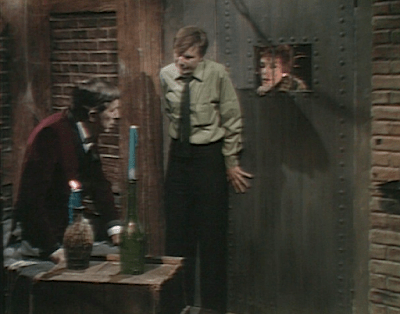
Now, Barnabas has himself become the blood thrall of a vampire, his ex-wife Angelique. Discovering the bite marks, Julia decides to address the situation by locking Barnabas and his servant Willie in the cell. Barnabas won’t be able to get out to heed Angelique’s summons, and Willie hangs a cross over the door to keep her from materializing inside it.
We cut to Maggie’s house. Maggie’s memory of her ordeal as Barnabas’ victim has been wiped from her mind a couple of times. She receives a visitor, the suave Nicholas Blair. Unknown to Maggie, Nicholas is a warlock and Angelique’s master. He has a crush on Maggie which has distracted him from his managerial responsibilities, which to be frank he had not been handling very diligently in the first place. Maggie gives Nicholas several pieces of news that he really ought to have been aware of for some time. She tells him that her ex-fiancé, Joe Haskell, is still alive; that she visited Joe twice while he was at the Old House recovering from some injuries; that Joe is now in the hospital under police guard; and that Joe tried to kill Barnabas and keeps vowing that he will try again, since he believes Barnabas is trying to kill him. Nicholas is flummoxed by all of this, and meekly goes along when Maggie insists on visiting the Old House to pay a call on dear, sweet Barnabas.
The scene in Maggie’s house has an odd feature. We’ve just had a closeup of Willie hanging a cross above the door in the cell to keep Angelique away. In the early days of the vampire storyline, it was not at all clear that the cross would deter vampires in the world of Dark Shadows, since Barnabas was often seen strolling comfortably through a cemetery where half the grave markers were cross-shaped. It was not until #450, during the 1790s flashback, that we saw Barnabas recoil from a cross. In #523, we learned that the cross also immobilizes Nicholas. Yet Maggie is today wearing a dress the front of which is dominated by a red cross, and it doesn’t bother Nicholas a bit. The show is drifting into a spot where it may have to stop and spend time explaining its theurgy. Does the cross only work against a demonic creature if it is specifically aimed at that creature? Or if the person setting it up knows about the creature? Or is there some other qualification? It’s getting confusing.
At the Old House, Julia tells Maggie and Nicholas that they cannot see Barnabas, because he is resting. Maggie keeps insisting, and Julia shifts her ground, claiming that Barnabas went out, she knows not where. When Julia says this, Maggie is incredulous, but Nicholas brightens. Evidently he wants to believe that Barnabas has gone off to respond to Angelique’s call, and accepts Julia’s statement happily. Maggie apologizes for demanding to see Barnabas, and she and Nicholas leave.
Meanwhile, Barnabas is scheming to get out of the cell. While Willie is complying with his request to pour a glass of water, Barnabas bashes him on the head with an empty bottle. He then goes to the hatch for the secret panel, remembers that “Maggie found it a long time ago!” and figures out how to open it. Since we saw Willie open the hatch and show Adam Barnabas’ jewel box in #494, you would think Barnabas already knew how it worked. At that time, it also seemed that the passage behind the hatch had been sealed up, so that it no longer led to the beach. Apparently we aren’t supposed to remember that. Barnabas crawls out and closes the hatch behind him before Julia comes back.
As Barnabas, Jonathan Frid usually moves in the stateliest possible manner. When he escapes from the cell today, the camera lingers on him crawling, driving home the contrast with his typical gait. That is quite different from what we saw in #260, when he followed Maggie into the hatch- then, we saw him move toward the opening, but cut away before he had to take an ungainly position. Today, the makers of the show want us to hold the image of a crawling Barnabas in our minds.
Crawling suggests Barnabas’ weakness under Angelique’s power, certainly, but in this setting it suggests more. This is the house where he was born, and what he is crawling into is a lightless passage that it looks like he will have to squeeze through to emerge outside. He has regressed not only to infancy, but all the way back to birth. If Joshua did indeed confine him to this cell in his childhood, Barnabas would likely have experienced that same regression in those days as well.
The sign of the cross reminds us of one who said that we must be born again to receive a life in which our hopes will be fulfilled more abundantly than we can ask or imagine; Barnabas labored for 172 years under a curse that compelled him to die at every dawn and revive at every sunset, but perhaps even before that he was the prisoner of a cycle of abuse that forced him to experience the trauma of birth over and again, each time finding himself in the same narrow space, a stranger to all hope. Indeed, when Barnabas first became a vampire in the 1790s, he put his coffin in this basement, near the cell, and he persisted in putting it there even after it became obvious that it was very likely to be discovered. That persistence made no logical sense in terms of Barnabas’ need for operational security, but if he saw his vampirism as a continuation of his childhood experience of confinement in the basement cell, it would make all the sense in the world. That is his place, that is where he belongs, that is his reality.
 Dark Shadows Commentary