
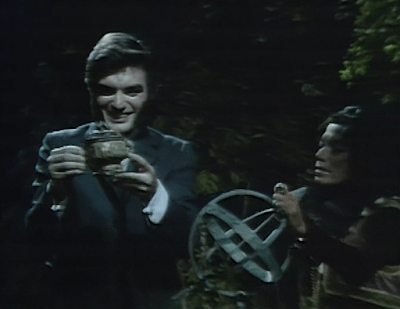
In this episode, libertine Quentin Collins teams up with broad ethnic stereotype Magda Rákóczi to find an Egyptian urn belonging to Quentin’s enemy, undead blonde fire witch Laura Murdoch Collins. Quentin has learned that the urn contains a magic fire, and that if the fire goes out Laura will die.
Quentin and Magda find the urn hidden under an armillary sphere near the gazebo on the grounds of the estate of Collinwood. Quentin takes the lid off the sphere, and the flame jumps out. He then takes some sand from a decorative pot near the gazebo and starts heaping it on the flame. If the flame keeps burning when the lid is on the urn, you’d think only magic could put it out. Then again, it is Collinwood- maybe they have magic sand around. The flame does fade from view, and we cut to a scene of Laura losing her strength.
In a movie that runs two hours or less, the characters can be frantically absorbed in a search for any old thing. Alfred Hitchcock famously made that point when he called the objects of these searches “MacGuffins.”
But when a show that fills a thirty minute time slot five days a week and a storyline can stretch on for months, a MacGuffin has to represent something important about a character or a relationship between characters. So when, in the early days of the show, strange and troubled boy David Collins tried to kill his father Roger by sabotaging his car, it was fitting that the resulting plot spent a lot of time on the bleeder valve David removed from the car’s braking system. David is interested in mechanical work, and in his hostility to his son Roger refuses to share that interest or do anything to support it.
It was less successful when Roger was suspected of murder and the piece of evidence he spent several weeks obsessing over was a filigreed fountain pen belonging to his friend-turned-nemesis Burke Devlin. There was some obvious sexual symbolism in the question of where Burke’s pen is, and that symbolism did focus our attention on the question of what exactly Burke and Roger’s relationship was like before they turned against each other. Had writers Art Wallace and Francis Swann stayed with the show, they might have used that question to make the pen a powerfully evocative image. But Ron Sproat and Malcolm Marmorstein took over the writing duties as the fountain pen story was getting started. Sproat was gay himself, and perhaps for that reason made a point of avoiding any suggestion of homoeroticism in his work. Marmorstein was just clueless. In their hands, the pen was just a pen, and the 21 episodes devoted to the search for it were not among the great artistic achievements in the history of television.
The urn does remind us that Laura is supposed to have a mystical connection to Egypt, which is more meaning than Sproat dared or Marmorstein could attach to Burke’s pen. But her relationship to that country is not central to anything we see, as David’s relationship to his father was central to what we saw in the early days. So as metonymy for Laura and Egypt it is marginally more exciting than the pen was as a metonymy for Roger and Burke, but significantly less exciting than was the bleeder valve as a metonymy for David and Roger.
At the beginning of the episode, we have one of the most preposterously bad special effects we’ve seen so far, which is saying a lot. Teacher Tim Shaw is rescuing Laura’s daughter Nora from a burning school building. The school as seen in the green screen is hilariously unconvincing.

 Dark Shadows Commentary