
In the middle of The Odyssey, Odysseus and his companions enter a certain cave and follow a path that leads to the realm of the dead. There, Odysseus talks with several people whom he knew when they were alive, then comes back to the upper world. This passage, known in Greek as the νέκυια (nekyia,) led many subsequent epic poets to include journeys to and from the Underworld in their works. In the Aeneid, his Latin language response to the Iliad and the Odyssey, Vergil put Aeneas’ voyage to the Underworld in the same halfway spot where the nekyia stands in the Odyssey. The words of warning the Cumaean Sibyl speaks when she gives Aeneas directions to reach the Underworld by way of a path leading through the crater in Mount Avernus are quite famous:
Facilis descensus Averno:
Noctes atque dies patet atri ianua Ditis;
Sed revocare gradum superasque evadere ad auras,
Hoc opus, hic labor est.
The road down through Avernus is easy.
The doors of dark Dis lie open by day and by night.
But to reverse your stride and escape to the air above,
This is the achievement, this is the feat.
(Vergil, Aeneid 6:126-129, my translation.)
It wasn’t only warrior princes like Odysseus and Aeneas who had to go to the realm of the dead and back in the mythology of the ancient Mediterranean. The legendary poet Orpheus was so disconsolate when his wife Eurydice died that he journeyed to the Underworld to plead with the gods of the dead to let him take her back with him. As Ovid tells the story in Book 10 of his Metamorphoses, Orpheus made his case in a song that was so beautiful that the whole pantheon of deities who dwell among the ghosts of humans wept. Their chief, known by a long list of names including Pluto, Dis, and Hades, was no exception. Through his tears, he agreed to release Eurydice. But the god knew his business too well not to make conditions. First, Orpheus and Eurydice would have to take the hard and treacherous road that separates the shades of the dead from the world of the living. Second, they would have to complete the whole journey without once looking at each other.
They made it through all the ruggedness and the many snares. At the moment Orpheus felt the warmth of the sun on his cheeks once more, he became so excited that he forgot everything. He turned his head to face Eurydice and exclaim that they had succeeded. But she was still in the shadows. He saw only her silhouetted figure, and that only for an instant. She shrank from him at impossible speed, disappearing forever into the darkness of death.
Dark Shadows steals from every writer, sooner or later, and they’ve stolen a woman named Amanda Harris from a story that comes later in Book 10 of Ovid’s Metamorphoses. A sculptor named Pygmalion was a sour misogynist, who sought a substitute for the companionship of the real live women he so disliked by making a statue of a woman he thought he could get along with. Much to his surprise, the statue came to life and they fell in love, more or less.
In 1969, we learned that an artist named Charles Delaware Tate, who was every bit as unpleasant a person as Ovid’s Pygmalion, had painted a portrait of an imaginary woman and that, because of some magic powers Tate was unaware he had, that woman had popped into existence and started calling herself Amanda Harris. It was a couple of years after her inception that Amanda met Tate. Unlike Pygmalion’s statue, Amanda was as repulsed by her creator as one would expect her to be. Instead, she fell in love with the boundlessly charming, albeit none too admirable, Quentin Collins.
Now Amanda has died, and Quentin is willing to do anything to be reunited with her. A god of death named Mr Best has offered him a sporting proposition. If he and Amanda can walk the whole of the hard and treacherous road that separates the shades of the dead from the world of the living without once touching each other, they can share an eternal life. But if they do touch, or if either of them falls victim to one of the many traps along the way, they will be separated forever.
Their journey almost ends before it begins. Amanda sees Quentin looking out the door that opens on the road home, and reaches out to touch him. At the last second he tells her not to, explaining the conditions Mr Best had laid down. They set out. Along the way, Amanda is caught in a giant web where she is menaced by a giant spider, twists her ankle when she trips over some rocks, has to walk over a rickety rope bridge, and experiences a series of phobic reactions. She is just about to make it when, not looking down lest her fear of heights get the better of her, she puts her foot through a gap in the rope bridge and falls into oblivion.
It’s unclear what this will mean for Quentin. He has no direct connection to any other unresolved story, and while there are characters who care about him he isn’t particularly interested in having anything to do with them. He has been one of the show’s great breakout stars, second only to Jonathan Frid as occasional vampire Barnabas Collins, so it is hard to believe they won’t come up with something new for him to do, but it is not at all clear what that might be.
Book 10 of Ovid’s Metamorphoses does not seem like it will be very helpful. When Orpheus loses Eurydice, he can no longer stand the sight of any other woman, so to pass the time he invents male homosexuality. He has great success popularizing his invention throughout his homeland of Thrace. When the Thracian women find that many of their menfolk have lost interest in them, they signal their displeasure by killing Orpheus. I very much doubt that the American Broadcasting Company’s office of Standards and Practices would have been too happy at the idea of dramatizing that story five days a week at 4 PM in 1970. Besides, Dark Shadows has been so antiseptically sexless that the women of Collinsport wouldn’t be any worse off if the men devoted all their eroticism to each other, so you couldn’t use that ending.
The Orpheus and Eurydice story only takes up half of today’s episode. The rest recounts the final hours of the life of Mr Paul Stoddard. Paul has found out that a group of people in and around the village of Collinsport are in the service of invisible supernatural beings known as the Leviathans. Earlier this week he encountered a nonhuman creature that is central to the Leviathan cult. Contact with the creature caused his clothes to rot and stink and left him dazed and unable to speak.
Paul is currently sitting and staring into space in the apartment of Professor Timothy Eliot Stokes, expert on the occult. When we cut to Stokes’ apartment from Quentin and Amanda on the way back to the world of the living, we see a bust of the poet Dante, reminding us that Christian poets followed ancient pagans in writing epics about visits to the realms of the dead. It also suggests that Quentin’s experience in Mr Best’s domain may give him some knowledge or power that will allow him to join Stokes and mad scientist Julia Hoffman in their battle against the Leviathans.
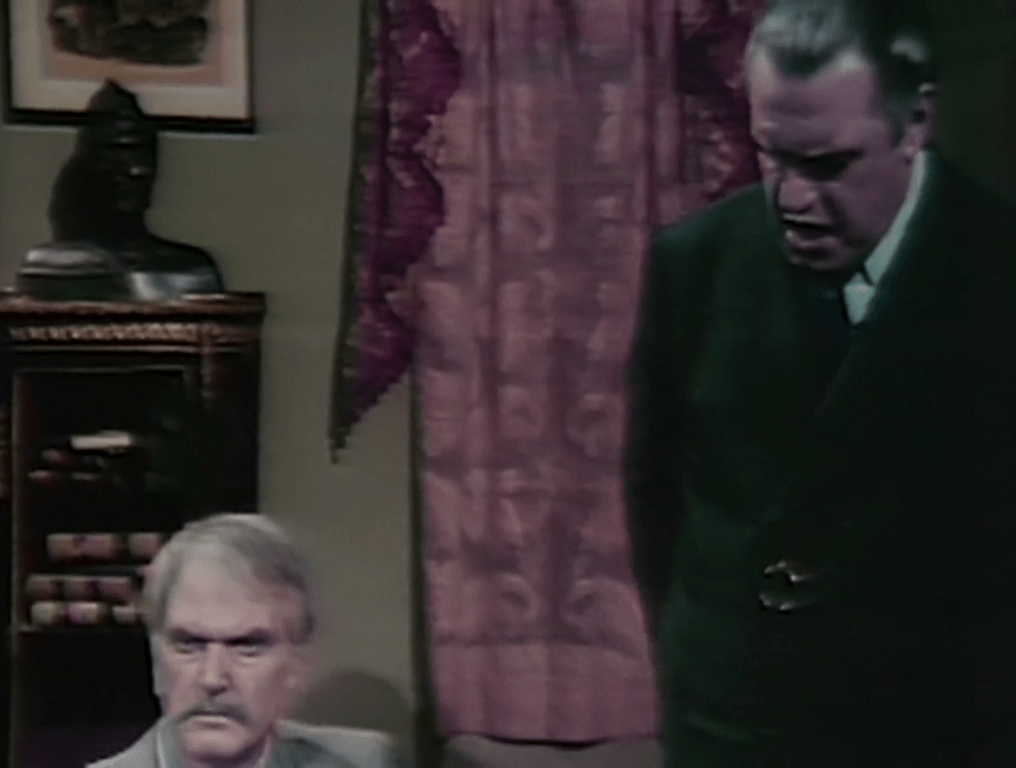
Stokes tries to get Paul to tell him what happened when he encountered the creature, but he will neither speak nor move. Stokes leaves the room for a moment, and Paul gets up to call the police. Stokes stops him doing that, for some reason. Paul runs to Stokes’ bedroom and locks himself in. Julia enters, and they try to persuade him to come out. Julia pretends to call the sheriff. A loud noise comes from the room, and Paul comes reeling out. He falls down and dies. Stokes reports that the room is entirely destroyed. Its ruins are covered with a slime that emits an unbearable stench. In a mild tone, he adds that perhaps it might now be a good idea to call the police after all.
This episode marks the final appearance of Dennis Patrick on Dark Shadows. We will see an extraordinary still photograph of Paul in #953, but the actor is gone. Patrick left to produce and appear in the movie Joe, which was quite an event in its day. Patrick got out of his contract by offering to punch Dan Curtis in the face; evidently Curtis didn’t take offer that too seriously, because he gave Patrick a small part in the feature film House of Dark Shadows later in 1970.
 Dark Shadows Commentary