
Well-meaning time traveler/ bloodsucking ghoul Barnabas Collins has met Laura Murdoch Collins in 1897, and has recognized her as the Laura Murdoch Stockbridge he knew when he was a ten year old boy in 1767. The audience knows that she is also the Laura Murdoch Radcliffe of 1867, and the Laura Murdoch Collins who was on Dark Shadows as its first supernatural menace from December 1966 to March 1967. We learned in that period that Laura is an undead blonde fire witch who incinerates herself and a young son of hers named David at intervals of exactly one hundred years so that she- but not the Davids- will rise from the ashes as a humanoid Phoenix.
We have already seen two major retcons of Laura’s story as it was told in 1966-1967. The precise regularity of her one hundred year cycle was stressed heavily in those days; it was not only the central piece of evidence that led the other characters to figure out what was going on and rise up against her, but was also the first instance of Dark Shadows using anniversaries as a way of creating suspense when the supernatural elements of the story meant that the usual patterns of cause and effect did not apply. Laura’s presence in 1897, thirty years off her established cycle, tosses all of that into a cocked hat.
Moreover, her identity as the wife of stuffy Edward Collins and mother of twelve year old Jamison and nine year old Nora Collins is also incompatible with the previous story. The Stockbridges were supposed to have been, in their day, among the most prominent families in the part of Maine where the great estate of Collinwood sits. But the fire in which Laura and David Stockbridge went up in smoke occurred two hundred years before. In the USA, that is a long enough interval for anything to be forgotten. Laura and David Radcliffe met their demise only half as long before, but the Radcliffes do not seem to have been quite as well-known or as close geographically to Collinwood as were the Stockbridges. So we could believe that when the twentieth century Laura Murdoch showed up in Collinsport in the 1940s or early 1950s, no one there would have remembered her namesakes. But we saw in #684 and #685 that there were still elderly people around Collinsport in the late 1960s who remembered 1897 quite well. And Jamison was himself the father of Elizabeth Collins Stoddard and Roger Collins, the adults at Collinwood in the 1960s. It is not plausible that no one would have said anything when in 1956 Roger, the only son of the family that owns the town, married a woman named Laura Murdoch who was the exact double of his grandmother who was also named Laura Murdoch.
The show doubles down on that implausibility today, when Barnabas summons his blood thrall Charity Trask to look at a portrait he has found in the Old House at Collinwood. It shows Laura Stockbridge, and is a perfect match for the Laura they have met. Barnabas says that Laura was the first wife of his uncle Jeremiah, and that he himself was ten years old when she came to Collinwood.
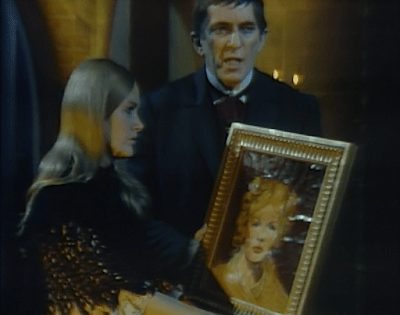
This gives us a Laura who does not marry into various leading families of the region, but into the Collinses over and again. That makes a kind of sense- the show has not developed any other leading families, not even as characters who are only mentioned but never appear. The Collinses now make up the entire local upper class. In #474, permanent houseguest Julia Hoffman called the Collinses “a very inbred family”; I don’t think she meant that in quite the sense which this new version of Laura is giving it, but as they move towards a dramatis personae that is all-Collins all the time there’s no escaping it.
It also represents a reverse retcon. When Barnabas talked about Jeremiah in his first months on the show, he said that when he was a young man Jeremiah was an old one, and that Jeremiah’s beautiful young wife fell in love with him. But when from November 1967 to March 1968 Dark Shadows became a costume drama set in the 1790s, we saw that Barnabas and Jeremiah, though nephew and uncle, were virtually the same age. With Jeremiah marrying Laura when Barnabas was ten, we return to the previous conception of their ages.
Barnabas’ first conversation about Laura today with Charity is interrupted when another undead blonde fire witch turns up. She is Angelique, who in the 1790s turned Barnabas into a vampire in the first place. She introduces herself to Charity as Barnabas’ fianceé, which prompts Charity to run away and go to bed. Angelique then tells Barnabas that he ought to leave Charity alone, because her father, the Rev’d Mr Gregory Trask, can make trouble that will defeat his mission. Barnabas starts to explain how bad Trask is, to which Angelique responds that he has one job and he’d better stick to it if he is to have any hope of success. She tells him that he will have to settle for blood slaves he selects from among the girls at the docks, girls who have nothing going for them “and above all no fathers.”
Charity, asleep in an upstairs bedroom in the great house of Collinwood, has a dream in which she is getting married. She is in fact engaged to marry a man named Tim, but in the dream Angelique tells her that she is not marrying Tim. She is, instead, to be the bride of Death. This is a very old image indeed; one of the main motifs that runs throughout Sophocles’ Antigone is that the heroine, engaged to marry Haemon, her first cousin (both simple and once removed- Antigone is the daughter of Oedipus and Jocasta, so she knows from inbred families) will instead be married to Death itself. At the climax of the dream, Barnabas bares his fangs at Charity.
Charity’s father comes to the great house. He meets Angelique, who identifies herself as Barnabas’ fiancée and charms him. She urges him to see to it that Charity marries Tim as soon as possible, and warns darkly that there are many kinds of flames burning around them.
The mistress of the house, spinster Judith Collins, then enters and explains to Trask that Charity is still in bed. Trask is shocked by this “sloth” (which he pronounces “slowth,”) but Judith explains that Charity is ill. Judith is sure Charity will be fine after a day of rest. Judith tells Trask that she is deeply saddened that his boarding school has burned down. She offers Trask a great deal of money to rebuild it, and the use of a house on the estate as temporary quarters for the school in the meantime. Trask is delighted. When Judith mentions that his wife Minerva had said that his health was poor, Trask says that it is in fact Minerva whose health is poor, and getting worse. The audience knows that Trask is evil, and many will interpret this remark as a sign that he plans to hasten the deterioration of Minerva’s physical condition.
Judith takes Trask to Charity’s bedroom. They are shocked to find her gone. Judith is sure that she wandered off in delirium, but the filthy-minded Trask raves that she must have set out on some errand of grievous sin. He’s right about the sinfulness, though wrong to focus the blame on Charity- she has answered Barnabas’ summons and is with him in the Old House.
Charity comes back to the great house. Her father is ranting at her when she collapses. He looks at her neck, and finds the bite marks. Perhaps Angelique’s warning to Barnabas came too late.

 Dark Shadows Commentary