
A shape-shifting monster from beyond time and space has assumed the form of a young man and decided to marry heiress Carolyn Collins Stoddard. Carolyn’s distant cousin, old world gentleman Barnabas Collins, knows all about the monster and wants to prevent the wedding.
The other day, the monster mentioned to Barnabas that when he is not in human form, nothing can kill him. That would seem to imply that when he is in human form, at least some of the things that kill humans can kill him. So Barnabas slips some poison in a drink and gives it to the monster. The plan is logical enough, but like all of Barnabas’ plans it fails. Whatever the monster’s vulnerabilities are, that particular poison is not one of them. It does not harm him at all, though it does affect the drink’s flavor sufficiently to damage the monster’s confidence in Barnabas’ bar-tending abilities.
Barnabas’ next plan is less sensible. His ex-wife, wicked witch Angelique, is living nearby with her new husband. He goes to Angelique and asks her to take Carolyn in for a while. Angelique reminds Barnabas that Carolyn knows her and dislikes her. She was married to Carolyn’s uncle Roger for a while in 1968, when she was using the alias Cassandra. By the end of that period, she had alienated Carolyn and everyone else at the great house of Collinwood. Barnabas exclaims “But she won’t recognize her; you had dark hair!” Presumably the scripted line was “But she won’t recognize you; you had dark hair!”
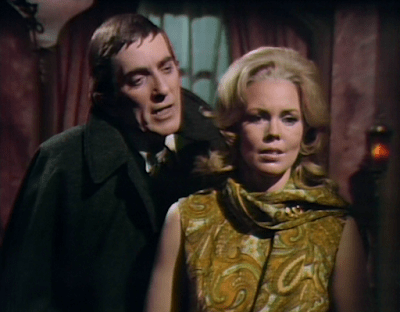
Which doesn’t really make all that much more sense- the black wig Angelique wore when she was calling herself Cassandra was the entirety of her disguise. She didn’t need to conceal her identity any more thoroughly than that, since the only people who could recognize her were Barnabas and time-traveling governess Vicki. Barnabas couldn’t afford to admit that he had lived in the 1790s and married a witch, and Vicki was at that point not allowed to do anything that would affect the course of the A story, so the wig was plenty. To say now that the difference in hair color will keep Carolyn from recognizing Angelique as Cassandra is to lampshade the absurdity of Barnabas’ idea.
Barnabas tells Angelique that the monster is affiliated with mysterious supernatural beings known as the Leviathan People. This alarms Angelique sufficiently that she agrees to hide Carolyn.
This is also the episode in which rakish libertine Quentin Collins reintroduces himself to the family at Collinwood. They had known him as the ghost who drove them from their home in November 1968, and Carolyn met the living Quentin in late 1969, when he went by the name Grant Douglas.
Quentin is at loose ends, so he agrees when Barnabas and mad scientist Julia Hoffman ask him to help them in their battle against the Leviathans. The plan is for him to use the power of his handsomeness and charm to distract Carolyn from the monster. This would seem to be quite a sensible idea, since he has been the big attraction of the fan magazines since he joined the show.
We cut to the great house of Collinwood, where the piano is being played very well. We see that Carolyn is the pianist. This is puzzling to longtime viewers. The piano has been a prominent part of the drawing room set from the beginning of the show, an echo of the deep prehistory of Dark Shadows, which was originally based in part on old teleplays Art Wallace wrote about a lady who gave piano lessons. We have seen Carolyn poke at the keyboard a couple of times, in a manner that made it clear she could not play at all.
Quentin knocks at the front door and Carolyn lets him in. He gives his right name, and claims to be his own great-grandson. When Carolyn asks why he said his name was Grant Douglas, he claims to be a writer who used that among other pseudonyms. That doesn’t explain anything, but Carolyn settles for it, for some reason. He tells her that, since they are only third cousins, their family relationship is no bar to them spending a great deal of time together. She says she is busy tonight, but eagerly volunteers that she is free tomorrow.
The monster enters. He meets Quentin, and they take an instant dislike to each other. That doesn’t mean much, since the monster is extremely obnoxious and everyone not under the power of the Leviathans dislikes him. For that matter, some who are under their power can’t stand him, either. For example, Barnabas was a devotee of theirs until he had to deal with the monster, and his personality broke the spell. So it remains to be seen what contribution, if any, Quentin will make to this story.
Quentin doesn’t try to persuade Carolyn to break her date with the monster. He, Julia, and Barnabas are at Collinwood when the monster calls. He tells her Carolyn is on her way, two hours earlier than originally planned. The monster and Carolyn share a drink; he slips her a mickey. Once she is passed out, he carries her up to the room in which he assumes his true form, declaring that her new life is about to begin.
Up to this point, drugging drinks has chiefly been a source of comedy on Dark Shadows. Barnabas tried to poison Angelique in #402, when they were married; that led to a farce scene when his mother showed up, Angelique passed the poisoned drink to her, and he had to scramble. For a while in 1968, a warlock calling himself Nicholas Blair hung around and functioned as Angelique’s boss; in #528, she asked him to slip some poison to Vicki, prompting him to complain that “I am much too talented to spend my time drugging drinks.” By the time he was done, he had not only complied with Angelique’s request, but drugged a couple of other people’s drinks on his own initiative. He may as well have kept his pride, since none of those poisonings got him what he wanted. So the monster’s use of that tactic might lead us to suspect that Carolyn’s odds are better than they appear.
 Dark Shadows Commentary