
Episode 28: Just curious

I think I said everything I wanted to say about this one in the comment I left on John and Christine Scoleri’s Dark Shadows Before I Die. So here it is:

“Idiot Plot” is a term for a story that can go on only if the characters in it are dumber than the average member of the audience. When Vicki left the valve where David could steal it in episode 26, Dark Shadows had its first Idiot Plot.

Now, just two days later, we have our second. The restaurant is open for business, and Maggie says in so many words that Roger is a frequent customer there. So he should walk right in and lay hold of David. But unaccountably, he waits for Maggie to let him in. She turns her back on David, calls Roger by name, and declares that she’s been tricking David into staying, all while David is a few feet away. Even worse, we have a number of scenes suggesting that Maggie had searched the hotel extensively for David and failed to find him, when he was simply hiding in the very telephone booth she herself had used a few minutes before.

Art Wallace is the only credited writer for the first eight weeks of the show. I’m sure he had some help, but not enough, apparently- these two episodes not only disappoint viewers who expect a well-constructed drama, but also do serious harm to the characters of Vicki and Maggie. Vicki has to be so sweet and innocent that unless she’s also as smart as she’s seemed in the first five weeks, she’ll get pretty cloying pretty fast. And Maggie, whether it’s the original wised-up dame who’s everybody’s pal but nobody’s friend or her successor, the nicest girl in town, has to produce witty dialogue and see through people’s attempts to deceive her if she’s to contribute to the story. Casting either of them as Designated Idiot is a sure way to put her on an ice floe to oblivion.

Two other things:

Interesting to see the first scene between Maggie and David. Especially so knowing that these characters will become important to each other later on, but already so as confirmation that the hostility Maggie had expressed towards the Collinses in general in Episode 1 isn’t going to define her character.

The picture of Lyndon Johnson in the sheriff’s office is apparently there to promote ABC’s coverage of the Luci Johnson’s wedding that weekend, but it’s a very odd choice of image. You’d expect the president’s photograph in a government office to show him from the chest up, showing his full face, with his eyes looking at the viewer and a calm or cheerful expression. But this picture is an extreme closeup of his face in profile, and he appears to be wincing. On a wall otherwise decorated with wanted posters, it communicates something less than unqualified admiration for President Johnson. If, as Roger implied in episode 26, the sheriff owes his office to the support of the Collins family, the picture would suggest that the Collinses were not LBJ fans.

I’ll also mention that Marc Masse’s entry for this episode on his Dark Shadows from the Beginning features one of his most outlandish accounts of a control room conversation between director Lela Swift and executive producer Dan Curtis. If you miss the sensibility of the 1970s National Lampoon, you’ll enjoy reading it.
Episode 25: A neat way of managing people

The episode revolves around a letter to Victoria from the Hammond Foundling Home. The letter reports that no one connected with the Home had ever heard of the Elizabeth Collins Stoddard or any of the other Collinses before the letter came offering Vicki the job as David’s governess. This letter has set Elizabeth into a panic, since it exposes as a lie her story that Roger was friends with someone connected to the Home and that that person had recommended her. It sets David into an even more extreme panic, since he is terrified that his father will send him away to some kind of institution where children are kept and the Hammond Foundling Home is such an institution.

In her panic, Elizabeth demands that Roger sit down with Vicki and corroborate her lie. Roger is worried that Burke, who has hired private investigators to look into Vicki’s background, will discover some piece of information that will damage the family, and wants Elizabeth to confide in him. He is insistent enough about this to raise the audience’s hopes that in some future episode, we will get answers about Vicki through dialogue between the two of them. For now, she shuts him down by threatening to throw him out of the house unless he obeys her.

When Roger does talk with Vicki, she reminds him that she had asked him if she knew anything about her or about the reason she was hired when they first met. He had said no, and in every way showed bafflement about how Elizabeth heard of her. He tries to explain that away by saying that he was distracted by worry about Burke, and tries to deflect further questions by saying that his contact is a donor who wishes to remain anonymous.

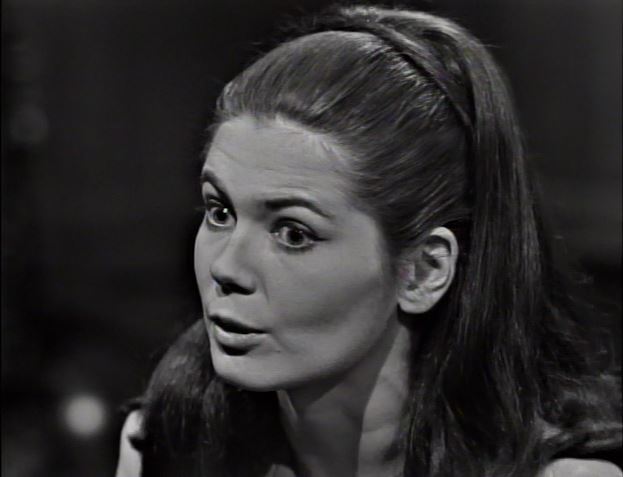
Vicki is obviously unconvinced. Alexandra Moltke Isles has strabismus, and in her closeups during the scene with Roger she turns this to her advantage. Her eyes seem to be moving independently of each other, a more polite expression than eye-rolling, but just as effective at communicating disbelief. Marc Masse captured the effect quite well in this still image, on his Dark Shadows from the Beginning:

Roger’s remark to Elizabeth in this line, that she has “a neat way of managing people,” applies equally well to Vicki in her scene with him. At the end of the conversation, she knows that he was lying, and he knows that she knows. She also knows that he is under his sister’s thumb, not a threat to her position no matter how uncomfortable he may find her presence on the staff, and he knows that she knows that.

David’s panic leads him to take a less devious path than does his aunt, but ultimately an even more disastrous one. He steals the letter from Vicki. His father catches him with it and returns it to her.

Vicki herself is less concerned with the letter than with a thought we saw take shape in the back of her mind at the end of episode 23. She asks David about the magazines on auto mechanics he likes to read, about how he learns to put things together and take them apart. David responds with a denial that he sabotaged his father’s car; Vicki calmly replies that she hadn’t accused him of that.

Vicki comes into the drawing room and tells Elizabeth that David has been acting strangely ever since his father’s car went off the road, that when the sheriff came he was overwhelmed with the thought that he would be arrested, etc. Elizabeth dismisses the topic brusquely, seeing no significance in it. Vicki persists in the topic, reminding her that the sheriff said they should try to think of someone other than Burke who might want to kill Roger. Elizabeth declares “There is no one else”; at that, Roger sashays into the room and declares “Except my loving son, of course.”

Elizabeth has even less patience with this remark from Roger than with whatever it is Vicki is saying, and moves along so that Roger can tell Vicki the lie she has ordained. In the course of that conversation, she again says that they don’t actually know that Burke was the saboteur, a point that is no more meaningful to Roger than it had been to his sister.

Afterward, she goes back to her room and finds that David has stolen the letter again. She goes to his room to look for it. She doesn’t find it. Instead, she finds the bleeder valve, evidence that her suspicions are correct.

Episode 10: To the death of the monster

Carolyn is in Burke’s hotel room, where he charms her and tricks her into believing that he’s planning to leave town soon. I suppose the definition of “dashing” would be a charming fellow who makes things happen, things you wouldn’t have predicted and of which you aren’t sure you can approve. Burke is at his most dashing in scenes where he’s trying to enlist the women and children of Collinwood to his side. With Carolyn here, with Vicki back in episode 7, most of all with David in episode 30, we wonder what exactly he’s trying to do. He’s not so good with the men- when he tries to recruit Joe Haskell to his intelligence-gathering operation in episode 3, he ends up baldly offering him a bribe.

Liz and Roger are in the drawing room, where she demands he be less openly hostile to his son David. Unknown to them, David and his toy robot (a Horikawa “Attacking Martian,” which sold for $4.22 in 1966, not including two D batteries) are hiding behind a chair listening to Roger’s brutal denunciations of the boy. Unknown, that is, until Roger goes to the brandy bottle for his second drink, when the Attacking Martian starts attacking Roger.

Roger all but assaults David in response. David flees his father’s rage. He runs out of the house, telling Roger he hopes Burke Devlin gets even with him. Roger is as bleak and maladroit in these interactions as Burke is glittering and skillful in his handling of Carolyn. Again we see Art Wallace’s use of intercut scenes to bring out a comparison between characters.

After the second part of the scene in Burke’s room, David slips back into the house to find his Aunt Elizabeth asleep in a chair, muttering about ghosts. After all the talk about ghosts in the first two weeks, Elizabeth’s muttering about them seems significant- perhaps we are to think that her dream is a message from the ghosts who linger about the house, a sign that something is happening that will stir them up. Elizabeth awakes, and sees that David is in front of her, smeared with grease and holding a small object. He won’t answer any questions or let her see what he has in his hand. Before she can pursue the matter, Carolyn appears in the foyer, bringing an unexpected guest- Burke Devlin. Confronted with this shocking sight, she forgets all about David.

Episode 9: There are no ghosts here

The episode begins with Bill Malloy at the front desk of the Collinsport Inn, using the telephone to call Burke Devlin’s room. Burke hangs up on him. It ends with Carolyn Stoddard standing on the same spot, making the same call. Burke invites her up. Marc Masse has a nice discussion on his blog of what this pair of scenes means within the formal structure of the show at this point.

Carolyn tells Vicki about Josette and the two governesses who fell to their deaths from Widow’s Hill, and about the legend that a third governess will follow. Liz declares “There are no ghosts here,” but uses the word “Poltergeist” in a little speech about ghosts, a sufficiently sophisticated term in 1966 to suggest that someone using it has done serious reading about the supernatural. Coupling these lines with Burke’s statement in episode 7 that there are literal ghosts at Collinwood and other remarks that Roger and Carolyn have made in other episodes, the show is going out of way to keep the possibility open that there will be literal ghost stories.

Episode 7: Nowhere- Everywhere- Perhaps I was here.

Vicki and Burke run into each other at the Collinsport Inn where Maggie serves them coffee, Roger lets himself into the Evans cottage where he makes demands of Sam, Maggie tells Roger that Burke and Vicki are sharing a table and he runs away.

In these interactions, we see Burke using his considerable charm to try to get information out of Vicki, Roger using his social position to try to bully Evans the father while Evans the daughter exposes his cowardice, Sam wallowing in self-pity, Maggie letting information out indiscriminately, and Vicki taking it all in, cautiously.

Marc Masse’s post about this episode on his Dark Shadows from the Beginning has some interesting stuff. Both Mitch Ryan as Burke and Mark Allen as Sam are required to talk with their mouths full; both of them have mishaps, which he records with gifs showing matter falling out of their mouths. He also has these intriguing paragraphs about the character of Sam Evans:

One thing about the Evans cottage you notice in this episode is that when Sam walks in the door you can see houses across the street, a setting that would suggest a quiet, cozy cul-de-sac near the waterfront. Sam has neighbors, but none ever come calling. One gets the impression that Sam is troubled about something and just wants to be left alone, but time and again unwanted trespassers will just keep barging in, like this nervous, frightened man who lives in a mansion on the hill who busts in to order him around and warn him to keep certain information secret that might be damaging to the both of them. There will at one point be a cannery plant manager who just walks in without knocking while he and Roger are arguing about Burke Devlin, the plant manager telling Sam that if he wants privacy he should keep his door locked. But even that wouldn’t work, because as time goes on the trespassers will only become more aggressive: a fire goddess who, by staring into a blazing fireplace miles away, can make Sam fall asleep on the sofa with a lit cigarette to ignite a nearby newspaper so that he burns his hands badly enough that he can no longer paint; a newly risen vampire who sneaks in through the French windows to make a blood bank of his daughter; a Frankenstein monster who lets himself in for food and shelter and who knows where the cutlery is kept; a werewolf that doesn’t even bother with locked doors and just crashes in through the nearby window. The Evans cottage is a hub of activity for invasive beings with criminal intent.

But now, in the relatively sane and quiet summer of sixty-six, all Sam Evans has to do for a little peace of mind is assure his unwanted patrician visitor that he will not do or say nothing to jeopardize the agreement the two apparently made that ties them together like conspirators – because that’s what they represent to the viewer, two people who keep information away from others, information the viewer at this point is also not fully privy to.

But the one salvation for Sam Evans is that, unlike Roger Collins, he does seem to have some remnant of a conscience about whatever unsavory information ties these two unlikely co-conspirators together, and therefore a soul that may be worth saving.

Marc Masse has more use for Mark Allen’s acting than I do- I would say that he tends to be monotonous, his voice either a constant whine or a series of bellows. So I find it difficult to think of Sam Evans #1 as a soul worth saving. But this is a most insightful passage.

Episode 2: Wouldn’t be the first, you know

Marc Masse’s Dark Shadows from the Beginning is in one of its accessible phases now, and his discussion of episode 2 includes some interesting comparisons between the finished episode and Art Wallace’s story bible for the series, Shadows on the Wall. For example:

Here is Art Wallace’s introductory description of Joe in Shadows on the Wall: “Joe Haskell is twenty-one. A rugged New Englander with a deep love of the sea, Joe is a young man of natural dignity and quiet ambition.”

But the viewer’s first impression of Joe Haskell is that of a sap, cuckolded into brooding over a mug of beer while his date plays the field before his very eyes.

And:

During the scene with Elizabeth and Carolyn in the drawing room, episode writer Art Wallace lifts two of Carolyn’s lines directly from his story outline in Shadows on the Wall. These are: “Besides, how do you expect me to go away and leave you alone in this beautiful nuthouse?” and “All I can say for her, mother, is she must be out of her mind.” In the story outline, the lines are written as “Besides, how do you expect me to get married and go off and leave you alone in this beautiful nuthouse.” and “All I can say for her is she must be out of her mind.”

The scene at the Blue Whale and Carolyn’s mood when she arrives home and the topic of discussion with her mother coincide exactly as given by Art Wallace in Shadows on the Wall: “Carolyn’s in a vile mood. The boy she’d been with had been a dud….had started an argument in the juke joint. There’d been a free-for-all, and her evening had been ruined.”

Then:

In this episode Elizabeth is seen playing the piano in the drawing room. The reason for there being a piano in the drawing room comes from the character of a previous work by Art Wallace, which he drew on when creating the character of Elizabeth Stoddard. In The House, a one-hour production for NBC-TV’s Television Playhouse broadcast on September 8, 1957, Caroline Barnes is a wealthy recluse in a New England fishing village who occupies her time as a piano teacher.

In Art Wallace’s story outline for Shadows on the Wall, when Victoria Winters arrives at Collinwood it is the month of October.

In later posts, Masse will clarify that the 1957 version of The House was actually Wallace’s second treatment of the story that would later give rise to the characters of Elizabeth and Carolyn Stoddard. Three years before, a thirty-minute anthology series called “The Web” had broadcast his first version of it. That version, as shown at a Dark Shadows convention, has been posted on YouTube:

Episode 1: Who’s talking?

In 281 of the posts that follow, I link to comments I made on Danny Horn’s great blog Dark Shadows Every Day. Danny starts with episode 210 and makes only a handful of remarks, most of them highly disparaging, about the first 42 weeks of the show. As a particular fan of that period of the show, that distressed me when I first started reading him, but I found that it gave me an opportunity to make substantial contributions to the comment section. I could always find something in those early stories that gave extra depth to whatever was going on in the later installments.

Now, Mrs Acilius and I are watching the show through a second time, again starting with episode 1. I’d so much enjoyed commenting on Danny’s site when we were watching 210-1245 from March of 2020 to April of 2021 that I decided to start commenting on a blog that covered the first 42 weeks. So I’ve left many comments on John and Christine Scoleri’s Dark Shadows Before I Die.

The Scoleris haven’t assembled the kind of community that made Danny’s comment section a big party. I still get responses to comments I left on Danny’s site, almost a year and a half after his final post. I have yet to get a reaction to any of my comments on Dark Shadows Before I Die. So I’m thinking of just recording my thoughts here.

The Scoleris aren’t the only bloggers who discuss the first 42 weeks of the show. There’s also Marc Masse, a.k.a. Prisoner of the Night, whose (fiercely controversial) Dark Shadows from the Beginning is occasionally viewable, usually private. And of course Patrick McCray, whose Dark Shadows Daybook set the standard for online commentary on the show. Neither of those sites has an open comments section, which is why I’ve been contributing to the Scoleris. There are also podcasts, Facebook groups, Reddit threads, etc, but I’m not into any of those.

Asking who to talk to and how to get through to them brings episode 1 to mind. Vicki comes to an unfamiliar town, and the audience comes to an unfamiliar show. She’s a stranger looking for someone to talk with; we’re viewers of a daytime soap, a genre that consists almost entirely of conversation. Everyone Vicki meets is talkative enough, but most of their talk is about how they aren’t speaking. The lady sitting next to her on the train goes on about what a nasty place Collinsport is. The fellow who gives her a ride from the train station responds to the innkeeper’s warm greeting with an ostentatious refusal even to acknowledge that he knows him, let alone to engage in conversation. The server at the lunch counter announces to Vicki, before she’s had a chance to say two sentences, that she regards her as a “jerk.” The family she will be working for is represented by a lady who won’t answer her brother’s questions as to who Vicki is and why she hired her, a reticence that is made all the more ominous when a private investigator reports on their strange, unfriendly ways. Dark Shadows fandom is far less forbidding than the situation Vicki faced!