
This one resets the series.
Reclusive matriarch Liz calls well-meaning governess Vicki into the drawing room in the great house at Collinwood. She asks Vicki where her charge, problem child David, is. When she tells her David is upstairs in his room, she asks Vicki to close the drawing room doors, explaining that she does not want their conversation overheard.
Of course David comes downstairs and puts his ear to the doors as soon as they are closed. Liz starts talking with her about some recent plot developments, and we hear a commotion outside the doors. Tightly-wound caretaker Matthew has caught David eavesdropping. Liz sends Vicki and David away, and talks to Matthew about events we saw several days ago.
David starts telling Vicki about the ghosts who haunt Collinwood, and shows her a drawing he made of one of them. Vicki is impressed with the drawing, and shows it to Matthew. Matthew accuses David of going to the Old House and copying the portrait hanging there. Vicki has never heard of the Old House- nor has the audience, it’s the first reference to it. David denies Matthew’s accusation, and says that it is a drawing of a ghost he has seen.
Vicki takes the drawing to Liz, who immediately recognizes it as Josette Collins. She opens the family history to the page featuring a portrait of Josette, and asks David if he copied that portrait. Again David insists it is a drawing of an actual ghost he has seen. The day before yesterday, in episode 68, we saw David studying that page, so it is quite plausible that he did copy it. Still, regular viewers will remember that in episode 52 the book opened itself to that same page when no one but the audience could see, so we might also wonder if David is telling the truth.
Flighty heiress Carolyn tries to talk her mother into hiring a housekeeper. When she mentions that one thing a housekeeper might relieve Liz of is her loneliness, she answers wryly, “You forget, dear, I have all of David’s ghosts.” In this reply, we return to the ambiguity of the first weeks of the show, when, in conversations with Vicki, one character after another would use the word “ghost” in a metaphorical sense, to refer to present difficulties resulting from unresolved conflicts in the past. Vicki would invariably respond with some line like “Surely you don’t believe in ghosts!,” as if they were talking about literal ghosts. And each time, the response would be that they did indeed believe in literal ghosts, and that if she stayed in the old dark house on the hill for any length of time she would believe in them too. Aside from the book opening itself in #52, the ghostly manifestations we have seen so far have been equivocal, possibly hoaxes, possibly tricks of the light. Even the incident of the book was small and symbolic. The ghosts could still dissolve into the atmosphere and into mere metaphor.
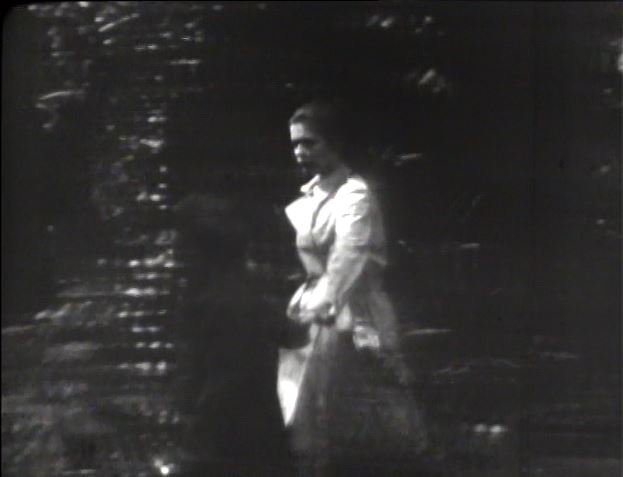
Determined to befriend David, Vicki agrees to go to the Old House with him to look for ghosts. We are treated to 90 seconds of location footage of Vicki and David walking through the woods to the Old House. This is by far the longest exterior sequence in the entire series, and it is done with extraordinary ambition. Most of Dark Shadows’ exterior shots are not only extremely brief, but are accompanied only by music. In this one, the actors’ voices are dubbed throughout, and multiple sound effects are added.
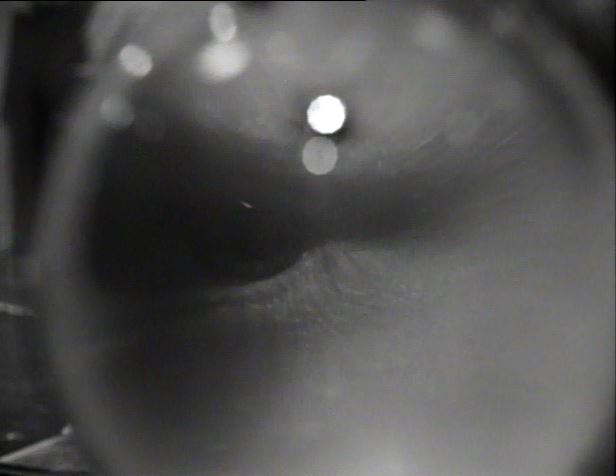
Vicki and David enter the Old House. As they do so, David shines his flashlight directly into the camera and creates a halo effect. This would not seem desirable, but it will be done dozens of times in episodes to come. It’s probably a mistake here- maybe a mistake most of the time- but they do it so often, there must have been some kind of intentionality behind it.

Vicki and David examine the portrait of Josette hanging above the mantle. Vicki is impressed with its likeness to David’s drawing. David tells her that he has been through every part of the Old House, but denies that the portrait was his model. He tells Vicki of the legend that Josette’s ghost is trapped at Collinwood until another girl falls to her death from Widow’s Hill, and goes on and on about his hope that Vicki will be that girl.
This charming conversation is interrupted when the door suddenly opens. Frightened, David breaks off in the middle of telling Vicki that he wants her to die and clutches at her for safety.

In a moment like this, we can understand why Vicki keeps believing she can reach David. She knows that he is deeply disturbed, and that his violence may well turn against her. But she can also see inside him an awareness that he needs a friend. She has decided to risk his worst in hopes that his sense of that need will eventually break through his rage.
It is Matthew at the door. He scolds Vicki and David for visiting the Old House after he had told them how dangerous it is. The three of them talk a bit about the legends, then Matthew insists on leaving. Vicki turns to David, apparently willing to stay there with him. David looks bitterly at Matthew, and says that there is no point in staying. Josette won’t appear when Matthew is around, because she doesn’t like him. When Matthew says the place should be torn down, David becomes upset and says that he will tell Josette to kill him if he tries it.
The three of them do leave. Then something happens…
We see the vacant parlor of the Old House. The portrait of Josette begins to glow. A figure takes shape, and walks down from the portrait to the floor. It vanishes from the parlor, and reappears outside. It dances among the columns surrounding the house, glowing an unearthly white. Josette has come all the way out of the back-world into the foreground. We can expect her to stick around. Perhaps others will follow where she has led.


On his blog Dark Shadows from the Beginning, Marc Masse cites the book Dark Shadows: The First Year, by Nina Johnson and O. Crock (Blue Whale Books, 2006.) I think you might have to go to Dark Shadows conventions to find a copy of this book. I’ve certainly never seen one.
Evidently, Johnson and Crock had access to much of the original paperwork generated by the makers of the show. Today’s closing credits are truncated by a technical fault. The only writing credit shown is Art Wallace’s story creator tag. Fandom has jumped to the conclusion that Art Wallace wrote the episode, but the documents show that Francis Swann did. That makes sense- the two of them have been swapping weeks, with Wallace writing five episodes, then Swann writing five. Swann wrote the other four episodes this week, and Wallace wrote next week’s five, so it would be a deviation from the pattern if Wallace wrote this one as well. Since the episode is such a watershed in the development of the show it is tempting to attribute it to the original writer. But clearly, it is Swann who gave us our first looks at the Old House and at Josette.

 Dark Shadows Commentary