
Yesterday, several characters saw clear evidence that supernatural forces are intervening to warn that the mysterious and long-absent Laura poses a grave danger to her son, strange and troubled boy David Collins.
High-born ne’er-do-well Roger Collins was one of those characters. In keeping with his family’s traditions, Roger habitually responds to signs of the supernatural by going into denial. He has an especially strong motive for denying that there is anything alarming about the relationship between David and Laura. David is his son, Laura is his wife, and he wants to be rid of them both. Laura wants to divorce him and leave with David, a prospect he finds most attractive.
At the insistence of well-meaning governess Vicki, Roger tells reclusive matriarch Liz some of the signs that uncanny beings are at work. In response, Liz decides to go to Laura and tell her that she may no longer see her son.
The confrontation between Laura and Liz takes place in the cottage where Laura is staying now that she has returned from her long absence. Laura points out that it is absurd for a child’s paternal aunt to forbid his mother from seeing him. The only case Liz could make in answer to this objection would rest on yesterday’s supernatural manifestations, but even if she had seen those events first-hand that isn’t something you can really bring up while conducting an argument in the modern world. So the two women just make assertions about their respective strength of personality.
Upstairs at Collinwood, David was crying before Vicki managed to calm him by telling him his mother’s favorite story, the legend of the Phoenix. In his sleep, he is crying again. Laura appears as a glowing figure in the corner of the room. She awakens him and stands at the foot of his bed.
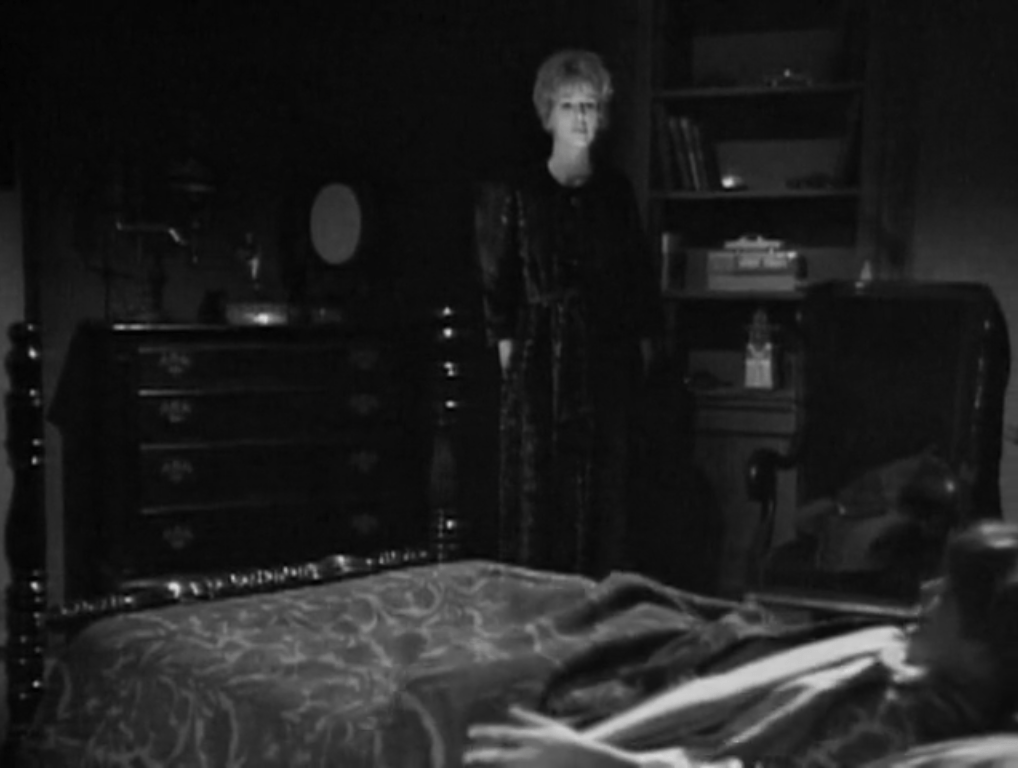

The oldest surviving version of the legend of the Phoenix appears in the Histories of Herodotus. Many passages in Herodotus describe dreams, and they all represent the dream as a figure standing at the foot of the dreamer’s bed, making a speech to him. That’s the usual form dreams take in ancient Greek literature generally, in fact, and that Greek image of the dream has had its influence in later writing. So I suppose it could be that Laura’s visit to David is a nod to the sources of the Phoenix legend, and it certainly could be meant to suggest a familiar way dreams are depicted in literature.
Diana Millay usually plays Laura as a dreamlike figure, rather vague in manner and stilted in speech, and this scene is no exception. David Henesy plays David Collins here in the wide-awake style of an uncomfortable character in a comedy of manners. Laura makes cryptic promises of being forever united to David, to which he gives polite but nervous responses such as “That’s nice!” and “I’m sure we will!” David doesn’t seem to be asleep, suggesting that Laura’s otherworldly manner signifies nothing so familiar as a dream.
Laura notices David’s tears. She gives him a handkerchief to dry them. At the end of their conversation, she vanishes into thin air and David falls asleep. The handkerchief is still there, however, proving it was no ordinary dream.
At this stage of her existence, Laura seems to be divided into at least three entities. There is the woman who lives in the cottage, visits the great house, and talks to the other characters. There is a ghostly image David has seen flickering on the lawn. And there is a charred corpse in the morgue in Phoenix, Arizona. There is no assurance that these are the only three components of Laura, and no explanation of how they relate to each other. Does the speaking character know about the ghost? Does one control the other? If they operate independently, do they have the same goals? If they have different goals, might they come into conflict with each other? A scene like this one raises all of those questions, because we don’t know which Laura we’re dealing with.
It is also possible that she isn’t Laura at all. A couple of weeks ago, we thought it was Laura who compelled drunken artist Sam Evans to paint pictures of her naked and in flames. Yesterday, we learned that the spirit possessing Sam was actually the ghost of Josette Collins, and that she was doing it to oppose Laura’s plans. So maybe Josette has disguised herself as Laura in order to unsettle David and keep him from following his mother to his doom.
There is an unusual blooper just short of the 3 minute mark. From 2:51 to 2:57, Alexandra Moltke Isles has a fit of the giggles. This starts when Joan Bennett enters and flares up again as she walks past Mrs Isles. It’s true that Miss Bennett’s dress betrayed a good deal more of the outlines of the garments underneath it than one would expect. That may have had something to do with the laughing attack, but Mrs Isles was usually so professional that it is difficult to believe she wouldn’t have gotten that under control after dress rehearsal. Some of the actresses have talked about how Louis Edmonds would make remarks to them before shots that made it extremely difficult for them not to laugh on camera during serious scenes, perhaps he was the culprit here.


 Dark Shadows Commentary