Episode 150: Time isn’t easy to give

Yesterday, several characters saw clear evidence that supernatural forces are intervening to warn that the mysterious and long-absent Laura poses a grave danger to her son, strange and troubled boy David Collins.

High-born ne’er-do-well Roger Collins was one of those characters. In keeping with his family’s traditions, Roger habitually responds to signs of the supernatural by going into denial. He has an especially strong motive for denying that there is anything alarming about the relationship between David and Laura. David is his son, Laura is his wife, and he wants to be rid of them both. Laura wants to divorce him and leave with David, a prospect he finds most attractive.

At the insistence of well-meaning governess Vicki, Roger tells reclusive matriarch Liz some of the signs that uncanny beings are at work. In response, Liz decides to go to Laura and tell her that she may no longer see her son.

The confrontation between Laura and Liz takes place in the cottage where Laura is staying now that she has returned from her long absence. Laura points out that it is absurd for a child’s paternal aunt to forbid his mother from seeing him. The only case Liz could make in answer to this objection would rest on yesterday’s supernatural manifestations, but even if she had seen those events first-hand that isn’t something you can really bring up while conducting an argument in the modern world. So the two women just make assertions about their respective strength of personality.

Upstairs at Collinwood, David was crying before Vicki managed to calm him by telling him his mother’s favorite story, the legend of the Phoenix. In his sleep, he is crying again. Laura appears as a glowing figure in the corner of the room. She awakens him and stands at the foot of his bed.
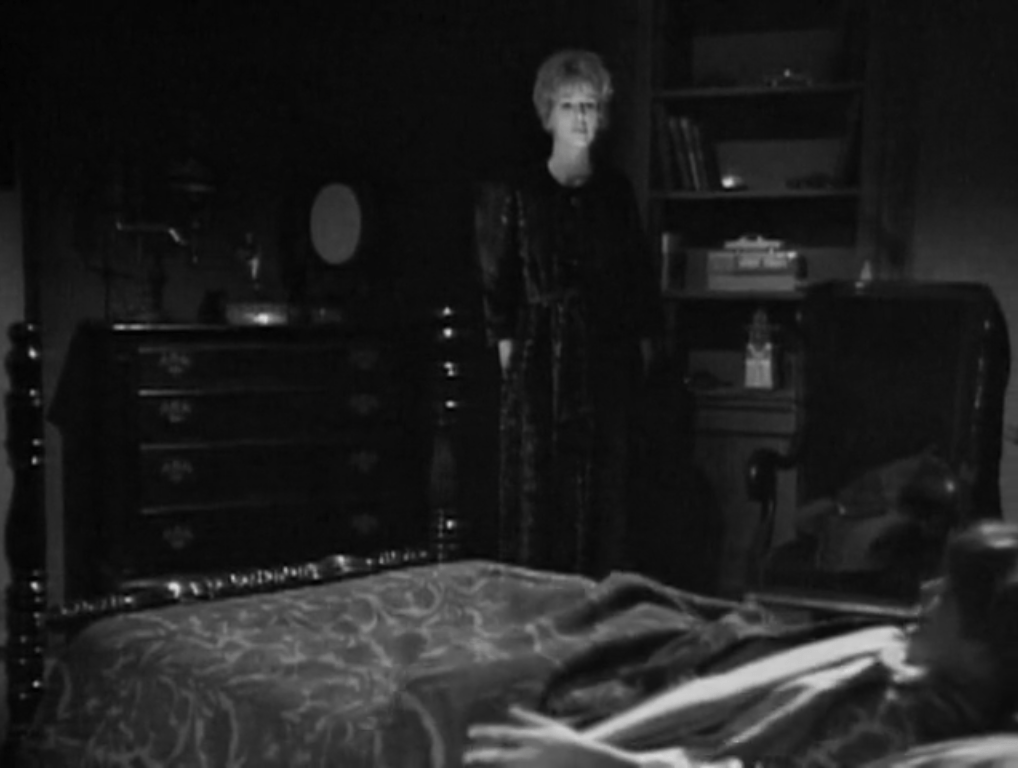
Laura appears
Laura speaks

The oldest surviving version of the legend of the Phoenix appears in the Histories of Herodotus. Many passages in Herodotus describe dreams, and they all represent the dream as a figure standing at the foot of the dreamer’s bed, making a speech to him. That’s the usual form dreams take in ancient Greek literature generally, in fact, and that Greek image of the dream has had its influence in later writing. So I suppose it could be that Laura’s visit to David is a nod to the sources of the Phoenix legend, and it certainly could be meant to suggest a familiar way dreams are depicted in literature.

Diana Millay usually plays Laura as a dreamlike figure, rather vague in manner and stilted in speech, and this scene is no exception. David Henesy plays David Collins here in the wide-awake style of an uncomfortable character in a comedy of manners. Laura makes cryptic promises of being forever united to David, to which he gives polite but nervous responses such as “That’s nice!” and “I’m sure we will!” David doesn’t seem to be asleep, suggesting that Laura’s otherworldly manner signifies nothing so familiar as a dream.

Laura notices David’s tears. She gives him a handkerchief to dry them. At the end of their conversation, she vanishes into thin air and David falls asleep. The handkerchief is still there, however, proving it was no ordinary dream.

At this stage of her existence, Laura seems to be divided into at least three entities. There is the woman who lives in the cottage, visits the great house, and talks to the other characters. There is a ghostly image David has seen flickering on the lawn. And there is a charred corpse in the morgue in Phoenix, Arizona. There is no assurance that these are the only three components of Laura, and no explanation of how they relate to each other. Does the speaking character know about the ghost? Does one control the other? If they operate independently, do they have the same goals? If they have different goals, might they come into conflict with each other? A scene like this one raises all of those questions, because we don’t know which Laura we’re dealing with.

It is also possible that she isn’t Laura at all. A couple of weeks ago, we thought it was Laura who compelled drunken artist Sam Evans to paint pictures of her naked and in flames. Yesterday, we learned that the spirit possessing Sam was actually the ghost of Josette Collins, and that she was doing it to oppose Laura’s plans. So maybe Josette has disguised herself as Laura in order to unsettle David and keep him from following his mother to his doom.

There is an unusual blooper just short of the 3 minute mark. From 2:51 to 2:57, Alexandra Moltke Isles has a fit of the giggles. This starts when Joan Bennett enters and flares up again as she walks past Mrs Isles. It’s true that Miss Bennett’s dress betrayed a good deal more of the outlines of the garments underneath it than one would expect. That may have had something to do with the laughing attack, but Mrs Isles was usually so professional that it is difficult to believe she wouldn’t have gotten that under control after dress rehearsal. Some of the actresses have talked about how Louis Edmonds would make remarks to them before shots that made it extremely difficult for them not to laugh on camera during serious scenes, perhaps he was the culprit here.

The giggle begins
The giggle resumes
The giggle concealed

Episode 128: Whaddaya hear from the morgue?

Maggie Evans, keeper of the restaurant at the Collinsport Inn and The Nicest Girl in Town, greets her boyfriend, hardworking young fisherman Joe, with a hearty “So, whaddaya hear from the morgue?” As Dark Shadows gets to be more deeply involved with horror and the supernatural, that will become a plausible alternative title for the series.

Maggie wants to know the details of the death of Matthew Morgan, fugitive and kidnapper, whom she believes to have been scared to death by ghosts. Joe doesn’t want to entertain that idea. Maggie’s father, drunken artist Sam Evans, shows up and announces that he’s tired of the topic of Matthew’s death. He wants to talk to Maggie privately.

Sam wants Maggie to get information about a mysterious woman who is staying at the inn. Maggie says that the woman won’t give her name or say much of anything about herself, but that she spent some time telling her about the legend of the phoenix. That rings a bell for Sam, making him uncomfortable. Maggie says she was glad to hear about it- “It isn’t something you hear the yokels around here talking about.” Not like the latest doings at the morgue…

Sam won’t tell Maggie why he wants to know who the woman is or why he is so agitated about her. He does tell her that he’s on his way to the tavern, and she doesn’t like that at all. Today’s episode and tomorrow’s go into depth presenting Maggie as an Adult Child of an Alcoholic. Joe volunteers to go to the tavern with Sam and keep an eye on him.

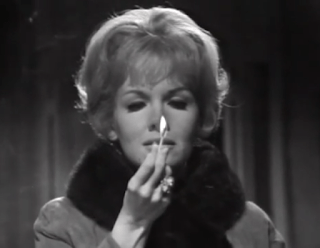
The mystery woman comes into the restaurant after Sam and Joe leave. She lights a cigarette and stares raptly at the flame of her match.

The look of love. Screenshot by Dark Shadows Before I Die

Maggie engages the woman in conversation. She starts with a cheery description of Matthew Morgan’s autopsy report. The woman’s bewildered reaction makes you wonder what it would be like to walk into a diner and be regaled with clinical details of an unexpected death. Maggie asks a series of questions. She leans further and further forward across the counter as she tries to get the woman to identify herself. By the time the woman leaves without giving any answers, Maggie almost falls face-first into her coffee cup.

Maggie goes to the tavern and tells her father that she made a fool of herself in a fruitless attempt to get the information he requested. Sam gets upset, then leaves to conduct his own investigation. He goes to the inn, looks in the guest registry, and finds a name. He goes to the telephone booth and watches the woman come into the lobby. He makes a phone call.

He is calling high-born ne’er-do-well Roger Collins. Ten years ago, Roger paid Sam to conceal evidence implicating him in a case that sent dashing action hero Burke Devlin to prison. Burke came back to town seeking revenge against Roger in episode 1, and he has by now figured out that Sam had something to do with the case as well. Roger and Sam hate each other, but are bound together by the case. Sam tells Roger to meet him at the tavern immediately.

Sam makes Roger buy him a couple of drinks, then tells him that the last person either of them had wanted to see has come back to town- Roger’s estranged wife Laura, the other witness to the event ten years ago.

The closing scene makes me wish they hadn’t put Laura’s name in the credits the other day. There has been enough evidence on screen that returning viewers will be fairly sure it must be Laura by this time, but if there were a chance it might be someone else Sam’s revelation and Roger’s reaction would have packed more of a punch.

Episode 124: To die again

Well-meaning governess Vicki has been the prisoner of fugitive Matthew, bound and gagged in a secret chamber, for several days. Vicki is sick of it, the audience is sick of it, and Alexandra Moltke Isles is sick of it. Just look at her bouncing the production slate on her knee:

Posted on Twitter by the Widow Tillane

Today, strange and troubled boy David Collins has found Vicki. David has been helping Matthew, under the impression that he was innocent. Now his pathological fear of punishment takes over. In the first month of the series, that fear had led him to try to kill his father. Now, it leads him to run away and leave Vicki at Matthew’s mercy.

David meets Matthew in the woods. Matthew believes that David has found Vicki, and tries to drag him back to the Old House. David breaks free, and runs back home. Once there, he does something we have never seen him do before- he calls for his father.

Meanwhile, a mysterious woman is hanging out in the restaurant at the Collinsport Inn. There, she tells Maggie Evans, counter-woman and The Nicest Girl in Town, the legend of the phoenix. Maggie can’t get the woman to tell her her name or much of anything else about herself. Evidently the audience isn’t supposed to have too much fun trying to guess who she might be- at the end of the episode, she is credited as “Laura Collins,” a name returning viewers will recognize as that of David’s mother.

My usual themes: Supernaturalism

In 281 of the posts that follow, I link to comments I made on Danny Horn’s blog, “Dark Shadows Every Day.”

Not all of these comments were absolutely unique. Several times I made remarks about the concept of the supernatural that Dark Shadows develops with all its ghosts, witches, and other weird beings.

In this remark about Danny’s post on episode 659, I respond to a discussion in the comment thread in which several people dismissed the idea that it was the ghost of Sarah Collins who sent Vicki back in time in episode 364, precipitating the show’s first time travel storyline:

It makes sense to me that Sarah sent Vicki back. The whole thing with the supernatural is that what seems weakest is actually strongest. The dead are stronger than the living, children stronger than adults, etc. So it fits the conceit that a long-dead and not especially bright little girl is the greatest power. It fits the dramatic development as well- throughout her time as a ghost Sarah steadily reveals more and more powers, and by the time of the seance we’re wondering what she will show us next. Moreover, her whole approach throughout 1967 is an attempt to curb Barnabas’ murderousness and to shield him from accountability at the same time. Vicki’s return from 1795 storyline precipitates events that achieve precisely that goal, and it is the goal to which Julia (Sarah’s successor as a sister to Barnabas) devotes herself for the rest of Barnabas’ time on the show.

I enlarged on my thoughts about Sarah’s ghost in a response to a post about an episode in which she actually appears, number 294:

“I don’t really think the writers are sure who Sarah is, or what she wants.” I don’t think that either we or she are supposed to know what Sarah wants. Up to this point she’s been very mysterious- for the first few episodes it was unclear what she remembered from one appearance to the next. And of course she several times expresses puzzlement that she can’t find her parents in the Old House, and she doesn’t know why David and the others think her clothes are old-fashioned. So they leave open the possibility that she was just a projection from the past with no intentions and no ability to learn in the present.

By now it’s clear that she is a character interacting with other characters, but still unsettled as to whether she knows she’s a ghost, or what happened to any of the people from her corporeal days, or what century it is. It still could be that her presence is just a side-effect of Barnabas’ revival, that she represents some kind of energy that was released into the world when he came out of the box. In the Phoenix storyline, they played with that same kind of ambiguity- Laura’s presence in the house coincided with other disturbances, over which she had no control and of which she was not aware.

Later it will become clearer that Sarah knows a fair bit, but right up to the moment Vicki vanishes from the seance she is trying to figure out a way to curb Barnabas’ murderousness without betraying him. Indeed, the speech Sarah gives speaking through Vicki at that seance is the climax of that whole development- Sarah is deep in her own thoughts, trying to solve an impossible problem, and taking a gamble on something amazing of which the most she can say is that “maybe” it will work out.

In a comment on episode 639, I said a bit more about the idea that Sarah herself is supposed to seem uncertain about her nature, her powers, and her goals, finding actress Sharon Smyth the perfect choice to play such a character:

When she first starts showing up, Sarah is a total mystery to us- it’s pretty clear she’s a ghost, but do ghosts form memories? That is, can she remember during one appearance what happened in her previous appearances, or does she know only what she learned in life? Does she have plans and intentions, or are her appearances simply the result of invisible forces? … young Sharon Smyth’s confused demeanor (nowadays she sums her performance up in “one word- clueless”) plays right into all those questions.

In a comment responding to the post about 730, I commented on how the original Phoenix storyline of episodes 126-192 (what I call the “Meet Laura” period of the show) set the stage for the supernatural tales that would come to dominate the show after the vampire shows up in episode 211:

Laura is the first paranormal being who sets a story in motion. Ghosts had been in the background from the beginning and had played important roles in ending Vicki’s first two imprisonments, but they hadn’t started any plotlines. The Phoenix story is bounded by the supernatural on all sides. At the end of it, virtually all the characters concede that they have just seen something that cannot be explained and tacitly agree never to speak of it again.

One of my less well-formed comments was a rambling half-essay about ways that particular kinds of Christians might be expected to respond to particular supernatural stories that I contributed to the thread responding to episode 1017. It was one of those internet moments where you click “Post” because it’s the only way you can imagine yourself letting go of something you’ve already wasted too much time on. Unsatisfactory as that comment wound up being, I can defend my motivation for writing it. Several contributors had made blanket assertions about what Christianity teaches concerning various matters, and someone really ought to have objected that different groups of Christians teach different things.