Downstairs in the great house of Collinwood, high-born ne’er-do-well Roger and dashing action hero Burke have another of their quarrels. Upstairs, well-meaning governess Vicki tells reclusive matriarch Liz about her shockingly lonesome childhood. Nothing happens to advance the plot, but the actors make Francis Swann’s dialogue sparkle.
Roger and Burke’s conversation revolves around one of the two major storylines introduced in episode 1, The Revenge of Burke Devlin. Liz and Vicki’s revolves around the other, Victoria Winters’ Quest to Learn Her Origins. The investigation into the death of beloved local man Bill Malloy has suggested that one or both of these may become interesting, though by now that prospect has been reduced to rather a low order of probability.
The real themes of the conversations are the real themes of the whole series- loneliness and denial. As Vicki goes on about how solitary her childhood was at the Hammond Foundling Home, Liz’ face shows one expression of agony after another. When Liz tells Vicki that she can understand loneliness, Vicki tells her that she could leave the house if she wanted to do so. Liz replies with a note of absolute finality- “No. I couldn’t.” Vicki tries to open a new topic, mentioning Liz’ daughter Carolyn, but the barriers have gone up.
Roger insisted on talking to Burke alone. The two of them go round and round, not answering each other directly or telling each other anything new. They can’t talk productively to each other, but can’t talk to anyone else at all. The unresolved, unexplained past they share binds them together and shuts everyone else out. As he leaves, Burke declares that he will return to Collinwood- “possibly to stay.” He’d been telling Liz that he wanted to buy the house, and in previous episodes we’ve seen him scheming to drive the family to bankruptcy and collect their assets. But in this context, his line sounds less like a threat to take the house from the family than like a proposal to move in with them.
There is also a memorable production fault. A camera bounces out of control and gives the audience a view of the lights above the set:
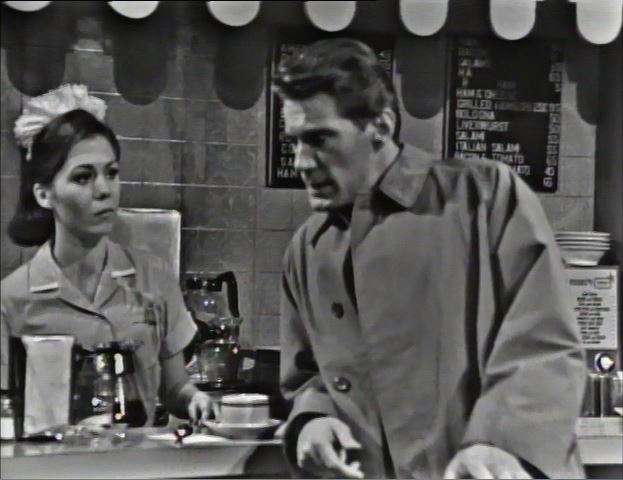
In the opening teaser, dashing action hero Burke Devlin is having lunch in the restaurant at the Collinsport Inn. As usual, he’s alone there. He strikes up a conversation with Maggie Evans, who runs the place. She listens sympathetically while he tells her that he’s worried about the missing man, plant manager Bill Malloy. He goes on about the great meal he’ll buy for his dear friend Bill when he finally turns up. Maggie has to break the news to him that the Coast Guard has fished Bill’s corpse out of the sea.
Burke suspects that his bitter enemy, high-born ne’er -do-well Roger Collins, is responsible for Bill’s death. After he telephones the sheriff’s office to ask for information and doesn’t get answers, he returns to the restaurant, agitated. Well-meaning governess Vicki walks in; Burke snaps at her about Roger, and they quarrel. Burke goes to the sheriff’s office with this suspicion. So far from enlisting the sheriff as an ally against Roger, Burke finds himself being questioned as a suspect.
Burke returns to the restaurant. Vicki is still there, having had a heart-to-heart with her new friend Maggie. Burke yet again asks Vicki for a date; she yet again refuses him, this time because she’s planning to have dinner at Maggie’s house where she will be introduced to Maggie’s father, Burke’s former friend Sam.
Patrick McCray and Marc Masse write characteristically admirable posts about this episode on their blogs. McCray cites this episode as a fine example of the kind of story-telling that defined the show in its first 42 weeks:
Episode 57 is a focused study in how much the show would change in its first year. That’s not damning with faint praise nor stating the obvious about supernatural vs secular threats. It’s a compelling little episode that moves faster than many in the post-1897 run of the series. Within it is an entirely different approach to storytelling. Far more than other soaps, DARK SHADOWS was a show about action. Characters did things in the present rather than just talk about things done in the past. And when time, space, morality, and death are irrelevant to many of your main characters, it’s easy to present a Nietzschean amusement park of action and story twists. That’s not how the program began, though. It was only with the introduction of Laura Collins that DARK SHADOWS became a series about possibilities, not limits. But limits, and seeing attractive, interesting people struggle against them, is the bread and butter of terrestrial TV drama, and episode 57 is a beautifully executed cage.
He goes on to talk about the sorts of characters they can have in this period of the show who would become impossible in later days. Bill Malloy, for example: “Malloy was too good at getting things done to coexist with incredibly vulnerable monsters whose only protection came from how unobservant everyone else was.” Because of the centrality of the character of Liz and the theme of her seclusion in this period of the show, I’d always thought of the first 42 weeks as a study in the social and psychological effects of the refusal to face unpleasant facts. But of course denial is still the show’s great theme all the way through.
Masse discusses the apparent discontinuity of Burke’s wistful tone before he learns that Bill is dead with Burke and Bill’s relationship as we saw it when Bill was alive:
And since when has Burke even cared about Malloy as a person? If he really had revered Malloy for having given him his start as he claims today, then how come he didn’t buy Malloy that best meal ever upon his return to Collinsport, instead of just toying with him at the Blue Whale in episode 3, hanging up the phone on him in episode 9, and then deftly evading his questions before showing him the door when Bill [paid] an unannounced visit to Burke’s hotel room in episode 21?
The above three episodes along with number 57 were all written by story creator and developer Art Wallace, which shows that already by September 1966 Dark Shadows was reinventing itself storywise to such a significant degree that contradictions in continuity would present themselves even if episodes in question were written by the same writer. Burke did acknowledge to Malloy in episode 45, a Francis Swann episode, that he’d been a fair employer to him when he was just starting out working on the boats of the Collins fleet; but in keeping with the opportunistic nature of Burke’s character, this was only after Malloy had offered to make a deal with him, which Burke must have surely understood would greatly benefit his own interests.
I think there is a bit more grounding in what we see for Burke’s rhapsody about Malloy in today’s episode than Masse gives the show credit for. Also, that it is misleading to suggest that only now are we seeing abrupt changes.
I’ll deal with the second of these points first. When Burke came to town in episode 1, he was cold to everyone. They retconned this aspect of his personality in episode 21, where he revisits the sets where he dealt some of his harshest snubs in #1 and is a hail-fellow-well-met even to people whom he had reason to avoid. That was a necessary revision. Soap opera writing is largely a matter of filling screen time with conversation, so a character who isn’t on speaking terms with anyone is useless. But it wasn’t a very well-motivated change in terms of what has happened in the story. Viewers who remembered episode 1 would have had a hard time explaining why Burke’s attitude is so different now.
This time, though, Art Wallace’s script makes it clear time and again that Burke is isolated and getting lonely. He had expected Sam to be his friend, but has learned that Sam fears him. Sam’s daughter Maggie listens sympathetically to him, but he’s a customer of hers, and that’s her job. He certainly can’t expect a social invitation to the Evans house. He thinks he might be able to join forces with the sheriff, but is lucky to get out of his office without a bail ticket. He arrived on the same train as Vicki, and was attracted to her from the first. Every time he sees her, he asks her out and she turns him down. When he finds out that Vicki will be having dinner with the Evanses, it makes the picture of his isolation complete. Burke hasn’t made a single friend all the time he’s been in town, and it’s getting to him.
This takes us back to Patrick McCray’s point, about the “incredibly vulnerable monsters whose only protection came from how unobservant everyone else was.” As time goes on and Dark Shadows becomes more and more a show for young children, it will often be laughable just how unobservant the human characters are. But the first of the incredibly vulnerable monsters will meet a family buffeted by hostility, suspicion, and blackmail, surrounded by enemies even inside the walls of their big dark house on the hill. He will present himself to the Collinses as a warm-hearted, charming, unworldly visitor from a foreign land who wants nothing but their friendship. The lonely people he meets will all but collapse into his arms. In Burke’s rhapsody about Bill, we see the same neediness at work.
Bill goes to the restaurant and asks Maggie a bunch of questions about Sam. As he is getting ready to leave, Vicki comes in and Maggie asks her questions about Collinwood. When Vicki leaves, Sam comes in.
Joe goes to the Blue Whale and finds Bill day-drinking. As Joe is getting ready to leave, Sam comes in and he and Bill have a conversation about what Sam told Bill when he was about to pass out drunk. Joe then goes to Collinwood and talks to Vicki about Carolyn.
Vicki’s scenes are, strictly speaking, filler. Alexandra Moltke Isles seems to have known that her character was stuck in a dead end. She plays Vicki very brightly, with maximum excitement, as if she doesn’t get out much and is thrilled that people are paying attention to her. When Joe leaves, she stands in the foyer staring off into space, looking hopeless:
On the one hand, that’s a sign of bad things to come for Vicki. Her great story-line, her winning David’s friendship, is still to come, but once that is complete her character will go completely to waste.
On the other hand, Mrs Isles’ performance in this episode is the first example of a resource they will draw on to introduce all sorts of alarming characters into the cast. That resource is the keen loneliness of the residents of Collinwood. Several times people will turn up whom the Collinses ought by all rights to throw out on the street immediately, most notably a certain cousin from England who will present himself at the house next spring. But they are isolated in their big dark house, battered by hostility, stung by betrayal, and desperate to find someone they can trust.



 Dark Shadows Commentary