The opening voiceover tells us that “Evil reaches deeply into man’s soul, turning his heart to stone, transforming him into a vile monstrosity, and it is horrible to observe this process in an innocent and not be able to recognize it or prevent it.” Without that introduction, first-time viewers would have no reason to assume that Maggie Evans, The Nicest Girl in Town, is going through anything other than an ordinary sickness that has her looking bad and snapping at people.
Kathryn Leigh Scott does play Maggie’s moodiness very well. She does an especially admirable job in the scene where she yells at her boyfriend, hardworking young fisherman Joe, and orders him out of the house. After Joe goes, Maggie looks directly into the camera, and returning viewers will recognize that she is well on her her way to becoming the undead.
Bloofer lady
Meanwhile, well-meaning governess Vicki and dashing action hero Burke are dressed up and having dinner in Collinsport’s only night spot, The Blue Whale. Most of the time, The Blue Whale is a waterfront dive with frequent bar fights. But when Burke and Vicki dine there in their good clothes, the place transforms into a respectable restaurant, as it did in #189.
Burke and Vicki recap some plot points surrounding the great estate of Collinwood. Later, Maggie’s father Sam comes in and tells them of her condition. Vicki replies to Sam’s description with “Now let me see if I understand this. You said that yesterday she was sick and she collapsed, and last night she was up and around, and this morning she was sick again?”
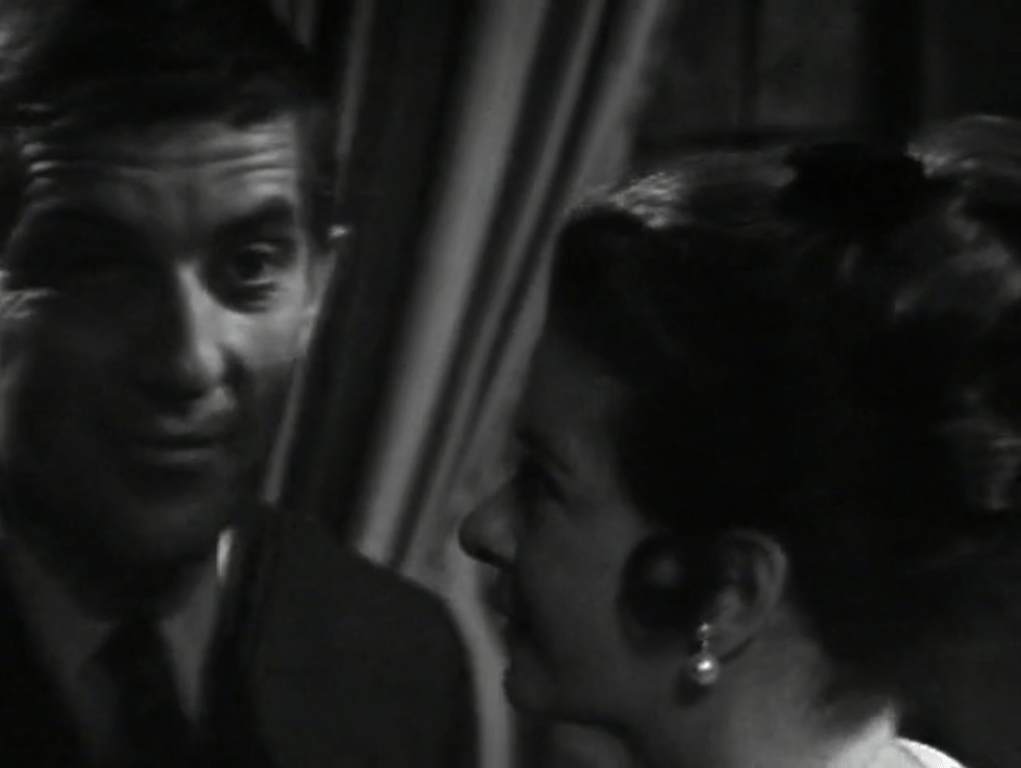
In his post about this episode on his great blog Dark Shadows Every Day, Danny Horn’s response to this line is “IT IS NOT OKAY TO SUMMARIZE A RECAP THAT HE JUST SAID ONE SENTENCE AGO.” It’s true that the episode is heavy on recapping. A defter writer than Malcolm Marmorstein probably would have started the scene with Vicki putting this question to Sam, leaving out the recap that it re-recaps. But Vicki’s question itself is a good moment. As she delivers it, Alexandra Moltke Isles uses her face to show Vicki coming to a realization that has so far eluded everyone else.
The moment of recognition
Vicki recognizes that Maggie’s symptoms are identical to those which sorely bedraggled blood-thrall Willie Loomis displayed a couple of weeks ago. As she explains this, we see Burke gradually catch on and Sam absorb the information. Up to this point, everyone has been remarkably obtuse in failing to make this connection- the same doctor who examined Willie examined Maggie today, and doesn’t give any sign of recognizing it, or for that matter of understanding anything else relating to medicine.
As Vicki was the only character yesterday who escaped the long-running Idiot Plot that goes on because everyone fails to notice the abundant evidence that reclusive matriarch Liz killed her husband and buried him in the basement, so she is the only character today who spots the obvious similarity between the cases of the two victims of the vampire. The show is still sputtering along, but in a Smart Vicki turn like this we can find a glimmer of hope that it will start moving soon.
Maggie Evans, The Nicest Girl in Town, is closing up shop in the restaurant at the Collinsport Inn. A stranger startles her. He is the mysterious Barnabas Collins. Barnabas recently left his long-time residence in the cemetery five miles north of town and has been hanging around the great estate of Collinwood, but this is the first time we’ve seen him in Collinsport proper.
In the opening months of Dark Shadows, the restaurant, like the rest of the inn, was coded as the base from which dashing action hero Burke Devlin mounted his campaign to avenge himself on the ancient and esteemed Collins family. As the Revenge of Burke Devlin storyline ran out of steam, the restaurant emerged as a neutral space where new characters could be introduced without defining their relationships to the established cast all at once. In that period, Maggie was Collinsport’s one-woman welcoming committee.
Now, even Burke has given up on his storyline. The only narrative element of the show with an open-ended future is Barnabas, and once the audience has figured out that he is a vampire there’s no such thing as a neutral space where he is concerned. So it is not clear what, if any, role the restaurant will have from now on.
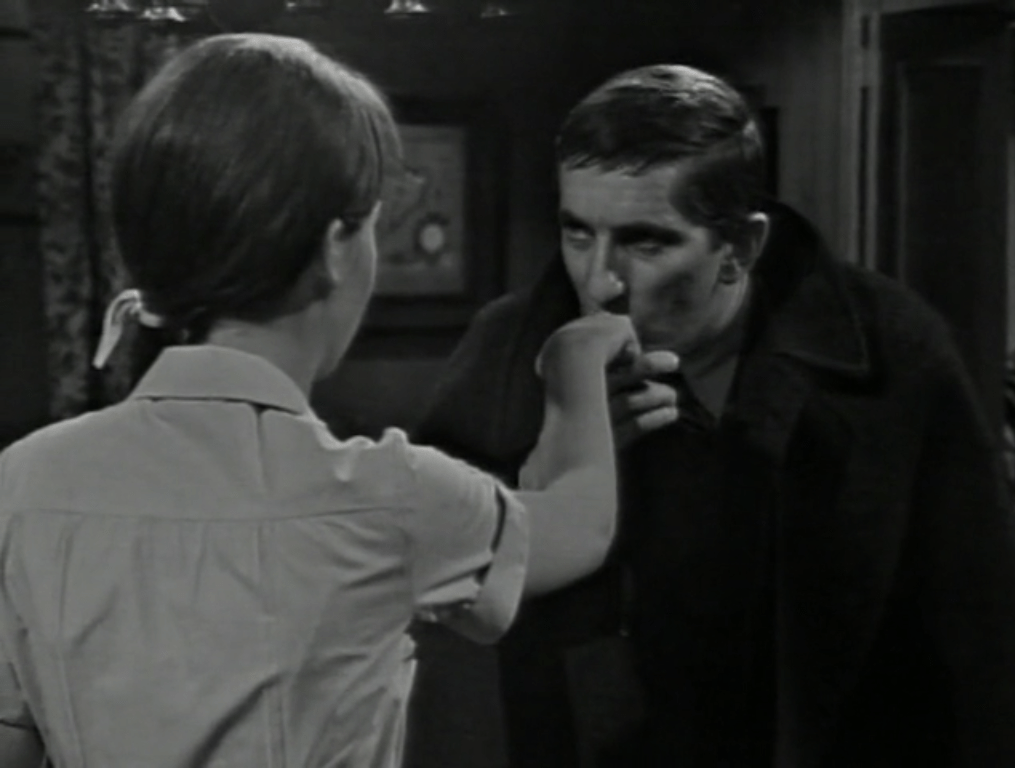
Barnabas asks if it is too late to get a cup of coffee. Maggie tells him it is, but relents after about a minute and reopens to serve him. She is charmed by his old-world manners and excited to learn that “there is a new Collins in Collinsport.” He tells her he is staying at the long-abandoned Old House on the grounds of Collinwood, prompting her to marvel at the idea of someone living in a dilapidated ruin that is probably haunted. When she admires his cane, he explains that it is not only quite valuable, but is also a family heirloom and on that account his most prized possession.
Barnabas appears to drink the coffee, as he appeared to drink the sherry his distant cousin Roger served him when he visited Collinwood in #214. Usually vampires are supposed to limit their diet strictly to human blood, but just a few weeks ago Dark Shadows wrapped up a long story about Laura Murdoch Collins, a humanoid Phoenix, who raised everyone’s suspicions by never being seen to eat or drink. So they may have thought that it would be repetitious to follow the Laura arc so closely with another undead menace who betrays himself with the same sign.
Barnabas kisses Maggie’s hand in farewell
Maggie’s boyfriend, hardworking young fisherman Joe, comes bustling into the restaurant seconds after Barnabas leaves. Maggie is surprised that Joe and Barnabas didn’t pass each other, and puzzled when Joe tells her there was no one in sight anywhere near the inn. Neither of them had heard of Barnabas before.
Joe tells Maggie that a woman named Jane Ackerman had an unpleasant run-in with a man she couldn’t see earlier in the night. The fellow retreated before doing her any serious harm, but Joe seems fairly sure that whoever it was is a real threat to the women of Collinsport. So he wants to keep Maggie company. Maggie doesn’t seem worried, either for her own sake or for Jane’s. She’s just happy to see Joe, and gladly agrees when Joe suggests they go to the local tavern, the Blue Whale.
As Dark Shadows’ principal representatives of Collinsport’s working class, Maggie and Joe illustrate the point the opening voiceover made when it said that people “far away from the great house” of Collinwood would soon be “aware of” Barnabas and of “the mystery that surrounds him.” As a name we have never heard before and are unlikely to hear again, “Jane Ackerman” reminds us that there is a whole community of people for Barnabas to snack on.
As Joe and Maggie are heading out of the restaurant, she notices that Barnabas left his precious cane behind. She wants to go straight to the Old House to return it to him. Joe would rather wait until morning, but Maggie explains that she doesn’t want to be responsible for it overnight. This is a bit odd- they are in a hotel, after all, a business that specializes in keeping valuable property safe while its owners sleep.
Perhaps Maggie wants to see the Old House. Joe has been there many times. When we saw him there with Burke, searching for well-meaning governess Vicki in #118, he mentioned that when he and flighty heiress Carolyn were children, they would occasionally play there. He returned there during the Laura storyline. Even Maggie’s father has visited the Old House, participating in a séance there in #186 and #187. Maggie has never been there at all. So perhaps she just feels left out.
Maggie and Joe knock on the doors of the Old House. No one comes. As they turn to go, there is a closeup of the door knobs turning. Maggie and Joe hear a door open, and go in. They don’t see anyone, but candles are burning and Joe remarks that the front parlor has been fixed up. Joe goes upstairs and leaves Maggie behind, explaining that he knows his way around the place and it isn’t safe up there for someone who doesn’t.
Once Maggie is alone, Barnabas appears next to her. She is startled and cannot see how he could have got there without her knowing. He apologizes for once more catching her unawares. He seems surprised that she is not alone. When Joe comes downstairs, he is exceedingly polite to both of them.
After Maggie and Joe excuse themselves, Barnabas’ blood-thrall, the sorely bedraggled Willie Loomis, appears. With obvious difficulty, Willie forces out one word after another, and manages to ask Barnabas what he plans to do to Maggie. Barnabas is displeased with Willie’s presence and with his presumption that he has the right to question him. He climbs the stairs and looks down at Willie, full of menace and demanding that he go out and do the work Barnabas has ordered him to do. Willie tries to refuse, but cannot stand the look Barnabas is giving him.
Barnabas gives Willie his orders
During this staring contest, Barnabas and Willie are standing on the spots where strange and troubled boy David Collins and Barnabas had stood when we first saw Barnabas in the Old House in #212. In that scene, David and Barnabas were more or less eye-to-eye, and for a moment it seemed that Barnabas was contemplating violence against David. In this scene, Barnabas shows how committed he is to violence. He has a power over Willie that he gained by the extreme violence of drinking Willie’s blood, and Willie’s inability to resist Barnabas’ stare shows that power in use. Willie’s horror at the task Barnabas has assigned suggests that it also is violent.
My wife, Mrs Acilius, believes that the confrontation between Willie and Barnabas solves one of the behind-the-scenes mysteries about Dark Shadows. Why was James Hall replaced by John Karlen in the role of Willie? She points out that Hall, while he is a fine actor, had a lot of trouble with Willie’s lines, particularly in the long he shared with Dennis Patrick’s Jason McGuire. By the time Willie was recast, Jonathan Frid had been attached to the role of Barnabas for some days, and Frid never made it a secret that he was a slow study. So if there were going to be a lot of long conversations between Willie and Barnabas, Willie had to be played by an actor who could get his dialogue letter perfect day after day. That was John Karlen.
After Willie scurries off to do whatever evil chore Barnabas has ordained for him, Barnabas wanders over to the window. On his way, we see that the portrait of Josette Collins is no longer hanging in the spot over the mantle where we have seen it since our first look at the Old House in #70. At the end of that episode, Josette’s ghost emanated from the portrait and danced around the outside of the house. From that point, the Old House was chiefly a setting for Josette. Crazed handyman Matthew Morgan learned that to his cost when he tried to hold Vicki prisoner there and Josette and other ghosts ganged up on him and scared him to death in #126. Laura knew that she was entering the territory of a powerful enemy when her son David took her to the Old House in #141, and when Vicki had formed a group to oppose Laura’s evil plans she and parapsychologist Dr Guthrie went there to contact Josette. In #212, Barnabas addressed the portrait and told Josette that her power was ended and he was now the master of the house. Removing the portrait tells us that Barnabas is confident that he is not only a new Collins in Collinsport, but that he is now the Collins at Collinwood.
Barnabas then does something Laura did several times- he stares intently out his window. When Laura stared out her window, David would be violently disturbed, no matter how far away he was or how many obstacles were between him and his mother. These incidents were a big enough part of Laura’s story that regular viewers, seeing Barnabas stare out the window, will expect someone at a distance from him to react intensely.
We cut from Barnabas to Joe and Maggie at her house. Joe asks what time he should pick Maggie up tomorrow, and Maggie suddenly becomes disoriented. Kathryn Leigh Scott has a sensational turn playing that moment of lightheadedness, creating the impression that she is having a scene with Barnabas. As she recovers, she explains to Joe that she has the feeling she is being stared at. Then we dissolve to Barnabas in his window. Barnabas may not be Maggie’s mother, but apparently there is some kind of link between them. Perhaps kissing Maggie’s hand in the restaurant was enough to give Barnabas the power to creep her out even when he is miles away from her.
We’ve spent over 42 weeks with the ancient and esteemed Collins family of Collinsport, Maine- reclusive matriarch Liz, high-born ne’er-do-well Roger, flighty heiress Carolyn, strange and troubled boy David, and David’s well-meaning governess Vicki. Liz owns all the biggest things in and around the town, but the family is isolated and embattled. Someone bought up Liz’ debts and tried strip her of all her assets, her only servant went on a killing spree and was stopped only by the intervention of ghosts, Roger’s ex-wife showed up and turned out to be a murderous fire witch from beyond the grave, and now Liz herself is being blackmailed by seagoing con man Jason McGuire. Jason even forced Liz to share her home with his rapey henchman, dangerously unstable ruffian Willie Loomis.
Today, an unexpected visitor comes to call on Liz at the great house of Collinwood. He identifies himself as her distant cousin, Barnabas Collins, the last survivor of the English branch of the family. This is the first Liz has heard of the existence of such a branch, but Barnabas’ resemblance to an eighteenth century portrait that hangs in the foyer is strong enough to make his claim plausible. He charms her with his old world manners. Regular viewers, knowing how lonely Liz must be, are not surprised that she is delighted with him.
Liz taking in in the information about her previously unknown relativeLiz warming to Barnabas’ companyLiz falling a little bit in love with Barnabas
Many commentators think it strange that this cousin from England does not have an English accent. I don’t see why. The last character on Dark Shadows to speak with an accent that had anything to do with the show’s setting in central Maine was killed off in #186, and Barnabas has the same mid-Atlantic accent Liz and Roger use. Since he goes on at length about himself as a typical member of the Collins family, we might assume they’ve all been talking like that for hundreds of years.
David plays in the long-abandoned Old House on the grounds of the estate. He sees Barnabas silhouetted in the doorway and greets him. Barnabas enters only after David has spoken to him.
David sees Barnabas
David thinks that Barnabas is the ghost of the man in the portrait. When David tells him that he is on intimate terms with several ghosts, Barnabas gives him a hard look and takes a step towards him.
David thinks Barnabas is a ghost
Barnabas reacts to David’s remarks with such a stiffly attentive face and such a deliberate movement of the body that we might sense menace. A man preparing a deadly attack might look like this. But David does not pick up on any danger. He chatters happily away about his ghost friends. As he does, Barnabas relaxes.
David chatters happily to Barnabas
Returning viewers know that Barnabas is not in fact from England, but that Willie released him from a coffin where he had been confined for many years. He resembles the portrait painted in the eighteenth century because he sat for it. He embodies a malign supernatural force that we heard calling to Willie through the portrait and that the caretaker of the old cemetery has said creates a palpable aura of evil that emanates from the tomb where, unknown to him or anyone else, Barnabas’ coffin lay hidden.
None of the characters in today’s episode knows these things, but when David goes back to the great house he shows that he is onto something. He tells Liz and Vicki that he thinks “there’s something funny” about Barnabas. After Liz leaves, David explains to Vicki that Barnabas does not seem angry, as does the man in the portrait, but sad, terribly sad, as if he were “haunting the rooms” of the Old House. Evidently David is rehearsing the part of Captain Shotover in Shaw’s Heartbreak House, with his famous speech about how “We don’t live in this house, we haunt it.”
Vicki functions as an internal audience in her scenes today. She is the recipient of some flowery gibberish from Barnabas about the loveliness of the syllables in her name, and afterward agrees with Liz that Barnabas is very charming. She has a conversation with Liz about whatever is happening in the Jason/ Willie story, and reacts with alarm when Liz says things we are supposed to find alarming. Finally, she is someone in front of whom David can speak freely enough to tell the audience that we’re going to wind up feeling sorry for Barnabas.
Passive as Vicki is in her time on screen today, her opening voiceover is a bit more intriguing. The first 270 episodes of Dark Shadows open with brief monologues by Alexandra Moltke Isles in character as Vicki. Usually, these monologues allude to events in the story. The implication would seem to be that Vicki either knows what is going on or will eventually find out, and that she is speaking to us from the future, where she is looking back on the events we are about to see. This has very much included the advent of Barnabas. In the opening of #202, Vicki told us that Willie was destined “to awaken and unleash a force that will affect the lives of everyone”; in #209, she said that he had “stumbled onto the darkest and strangest secret of all”; and in #210 and #211, she again referred to his grave-robbing expedition and its fell consequences.
We’ve had two major breaks so far from the pattern that establishes Vicki the speaker of the opening voiceover as the person who already knows what we are in the process of finding out. Vicki opened #15 by saying that she had at that point in the story befriended David, something she was in fact months from doing. She opened #102 telling us that Roger was the only person she had to fear, when in fact Roger was the least of her problems. Now, we break from it a third time.
Today’s opening voiceover runs thus:
My name is Victoria Winters. Night is drawing nearer and nearer to Collinwood, and the man who disappeared into another night has not been found. But out of the falling dusk, another man has come, a stranger who is not a stranger, a man with a face long familiar to those who live at Collinwood, a man who has come a great distance but who still bears deep within him a soul shaped by the far country from which he came.
Some may argue (as the Dark Shadows wiki does) that “the far country” might be a reference to death, and so this monologue might be delivered by someone who knows that Barnabas has risen from the grave. But if you know that, you aren’t likely to say that he “bears deep within him a soul,” since we usually hear that vampires don’t have souls.
Vicki has been, not only the narrator, but the point of view character and the chief protagonist of Dark Shadows up to this point. So when we ask whether her voiceover suggests that she might remain unaware of Barnabas’ nature, we are asking if she will continue in that role.
The blackmail storyline was the only one going on Dark Shadows between #201 and the arrival of Barnabas. It has an expiration date, not only because Liz will eventually run out of stuff to surrender to Jason, but also because actor Dennis Patrick agreed to play Jason on condition that he be allowed to leave whenever he wanted, but in no case later than the end of June. The show has been trending heavily toward the supernatural thriller/ horror story genre since December. Indeed, Jason’s first entry into Collinwood in #195 comes with a hint of the portrait of Barnabas, suggesting that his purpose was to introduce Barnabas to the show.
So, while they could not possibly have foreseen that Barnabas would be the hit he actually became or how they would go about rebuilding the show around him, it was likely that if ABC renewed Dark Shadows and it continued beyond #260, Barnabas would have to be a presence in one way or another.
This might offer Vicki a way back in. The previous deadly threats, crazed handyman Matthew Morgan and blonde fire witch Laura Murdoch Collins, were both thwarted by Vicki’s relationship with the ghost of Josette Collins. Josette’s portrait hangs at the Old House, and her spirit is strongest there. Since Barnabas is already at the Old House, perhaps we should expect Josette to help Vicki defeat him as she helped her defeat Laura.
The first question that expectation brings to mind is whether Barnabas is also connected to Josette, and if so how. Today, he identifies Josette to David as “our ancestor.” It has been established that Barnabas is the son of Joshua and Naomi Collins, that Joshua and Naomi continued to live in the Old House after David’s ancestor Jeremiah Collins built the great house, that Jeremiah was not the son of Joshua and Naomi, and that Josette was married to Jeremiah. In the closing scene today, Barnabas makes a speech to the portrait of Josette, telling her that he claims the Old House for himself and that she and Joshua no longer have power there.
Barnabas’ bracketing of his father and Josette as the two relatives who thwarted him would suggest that those two were closely related. I think the likeliest explanation at this point is that Jeremiah and Josette were the parents of Joshua and Naomi, and that Barnabas’ grandmother took his father’s side against him in their climactic battle. All of that is subject to change, of course- Jeremiah, Joshua, and Naomi are only names, and for all the heavy lifting Josette’s ghost has done in the story since December of 1966 she has spoken only a few words and barely shown her face. So even a drastic retcon wouldn’t require explaining any memorable images away.
If Josette is Barnabas’ grandmother, it would seem that he would know a lot more about her than even her friends Vicki and David do. So Vicki is going to have to be on her toes to recruit Josette and deploy her in a battle against Barnabas as effectively as she did in her showdown with Laura. If, as the opening voiceover suggests, Vicki is going to remain oblivious to what Barnabas is all about, Barnabas’ declaration that Josette’s power is ended will prove correct. In that case, Vicki’s future on the show would appear to be sharply limited.
Every episode of Dark Shadows begins with a voiceover narration. This is how today’s goes:
My name is Victoria Winters. The brightness of the morning cannot mask the fact that the night has been marked by a restless, fitful sleep, especially for one young woman who has been disturbed by strange premonitions and events that she does not fully understand.
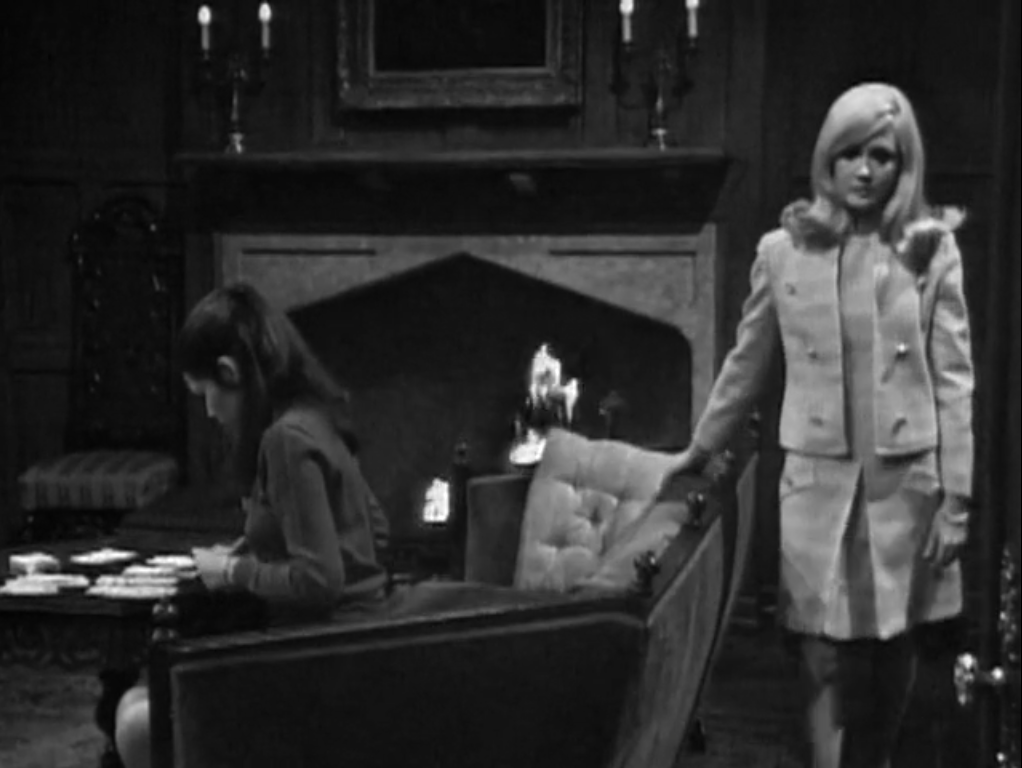
We then see the drawing room of the great house at Collinwood, where two young women are both showing signs of disturbance. There’s no way of telling which one the narration is referring to. Flighty heiress Carolyn is pacing and talking, while well-meaning governess Vicki is clenched tight playing solitaire. This sloppy mismatch is the first sign that we’re dealing with a script by Malcolm Marmorstein, the worst writer on Dark Shadows.
Disturbed by strange premonitions and events
Vicki and Carolyn are worried about strange and troubled boy David. David has spent the night with his mother, blonde fire witch Laura, and is not back yet. They are convinced that Laura is dangerous, but cannot be sure how or to whom. Marmorstein’s awkward dialogue stumbles up to a climax in which Vicki tells Carolyn that visiting parapsychologist Dr Peter Guthrie had said he was inclined to organize a séance. Considering that he first discussed that idea in a conversation with the two of them yesterday, Vicki’s announcement of this as news and Carolyn’s incredulous reaction will leave returning viewers mystified.
David comes home. He’s fine. He tells Vicki that he sensed the presence of the ghost of Josette Collins watching over him in his mother’s cottage, and that he knows he is safe wherever Josette is. What the audience knows, but neither Vicki nor David does, is that Laura and Josette had a confrontation while he was sleeping, and that Josette retreated. Josette is not strong enough to defeat Laura by herself. When David goes to sit by the fire and stare at it in a trance-like state, as his mother habitually does, we wonder how Vicki and the others will put together a strong enough force to help Josette save David. That’s a suspenseful sequence, effectively realized.
Hardworking young fisherman Joe comes to the house on a business matter. He and Carolyn have a conversation about their defunct romance. Carolyn says that she has matured since those days, and that she is free to give it another try. Joe says he is not free. For a show with so many ghosts and ghoulies, it’s surprising that Dark Shadows inspires the greatest fear in its fans when they threaten to bore us yet again with a tedious dead-end storyline like the Carolyn/ Joe relationship. It’s certainly a relief when Joe is so firm as to leave no doubt that we’re finally done with that.
Joe has transferred his affections to Maggie Evans, The Nicest Girl in Town. We dissolve to an extreme closeup of the laughing mouth of Maggie’s father, drunken artist Sam Evans. Sam is in the local tavern, The Blue Whale, with a drink in his hand, a crony on either side of him, and some music we haven’t heard before on the jukebox.
Glad Sam
Maggie and Joe are at a table, where he is trying to make her jealous by telling her of Carolyn’s interest in him, and she can’t stop watching her father and fretting about his drinking. The two of them talk a bit about how Sam’s drinking has reversed the roles of parent and child. That’s the big theme of Maggie in the first 42 weeks of the show, that she is an Adult Child of an Alcoholic. It’s because she’s had to cope with Sam’s addiction that Maggie is so nice to everyone, and also because of it that she has a habit of starting her lines with a little laugh that doesn’t always make sense in context. As the show goes on, Sam drinks a lot less and Maggie gets involved in a wider variety of stories, but that weird little laugh, the union card of many an ACoA, stays with the character to the end of her time on the the series.
Maggie leaves Joe alone at the table while she confronts Sam. She doesn’t stop him drinking, but she does manage to wreck the good mood he and his buddies had going. In the course of their talk, they recap the conversation Sam had with Dr Guthrie Thursday.
Dashing action hero Burke Devlin comes in and sits down with Joe while Maggie is scolding Sam. The two of them have been at odds over Carolyn, and now discover that neither of them is interested in her any longer. Joe seems irritated that his list of reasons to dislike Burke has grown shorter.
When Maggie returns to the table, Burke exchanges a few friendly words with her. He then goes to the bar to buy Sam a drink. Maggie voices her dismay at this plan, and even Bob the bartender gives a dark look at the idea of serving Sam yet more booze. But Burke ignores them both.
Burke wants to know about the conversation Sam had with Dr Guthrie. They recap the conversation Sam had with Maggie a few minutes before. Burke is in love with Laura, and may be under her influence. This conversation raises the prospect that Burke will be an ally of Laura’s against Vicki and her team. Its similarity to the conversation Maggie and Sam had so shortly before suggests that the Evanses may also make themselves more useful to Laura than to the good guys. The repetition grates hard enough on the audience that it is an inefficient way of making that point, but the point itself does add to the suspense.
Most episodes of Dark Shadows have only five credited actors and no extras. This one has seven credited actors and a bunch of extras, including featured background player Bob O’Connell as the bartender. There have been several episodes the last couple of weeks with only four actors; apparently they’ve been saving up to splurge on this one. It is by no means the dullest installment of this period of the show, but neither are there any of the thrills or major story developments you would expect from a high-budget episode. Frankly, it’s rather worrying that this is what they lay out the big bucks for now. Is this as exciting as the show is going to get?
The writers didn’t always put a lot of effort into Dark Shadows’ opening voiceovers, but today’s is exceptionally dire:
My name is Victoria Winters.
Collinwood is still living up to its name as a ghost-ridden house where deaths have gone unsolved. Except that in this case, the murderer is known. Only his whereabouts are unknown. But much like a wounded animal at bay, he has taken refuge in the one place where he thinks he will be safe. The Old House has already been searched thoroughly, so Matthew Morgan feels this is one place the police will not look again.
“Collinwood is still living up to its name”- it is still in the woods and is still occupied by people called Collins? No, “its name as a ghost-ridden house.” So, it is living up to its reputation, not to its name.
Then we get three short sentences beginning with “Except,” “But,” and “Only.” If the narrator has to issue three retractions in fifteen words, it’s difficult to be optimistic about what will happen when people start exchanging dialogue.
“But much like a wounded animal at bay, he has taken refuge in the one place where he thinks he will be safe.” How does that make him more like a wounded animal at bay than like any other creature who is aware of only “one place where he thinks he will be safe”?
“The Old House has already been searched thoroughly”- that sounds OK, until about 30 seconds into the episode, when Matthew lets himself into a secret chamber of the Old House that only he knows about. When you say a house has been searched “thoroughly,” I for one assume you mean that the searchers figured out how many rooms were in it.
This is the final script credited to Francis Swann. That sloppy, confused narration doesn’t sound like his writing. Maybe he was in such a rush to be done with Dark Shadows that he didn’t bother to take a second look at the opening voiceover once he’d pounded it out of his typewriter.
Or maybe he didn’t write it at all. Malcolm Marmorstein’s name will appear in the credits soon, and Marmorstein was eminently capable of writing something that lousy. The actors have an unusually hard time with their lines today, as if the teleplay got to them later than usual. Swann hasn’t written an episode since #106, and that one felt very much like his farewell. So it could be that Marmorstein was supposed to write this one, got stuck, and Swann came in to bail him out.
Further supporting that theory is a change of texture between the first half of the episode and the second half. After the prologue showing the fugitive Matthew hiding in the Old House, we go to the room in the Collinsport Inn occupied by dashing action hero Burke Devlin. Mrs Johnson, housekeeper at Collinwood and spy for Burke, visits him there. She recaps the last couple of episodes for him. The scene is listless and disjointed, in part because of the actors going up- at one point Clarice Blackburn actually prompts Mitch Ryan with Burke’s next line- but also because they have so little to work with when they do remember what they’re supposed to say.
After Mrs Johnson leaves Burke’s room, strange and troubled boy David Collins drops in on him. Mitch Ryan and David Henesy were always fun to watch together, and they manage to get a good deal of interest out of an opening exchange in which David tries to get Burke to admit that Mrs Johnson is his agent inside the Collins home. They then go into Burke’s kitchen, where they talk about their respective grudges against David’s father, high-born ne’er do-well Roger Collins. That’s an emotionally charged topic, and the kitchen is an intimate space. But the conversation is dull. The actors don’t look at each other very much- even when they aren’t reading off the teleprompter, they keep casting their eyes to the floor, as if they’re having trouble staying awake. You can’t blame them if they are sleepy- there’s nothing new in their lines.
The second half of the episode takes us back to Collinwood, and all of a sudden it comes to life. In the foyer, an authoritative-sounding Mrs Johnson scolds David for not hanging his coat up properly. He then puts her on the spot with his ideas about her and Burke. Once he has her good and nervous, he tells her he’s going to the Old House to talk to the ghosts. Mrs Johnson takes the supernatural very seriously, and responds to that idea with some words spoken in a deeply hushed tone. She finally dismisses him with a brusque command to be back for dinner. After the door closes behind him, she looks about for a moment, pensive. Taking Mrs Johnson through these moods, Clarice Blackburn traces a clear line of emotional development that gives the scene a healthy dose of dramatic interest.
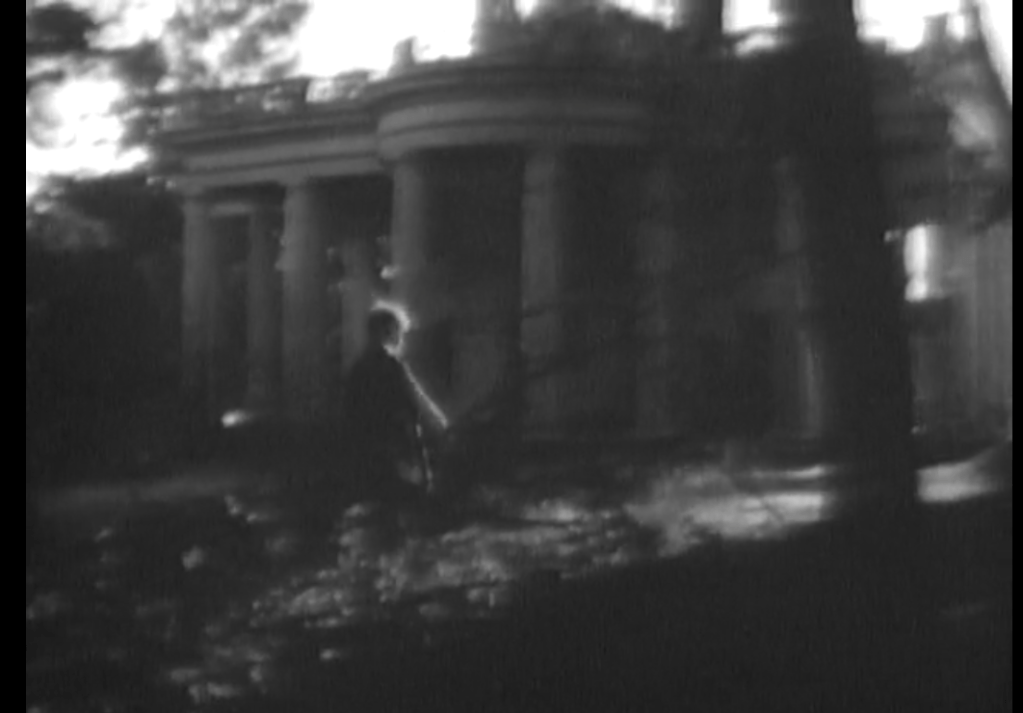
We are then treated to a previously unseen location insert in which David is skipping along the path to the Old House. It’s a lovely little scene, dreamlike and eerie:
David skipping on his way to the Old House
David stands before the portrait of Josette Collins and asks for information about Matthew. The portrait isn’t talking, but Matthew himself appears. David tells Matthew that he doesn’t believe he is a murderer, and that the two of them can investigate and prove his innocence. When David tells Matthew he has no choice but to trust him, Matthew asks “Ain’t I?” Returning viewers remember that in the previous two episodes, well-meaning governess Vicki and reclusive matriarch Liz both asked Matthew to trust them. In response, he tried to kill Vicki, and only his fanatical devotion to Liz kept him from doing the same to her. David’s blithe self-assurance stops Matthew this time, and he agrees to stay in the Old House and let David take care of him.
This episode is the first time we see the secret chamber off the parlor of the Old House. Much will happen there. Another first comes when Matthew is deciding whether to trust David or to kill him. He goes to the window of the parlor. We cut to the outside, and see him in the window thinking murderous thoughts. Many, many times next year and the year after we will see another character, one not yet introduced, in that window, vowing to kill someone or other.
The Old House isn’t the only place where today brings firsts. Up to this point the proper way for people to dispose of their coats when entering the great house of Collinwood has been to fold them and place them on a polished table in the foyer. But this time, David responds to Mrs Johnson’s reproof by taking his coat to a space next to the door where he mimes placing it on a hanger. In later years, we will actually see a set dressing there that can pass for a closet, but for now we just have to imagine one exists.
A deluxe episode today- multiple location inserts, three sets, six credited actors, several extras, music we haven’t heard before, and a special effect. By Dark Shadows standards, that’s a spectacular.
At the end of yesterday’s episode, high-born ne’er-do-well Roger Collins had sneaked up on well-meaning governess Vicki from behind, seized her, covered her mouth with his hands, and ordered her to be silent. Since Vicki is convinced Roger is a murderer and is afraid he will murder her to protect his secrets, that was quite a cliffhanger.
As we open today, Roger makes Vicki promise she won’t scream if he lets her go. He explains that when he decided to forcibly silence her, Maggie, keeper of the Collinsport restaurant and The Nicest Girl in Town, might still have been within earshot of a scream. So he “had to do that.” Otherwise, Maggie, to whom he contemptuously refers as “that little countergirl,” might have intruded on their private conversation. Now, they are all alone in the house.
Vicki does not find Roger’s explanation of his assault on her any more satisfactory than we might expect. She moves about the room keeping her eyes on him, her weight on her toes, and a clear line between her and the exit. Roger asks if she thinks he killed beloved local man Bill Malloy. She answers “I don’t think anything.” He asks her to listen to the whole story. She hears him out, but doesn’t let her guard down for a second.
Roger admits that he did see Bill the night he died. That involves admitting that he tricked Vicki into thinking he left home later than he in fact did, and thereby into giving him a false alibi in a statement to the sheriff. Roger ignores Vicki’s shocked reaction to this, and goes on to explain that Bill was already dead when he saw him. They had arranged to meet atop Lookout Point, but when Roger arrived he saw a body face-down on the beach below. He hurried down, and saw that it was Bill. Vicki asks if he looked like he’d been dead long. Not long, Roger says; he must have fallen off the cliff, been knocked unconscious, and drowned in the two or three feet of water on the beach just moments before.
Roger says he left Bill without calling for help or reporting the accident because he was afraid people would think he murdered him. “After all, I had motive, as they say.” Roger’s motive would be that Bill was trying to prove that he, not dashing action hero Burke Devlin, was responsible for a fatal hit-and-run accident ten years before. “Even you don’t believe me, do you?” he asks Vicki. Vicki says she doesn’t know what to believe, and edges closer to the door.
Returning viewers know that Roger is Dark Shadows’ most clearly defined villain, and have seen him frantically trying to conceal or destroy evidence relating to Bill’s death. Any story the makers of the show want us to consider accepting will have to give him some share of guilt. In this story, he is admitting to leaving the scene of a fatal accident. That is the very crime Bill was trying to prove that he, not Burke, committed ten years before. Since Roger is not a doctor, he is not competent to make a determination as to whether an unresponsive person is dead. For all he knows, Bill might have been saved had he gone for help. If we’ve been paying attention to the “Revenge of Burke Devlin” story, we should be wondering whether the account Roger has given Vicki will itself be enough to send him to prison. If so, we will wonder what Roger has up his sleeve to keep her quiet.
At the long-abandoned Old House, Roger’s son, strange and troubled boy David Collins, is talking to the portrait of his ancestor Josette. He asks Josette why she won’t “come down like you usually do” and talk to him. We don’t hear an answer, but David says “Well, I suppose you know what’s best.”
David tells the portrait that his governess Vicki knows that his father murdered Bill Malloy. He asks Josette if Bill’s ghost is with her and the other ghosts. Apparently she doesn’t answer him. He says that if his father finds out what Vicki knows, he will murder her, and then probably go on to murder him as well. David hears sounds outside the Old House. He puts out his candle and hides behind a chair.
Gruff caretaker Matthew enters. He announces to the dark room that he saw a light through the window, so there’s no point hiding. David comes out from behind the chair. He tells Matthew that he is visiting his friends- the ghost of Josette, of another woman similar to her, and of a younger woman, one about Vicki’s age. Matthew dismisses the topic of ghosts. David tells him that Vicki knows who killed Bill Malloy. As he has done each time Bill’s death has been mentioned, Matthew becomes agitated.
This time, Matthew’s agitation takes the form of a solicitous curiosity. David declares that his father is the murderer. “Did Miss Winters say that?” Matthew asks. No, David allows, but that’s what she meant. He asks Matthew to help him protect Vicki from Roger. Matthew mutters that he wouldn’t want any harm to come to Vicki.
Matthew’s agitation redirects our attention to the opening voiceover. Each episode starts with a brief monologue. For the first 55 weeks, all of these are delivered by Alexandra Moltke Isles in character as Vicki. Usually, they are not very informative. They are more about setting a vaguely anxious mood than about giving us specific facts about what’s going on in the story. Usually, whatever factual claims they do make are true. The only clear exception we’ve seen to that pattern so far came in #15, when Vicki says in the opening voiceover that she has made friends with David, a claim utterly belied by all the events that follow. Today, Vicki says in the opening that Roger is “the one person I have reason to fear.” That may also be false. Early on, reclusive matriarch Liz warned her that Matthew is a “strange and violent man,” and his unease about the death of Bill suggests that she might do well to keep an eye on him.
After David and Matthew have left the house, we see a replay of a bit of video from episode 70. The portrait of Josette glows, and her transparent figure walks down invisible stairs from the mantelpiece to the floor, then turns and looks back at the portrait. When David asked Josette to “come down like you usually do,” evidently he was referring to this manifestation.
Josette’s apparition has a different resonance for viewers today than it would have had for most viewers in 1966. The devices on which we see the show now have bigger screens and far clearer pictures than almost anyone would have had in those days. So it is easy for us to recognize a fact of which almost no members of the original audience would have been aware- the ghost of Josette is played by Kathryn Leigh Scott, the same actress who plays the Maggie whom Roger disdained as “that little countergirl.” Social class is a major concern of the show in the first 42 weeks, and the contrast between high-status and low-status characters is especially vivid today. That a character whose station is so lowly Roger cannot even bring himself to mention her name is played by the same person who plays a personage so lofty that she has a mansion to herself more than a century after her death gives a special punch to that contrast.
Meanwhile, flighty heiress Carolyn is on a date with Burke in the local tavern, The Blue Whale. Carolyn and Burke are well-dressed, as are the several extras at the other tables. They have china plates in front of them, and there is a more upscale type of background music playing than we usually hear at The Blue Whale. The show is at pains to establish that the tavern is a place for a nice date, rather than the waterfront dive it often appears to be. If that isn’t enough to set up an expectation that Burke and Carolyn’s date will be an important one, he says he plans to take her to another, even nicer, place later on for dancing and drinks.
Carolyn tells Burke she thinks that Vicki and Roger are becoming a couple. He is surprised. As she is explaining what has led her to this theory, she mentions that she told Roger something which Burke knows will reveal that Vicki suspects him of killing Bill. Burke excuses himself, saying that he is supposed to telephone his lawyer. He calls Vicki, and tells her he’s sending a taxi to take her away from Roger. She agrees to meet it.
Back at the table, Burke abruptly terminates the date. He explains to Carolyn that he has an urgent business meeting in ten minutes. She takes the news with uncharacteristically good humor.
Vicki slips out the back door of the house. The episode closes with a new location insert, a shot of her outdoors in the dark.
This may sound like a lot of talk, much of it recapping, but when you watch it the whole thing feels like it’s packed with high-stakes action. The actors are all in good form today, and, as usual, Francis Swann’s script gives them the opportunity to show what they can do. It is strong from beginning to end, well worth the extra expenditures they devoted to it.
Each episode of Dark Shadows begins with a voiceover. In this phase of the show, the voiceovers are all narrated by Alexandra Moltke Isles in character as Victoria Winters, well-meaning governess, and are brief passages of almost purely decorative prose, meant only to set a mood and to vanish from the audience’s memory as soon as the action starts. Art Wallace and Francis Swann, the writers credited for the first 97 episodes, were old pros who had been turning out scripts for decades, and were good at staying out of their own way. That’s why I haven’t yet said anything about any of the opening voiceovers- when Wallace or Swann set out to write something forgettable, they succeeded. By the time I started writing, I had no recollection of them whatever.
Today’s opening voiceover is unusually substantive, so much so that it threatens to leave a trace in the audience’s mind:
My name is Victoria Winters. Once again it is quiet in Collinwood. There is no sound but the ticking of the great clock in the entrance hall. And the lonely footsteps of a woman who hasn’t left its grounds in eighteen years. A woman whose life is limited to musty corridors and the endless beat of a grandfather clock. A beat that seems to ignore the vitality of the world around it.
Vicki names herself, names the estate where she lives, talks about how quiet it is, mentions the clock, tells the audience that the lady of the house is a recluse who hasn’t left home in eighteen years, complains about the air quality in the house, brings the clock up again, and assures us that interesting things are happening everywhere except here. It leaves us wondering why Vicki is so hung up on the clock, why she doesn’t run the vacuum cleaner herself, and why, if the entire world surrounding Collinwood is chock full of vitality, they don’t turn the camera in some other direction.
That’s the sort of thing we’re going to get from Wallace and Swann’s immediate successors, Ron Sproat and Malcolm Marmorstein. In writing their opening voiceovers, Sproat and Marmorstein fell between two stools. They didn’t write brief, deliberately forgettable passages as Wallace and Swann had done; nor did they integrate the opening voiceovers into the action of the show, as would happen in later years when the story is moving very fast and the episodes start with detailed recaps of events so far. Instead, Sproat and Marmorstein saw the voiceovers as vehicles for long passages of flowery, over-developed imagery. Those are certainly no more effective at setting a mood than were Wallace and Swann’s brief remarks, but they do both try the patience of the audience and linger as distractions. That’s one of the things that prejudices viewers against the character of Vicki- since so many episodes from the Sproat/ Marmorstein era start with Vicki rambling on about the weather or making vague remarks about “one small boy” or whatever, the first impression she leaves on viewers who start watching with episodes from that period is that of a prattling fool.
While Wallace and Swann are the only writers whose names have appeared in the credits thus far, it is very possible that others not credited contributed additional bits. I may be wrong, but my nose catches a whiff of Marmorstein in these six strange, distracting sentences. The description of the clock while we’re looking at it, the specified number of years since reclusive matriarch Liz has left the estate, the evocation of the “musty corridors,” the yearning glance at the eventful world outside, are all typical of Marmorstein’s attempts to turn the voiceovers into freestanding dramatic monologues, but without identifiable characters or plot development.
Today’s episode doesn’t shed much light on Vicki’s relationship to the clock or on the standards of cleanliness in the great house of Collinwood. Instead, it’s a kaleidoscope episode, in which each change of scene varies the combination of characters who interact on each set. The action plays out on two sets this time, the foyer/ drawing room representing the downstairs of the great house, and the Blue Whale tavern, representing the low and bustling life of the village. Because the sets typify the “musty corridors” inside the house and the “vitality of the world around it,” the episode is also a diptych of sorts- not Art Wallace’s usual diptych contrasting two pairs of people, but a diptych contrasting two places and the attitudes those places inspire in the people who spend time in them.
The five pieces tumbling about in today’s kaleidoscope are reclusive matriarch Liz, tightly-wound handyman Matthew, flighty heiress Carolyn, hardworking young fisherman Joe, and Maggie, the nicest girl in town. The regular bartender at the Blue Whale gets a fair bit of screen time as well. In the first 63 episodes, he’s answered to names including “Joe,” Andy,” “Mike,” and “Punchy.” Today, Joe the fisherman calls the bartender “Punchy,” a name he called him most recently in episode 56, the same episode where drunken artist Sam calls him “Mike.” Maybe we’re supposed to think that the young men know the bartender as “Punchy,” the older men as “Mike.” Eventually the show settles on the name “Bob” for him, perhaps because the performer’s name was Bob O’Connell. In one episode (#319,) Sam calls him “Ba-ba-roony,” giving rise to the idea that his name is Bob Rooney.
Liz appears only at Collinwood, of course; Joe and the bartender appear only in the bar. The others migrate back and forth between the two sets. We first see Carolyn with Joe in the bar, talking about what a flop their date has been and how pointless their whole relationship is. Maggie interrupts this thrilling conversation, looking for her father, Sam the drunken artist. After puzzling Carolyn and Joe with a number of cryptic remarks, Maggie gives up looking for her father and goes to Collinwood to look for high-born ne’er-do-well Roger. Roger isn’t home, so she winds up talking to Liz. This is the 63rd episode, and it’s the first time we’ve seen these two major characters together.
We first see Matthew in Collinwood, telling Liz how much he wants to help her. He then goes to the bar, where Carolyn and Joe see him. Matthew is looking for dashing action hero Burke Devlin, whom he hates. He implies to Carolyn and Joe that Burke is to blame for the death of beloved local man Bill Malloy. Joe doesn’t like Burke any more than Matthew does. The instant he hears Matthew’s idea, he is all in on it. Carolyn resists the suggestion.
Carolyn goes home to Collinwood. Maggie has explained to Liz that Burke has been saying terrible things about her father, that she can’t find her father to ask him about Burke’s allegations, and that Roger might know something about them. Liz urges Maggie to believe in her father, and to regard Burke as a dangerous, unscrupulous man capable of many dark deeds. Hearing the last part of this, Carolyn asks her mother if she believes that Burke is capable of murder. Yes, Liz says, she does believe that he is capable of that.









 Dark Shadows Commentary