
Episode 932: Just ourselves, and immortality

For most of 1969, Dark Shadows was a costume drama set in the year 1897. Among the characters we got to know were Quentin Collins, Charles Delaware Tate, Count Petofi, and Amanda Harris. Quentin was a rakish libertine and occasional murderer who was cursed to be a werewolf. Tate was an artist. Petofi was a sorcerer who had, for reasons of his own, given Tate the power to paint portraits with magical effects. Tate painted a portrait of Quentin that cured him of the effects both of lycanthropy and of aging. He painted a portrait of an imaginary woman, and she popped into being and became Amanda.

The story of Quentin’s portrait is borrowed from Oscar Wilde’s 1895 novel The Picture of Dorian Gray. The story of Amanda is borrowed from the story of Pygmalion and Galatea that Ovid told in Book 10 of his Metamorphoses. While Pygmalion’s statue of the ideal woman loved him when it came to life, Amanda can’t stand Tate. That’s understandable; like all characters played by Roger Davis, Tate had an intolerable personality. Amanda fell in love with Quentin, who is cruel and evil, but very charming.

Now it is 1970. Quentin has come back to the village of Collinsport, still young and handsome, but suffering from amnesia and unwilling to believe that he is a hundred years old. Amanda is back too. She is also young, not because of the painting, but because a god of death named Mr Best gave her several decades to reconnect with Quentin, get him to say he loves her, and then live with him ever after, perhaps happily.

Mad scientist Julia Hoffman has been working with Amanda to restore Quentin’s memory. Julia, Amanda, and Quentin go to see Quentin’s portrait, which Julia has just had restored. It is suitably gruesome, and Amanda runs out screaming when she sees it. But Quentin examines it, and his memory comes back to him. Julia tells him about Amanda’s deal, and says that Mr Best is on his way. He could catch up with Amanda at any time. Quentin runs out to tell Amanda that he loves her, but gets to the scene a moment too late.
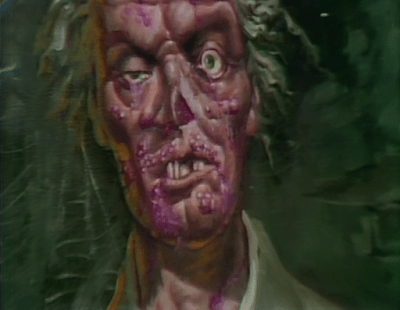
Quentin’s portrait, a face only a fan of EC Comics could love. Screenshot by Dark Shadows Before I Die.

Mr Best takes Amanda to a hotel lobby. She described this lobby to Julia in #922 when she explained her arrangement with Mr Best, but he has to explain it to her today. In #922 he called it “The Stopping-Off Place”; today he calls it “A Passing-Through Place.” He excuses himself, since he has other souls to harvest.

Amanda is alone for a moment with a bellhop in a white costume with an accent that is supposed to be sort of Cockney, or perhaps Australian. The bellhop makes it clear that he used to be alive, and that his current job makes him nostalgic for his days as a human. When he mentions things he can’t do anymore, he looks Amanda up and down for a half second. The wistfulness of his tone, the frankness of his look, and the sadness with which he turns away from her leaves no doubt what he misses. It’s a surprisingly lovely moment, and a much more adult one than we expect from the show at this point.

Back in the land of the living, Quentin and Julia have a scene in Amanda’s suite at the Collinsport Inn. Julia leaves, and Quentin tries to kill himself. Mr Best stops him. He tells him that he knows he is alive “by courtesy of Count Petofi”; this is the first time we have heard Petofi’s name since the show came back from 1897, and the first vague hint that Petofi might have survived the fire that appeared to have killed him in #884. He says that it is not Quentin’s time to die.

Quentin says he doesn’t want to live without Amanda, and Mr Best gets a bright idea. He says he likes experiments, and he has one he will run with the two of them. He takes Quentin to The Stopping Off/ A Passing-Through Place. He explains his idea. As befits Amanda, it is derived from the tale of Orpheus and Eurydice which Ovid tells earlier in Book 10 of the Metamorphoses. As Orpheus was allowed to bring his wife Eurydice back from the realm of the dead so long as they could make the long, arduous journey without looking at each other, so Quentin will be allowed to bring Amanda back so long as they do not touch each other until they return to the sunlight. The episode ends with Quentin deep in thought about this proposition while Amanda walks up behind him, stretching her hand towards him.

Mr Best tells Quentin that if he and Amanda can make their way through the countless traps and perils of the journey back to the upper world, they will be together “for eternity- whatever that means.” It’s intriguing he doesn’t know- he explicitly identifies himself as an immortal being today, and he has such a wide range of discretion that he can only be called a god. Apparently writer Sam Hall is imagining a cosmos where even the gods are left guessing about the answers to the big questions.

The story of Orpheus and Eurydice has long been a popular favorite. In the 1960s, Jean Cocteau’s 1950 Orphée and the 1959 Brazilian hit Black Orpheus were both staples of art cinema and would have been familiar to NYC theater people like the makers of Dark Shadows, so it is hardly surprising that when they start looking to classical antiquity as a source of material that was one of the first stories to come to mind.

This is Emory Bass’ final appearance as Mr Best, and Brian Sturdivant’s only appearance as the bellboy from Hell. Each will return in another small part later this year.

The closing credits roll over an image of Quentin’s portrait. Most of them do, anyway. Sturdivant’s was cut into the middle of the roll over a black background. Apparently they forgot about him until the last minute.
Better late than never. Screenshot by Dark Shadows Before I Die.

Episode 877: Put down that sword

Throughout October 1897, which at 4 PM on participating stations of the ABC television network coincided with October 1969, 150 year old sorcerer Count Petofi occupied the body of handsome young Quentin Collins and banished Quentin to his own aging form. Last week Quentin broke that spell, and now the two of them are themselves again.

News of the restoration has not reached everyone, however. On Friday and Monday, Quentin’s lover, maidservant Beth, saw him at the top of Widows’ Hill. Thinking he was Petofi, she flung herself to her death on the rocks below rather than submit to whatever evil magic he had in store for her. Yesterday, Petofi’s unreliable servant Aristide went to Quentin, thinking he was his master, and begged for a task by which he could earn his way back into his good graces. Quentin sent him to murder Petofi, which he is trying to do when we open today.

The attempt takes place in the studio of artist Charles Delaware Tate, an unpleasant man who is tied to Petofi. Tate finds Aristide plunging a knife into Petofi’s chest. He stops the attack and gets through to Aristide that the swap is over and he is stabbing Petofi himself. Desperate to undo his latest offense, Aristide hastens back to the great house of Collinwood, intending to kill Quentin.

Petofi comes to and tells Tate that he intends to repossess Quentin’s body and use it to escape his enemies. When Tate tells him what Aristide has gone to do, he sends him to stop him. He does so, showing up in the drawing room at Collinwood in the nick of time and, at gunpoint, forcing Aristide to lay down the sword with which he was about to run Quentin through.

Back in the studio, Petofi instructs Tate to draw a magical sketch. The sketch depicts a man called Garth Blackwood, a cruel jailer whom Aristide killed when he escaped from prison in England. Petofi remembers meeting Aristide for the first time the night he escaped Blackwood’s prison. In #854 Petofi had said he met Aristide in an alley near the Thames in London, but this time we flash back to a meeting on the moors in the county of Devon. Petofi recalls that Aristide pledged his fealty to him in return for freedom from Blackwood’s ghost.

Once Tate has drawn his sketch, Blackwood will come back to life, determined to take his vengeance on Aristide. Aristide returns to the studio to resume begging for mercy, and Petofi takes great pleasure in showing him the sketch and telling him what is in store for him.

Garth Blackwood.

Episode 255: My fair lady

Accustomed to Her Face

Imperious eccentric Barnabas Collins wants to reinvent working girl Maggie Evans as a member of his class- genteel in manner, florid in speech, thirsty for the blood of the living. Willie Loomis does not believe Barnabas’ plan will work, but because of the nature of their relationship he of course helps him with it. Living in their house, Maggie sometimes seems to be well on her way to developing the traits Barnabas is trying to inculcate in her, but at other times protests that she will never change.

Maggie’s father Sam is a drinking man. He comes to the house today to get some cash from Barnabas. Sam doesn’t know about Barnabas’ project; his visit has nothing to do with Maggie. He is an artist, and is delivering a portrait Barnabas commissioned him to paint.

The episode ends with a musical number. Maggie is in the basement prison cell where Barnabas keeps her between elocution lessons. Through the bars of her door, she sees and hears a little girl in eighteenth century garb singing “London Bridge is Falling Down.” The girl sings an obscure variant of the song with a verse that runs “Take the key and lock her up, lock her up, lock her up. Take the key and lock her up, my fair lady.”

Falling down.
Screenshot by Dark Shadows Before I Die

Up to this point, the Barnabas story has been a mashup of Dracula with the 1932 film The Mummy. There isn’t any particular reference to vampirism today. Maggie’s neck is uncovered throughout the episode, and we don’t even see the bite marks. It’s all about The Mummy and its possible sources.

Imhotep’s attempt in The Mummy to turn Helen Grosvenor into Princess Ankh-esen-amun may have been inspired in part by George Bernard Shaw’s Pygmalion. Imhotep only has Helen in his custody for a few minutes of screen time and those minutes are so heavy with images of Egyptian antiquities, suggestions of magic, and the threat of extreme violence that they never find time for an explicit comparison.

Dark Shadows, on the other hand, keeps Maggie in Barnabas’ house for weeks and weeks, so it’s inevitable that sooner or later they would explore the connection. Thanks to Lerner and Loewe, the story of Pygmalion was very familiar to American audiences in 1967. It’s only surprising that Sam isn’t getting married in the morning, Maggie’s boyfriend Joe doesn’t tell us that he’s often walked down Barnabas’ street before, and Maggie never shouts at a race horse to move its bloomin’ arse. Considering the alarmingly awkward movements people in Collinsport make when music is playing, there was never any prospect she could have danced all night.

Just You Wait

Maggie uses the word “undead” to describe Barnabas. The first time we heard that word on Dark Shadows was in #183, when parapsychologist Dr Guthrie told blonde fire witch Laura Murdoch Collins that he believed her to be “the undead.” Though Laura’s story owed many structural elements to Bram Stoker’s Dracula, not least Guthrie’s own depiction as a Van Helsing-like figure, she was not a vampire. So “undead” is not simply a euphemism for “vampire” on this show, though it is true they will avoid saying “vampire” until Barnabas’ 41st week.

Regular viewers who find a reminder of Laura in the word “undead” will be especially interested in today’s ending. When Laura was first on the show, she was a vague presence. There were indications that she wasn’t so much a person as she was a whole collection of phenomena, some of them physical, some of them purely spectral, each of them with its own purposes. As Laura became more dynamic, those phenomena resolved themselves into the deadly fire witch and her adversary, the benevolent ghost of Josette Collins.

Like Laura, Barnabas seems to have stirred up numerous uncanny forces with his arrival. The clearest indication of this so far has been the howling of dogs when he is forming an evil plan, a howling which is not related to his physical location and which, often as not, hampers his efforts. There have also been some shenanigans with the doors in his house which don’t seem to have a natural explanation and which he wouldn’t have had a motive to arrange. The appearance of the mysterious girl* suggests that this time, the antagonist will pull a whole new cast of characters out of the supernatural back-world behind the main setting of the show.

*The girl is a lot less mysterious than she ought to be, since the closing credits identify her as “Sarah Collins.” That’s enough to tell even first-time viewers that she is a member of the ancient and esteemed Collins family that is at the center of the show. It gives more away to regular viewers. The tomb from which Barnabas emerged has marked graves for his parents, Joshua and Naomi, and his sister, Sarah, who died in childhood.

And right before Sarah appears, Barnabas was looking at Josette’s portrait. From #70 to #191, that portrait would glow when the ghost of Josette was about to do something. So if we didn’t know her name, we might think that the girl was an ally Josette had recruited, or perhaps Josette herself in a different form than the adult ghost we have seen before. That in turn would send us into the weekend speculating about the ghostly adversaries who might be lining up to oppose Barnabas. Giving the name, even to viewers who’ve forgotten about Barnabas’ sister, limits our speculations to possible one-on-one confrontations.