Episode 251: Madness preferable to sanity

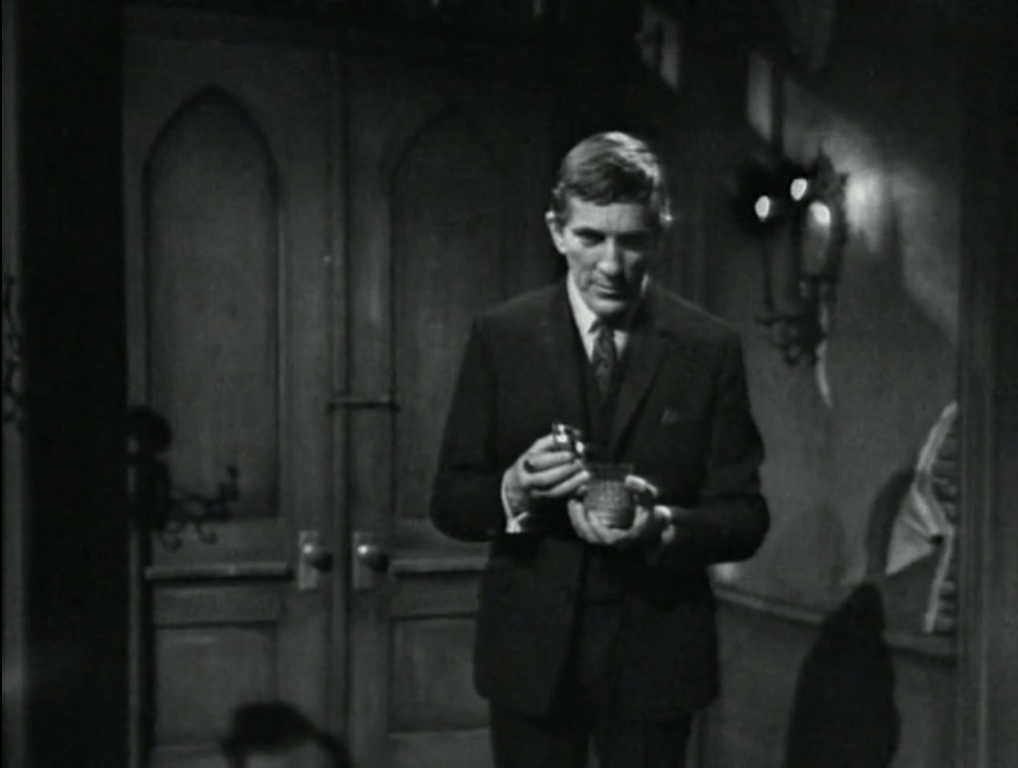
We reprise the final scene of Friday’s episode, in which vampire Barnabas Collins catches his prisoner Maggie Evans trying to stab him. He flashes his fangs at her.

Doctor Teeth and the Electric Mayhem

The first time around, this had been the climax of a number of powerfully realized scenes, so it still carried a punch despite the silliness of the fangs. From a standing start, though, the result is a bad laugh.

In the 45 seconds following the first commercial, ABC staff announcer Bill Rice* summarizes the action of the previous week’s episodes.** This recap comes so close to exhausting every event we saw in those 110 minutes of scripted drama that regular viewers will have another unintended laugh.

The recap was inserted because many ABC stations preempted Dark Shadows to cover a United Nations debate about the Vietnam War. The show was about as resolutely disengaged from contemporary politics as it was possible to be, but conjoining US policy in Vietnam with a character like Barnabas, who combines a vast capacity for killing with a desperate need to be loved, does bring certain thoughts to mind.

Barnabas and Maggie have a conversation about his inclination to kill her. Barnabas’ sorely bedraggled blood-thrall Willie Loomis joins in, saying that Barnabas will have to kill him first. This would not seem to present Barnabas with any difficulty at all. Willie wouldn’t be missed- everyone else on the show remembers Willie from the days before he met Barnabas, when he was dangerously unstable ruffian Willie Loomis, and has been urging Barnabas to get rid of him. Nor would it be especially difficult for Barnabas to replace Willie- he just has to bite someone else, and that other person will become his new slave. But Barnabas stands around arguing with Willie and Maggie. When someone knocks on the front door, he scolds Willie for failing to keep it locked, such a humdrum complaint under the circumstances as to bring another bad laugh. Barnabas leaves Willie and Maggie in the basement while he answers the door. Before he goes, he sticks out his lower lip, a facial expression known as “pouting.”

Barnabas pouts

The visitor is well-meaning governess Vicki, who tells Barnabas that the sheriff has ordered that no woman go out alone at night. Some think it strange to send a woman out alone at night to carry this message to a man who is indoors, but considering what we’ve seen of the sheriff, doing the exact opposite of what he commands would seem always to be the wisest course.

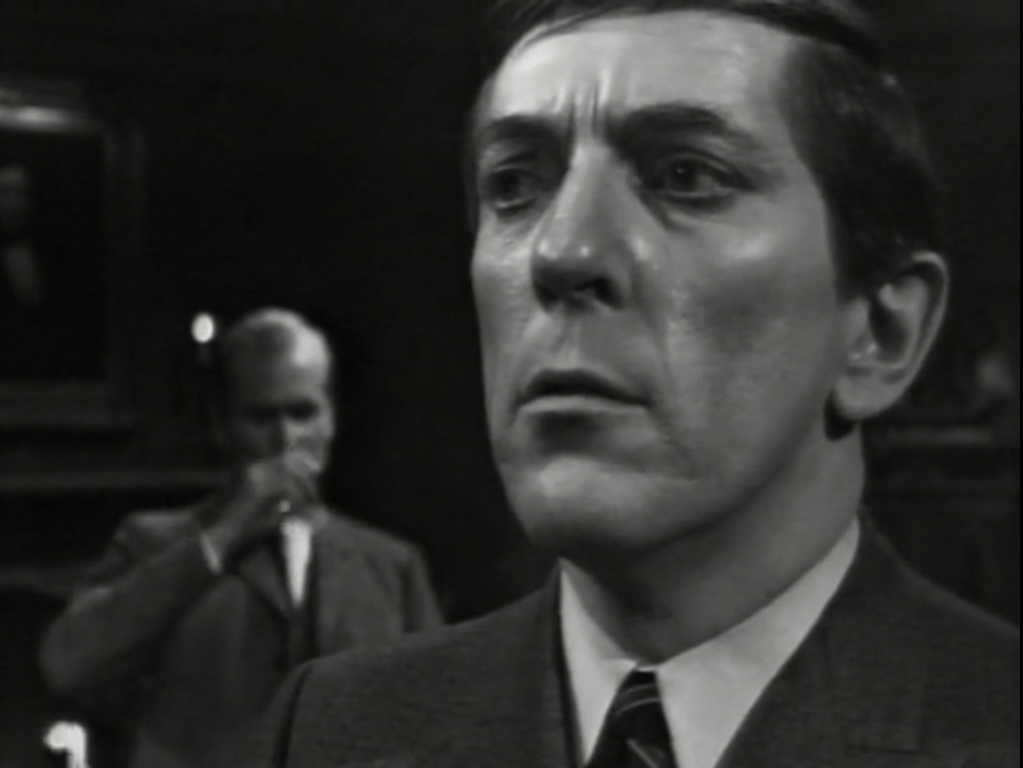
Vicki notices an antique music box on a table in Barnabas’ front parlor. Vicki admires its tune and makes a few not-very-coherent remarks about “the past” while it is playing. Barnabas has been using this music box as a tool to hypnotize Maggie into believing that she is his long-lost love Josette. After Vicki leaves, he opens it again, then looks at the door through which she left. He turns his head and smiles, looking very much like someone who has just had an exciting new idea.

Lightbulb moment

Meanwhile, Maggie and Willie talk to each other in the basement. The two of them had one of the most electrifying scenes of the entire series down there Friday. The last traces of that energy have been piddled away by the time Barnabas comes back downstairs and resumes his conversation with them.

Willie urges Barnabas to look at Maggie and see how beautiful she is. Barnabas says “No” and looks away. Coming at a moment of high dramatic tension, this might have been powerful. When we sit down as an audience, we enter into a sort of agreement that if the show includes something worth seeing, we will look at it. So when we see a character refusing to look at a sight as well worth contemplating as was the young Kathryn Leigh Scott,*** we might be shocked. But there has been too much idle chatter, and the memory of Barnabas’ pout is so fresh, that all we can think of is a petulant child saying “I don’t wanna look at her!”

Barnabas announces that he will not kill Maggie right away. He tells her that he will make her suffer torments worse than anyone has ever known so that death will finally come as a blessed relief, then locks her up in the prison cell in the basement of the house. What, your house doesn’t have a prison cell in its basement? It’s a standard feature of homes in Collinsport, as we will come to see in future episodes.

Barnabas goes to the great house of Collinwood and talks to Vicki. He brings a handkerchief that, legend has it, was a gift from the queen of France to Josette. They babble about “the past” and Barnabas invites her to drop in at his house “some day.” He says “day,” even though he’s busy being dead every day until sunset. And doesn’t specify when- any old time, if she hears screams coming from the basement she’ll probably just ignore them.

Evidently Barnabas is thinking of Vicki as a backup Josette in case Maggie doesn’t come around. This marks a retreat from #240 and #241, when strange and troubled boy David Collins, who has seen Josette’s ghost many times, saw Maggie in the gown Barnabas gave her and said that she must have been Josette because she looked “exactly the same” as he had seen her before. That suggested, not only that Barnabas chose Maggie because of her looks, but also that he might be right in thinking that she is Josette’s reincarnation. This storyline is modeled on the 1932 Universal film The Mummy, in which Imhotep’s idea that Helen Grosvenor is the reincarnation of his lost love Princess Ankh-esen-amun is substantiated when Zita Johann plays both roles. If Vicki and Maggie are interchangeable, then all of that goes by the boards.

*Presumably no relation to the main character of Gene Roddenberry’s 1963-4 CBS TV series The Lieutenant, one episode of which was written by Art Wallace.

**As transcribed by the Dark Shadows wiki:

For those who have missed the last few episodes of Dark Shadows: Elizabeth Collins [Stoddard,] at Jason McGuire’s insistence, has taken Vicki, Carolyn, and Roger into the basement room and convinces them that it holds no mystery. They don’t realize that beneath the flagstones on the floor is concealed the room’s secret—the body of Elizabeth’s husband, Paul. Elizabeth, now realizing that the secret can never be told, announces to the family that she and Jason will be married. Maggie Evans escaped from Barnabas and attempted to get to her father, but was recaptured and told by Barnabas that unless she assumes the identity of Josette Collins, she will die. Realizing that she can never escape, Maggie attempts to destroy Barnabas.

The title card shown during the recap

***Or for that matter as is the not-so-young Miss Scott of today, she’s one of the best looking octogenarians around.

Episode 247: A fix on this man’s character

Artist Sam Evans can think of nothing but his daughter Maggie, The Nicest Girl in Town. Maggie disappeared from the hospital weeks ago, and the police haven’t found a clue as to how she got out or where she is. Sam’s friend, dashing action hero Burke Devlin, drops by Sam’s house and offers to take him to dinner. Sam isn’t hungry. Burke urges Sam to work on a painting; he says he can’t concentrate.

Burke brings up the idea of Sam painting a portrait of him. Burke did commission Sam to paint him in #22, and for weeks and weeks afterward Sam vacillated about doing so. That was part of the since-abandoned “Revenge of Burke Devlin” storyline. In the notes about this episode on the Dark Shadows wiki, we read that “the episode’s writer seems unaware of the portrait-painting history between Sam and Burke, the fact that it was a sore subject, and even of the general animosity between the two.” I don’t think that is necessarily so. Burke gave up on his revenge in #201, and everyone was thoroughly bored by the topic well before then. So I suspect this conversation is telling us that Burke and Sam have turned the page on all that.

Before Maggie disappeared, Sam had been painting a portrait of mysterious eccentric Barnabas Collins. Barnabas insisted on working only at night and on doing all the painting at his place, the Old House on the estate of Collinwood, which does not have electricity. Since Maggie vanished, Sam has offered to take the canvas home and work on it there, but Barnabas would not let it leave his house. Tonight, Sam decides to go to Barnabas’ and do some painting by candlelight.

Sam knocks on Barnabas’ door. Barnabas’ servant, Willie Loomis, answers. Before he met Barnabas, Willie was a dangerously unstable ruffian. Willie menaced Sam and Maggie in the local tavern so severely that Burke had to beat him to a pulp, and Sam came away from the experience hating Willie. But in his time working on the portrait, Sam has come to believe that Willie is a changed man.

Willie explains that Barnabas is away, that he doesn’t know when he will be back, and that he isn’t supposed to let anyone in the house in his absence. Sam protests that he is no stranger, and that he is sure Barnabas will want the portrait finished. Willie finally suggests that he take the canvas home and work on it there. That’s what Sam has wanted to do all along, so he is delighted to hear it. He carries the painting to his station wagon while Willie carries the easel. The two are in a jolly mood as they leave the house, seeming very much like good friends.

Sam leaves his pipe on a table in the front parlor of Barnabas’ house. In the first months of the show he went back and forth between smoking this pipe with its white bowl carved into a likeness of George Washington and puffing on cigarettes. We haven’t seen the pipe in a long while, but today we get a number of closeups of it. The first comes before Sam leaves home to go visit Barnabas, and the second when he and Willie are on their way to the station wagon.

The pipe in the Evans cottage
The pipe at Barnabas’ house

As soon as Sam and Willie are outside, a figure draped in white comes down the stairs into the parlor. It is Maggie. It turns out Barnabas is the one who is holding Maggie. He has taken his cue from the 1932 film The Mummy, in which Boris Karloff is an undead creature who tries to convince a woman that she is the reincarnation of his lost love so that he can kill her and bring her back to life as that other person. Barnabas, it turns out, is a vampire. He wants to erase Maggie’s personality, replace it with that of his long-lost Josette, and then turn her into a vampire.

Maggie is sufficiently under Barnabas’ sway that doesn’t know who she is, but she is not fully convinced that she is Josette. When she picks up her father’s pipe she seems to remember something. She doesn’t sniff it, but a pipe is a highly aromatic object, and scents are powerful drivers of memory.

Maggie reaches for the pipe
Something comes back to Maggie’s mind

Maggie wanders back upstairs, keeping the pipe with her. Sam and Willie come in, and Sam is mystified that his pipe has vanished. When Willie says he must have left it outside, Sam starts to argue. Seeing that the pipe isn’t in the room and believing there is no one else in the house, Sam laughingly calls himself absent minded and asks Willie to keep an eye out for it.

Maggie wanders back downstairs after her father has gone. She and Willie argue about whether she ought to leave her room and who she is. She doesn’t let on that she knows anything about the pipe. She goes upstairs again, and Willie goes to the basement.

This is the first time we have seen the basement, and we get a long look at it. There is a metal door with a barred window, big cobwebs, a stone staircase, big candelabra, and a coffin. The coffin lid opens, and we see Barnabas inside. This is the first time we’ve seen him there.

Barnabas asks Willie why he has come. When Willie tells him he has news, Barnabas beckons him closer. When Willie obeys, he grabs him by the throat. When Willie has delivered his report, he flings him to the floor, apparently on general principles. He stands over Willie’s crumpled form and gives a lecture about the importance of keeping visitors out of the house during the day. Notably, he does not object to sending the canvas home with Sam.

Maggie wanders downstairs a third time. We see her face and hear her recorded voice on the soundtrack. This is the third instance of interior monologue on Dark Shadows, after we heard Willie thinking at the portrait of Barnabas in #205 and #208. As Willie did not know who Barnabas was or why he was drawn towards him when we heard his thoughts, so today Maggie does not know who she is or what Barnabas is doing to her. She looks at the pipe in her hand, concludes that there is someone she must take it to, and walks out the front door.

In the Evans cottage, Sam is working on the portrait of Barnabas when Burke comes in with a sandwich to share. They chat about the painting. Sam explains that he can’t get the eyes right- they keep looking cold and forbidding, while he and Burke agree that Barnabas doesn’t seem that way at all.

We cut back to the Old House, where Barnabas is sitting in his armchair, giving Willie some orders. He may not seem cold and forbidding to Sam, but he couldn’t be more blatantly malevolent than he is with Willie. When they discover that Maggie is gone, Barnabas and Willie run out the front door.

This is the first episode in which Barnabas is just a total bastard the entire time. When he is with people who don’t know that he is a vampire, he plays the role of the Collins family’s mild-mannered cousin from England; Barnabas is so committed to that performance that we wonder to what extent he is a monster pretending to be a nice guy, and to what extent he is a nice guy forced to function as a monster. When we’ve seen him alone with Maggie, he has obviously been a crazy person, but a twisted sweetness comes peeping out as he talks about his longing for Josette. Even in his previous scenes alone with Willie, scenes that have more than once ended with him beating Willie unmercifully, Barnabas has allowed Willie to go on talking about his feelings much longer than he would have to if he were entirely sincere when he tells Willie that his inner life is of no consequence. But there isn’t the least flicker of warmth in either of Barnabas’ scenes today.

In the Evans cottage, Sam is puzzling over the portrait while Burke is in the kitchen. Maggie comes drifting into view in the window behind Sam. The Evans cottage has been a prominent feature of the show from its early days, and the foliage visible through the window has changed often enough from episode to episode that regular viewers know there is an actual space behind it, but this is the first time we have seen a person there. In her white dress, with her dazed expression and her wafting movements, Maggie looks like a ghost. Sam sees her and is startled. He calls her name. She disappears. Sam and Burke run out of the house to look for her.

There are some significant flaws in the episode. The opening scene between Sam and Burke goes on too long, the repeated closeups on the pipe are embarrassingly heavy-handed, and Maggie’s three trips downstairs are one too many. There are also some badly framed shots, surprisingly so for director Lela Swift. For example, I cropped the fifth image above to zoom in on Sam and Maggie. Here is what actually appears in the show, cluttered with distracting junk on all sides and devoting more screen space to David Ford’s butt than anyone wanted to see:

Moon over Collinsport

Still, there is a lot of good stuff in the episode, and the ending is very effective. It is far from a gem by any reasonable standard, but it may be the best script Malcolm Marmorstein ever wrote.

Episode 240: Don’t look for her there

Vampire Barnabas Collins has taken up residence in the long-abandoned Old House on the grounds of the great estate of Collinwood and restored two rooms, leaving the rest of the mansion a shambling ruin. That image captures the current state of Dark Shadows. This episode, like many others we’ve seen recently, contains some scenes that are all right by themselves, but that do not contribute to any structure. The result is continual frustration and disappointment.

From its introduction in #70 until Barnabas claimed it in #212, the Old House was the stronghold of the ghost of Josette Collins and the playground of Josette’s darling, strange and troubled boy David Collins. We’ve seen Josette appear several times, and characters including David, well-meaning governess Vicki, and artist Sam Evans have interacted with her. Now, Barnabas not only seems to have silenced Josette’s ghost, but is holding Sam’s daughter Maggie and trying to turn her into a resurrected Josette by following the procedures Boris Karloff’s character Imhotep demonstrated in the 1932 film The Mummy. Regular viewers are growing impatient to see Josette emerge from her portrait and lead the battle against Barnabas, as she led the successful battles against crazed handyman Matthew Morgan in #122-#126 and against blonde fire witch Laura Murdoch Collins in #126-#191.

Today, David reflects our impatience. We see him at the Old House, knocking on the door, then peeping through the window. He sees a veiled figure in Josette’s white dress walking down the stairs. He returns to the door, which opens for him. No one is in sight.

We have assumed that the woman in white was Maggie wearing the dress Barnabas gave her, but the fact that she was out of sight by the time the door opened suggests that it might have been Josette’s ghost after all. David calls to Josette. When she does not answer, he goes upstairs to look for her.

David finds Josette’s restored bedroom, where her portrait now hangs. He talks to the portrait, not in the easy conversational tone he had used with it in #102, but in awkward shouts. He pleads and protests that he can’t sense her presence. When he came to the house in #223 and saw that the portrait was not in its old place above the mantle in the front parlor, he had wandered around whining that the portrait is lost and Josette is lost with it. Now that he has found the portrait, his perplexity deepens- she is still nowhere near.

Barnabas enters, and demands to know what David is doing deep in his house. After a moment, he sits and talks with the boy. He tries to present the idea of ghosts as absurd on its face, but David has seen too much to find that convincing. When Barnabas tells him that the door probably opened because of the warping of the wood, we know that it must have been the work of a paranormal being- a villain cannot say something so plausible unless it is false. Even if the figure David saw was Maggie, there is definitely some spectral presence in the house that Barnabas does not know about and cannot control.

Barnabas and David have a man-to-man talk, or should I say ghoul-to-boy.

Barnabas finally tells David to take a long, deep look at the portrait, and asks him if he still feels that Josette is there. David says that he does not have that feeling. Barnabas triumphantly declares that Josette is really gone.

Now, at last, we expect everything will start to come together. David will talk to Vicki, they will compare notes about their encounters with Josette, and will try to figure out how and why she has changed. There will be images building on the ambiguity about who David really saw through the window and who really opened the door for him. David’s father, high-born ne’er-do-well Roger, will try to revert to his usual denials that anything peculiar is going on, but will grudgingly admit that the events of the last several months have proven that Josette’s ghost is real, and will not be able to resist wondering what is going on with it now. That in turn will lead to a new understanding between Roger and Vicki, allowing Roger’s relationships with both her and David to become more dynamic. Barnabas will realize that, even if he can keep Josette from manifesting herself again, she has already revealed enough to the characters about the supernatural back-world behind the settings in which they operate that she has created a dangerous situation for him, and he will have to scramble to keep them from discovering that he is a vampire.

The script brings us right up to the brink of every one of those events, only to whisk us away and instead show us something dull and pointless. David does tell Vicki that he saw Josette’s ghost, that Josette is in some way he cannot explain different than she was when he saw her before, and that he could not feel Josette’s presence in her portrait. But Vicki does not draw on her many experiences with Josette and join David in trying to unriddle these mysteries. Instead, she behaves as she did in the first twelve weeks of the show, and treats David as if he is having a neurotic episode.

David tells Vicki that Josette’s face, as he saw it through Barnabas’ window, was “exactly the same” as it was when he saw her ghost before. We don’t see the face at all today, and when we’ve seen Josette before, the only look we had at her face were brief glimpses in #149, #165, and #184. In each of those episodes, she was played by stand-in Rosemary McNamara. Today, the performer wearing the dress is Dorrie Kavanaugh. Casting Miss McNamara and letting a bit of her face peep out for a fraction of a second would seem to be way of building on the ambiguity, especially since she resembles Kathryn Leigh Scott strongly enough that she could easily be taken for Maggie.

Though Miss Scott played Josette’s ghost in #70 and #126, this is the first we’ve heard that Maggie resembles Josette. Perhaps Barnabas chose Maggie, not only because she is an attractive young woman who works late and often has to walk home alone after dark, but because she really does look like Josette. If so, the parallel with The Mummy is stronger- Helen Grosvenor looked just like the Princess Ankh-esen-amun, and the movie hints that Imhotep may have been right to believe that she was her reincarnation.

Vicki doesn’t react at all to David’s observation. She simply grows more exasperated with him for his persistence in believing in ghosts and intruding on Barnabas’ privacy, and warns him that “your father and I” will have to become stricter with him if his behavior does not improve.

Meanwhile, Barnabas and Roger are talking in the drawing room. Roger speculates that David has gone back to his preoccupation with ghosts because everyone is so worried about the missing Maggie, then remarks that it is strange that the boy’s behavior should have created a connection between Maggie and the portrait of Josette. This line doesn’t make any sense in the script as written, but if we could believe that Roger remembers what he recently knew to be true about Josette’s ghost, its powers, and its connection to Maggie’s father, it would be a sign that he is on his way to making a crucial discovery. In that situation, Barnabas’ mounting dread as he listens to Roger would carry considerable dramatic force, as opposed to the meaningless throwaway it in fact is.

Barnabas absorbing what Roger has said

Vicki’s amnesia is especially depressing, because the only story that consistently worked in the first 39 weeks of the show was the relationship between Vicki and David. At first David hated Vicki and wanted to kill her. After he found out she’d seen a ghost, David proclaimed his love for Vicki, but that was a love that might quickly transform itself into a violent hostility. Gradually, a true friendship grew between them. The Laura arc was the climax of that story, ending with David turning away from the biological mother who wanted to kill him and embracing Vicki as a more acceptable mother figure.

Once David had adopted Vicki as his new mother, their story was complete. Alexandra Moltke Isles and David Henesy made so much of Vicki and David’s scenes together, often in spite of very bad writing, that we are eager to see a sequel to that story that will give us more victories over the stuff that dribbled out of the typewriters of Ron Sproat and Malcolm Marmorstein. One possible sequel would have been an arc in which Vicki and David have to work together to defeat the vampire. If Vicki has forgotten everything that’s happened on the show since October of 1966, when she saw the ghost of Bill Malloy in #85, she won’t be able to do that, or much of anything else for that matter. The show has been primarily a supernatural thriller for months now, and if Vicki is excluded from the supernatural stories her future on it is very limited indeed.

A possible non-supernatural storyline might have been a romance between Vicki and Roger. After all, if Vicki is acting as David’s mother and she lives in the same house as his father, it only makes sense that the two of them should become a couple. And indeed, there are moments today when that seems to have happened. She hesitates for a fraction of a second while delivering the line about “your father and I,” which does sound so much like something an impatient mother would say. She then goes on to have a quarrel with Roger about how to discipline David and what emotions it is proper to display in front of him, sounding like they’ve been married for years. After a lot of raised voices, they apologize to each other and leave together.

We’ve seen Vicki and Roger in date-like situations a few times, for example in #78 and #96, and each time it has immediately become clear that the two of them are wrong for each other. Besides, Roger has been turning into the actor who plays him, the obviously gay Louis Edmonds. So a relationship between Vicki and Roger would be doomed from the start.

Still, it would reactivate some dead storylines. The series started with Vicki on a quest to learn who her parents were, a theme that went nowhere. They’ve been hinting very heavily that Roger’s sister, reclusive matriarch Liz, is Vicki’s mother, so that an engagement between Vicki and Roger would put Liz in a position where she could hardly keep that secret any longer. Moreover, Vicki has gone on some dates with dashing action hero Burke Devlin, who is not directly connected to any ongoing storylines. Burke hates Roger and is attracted to Vicki, so a love triangle involving the three of them might bring him back into the show. But that fizzles out just as the other potentially interesting situations do, leaving us without much to look forward to.

Episode 239: The lover of her

Vampire Barnabas Collins is taking a page from the 1932 Universal Pictures film The Mummy. Boris Karloff plays Imhotep, who rises from the dead and decides that a young lady named Helen Grosvenor is actually the reincarnation of his lost love, Princess Ankh-esen-amun. He abducts Helen, tells her she is Ankh-esen-amun, and tries to kill her so that she can come back to life as that lady. Likewise, Barnabas has abducted Maggie Evans, The Nicest Girl in Town, and set about brainwashing her into thinking she is his lost love Josette. He has made it clear to the audience, if not to the other characters, that he will kill her so that she can rise as a vampiric Josette.

Today, Barnabas and Maggie are having dinner. Maggie seems to be in a daze, and only repeats what Barnabas says to her. Still, she is smiling at him and answering to the name Josette. We can’t quite tell if she is succumbing to his lunatic plan or is simply playing along with him.

Maggie’s father Sam and boyfriend Joe knock on the door. When Barnabas’ sorely-bedraggled blood-thrall Willie Loomis mentions Joe’s name, Maggie’s head jerks to the side and her eyes open. At that, we know that she was falling under Barnabas’ spell, because we can see her coming out of it.

Maggie recognizes Joe’s name

That it is Joe’s name that breaks Barnabas’ hold over Maggie echoes another of Barnabas’ sources, Bram Stoker’s Dracula. In that novel, Professor Van Helsing is delighted to hear that the vampire’s victim Lucy Westenra is receiving blood from Arthur Holmwood, because Arthur “is the lover of her!” The vampire represents, among other things, a travesty of a sexual relationship, so that real sexuality is a weapon against him.

Willie hustles Maggie upstairs to Josette’s bedroom, which Barnabas has restored complete with hairbrush, perfume, jewelry, and a portrait of the lady herself. Included among these items is a mirror, which will be of no use to Maggie once she becomes a vampire, but which, like the other things, is among the standard appointments of an ancient Egyptian lady’s tomb. Maggie can hear her father and Joe talking in the parlor below, and their voices bring her back to herself. Willie tries to keep her quiet, and does succeed in preventing her from letting Sam and Joe know that she is there, but Barnabas hears enough to know that she is trying to escape.

Sam is an artist. Before Barnabas abducted Maggie, Sam had been coming to Barnabas’ house to paint a portrait of him. He tells Barnabas that with Maggie missing, he can’t concentrate on painting. Barnabas says that of course he wouldn’t dream of asking him to work at such a time. Sam offers to take the painting home and work on it there, but Barnabas insists it stay at the house.

It has been strange that Barnabas wanted Sam to paint at his house. Barnabas only exists at night, and his house has no electricity, so conditions couldn’t be worse for painting. Moreover, he wants to get close to Maggie, and working at the Evans cottage would mean seeing her every night. Perhaps there is some magical quality that will inhere in the painting if it is done in Barnabas’ house. We’ve already seen a number of portraits act as gateways to the supernatural. The ghost of Josette has emerged from her portrait several times. And a few months ago, Josette’s ghost went to the Evans cottage and possessed Sam to literally paint a picture of what blonde fire witch Laura Murdoch Collins was up to. So Barnabas may be leery of letting the portrait out of his sight, lest Josette or some other paranormal adversary of his take control of Sam and use it to reveal his horrible secrets.

In his scenes with Maggie at the dinner table, Jonathan Frid manages to convince us that Barnabas sincerely believes that his plan will benefit her, so much so that here would be no point in trying to appeal to his conscience. It is a tribute to his success that it is startling when the episode ends with Barnabas closing in on Maggie with the intention of doing her some kind of violence. We know that he is a vampire, we know that he has attacked Maggie and other women off-screen, and we’ve seen him beat Willie savagely. But it is still chilling to see his earnest sweetness give way to violent abuse.

Episode 236: The future, for the first time

Maggie Evans, The Nicest Girl in Town, has vanished from her hospital bed. We start with a long succession of characters talking about this fact with Maggie’s father Sam. Had David Ford played Sam as effectively as he did in his first weeks on the show, one such exchange might have made for a good scene. But Ford is overacting today, and the first part of the episode drags on and on.

We cut to the Old House on the great estate of Collinwood, where Maggie’s boyfriend Joe and dashing action hero Burke Devlin have gone. Vampire Barnabas Collins resides in the Old House along with his sorely bedraggled blood thrall, Willie Loomis. Joe and Burke have no clue there is anything odd about Barnabas, but they don’t like Willie and suspect he may know what happened to Maggie.

Barnabas lets Joe and Burke in the house and explains that he sent Willie to run some errands for him out of town. When they tell him about the evidence that has led them to think Willie might be connected with Maggie’s disappearance, he persuades them that there is nothing to their suspicions. Once they are gone, he calls out “It’s all right, they’ve gone. You’re safe here- safe here with me.” Maggie walks into the room.

Barnabas talking to Burke

This scene is very good. Barnabas is made up to look much more like The Vampire than he has been in previous encounters with characters he was trying to fool into thinking he was a harmless eccentric recently arrived from overseas. He is polite enough to Joe and Burke that they can chalk his appearance up to the lateness of the hour, but as the audience watches him extract information from them point by point, until he knows exactly what they do and don’t know, we can see him calculating when and how he will have to kill them. It is as good a scene as Jonathan Frid has had since he debuted as Barnabas.

Frid’s performance in this scene benefits from his flawless line delivery. Not so, unfortunately, the scene that follows. His bobbles are not especially bad by Dark Shadows standards, but his task is far more fragile than any he has taken on before. We’ve seen him pretending to be the Collins family’s mild-mannered cousin from England; in those moments, Barnabas himself is taking on a challenging acting job, and Frid’s difficulties sometimes dovetail with troubles we might expect Barnabas to have in his performance. We’ve seen him abusing Willie; in those moments, we might expect him to sputter a bit, and Frid can hide some of his memory lapses in that mannerism. But now, he is telling Maggie what his plans are for her. As he does so, we realize he is a crazy man spilling out his deepest and sickest obsession. That context leaves nowhere to conceal even the slightest flub. As a sign of triumphant psychosis, the lines have to flow without interruption. Every time Frid stumbles for a fraction of a second, he breaks character.

Nor can Kathryn Leigh Scott bail him out. As Maggie, her part is to wander around in a stupor and occasionally repeat the last word or two of whatever is said to her. She makes that a lot more interesting to watch than you might expect, but there’s only so far it can take you.

Barnabas’ plan takes us outside the themes we are familiar with from vampire fiction. He wants to brainwash Maggie into thinking that she is Josette Collins, who has now been retconned into the woman Barnabas loved in his human days. His goal is that Maggie Evans will cease to exist, and that in her body Josette will live again.

Dracula never wanted to do anything like that, though after Dark Shadows has a hit with this storyline it will become part of vampire lore. Prince Mamuwalde, the menace in the 1972 film Blacula, kidnapped the heroine and tried to turn her into his long-dead love. Another undead fictional man from Africa had tried the same thing in 1932, when Imhotep, played by Boris Karloff, had spent the bulk of The Mummy trying to turn the heroine into a revived form of his adored Princess Ankh-esen-amun. Frid’s face and coloring were somewhat similar to those of Bela Lugosi, a fact often remarked in connection with his casting as a vampire. But his voice and movements are strongly reminiscent of Boris Karloff, and as a mashup of Dracula and Imhotep he is a synthesis of these two actors.

Barnabas gives Maggie a music box that he had intended to give Josette. He says that he bought it for Josette in his travels in “the Orient,” intending to give it to her “on a very special day,” and “this is that day.” This leaves us wondering why the day never came when he could give it to Josette. Did he become a vampire before he returned from his travels? Did he come back from his travels to find that she was no longer available to him? Or was it supposed to be a present at their wedding, a wedding that never occurred?

Barnabas also produces Josette’s wedding dress and tells Maggie that she, as the new Josette, will wear it. When Imhotep produces Ankh-esen-amun’s clothing and jewelry, we remember that royal personages in ancient Egypt were buried with their possessions and assume that he has retrieved them from her tomb. The show did lead us to wonder if the Collinses once had a similar practice. Willie released Barnabas because he had heard a story that some of the Collinses were buried with expensive jewelry and so was trying to rob a grave. The story of the buried jewels was framed as an echo of the Gothic romances that inspired the first weeks of Dark Shadows, but has now become an anticipation of the show’s journey into Universal Pictures’ back catalogue of horror movies.

If Barnabas does manage to somehow erase Maggie and bring Josette back to life in her body, it won’t be the first time Miss Scott has played Josette. In #70, Miss Scott was the ghost who emerged from Josette’s portrait and danced outside the Old House. Miss Scott put Josette’s veil on again in #126 when she led the ghosts who scared maniacal handyman Matthew Morgan to death before he could murder well-meaning governess Vicki. In that one, she delivered a few lines as Josette. Miss Scott’s name did not appear in the credits as Josette in either of those episodes, and the only time we caught a glimpse of Josette’s face was in #149, when she was played by stand-in Rosemary McNamara. But if by any odd chance a viewer does know that Miss Scott has played Josette before, the final dissolve from a closeup of Miss Scott to one of Josette’s portrait suggests a definite possibility that Barnabas’ plan, nonsensical though it seems, will somehow succeed.

Danny Horn’s post about this episode on his Dark Shadows Every Day is particularly good. He compares its visual strategy to that of the one surviving contemporary segment of General Hospital, and praises the ambitious approach director Lela Swift took to composing images. I should also mention Patrick McCray’s Dark Shadows Daybook post, in which he analyzes the way the story alienates us from our rooting interest in Maggie’s safety by promising a more exciting story if Barnabas has his way with her for an extended period.

Episode 233: Very clever girl

Well-meaning governess Vicki and flighty heiress Carolyn are in the drawing room of the great house of Collinwood talking about how nervous the electrical storm outside is making them. Vicki describes her reactions while driving a car a few moments before. This deepens a mystery that opened yesterday- what car? They’ve so often made a point of having Vicki ask to borrow Carolyn’s car, or accepting rides from people, or catching the bus, or walking much further than people thought was sensible that you’d expect them to have mentioned something if she got a car of her own.

The lights go out, and the women get even more nervous. A figure appears in the doorway and frightens them. They are relieved to discover that it’s just cousin Barnabas. Barnabas is getting to be such a familiar presence that one suspects they might have been relieved to see him even if they knew he is a vampire.

Barnabas looks out the window at the storm and talks about how fierce the storms are on the hilltop Collinwood occupies. He mentions something we haven’t heard about for months, the “Widows’ Wail.” The wind makes a peculiar sound as it blows over Widows’ Hill, and there is a legend that it is really the disembodied voices of the widows whose menfolk died on the fishing boats of the cruel Collins family. We heard the sound effect several times in the first ten weeks of the show, and the legend often came up in those days.

Barnabas then goes on at great length about a woman who leapt to her death from the cliff on Widow’s Hill well over a century before. He makes it clear that the woman was alone with her lover, then describes particular words and gestures in such detail and with such feeling that only the lover himself could provide them. He assures the women that “every word” of his account is true, including the parts about the woman unable to face a future in which she would be transformed into something she found intolerable, the lover putting his lips on the woman’s neck, her growing faint as a result, her finding a last burst of energy to fling herself to death on the rocks below, and her body found bloodless, but with a look of serenity on her face.*

Carolyn was on edge to start with, and the story deepens her anxiety. She excuses herself to go to bed. Vicki was even more anxious than Carolyn before Barnabas started his tale, but as he goes on her fear vanishes. She tells Barnabas that she wonders if there is a connection between the “bloodless” body and the recent incidents of blood loss involving cows, Barnabas’ servant Willie, and Maggie Evans, the Nicest Girl in Town. Barnabas reminds her that his story took place in an earlier century. She says she knows that, but that she is thinking that the ordinary logic of the natural world may not be enough to solve the ongoing mysteries. Regular viewers will remember that Vicki has had extensive experience with the paranormal, and have been expecting her to be the first to consider the possibility that Willie, Maggie, and the cows have encountered something that is not subject to the same laws that describe ordinary phenomena.

Vicki updates Barnabas on her thinking. Screenshot by Dark Shadows Before I Die

Barnabas squirms, and at one point drops his “cousin from England” mask altogether. As Vicki is explaining her thinking, he says in a bland voice that she is a “very clever girl” and should be careful lest the same thing happen to her that happened to Willie, Maggie, and the cows. Then he looks up and starts to walk away from her, leading to an ominous music sting and a commercial break.

After the break, we see that Barnabas is still in the drawing room with Vicki. She looks startled, and asks him what he meant by his remark. He says that he merely meant that whatever happened to them might happen to anyone. If that is intended to retroactively veil his unveiled threat, it fails miserably- it sounds even more menacing.

Among the representatives of the show’s supernatural back-world whom Vicki has already met, none is more important than the ghost of Josette Collins. The woman Barnabas is describing threw herself to her death off Widow’s Hill in a previous century while wearing a white dress, as Josette did. Other women have jumped from there in the years since, but Josette is still the most famous. When Maggie’s father, artist Sam Evans, saw the portrait of Josette in #185, he asked if she was the lady who went over the cliff. Vicki’s excited reaction to the story suggests that she thinks Barnabas might be talking about Josette.

If he is, it is a major retcon. When we first saw Barnabas in the Old House in #212, he told strange and troubled boy David Collins that she was “our ancestor,” meaning a forebear both of David’s branch of the family and of “the original Barnabas Collins,” that is, himself. After David left, he told the portrait that the house was his now, and that the spirits of his father Joshua and of Josette have no more power there. When he refers to Josette as his ancestor and brackets her with his father, he implies that she sided with his father against him. Since we know that Joshua’s wife, Barnabas’ mother, was named Naomi, and that Josette’s husband was named Jeremiah Collins, the likeliest explanation of these lines would be that Josette was Barnabas’ grandmother. Just a few weeks later, they seem to have reinvented her as his lover.

Barnabas’ story is also a bit of a departure from the usual depiction of vampires. Bram Stoker’s Dracula may have been a revenant form of Vlad III of Wallachia, but he doesn’t mope around obsessing over the good old days in the fifteenth century when he could stay up all day impaling people to his heart’s content. He is entirely focused on the task before him. Dracula’s colleagues in film and on stage had likewise tended to be killing machines, not given to nostalgia or introspection.

Barnabas’ claims to be a devotee of the late eighteenth century have so far been a technique for shifting the conversation from current events, of which he is after all comprehensively ignorant, to the deep past, in discussion of which he can show that he knows so much about the Collins family that he must be a member of it. Even when he gets carried away, as in #214 when he was telling Vicki about the construction of the Old House and started laughing maniacally about the word “death,” it’s a reminder that the events he is talking about seem quite recent to him, since he emerged from his coffin not long ago. But today, he seems to be brooding over the past in a way that has less to do with previous vampires than it does with the character Boris Karloff played in The Mummy (1932). Indeed, Jonathan Frid’s voice and movements are so strongly reminiscent of Karloff that one wonders if Barnabas will turn out to be a merger of Dracula with Imhotep.

Seagoing con man Jason McGuire enters. Vicki hates Jason, who is flagrantly blackmailing reclusive matriarch Liz. She likes Barnabas, but the encounter with him is getting extremely awkward. She quickly excuses herself to go to bed. When Barnabas says that he too must be going, Jason insists that he stay.

Barnabas’ reaction to Jason is pretty funny. When Jason says he wants to discuss something with him, Barnabas tenses and rolls his eyes. Suddenly the drawing room is the scene of a drawing room comedy, and Barnabas is the classic snob forced to deal with an uncouth bounder. For regular viewers, their scene is not just a well-played, if not particularly well-written, specimen of this genre. Barnabas is the latest of the supernatural beings who have been driving the action of the show for six months, while Jason is a throwback to the days when Dark Shadows was a noir-ish crime drama centered on the search for Burke Devlin’s fountain pen. Barnabas’ disdain for Jason mirrors our lack of interest in reviving that phase of the show.

Jason reveals to Barnabas that he had seen Willie earlier that night, that he suspects Willie is involved somehow in the troubles afflicting Maggie, and that he knows Willie has been visiting Eagle Hill cemetery. All of this is unsettling to Barnabas. He goes home to the Old House on the estate, shouts “Willie!,” and raises the cane he had earlier used to give Willie a severe beating.

*John and Christine Scoleri transcribe Barnabas’ whole story in their post about this episode on their Dark Shadows Before I Die.