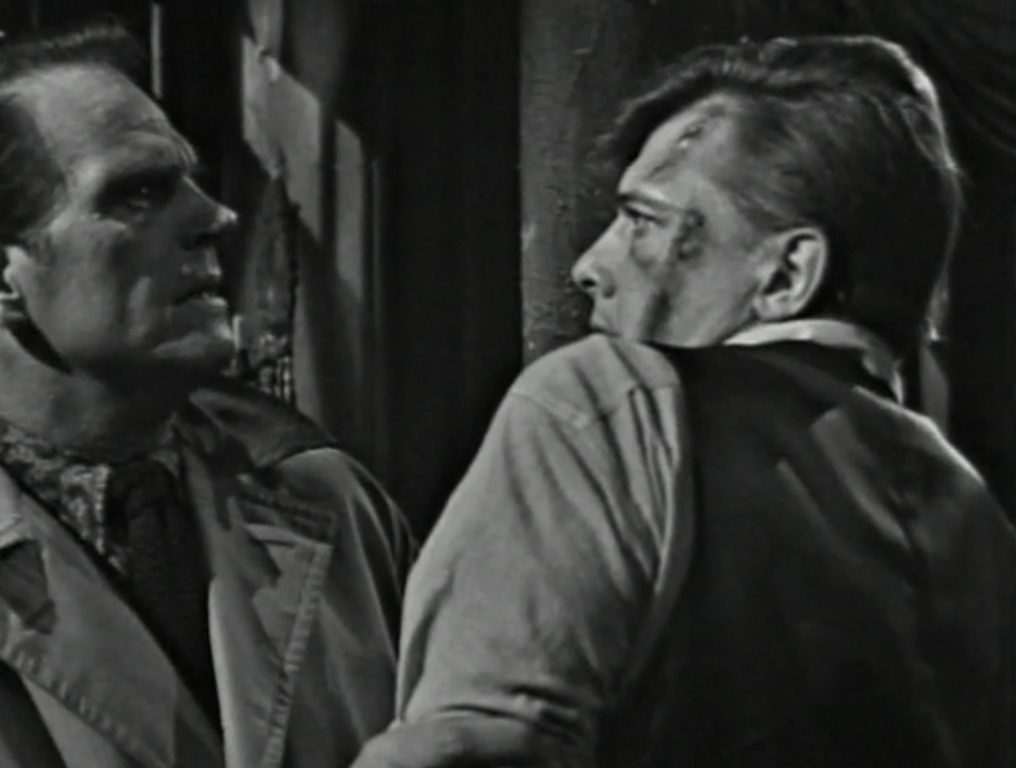
Episode 627: Her name is Victoria. I cannot take care of her.

Dan Curtis often said that the idea for Dark Shadows came to him in a dream about a girl with long black hair taking a journey by train. When he persuaded ABC-TV to let him make a pilot for a series, the most difficult part of the casting process was finding the actress who would embody that girl, whose name came to be Victoria Winters. Alexandra Isles, then still known as Alexandra Moltke, finally emerged as the one person who combined the right physical appearance with a mysterious, otherworldly quality that suggests a figure from a dream.

From Episode 1: The girl on the train. Reflected in the window behind her is Burke Devlin, her original love interest.

Mrs Isles’ casting had an immediate effect on the underlying story in Art Wallace’s original series bible, Shadows on the Wall. Wallace projected a puzzle about Vicki’s origins that would be resolved when it was revealed that she was the child of an extramarital liaison between Paul Stoddard, the long-missing husband of matriarch Elizabeth Collins Stoddard, and some unknown woman. Liz’ guilty feelings about Paul would explain her concern for Vicki and her decision to bring her to the great house of Collinwood as governess for her nephew, strange and troubled boy David Collins. Since Vicki would not be a blood relative of the Collins family, it would also leave an option for Vicki to develop a romance with David’s father, Liz’ brother Roger.

From Episode 1: The front doors of Collinwood open for the first time. Liz and Vicki come face to face, and each sees her own reflection in the other.

Wallace did include a note saying that if it was more story-productive, it could turn out that Liz was Vicki’s mother. Liz was played by Joan Bennett, whom Mrs Isles strongly resembled. When Bennett first saw Mrs Isles, she famously mistook her for her own daughter. From the first episode on, the show heavily signaled that Vicki was Liz’ daughter by a man other than Paul. Liz soon treats Vicki so much like a daughter that the only events that would follow from confirming the relationship would be to make some changes to Liz’ will. Since the business aspects of the characters’ lives ceased to generate action after the first few months, that would have been a severe anti-climax. So they wound up dropping the question altogether.

For the first 39 weeks of Dark Shadows, Vicki was its main protagonist. Not many of the storylines worked in those days; the only scenes that reliably clicked were those between Vicki and David. Even though their dialogue was as dreary as anything else in those early scripts, Mrs Isles and David Henesy managed to use their physical movements and the spaces they occupied to tell the story of a young woman persuading a boy to trust her. That version of the show ended with #191, when David ran from the mother who was trying to lure him to his death and flung himself into Vicki’s arms. That completed their story, and left neither character with a clear path forward.

From Episode 191: David turns from his mother and death, embracing Vicki and life.

After #191, the show was on course for the introduction of vampire Barnabas Collins. Vicki kept trying to get close to Barnabas; she even invited herself to spend the night at his house in #285 and #286. But he wouldn’t bite her, and she couldn’t get a foothold in the A-story otherwise. There was an odd meta-fictional side to Vicki in this phase. In-universe, she didn’t know that Barnabas was a vampire, and she certainly didn’t know that she was a character on a soap opera that was coming to be all about him. But her behavior made sense only if she did know those things and was making an effort to reestablish herself as a central figure in the action. I don’t know whether Mrs Isles or any other particular person was lobbying the writers to present her that way, or if it was a response to fan mail. It happened so often and led to so little that it did seem to be coming from somewhere outside the usual creative process behind the scripts.

In November 1967, Vicki came unstuck in time and found herself in the year 1795. She took the audience with her, and for several months the show was a costume drama set in the late eighteenth century. On balance, the result was a triumph. By the time Vicki and the show came back to contemporary dress in March 1968, Dark Shadows had become a real hit, and Barnabas had become one of the major pop culture phenomena of the 1960s. But Vicki did not benefit from that success. When the costume drama insert started, fans had every reason to expect it would revive her character. Barnabas spent most of his time in 1967 scrambling to impersonate a native of the twentieth century; Jonathan Frid would always say that it was in that scramble that he found Barnabas, and that he thought of him first and foremost as a liar. When Vicki turns up in Barnabas’ original period, we look forward to seeing her doing what he did, and trying to pass as his little sister’s governess. Remembering how well Mrs Isles did during the 39 weeks she carried the show on her shoulders, we look forward to her showing us what Vicki can do when she has to think fast.

But that was not to be. Instead, Curtis and his staff chose to write Vicki as an intolerable moron. She introduced herself to every new person by telling them that they are being played by actors who had other parts in the first 73 weeks of the show. Tedious as that habit was, it was compounded when she made one inexplicably idiotic decision after another as she failed utterly to adapt to her new surroundings. That would have been a difficult role to make appealing even if she had shared her screen time with a partner as capable as David Henesy. It became utterly impossible when Vicki made the least intelligible move of all and fell in love with her jailer/ lawyer/ boyfriend/ accomplice Peter Bradford, played by the abusive and shouty Roger Davis. Marooned in scene after scene with Mr Davis, Mrs Isles withered and Vicki became a cipher. By the time the court sentenced Vicki to be put to death for her many crimes, half the audience was on their side.

Shortly after Vicki returned to the 1960s, Barnabas finally bit her. Each of Barnabas’ victims reacted to his bite differently; Vicki’s reaction was perhaps the most unexpected, and certainly the funniest. She was just sort of chill about the whole thing. She showed up when Barnabas summoned her and didn’t object when he told he her she would become his vampire bride for all eternity, but first she had some errands to run, and she was irritated with him when he tried to get her to skip them. When a doctor saw the bite marks on her neck, she did not react with the fear or defensiveness of other victims, but innocently asked “Why are they bad?” She seemed to regard them as just another hickey, the result of Barnabas’ peculiar make-out technique.

Unfortunately, Peter came back to life and ruined Vicki’s relationship with Barnabas. He jumped out in the road in front of her car while she was driving off with Barnabas, causing her to crash. Vicki and Barnabas were taken to the hospital. There, one of the doctors turned out to be a mad scientist who cured Barnabas of vampirism. Once the cure took hold, Vicki forgot all about her time as Barnabas’ victim, and she sunk into a relationship with the irredeemably repellent Peter. Every time we’ve seen her in recent months, she has dragged Peter back to our attention. Mrs Isles has found ways to liven up Vicki’s scenes; she always projected a forceful personality when she was standing near the clock in the foyer of the great house of Collinwood, and she has even managed to coax Roger Davis into playing a couple of scenes competently. Mr Davis never had quite as much to offer as did the clock, but when Mrs Isles could raise her voice and fix him with a steely stare it does seem to have come back to him that he had had a lot of acting lessons and could deliver dialogue interestingly.

Today is Mrs Isles’ last day on the job. We open with a reprise of the end of yesterday’s episode, when Vicki finds the corpse of a strangled woman in the closet in Peter’s room. Peter assures her he doesn’t know how the corpse got there. She tells him they have to call the police. He says he needs time to figure out what happened before they can involve the police; she points out that delaying will only make him look guiltier in their eyes. He tells her that she should leave so that her name won’t be connected with the case; she tells him it is too late for that. We can see why Vicki has faded- she is thinking like a rational person from our world, not like anyone you would meet in Soap Opera Land.

Vicki goes home to Collinwood and tells permanent houseguest Julia Hoffman that Peter is in jail, suspected of murder. She explains that the dead person is a woman Peter knew only as Eve. Julia reacts with shock to the name; Vicki asks if she knew Eve. Julia says of course not, and Vicki tells her she will go wake Roger and ask him to help arrange bail for Peter. She goes into the door leading to the bedrooms, never to be seen again.
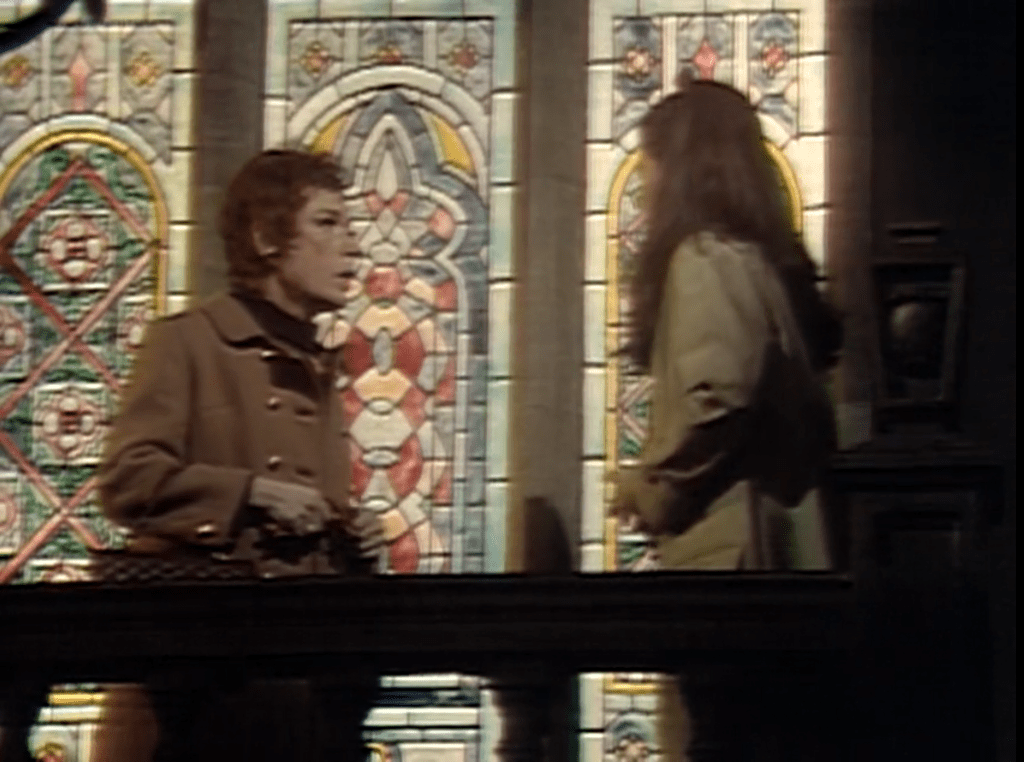
In her final appearance, Vicki talks with Julia, her successor as the principal audience-identification character.

Viewers who have been with the show from the beginning will see a loop closing in the idea of Vicki going to Roger’s bedroom while he sleeps. In #4, Roger had tried to let himself into Vicki’s bedroom at night, only to be caught with his hand on the doorknob by Liz. In response to Liz’ threats, Roger told her not to bother him about his “morals,” a choice of words that made it clear that his intentions with regard to Vicki were of a sexual nature. Later in the episode, he and Vicki bantered flirtatiously after he offered her a snifter of brandy; for the first and last time, Vicki sounded like what she was supposed to have been, a street kid from NYC. Roger has long since been stripped of all his villainous qualities; in #585, he and Vicki even shared a scene in her bedroom while she was in her nightgown, and it was all perfectly innocent. In that scene, we not only saw that the old menacing Roger was gone forever, but that Vicki was also reduced to such a humdrum status that a man can enter her bedroom at night without raising an eyebrow. Now that Julia sees nothing out of the ordinary in Vicki dropping in on Roger while he sleeps, that humdrum status is reinforced.

When Vicki first arrived in the village of Collinsport in #1, she met her original love interest, dashing action hero Burke Devlin. Burke told her she had found her way to “the beginning and the end of the world.” We are reminded of the beginning of the world since we know that the man who killed Eve was named Adam. This Adam and Eve are no one’s parents; they share nothing but hostility and death. The episode ends with the wicked Angelique trying to summon up the Devil, a symbol of the end of the world. She herself disappears, apparently destroyed. Burke’s description is finally fulfilled.

The part of Vicki will be recast twice in the months ahead, but those actresses never had a chance to breathe any life into her. The character had lost any reason to be on the show long before Mrs Isles’ departure. In #87, David had trapped Vicki and left her to die; wondering where she was, Roger said, “She came to us from nowhere, and now it seems she has disappeared into nowhere.” And so, at last, it has come to be. The long-haired girl from Dan Curtis’ dream, the image that started it all, has vanished, never to be seen again.

Episode 465: Too cool for ghoul

The other day, vampire Barnabas Collins added well-meaning governess Vicki to his diet. Barnabas has bitten several people in the year he has been on Dark Shadows, and his victims have reacted to the experience in a wide variety of ways. Vicki’s post-bite syndrome is unique on the show, and as far as I know unique in vampire stories. Her reaction could most succinctly be summarized as “not feelin’ it.”

Barnabas had hoped to enslave Vicki with his bite, as he had enslaved others, and attributes her blasé response to the unseen presence of wicked witch Angelique. But it may be that Barnabas has himself to blame. Several times in 1967, Vicki went out of her way to make herself available to Barnabas for biting. She invited herself to his house for a sleepover in #285, pressed her neck towards his teeth while embracing him in #311, and has rarely missed a chance to be alone with him. There is a hilarious meta-fictional element to this theme, as Vicki tries to secure a place for herself in the main storyline by becoming the vampire’s thrall.

For his part, Barnabas has time and again looked at Vicki’s neck, shown his fangs to the camera, and then backed off. Even when he finally did bite Vicki in #462, he spent so much time and energy displaying his internal struggle that my wife, Mrs Acilius, commented “Barnabas is about to make himself sick.” Indeed, he took so long making that display that the episode ended before he sank his teeth into Vicki, and we had to wait until the next day to be sure he’d actually gone through with it. You hardly expect Vicki to be excited that such a reluctant suitor has at long last deigned to attach himself to her.

Vicki has recently returned from a long visit to the year 1795,* when the human Barnabas died and the vampire began his career. Barnabas fears she may have discovered his secret while in that period, a fear that deepens as her scattered memories return.

In fact, Vicki never discovered that Barnabas was a vampire. She does have some information that, coupled with what she and others have already found out, could lead to his exposure, but she isn’t thinking about that at all. Instead, her main focus is on an unpleasant man named Peter, whom she met and with whom she fell in love in the 1790s. On Wednesday, she learned that shortly after she left the eighteenth century Peter had been hanged for a killing she committed,** and she is frantic with guilt about it.

At the top of today’s episode, Barnabas sends Vicki a telepathic message that they will be eloping tonight. She accepts this without any visible emotion. Then her friend, hardworking young fisherman Joe (Joel Crothers,) comes to the door. In the 1790s segment, Crothers played naval officer/ sleazy operator Nathan Forbes, a villain who was responsible for many terrible crimes against Vicki and people she cared about. This is the first time we’ve seen Joe since the show returned to contemporary dress, and Vicki takes a while to adjust to the fact that it is her trusty old pal before her, not the detestable schemer who did so much to blight her time in the eighteenth century.

Joe has come to bring Vicki a charm bracelet that his girlfriend Maggie had given her. The charm bracelet turned up in the old courthouse in the village of Collinsport. The courthouse has been disused for years and is about to be torn down. Joe wonders when Vicki was there; she makes many cryptic remarks in reply, but can’t bring herself to tell such a sensible fellow that she was tried there for witchcraft and sentenced to death 172 years before, much less that his counterpart gave the testimony that condemned her to the gallows.

After Joe has gone, Vicki still isn’t motivated to do anything to prepare for her departure with Barnabas. Instead, she takes a nap in the drawing room. She has a dream in which she sees Peter in his gaol cell. She promises him that she will prove his innocence, and marches off. She finds Nathan dozing at a desk. She tells Nathan that he could prevent Peter’s execution if he were to tell the judges that he lied when he told them he saw Peter kill the man whom Vicki actually killed. Nathan cheerfully explains that he cannot tell the judges anything, since he is dead. He tells Vicki that she is dead, too- he was strangled, she was hanged.

Nathan, having a wonderful time in the afterlife, proposes a toast “to Death- the best of all possible worlds!” Screenshot by Dark Shadows Before I Die.

Nathan’s statement is proof that the dream is not simply a product of Vicki’s psychology, but a communication with Nathan’s spirit. Barnabas strangled Nathan, but his father Joshua Collins hid that fact from the world, and neither Vicki nor anyone else alive in 1968 has any way of knowing about it. Vicki wasn’t hanged, but she was about to be when she was whisked back to her own time, and Nathan would have no way of knowing she survived.

Vicki goes back to Peter’s cell and finds it empty. She turns and sees the gallows, on which Peter is hanged before her eyes. She wakes up calling out Peter’s name.

Vicki opens her eyes to see Barnabas standing in front of her. He asks her who Peter was; she says he was someone she knew long ago, and that it will be hard for her to forget him. He asks if she knew he was coming; she affirms that she did. If he knew about the contents of the very elaborate dream she just had, he would have all the more reason to ask such a question. The only action of Barnabas’ mentioned in it was Nathan’s murder, and Nathan doesn’t bother to tell Vicki by whom he was strangled. There are four speaking roles and a background player in the dream, and not only is Barnabas not one of them, no one mentions in it his name, sees his image, or comes into contact with any of his belongings. Barnabas has been dominating the show since he was first named in #205, and Vicki, whom he was under the impression he had enthralled, has lost all interest in him.

Barnabas tells Vicki it’s time to go. She says she has to do something else first. She wants to go to the old Collins mausoleum and see if there is a secret room hidden there. If there is, she will know she really did travel back in time.

Barnabas was trapped in his coffin in that secret room from the 1790s until 1967, and is anxious that no one should discover its existence. He is also eager to get going with whatever plan he has made for Vicki. But he finds himself powerless to oppose her. Not only is he not her dark and irresistible master, as he had been of his other blood thralls, he isn’t getting nearly as much deference from her as she had always shown him before he bit her.

We cut to a car, in which Vicki is driving Barnabas to the cemetery. Apparently it is Vicki’s car. This is the first time we have seen Vicki driving, and it brings up a bit of a riddle for viewers who have been paying close attention to Dark Shadows from the beginning. In the first 46 weeks of Dark Shadows, Vicki was continually asking to borrow heiress Carolyn’s car, getting rides from people, walking longer distances than others thought reasonable, trying to catch the bus, and wishing she had a bicycle. In #232, #233, and #259, it was implied that Vicki had a car of her own. They never explained how or when she came into possession of such a thing, but they stopped all the business of her trying to find a way to get around. As we watch Barnabas squirming in the passenger seat, we can believe he would rather be standing with her at a bus stop.

Barnabas keeps telling Vicki that he doesn’t think they ought to go to the mausoleum. She snaps at him that he was originally enthusiastic about going. The statement is entirely false, and the line is entirely convincing. We saw that Barnabas was appalled at Vicki’s interest in the mausoleum, and we saw that she was too absorbed in her own thoughts to notice his feelings. The two of them bicker about the need to get settled before sunrise, and they sound for all the world like an old married couple. Barnabas exercises exactly zero control over Vicki, and the result is hilarious.

The bickering couple. Screenshot by Dark Shadows Before I Die.

The show so often puts Vicki in the role of Designated Dum-Dum, requiring her to facilitate the mechanics of the plot by doing things she would have no reason to do, that the show’s original protagonist is eventually swallowed up by Dumb Vicki. It’s always refreshing to see Smart Vicki put in an appearance. I don’t know if the woman we see today is a perfect example of Smart Vicki, but she certainly is Smart Alexandra Moltke Isles. Mrs Isles’ performance is so good that even a hater like Danny Horn had to admit in his post about the episode on Dark Shadows Every Day that she is fun to watch. And the character is Strong Vicki, taking action in pursuit of her own objectives, making use of the information available to her, and bending Barnabas to her will.

The scene in the car will have an amusing echo for longtime viewers. From November 1966 to March 1967, instantly forgettable young lawyer Frank Garner kept telling Vicki how interested he was in her. Vicki went on some dates with him and accepted him as her sidekick in her struggle against undead fire witch Laura Murdoch Collins, but all in all was almost as cool towards him as she has been to Barnabas post-bite. In #153, Vicki was Frank’s passenger in his car. He thought they were going out for a glamorous evening, but she abruptly insisted that they go to the old cemetery north of town and visit an old crypt. Frank was about as pleased then as Barnabas is now. I suppose a fellow ought to know what he’s getting into when he and Vicki get into a car together.

Barnabas sees a figure ahead and asks Vicki what it is. She looks and slows down. A man in contemporary dress who looks like Peter lopes into the road, smiles a big goofy grin, and waves. Even though Vicki’s movements and the sound effects told us she took her foot off the accelerator as soon as Barnabas said he saw something, the man is so close to the car that she slams on the brakes, the tires squeal, and she loses control of the vehicle. He must have wandered right in front of the car. That confirms for returning viewers that the man must be Peter. He always did the least intelligent and most dangerous thing, usually while grabbing at people and shouting in a petulant voice. Poor Vicki. Barnabas is a vampire and a cold fish, but she’s managed to get herself stuck with a guy who makes those shortcomings look minor by comparison.

Ugh, this guy. Screenshot by Dark Shadows Before I Die.

*It was 1795 in #365, and in #413 they explicitly told us the new year 1796 had come. But after Vicki returns to the 1960s in #461, the only year they talk about is 1795.

**With justification- she shot a man who was trying to strangle a young boy.

Episode 259: Mustache, must tell

Elizabeth Collins Stoddard, matriarch of the ancient and esteemed Collins family of Collinsport, Maine, receives a telephone call. Her daughter Carolyn is in jail. Driving drunk, Carolyn barely missed a pedestrian, smashing instead into a tree. The almost-victim rescued Carolyn from the car moments before the fuel tank exploded, and Carolyn rewarded her with some nasty remarks. Liz is upset that her brother Roger isn’t available to pick Carolyn up from the police station.

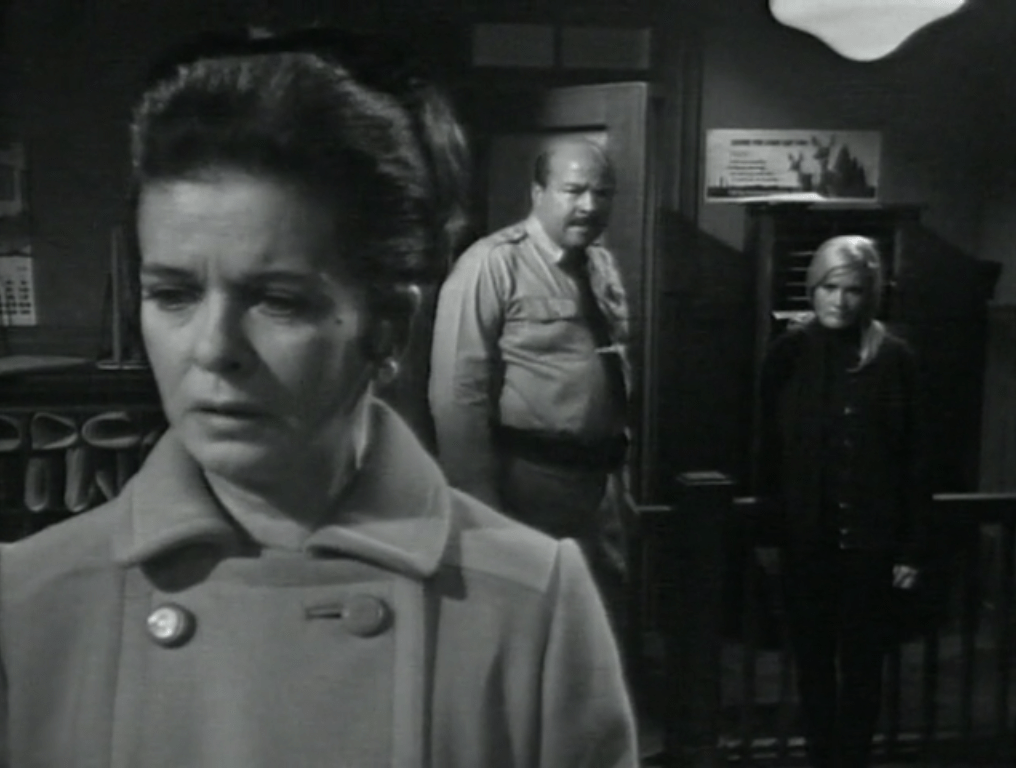
Well-meaning governess Vicki suggests that Liz go to the police station herself. Liz hasn’t left home under her own power for eighteen years, and so reacts to this idea with dread. Vicki talks her into it, giving Alexandra Moltke Isles a chance to show that there is some substance to her character. Looking in through the front door, we see Liz taking a series of halting, forced steps to Vicki’s car.*

Seen in isolation from the rest of the series, Liz’ march is a poignant evocation of agoraphobia. But the Liz-is-a-recluse story is a dead end. They never showed us anyplace Liz would want to go, and the reason for her staying in the house was exposed in #249 as nonsensical. Still, they’ve been presenting Liz as a recluse from the beginning, so sending her into town feels like a promise that something big will happen.

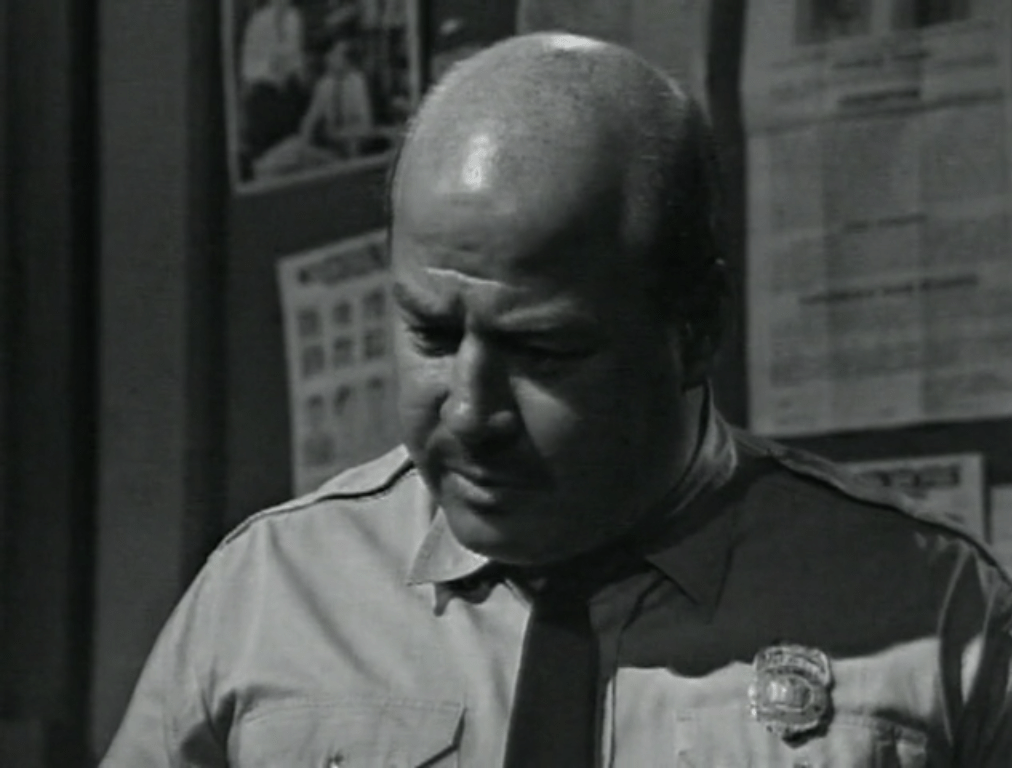
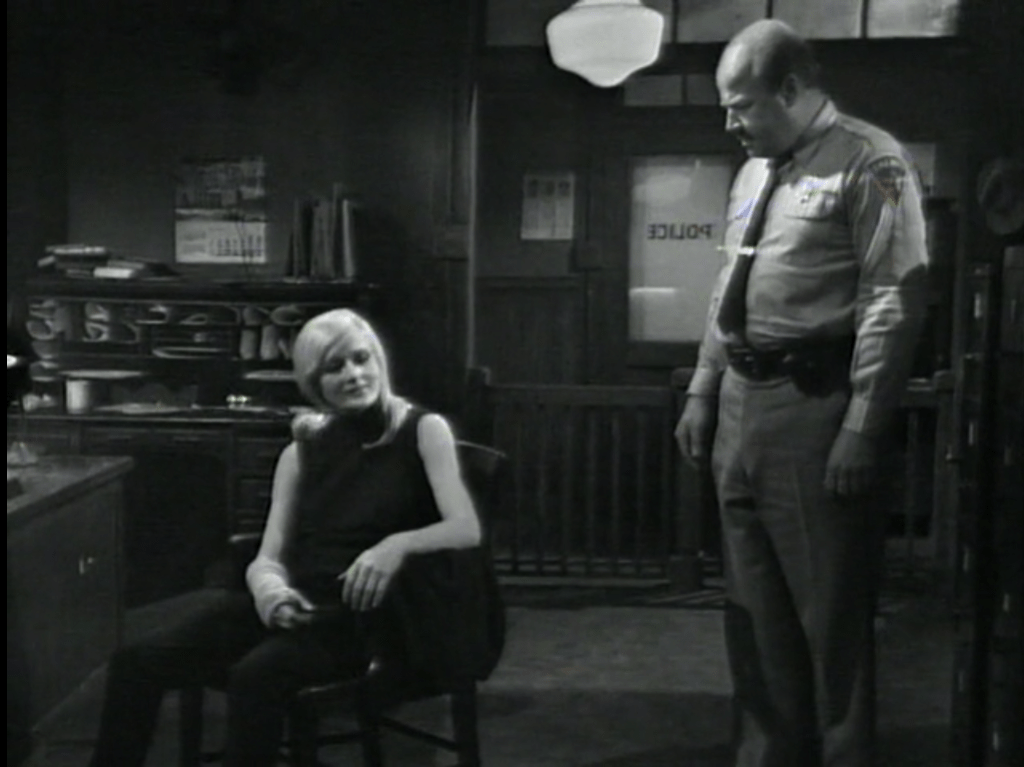
In the police station, we see that Sheriff Patterson has grown a mustache. He didn’t have one when last we saw him, in #248, and he won’t have one when next we see him, in #272. So this is our only chance to appreciate it.

Carolyn is doing a “teen rebel” bit. This would have been one thing earlier in the series, when she was supposed to be fresh out of high school and wildly capricious. But she took charge of the family business for a month early in the spring of 1967, and has been relatively level-headed since. When she makes sassy remarks to the sheriff, they are just throwing all that character development out the window.

Liz shows up, to the sheriff’s amazement and Carolyn’s. Carolyn recovers from the shock, and claims she is not impressed by Liz’ leaving the house. Liz supposedly stayed there for eighteen years waiting for Carolyn’s father, Paul Stoddard, to come back. Now she is divorcing Stoddard and marrying seagoing con man Jason McGuire. If Stoddard means nothing to Liz anymore, what’s the big deal about going into town? Carolyn then makes some superheated remarks about Liz’ disloyalty to Stoddard. Finally, she refuses to leave with Liz. She insists on spending the night in a cell.

In #244, Liz tried to tell Carolyn that her father was a terrible man who never loved anyone. Carolyn became upset and wouldn’t listen to her, then jumped to believe Jason’s stories that Stoddard was a fine fellow who doted on her. That was understandable as a first reaction to dismal news, but we’ve never seen any other indication that Carolyn is especially hung up on the father who disappeared from the house when she was an infant. All the shouting about “my father!” comes out of nowhere. The scene amounts to nothing.

Back in the drawing room, Liz has a conversation with Jason. She has agreed to marry him because he has threatened that if she does not he will reveal to the police that she killed Stoddard and he buried him in the basement. The blackmail plot has been dragging on for months, and we have yet to see anything happen between Liz and Jason that didn’t happen in the first five minutes they were on camera. At this point, scenes like this are just a test of the audience’s endurance.

Upstairs in Collinwood, Vicki hears sobbing in Liz’ bedroom. She calls to her, and lets herself in. She apologizes for urging her to see Carolyn. She suspects that Liz has something she wants to say, and gently presses her to say it. Liz finally confesses that she killed Stoddard. The whole scene is very effective, a strong conclusion to a weak outing.

*It became clear in #232 and #233 that Vicki has a car. How and when she came into possession of this vehicle has not been explained.

Episode 233: Very clever girl

Well-meaning governess Vicki and flighty heiress Carolyn are in the drawing room of the great house of Collinwood talking about how nervous the electrical storm outside is making them. Vicki describes her reactions while driving a car a few moments before. This deepens a mystery that opened yesterday- what car? They’ve so often made a point of having Vicki ask to borrow Carolyn’s car, or accepting rides from people, or catching the bus, or walking much further than people thought was sensible that you’d expect them to have mentioned something if she got a car of her own.

The lights go out, and the women get even more nervous. A figure appears in the doorway and frightens them. They are relieved to discover that it’s just cousin Barnabas. Barnabas is getting to be such a familiar presence that one suspects they might have been relieved to see him even if they knew he is a vampire.

Barnabas looks out the window at the storm and talks about how fierce the storms are on the hilltop Collinwood occupies. He mentions something we haven’t heard about for months, the “Widows’ Wail.” The wind makes a peculiar sound as it blows over Widows’ Hill, and there is a legend that it is really the disembodied voices of the widows whose menfolk died on the fishing boats of the cruel Collins family. We heard the sound effect several times in the first ten weeks of the show, and the legend often came up in those days.

Barnabas then goes on at great length about a woman who leapt to her death from the cliff on Widow’s Hill well over a century before. He makes it clear that the woman was alone with her lover, then describes particular words and gestures in such detail and with such feeling that only the lover himself could provide them. He assures the women that “every word” of his account is true, including the parts about the woman unable to face a future in which she would be transformed into something she found intolerable, the lover putting his lips on the woman’s neck, her growing faint as a result, her finding a last burst of energy to fling herself to death on the rocks below, and her body found bloodless, but with a look of serenity on her face.*

Carolyn was on edge to start with, and the story deepens her anxiety. She excuses herself to go to bed. Vicki was even more anxious than Carolyn before Barnabas started his tale, but as he goes on her fear vanishes. She tells Barnabas that she wonders if there is a connection between the “bloodless” body and the recent incidents of blood loss involving cows, Barnabas’ servant Willie, and Maggie Evans, the Nicest Girl in Town. Barnabas reminds her that his story took place in an earlier century. She says she knows that, but that she is thinking that the ordinary logic of the natural world may not be enough to solve the ongoing mysteries. Regular viewers will remember that Vicki has had extensive experience with the paranormal, and have been expecting her to be the first to consider the possibility that Willie, Maggie, and the cows have encountered something that is not subject to the same laws that describe ordinary phenomena.

Vicki updates Barnabas on her thinking. Screenshot by Dark Shadows Before I Die

Barnabas squirms, and at one point drops his “cousin from England” mask altogether. As Vicki is explaining her thinking, he says in a bland voice that she is a “very clever girl” and should be careful lest the same thing happen to her that happened to Willie, Maggie, and the cows. Then he looks up and starts to walk away from her, leading to an ominous music sting and a commercial break.

After the break, we see that Barnabas is still in the drawing room with Vicki. She looks startled, and asks him what he meant by his remark. He says that he merely meant that whatever happened to them might happen to anyone. If that is intended to retroactively veil his unveiled threat, it fails miserably- it sounds even more menacing.

Among the representatives of the show’s supernatural back-world whom Vicki has already met, none is more important than the ghost of Josette Collins. The woman Barnabas is describing threw herself to her death off Widow’s Hill in a previous century while wearing a white dress, as Josette did. Other women have jumped from there in the years since, but Josette is still the most famous. When Maggie’s father, artist Sam Evans, saw the portrait of Josette in #185, he asked if she was the lady who went over the cliff. Vicki’s excited reaction to the story suggests that she thinks Barnabas might be talking about Josette.

If he is, it is a major retcon. When we first saw Barnabas in the Old House in #212, he told strange and troubled boy David Collins that she was “our ancestor,” meaning a forebear both of David’s branch of the family and of “the original Barnabas Collins,” that is, himself. After David left, he told the portrait that the house was his now, and that the spirits of his father Joshua and of Josette have no more power there. When he refers to Josette as his ancestor and brackets her with his father, he implies that she sided with his father against him. Since we know that Joshua’s wife, Barnabas’ mother, was named Naomi, and that Josette’s husband was named Jeremiah Collins, the likeliest explanation of these lines would be that Josette was Barnabas’ grandmother. Just a few weeks later, they seem to have reinvented her as his lover.

Barnabas’ story is also a bit of a departure from the usual depiction of vampires. Bram Stoker’s Dracula may have been a revenant form of Vlad III of Wallachia, but he doesn’t mope around obsessing over the good old days in the fifteenth century when he could stay up all day impaling people to his heart’s content. He is entirely focused on the task before him. Dracula’s colleagues in film and on stage had likewise tended to be killing machines, not given to nostalgia or introspection.

Barnabas’ claims to be a devotee of the late eighteenth century have so far been a technique for shifting the conversation from current events, of which he is after all comprehensively ignorant, to the deep past, in discussion of which he can show that he knows so much about the Collins family that he must be a member of it. Even when he gets carried away, as in #214 when he was telling Vicki about the construction of the Old House and started laughing maniacally about the word “death,” it’s a reminder that the events he is talking about seem quite recent to him, since he emerged from his coffin not long ago. But today, he seems to be brooding over the past in a way that has less to do with previous vampires than it does with the character Boris Karloff played in The Mummy (1932). Indeed, Jonathan Frid’s voice and movements are so strongly reminiscent of Karloff that one wonders if Barnabas will turn out to be a merger of Dracula with Imhotep.

Seagoing con man Jason McGuire enters. Vicki hates Jason, who is flagrantly blackmailing reclusive matriarch Liz. She likes Barnabas, but the encounter with him is getting extremely awkward. She quickly excuses herself to go to bed. When Barnabas says that he too must be going, Jason insists that he stay.

Barnabas’ reaction to Jason is pretty funny. When Jason says he wants to discuss something with him, Barnabas tenses and rolls his eyes. Suddenly the drawing room is the scene of a drawing room comedy, and Barnabas is the classic snob forced to deal with an uncouth bounder. For regular viewers, their scene is not just a well-played, if not particularly well-written, specimen of this genre. Barnabas is the latest of the supernatural beings who have been driving the action of the show for six months, while Jason is a throwback to the days when Dark Shadows was a noir-ish crime drama centered on the search for Burke Devlin’s fountain pen. Barnabas’ disdain for Jason mirrors our lack of interest in reviving that phase of the show.

Jason reveals to Barnabas that he had seen Willie earlier that night, that he suspects Willie is involved somehow in the troubles afflicting Maggie, and that he knows Willie has been visiting Eagle Hill cemetery. All of this is unsettling to Barnabas. He goes home to the Old House on the estate, shouts “Willie!,” and raises the cane he had earlier used to give Willie a severe beating.

*John and Christine Scoleri transcribe Barnabas’ whole story in their post about this episode on their Dark Shadows Before I Die.

Episode 232: One quick day

Maggie Evans, The Nicest Girl in Town, has been sick in bed. As long as the sun is up, she is very weak, has no memory of what’s been going on, and can sleep. When darkness comes on, she has wild mood swings and has to be physically restrained from running out into the night.

Moreover, the people who have spent the most time trying to help Maggie have no idea what is wrong with her and don’t seem to be making any progress towards finding out. Her doctor is as ignorant of medicine as are the writers, which is to say completely. The parts assigned to her father Sam and her boyfriend Joe consist of variations on the theme of helplessness.

As this episode begins, Maggie is still in bed, Joe is still sitting with her, and they are still at a loss to understand the situation or develop any plans. After yesterday’s episode, in which the actors labored mightily to inject three minutes of nonverbal storytelling into the half hour window Dark Shadows filled, things are looking pretty grim for the audience.

But then we get a sign of hope. Joe calls well-meaning governess Vicki and asks her to sit with Maggie. At the end of #229, Vicki realized that Maggie’s condition is the same as that which befell the luckless Willie Loomis a few weeks back. Moreover, Vicki is our point-of-view character, and she has consistently been the first to catch on to information after it has been shown to the audience. In the storyline centering on blonde fire witch Laura Murdoch Collins, Vicki led the team that opposed Laura’s attempt to burn her son David to death, and ultimately rescued David as Laura vanished in the flames. So if a battle is going to be waged for Maggie’s sake, we expect Vicki to be a central figure in it.

When Vicki takes Joe’s call, she is in the foyer of the great house of Collinwood. Seagoing con man Jason McGuire is in the same space, and asks her about Maggie. Vicki hates Jason, who is flagrantly blackmailing reclusive matriarch Liz. Vicki keeps trying to excuse herself without answering his questions, and won’t make eye contact with him. But Jason insists, and she tells him enough that he, too, recognizes that Maggie is suffering from the same thing that happened to Willie.

If we remember the ending of #229, this is a poignant moment. If Vicki and Jason could work together, they could solve the puzzle and discover that the mysterious Barnabas Collins is in fact a vampire who has enslaved Willie and is preying on Maggie. But Vicki’s eminently justified loathing of Jason, combined with Jason’s own shortcomings, makes this impossible. As a result, Barnabas is free to go on wreaking havoc.

While Vicki makes her way to Maggie’s house,* Jason goes to the Old House on the grounds of Collinwood to call on Willie. He finds that his onetime henchman’s face is badly bruised and scraped. Regular viewers know that Barnabas used his heavy cane to give Willie a beating the other day, and these disfigurements confirm that Barnabas is quite uninhibited in his use of violence.

Jason discovers Willie’s wounds

Jason reminds Willie that he has found him a couple of times in Eagle Hill cemetery.** After one of those visits, Willie turned up very sick, with two little punctures in his skin and a great loss of blood. Though he was desperately weak during the day, at night he gained strength and ran out. Now, Maggie Evans has been found wandering in the same cemetery, and she exhibits the same symptoms.

Jason tells Willie that he won’t tolerate anything that might bring the police to Collinwood, and demands to know what is behind the troubles he and Maggie have had. Willie tells him it isn’t wise to probe into that matter. When Jason says that sounds like a threat, Willie replies that it is simply a warning. “Threat or warning, I don’t need either from you!” Willie has a strange faraway look as he replies “OK… but, at the moment, it’s all I have to give.” Willie then says “You’ll have to excuse me, but Mr Collins doesn’t like my entertaining guests.”

The reluctant host

The dialogue between Jason and Willie in this scene is spare and elegant, without a wasted word. The actors match it, giving delicate performances of a sort the scripts rarely support.*** As Willie, John Karlen begins it trying to conceal his wounds from Jason and scampering about the set looking for a place to hide. As Jason, Dennis Patrick begins in a stern but solicitous manner. When Jason cannot get Willie to tell him how his face was hurt, Jason finally declares “I’m not going to concern myself with what happened to you.” He then becomes more directly menacing, but with a faint undercurrent of panic as his fear that whatever is happening with Willie will upset his own plans grows. He loses his advantage, and Willie stops trying to hide. By the time the scene ends, Willie is in control. Jason promises to find out what Willie is up to, and Willie replies “Fortunately, you’re not a man who keeps his promises. Fortunately for you, that is.”

The scene is not only an improvement over the repetitious jabbering we heard in the episode Malcolm Marmorstein wrote yesterday, but such a departure from the usual standards of the show in this period that it’s hard to believe it was actually written by Ron Sproat, as the credits say it was. Joe Caldwell has been making uncredited contributions to the scripts for months now, and I believe this scene must have been one of his.

Vicki doesn’t know about Willie’s connection to Eagle Hill. She also doesn’t know that it was Willie who called to tell her where to find Maggie, something Jason figures out in his scene with Willie. Again, if it were possible for Vicki and Jason to pool their knowledge, things would start moving very quickly.

Back in the Evans cottage, Joe tells Vicki that Maggie is not herself. “I was in that room with her most of the day. I never missed her so much in my life.” I think that line was also one of Caldwell’s. Sproat was capable of writing the occasional lapidary epigram, as indeed was Marmorstein, but neither of them had much feeling for what the actors could do. So few people could deliver that line in as natural a tone as Joel Crothers achieves that it must have come from a writer who had Crothers’ voice in his head.

When Maggie was alone with Joe, she yelled at him to go away and never come back. Then, she sounded like a sick person who didn’t know what she was saying. With Vicki, she says very calmly that she and Joe must never see each other again as long as she lives. It leaves no doubt that she is protecting him, wanting him to stay away from her as she is absorbed into Barnabas’ world of the undead. That was clear enough to the audience yesterday, when she found herself receiving a transfusion of Joe’s blood and screamed that she didn’t want anyone’s blood, especially not his. If Vicki were able to add Jason’s information about Willie to what she already knows, she might begin to suspect something like it.

The thunder roars, the french windows swing open, and an ominous silhouette appears in the lightning. It is the figure of a man in a cape, holding a cane in his left hand.**** Vicki stifles a scream. The lightning illuminates the night again, and the figure is gone. Vicki rushes to close the windows, ignoring Maggie’s plea to leave them open.

Now you see him
Now you don’t

After closing the windows, Vicki turns to Maggie, bends over, and creaks out in a frightened voice “Ma-a-aggie!” Maggie responds “It’s all right… it’s all right now… it’s all right.” We cut to the closing credits, wondering just how wrong Maggie’s version of “all right” has become.

*How, I’d like to know? It’s unlikely she walked- Collinwood is miles from town, it’s a dark and stormy night, and several local women have been attacked by an assailant who is still unidentified and at large. But she doesn’t ask anyone to lend her a car, as she always has when she has wanted to go anywhere in previous episodes. Joe doesn’t say anything about coming to get her. And there hasn’t been any indication that she herself has acquired a car, or a bicycle, or a pogo stick.

**The show is still equivocating on the name of the cemetery. When it was first mentioned in #209, it was called “Eagle’s Hill.” Vicki and Sam still call it that, but the other characters who have mentioned it call it “Eagle Hill.” Eventually that latter form will become usual.

***John Karlen uses a vaguely Southern accent at some moments today. The first Willie Loomis, James Hall, is from Mississippi, and Karlen sometimes tries to make his version of the character sound like he also came from that part of the world. Eventually he will give up on that, and Willie, like Karlen, will be a native of Brooklyn.

****As a private joke,amusing only to me, I think of this as “Barnabas Collins #4.” Before the part was cast, producer Robert Costello was the model in the first stages of the painting of the portrait of Barnabas. Then stand-in Timothy Gordon played the hand that darts out of Barnabas’ coffin and grabs Willie’s throat in #210. Jonathan Frid first appeared in #211, making him Barnabas Collins #3. Today, stand-in Alfred Dillay becomes Barnabas Collins #4.