
This one is so good that I can’t resist going over it scene by scene. It has a wide variety of mood and image, tautly structured in a clearly told story, subtly realized by highly accomplished acting, and memorably presented in superb photography and imaginative sound design.
Well-meaning governess Vicki, out for a night-time stroll, makes her way to the crest of Widow’s Hill, where flighty heiress Carolyn stands looking down at the ocean swirling a hundred feet below. “Advance and be recognized! Friend or foe?” Carolyn challenges. Seeing Vicki, she remarks “Even the tutors are out tonight.”
Despite her whimsical greeting, Carolyn is in a low mood. She’s wondering at her own inability to take hardworking young fisherman Joe Haskell’s desire to marry her seriously. She tries to interest Vicki in some of the ghost stories that surround the great estate of Collinwood, while the wind whips around the hill making the eerie sound known as “The Widows’ Wail.” Vicki stoutly insists on reducing all of Carolyn’s tales to psychology and asking her about her feelings. You can really see Nancy Barrett’s Carolyn trying to maintain a light tone despite her gloom, and in Alexandra Moltke Isles’ Vicki you can just as easily see a determination to cut through the nonsense and stick to what’s real, a determination fueled partly by her empathy for Carolyn and partly by her reflexive rejection of the weirdness of her new home in the old dark house.
In the house, troubled rich boy David Collins is complaining to his aunt Liz that the ghosts won’t let him sleep. Liz tells him to turn the lights on and chase them away. Unsatisfied by that response, David persists. Liz tells him that she has no time for him now and sends him to his room. Ten year old David Henesy trades these well-written lines with veteran movie star Joan Bennett as her professional equal. David Collins continually does nasty things to characters we like, refuses to take responsibility for any of his wrong-doing, and becomes violently surly when interrupted in his endless bouts of self-pity. He ought by rights to be a difficult character to take. But David Henesy finds something lovable in him, and brings that out clearly enough that he’s always a welcome presence on screen.
Vicki and Carolyn come to the house. Liz is disappointed they aren’t her ne’er-do-well brother Roger. Liz had ordered Roger to leave his desk at her company and come home early in the afternoon. She has questions about the disappearance of plant manager Bill Malloy, and about Roger’s lie that he hadn’t seen Malloy the night before. It’s well after 10 PM now, and no one has seen or heard from Roger since Liz called him.
Carolyn and Vicki have tea and try to take Liz’ mind off her worries, but without success. Liz scolds Carolyn for bringing up the ghost stories at a time when everyone is worried about Bill Malloy, but she can’t long keep herself from drifting off into the tale of the two women who died falling off the cliff, and the third who will someday follow them. That drifting, as Joan Bennett plays it, speaks volumes about Liz’ state of mind. She’s agitated about Bill Malloy, about Roger, about the possible connection between their two absences. That agitation gives way to hopelessness.
Roger comes home. Liz greets him with a demand for explanations. He responds with perfect insouciance, informing his sister, in whose house he lives as a guest and from whose business he draws a salary on her sufferance, that he is going to the kitchen to make a sandwich. Louis Edmonds’ delivery of Roger’s lines is brilliantly funny- we laughed out loud.
Liz most definitely does not see the humor. She has a brief scene by herself after he goes off to prepare his snack. All she does is watch him leave the foyer, turn, walk a few steps to the drawing room, and take a seat. With no dialogue and no mugging for the camera, she shows anger, disbelief, exasperation, and despair. It is a wonderfully economical performance, quite as extraordinary as is Edmonds’ comic turn preceding it.
In Vicki’s room, we see the word “death” scrawled on her mirror in all caps. Vicki enters, dragging David behind her. She demands to know who wrote it. He insists that the ghosts of the Widows did it. Vicki remarks that it is surprising that the Widows have the same handwriting as David. Carolyn enters, sees the word, and scolds David. Vicki silences Carolyn with a glance and asserts control of the situation. Only when Vicki threatens to tell Liz about the word does David erase it, though he still insists it was the Widows who wrote it, not him.
After David has left the room, Carolyn tells Vicki how horrid David is. Vicki perks up and makes a series of jokes about the Widows. She’s in such a chipper mood as soon as David is out of earshot that she must have been putting on an act presenting herself to him as angry. Much to Carolyn’s mystification, Vicki likes David and is confident that sooner or later she will make friends with him.
At another point in the series, this scene might have been padded out to fill a whole episode. Today, Art Wallace writes a quick and forceful interlude, showing us everything we need to know about what the three characters in it are like and where they stand in their relationships to each other, shedding some light on the idea of the ghosts of the Widows, then moving on to the next story point. The writing is as economical as the acting, and as absorbing.
Liz and Roger have a confrontation in the drawing room. Liz asks why Roger didn’t come home when she told him to. He tells her that he went to Bill Malloy’s cousins’ house to see if Bill had been there, and that he simply forgot to tell her he would be making the trip. This response is so unsatisfactory that it seems to double the anger with which Liz puts her next question- why did he lie to her when he denied having seen Bill Malloy last night? Roger tries to weasel out of answering that question, and does manage to get Liz to give him some information he can use to craft more plausible lies, but does not get himself off the hook.
The relationship between Liz and Roger is the first of Dark Shadows’ several relationships between a Bossy Big Sister and a Bratty Little Brother. In Liz and Roger’s case, they are literally older sister and younger brother; the most important such relationship will be a figurative one, between Julia and Barnabas. But it’s Liz and Roger who set the pattern. Roger’s impossible behavior in this scene is certainly among the finest examples of brattiness among all the little brothers, and Liz shows with crystal clarity the limitations of the power of the Bossy Big Sister when confronted with a truly horrid Bratty Little Brother.
Carolyn and Vicki come downstairs. They are going back to the crest of the hill to look for Carolyn’s wristwatch. Once they’ve left, Liz meets David at the top of the stairs. She tells David that they are looking for a wristwatch. “That’s not what they’ll find- they’ll find death” replies the boy. Last episode, David received the gift of a crystal ball; that marked the beginning of his career as a clairvoyant.
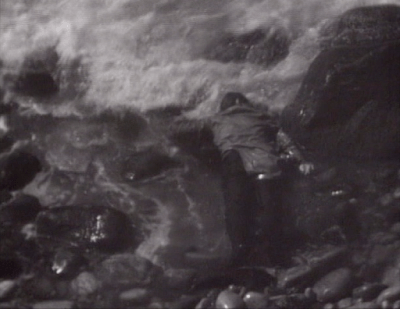
No sooner has the seer made his prediction than we hear Vicki screaming. Looking down from the cliff, she and Carolyn see a figure on the beach- a man face-down in the water. We hear the tide and the wind, sounds of nature on a large scale, and the immobile figure seems to represent something vast and inevitable.
 Dark Shadows Commentary