
Episode 364: Barnabas, Barnabas

Vampire Barnabas Collins has been part of Dark Shadows at least since we first saw his portrait on the wall of the great house of Collinwood in #204, more properly since they went to great lengths to make it look like there was a portrait on that spot in #195. He is now the main force driving the action of the show, and pretty much the only reason people are tuning in to watch it. The ghost of Barnabas’ ten year old sister, Sarah, first appeared in #255; ever since, we’ve been waiting for the two of them to meet. At the end of yesterday’s installment, they finally did.

Barnabas was in his living room, trying to choke the life out of his only friend and would-be lover, mad scientist Julia Hoffman. Sarah materialized, and he let Julia go.

This echoes a scene in #341. Barnabas and Julia were in the act of murdering her medical school classmate and onetime friend, Dave Woodard, when Woodard claimed to see Sarah. At that, Barnabas almost let Woodard escape. Only when Julia called out “Stop him!” did Barnabas take hold of Woodard and kill him. Not only is he murdering a good-guy character, he has coerced Julia into taking part in the crime and will gloat over her new status as a murderer. But in the middle of all that loathsome cruelty, we see a flash of his longing for his baby sister. It is a tribute to actor Jonathan Frid that we can feel Barnabas’ loneliness and want to like him even in the middle of one of the character’s very darkest moments.

This time, Sarah really is there, and she really does stop a murder. There is a puzzle as to why. In #360 and #361, Julia knew that Barnabas wanted to destroy her, and appealed to Sarah for help. Sarah refused, saying that she liked Dr Woodard and knew what Julia did to him. We heard Sarah’s “London Bridge” theme on the soundtrack during the murder of Woodard, so it is clear that she witnessed that crime. But if she can stop Barnabas killing Julia, why couldn’t she stop him killing Woodard?

Today is only the second time Sarah has appeared to more than one person at a time. When Barnabas’ ex-victim Maggie Evans, The Nicest Girl in Town, wanted to escape from the hospital where Julia was keeping her locked up in #294, both she and her nurse could see and hear Sarah. Maybe it is difficult for Sarah to manifest herself to two people, and impossible for her to show herself to three. In that case, Julia’s presence would have stopped Sarah from saving Woodard.

It’s also possible that Sarah can’t do anything that will lead to Barnabas’ capture. She has appeared to many people and given all of them clues about the strange goings-on, but she has referred directly to Barnabas only when speaking to his partners in crime Willie and Julia. Time and again she has stopped short of giving information that would expose her big brother. When Barnabas and Julia moved against Woodard, he was calling the sheriff. Woodard might have placed himself beyond Sarah’s protection when he picked up the telephone.

Indeed, if Barnabas does kill Julia now, he will probably be caught. Julia has given a notebook full of incriminating evidence about Barnabas to a local attorney to be handed over to the authorities in case anything happens to her. Besides, everyone knows she spends a great deal of time at Barnabas’ house, so if she suddenly goes missing he will be investigated. By preventing Barnabas from killing Julia, Sarah is protecting him from exposure.

Sarah tells Barnabas that he taught her the first lessons she ever received in morality, and that he has now forgotten them himself. He begs her to stay, showing at length the vulnerability and need that have been so effective at recruiting our sympathy when we have glimpsed them before. She says she will never appear to him again, not until he learns to be good. We’ve known him long enough to know that this will be an extremely long wait.

Barnabas begs Sarah to stay while Julia looks on. Screenshot by Dark Shadows Before I Die.

Sarah vanishes. Julia sees her friend shattered. She approaches him. She addresses him, for the first time, as “Barnabas, Barnabas.” He recoils from her. He does not renew his attempt to strangle her, but he does tell her in the coldest imaginable voice that he could kill her as easily as he could crush a moth. It hasn’t been two minutes since his little sister reduced him to tears, and he has snapped back into his place as death itself.
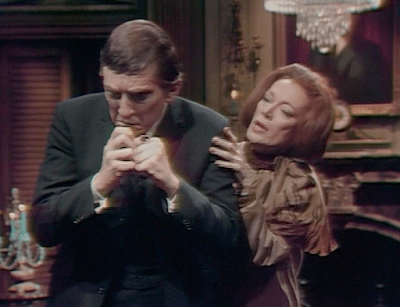
“Barnabas, Barnabas.” Screenshot by Dark Shadows Before I Die.

Some say that Barnabas’ frequent references to his longing for Sarah during these weeks are meant to make him easier for the audience to sympathize with. I think this scene shows that the opposite is more nearly the case. They’ve undercut every other ground for liking Barnabas, leaving us only his love for Sarah. When we see that not even a visit from Sarah can thaw him out for any length of time, not only do we have to give up any hope that there is a nice guy hidden inside him, but we also hear the door slamming shut on any possibility that his character will develop in a way that will surprise us. Since he is the show, the closing of that door means that Dark Shadows 2.0 is all but over.

In the great house, matriarch Liz breaks the news to well-meaning governess Vicki learns that the authorities in Brazil have identified one of the corpses found in the wreckage of an airplane that crashed outside Belem as that of Vicki’s depressing fiancé, Burke Devlin. It has been clear for some time that Burke probably died in that crash, so Liz is worried that Vicki’s refusal to accept their verdict is a sign that she is in an unhealthy denial about the facts of the situation.

In the first 25 weeks of Dark Shadows, Burke was a major figure, the arch-nemesis of the Collins family. His storyline never really took off, though, and when undead fire witch Laura Murdoch Collins was on the show from #126-191 his issues were all absorbed into her arc. He formally renounced his grudge against the Collinses in #201, and has been surplus to requirements ever since.

There is just one thing I wish they had done differently about Burke’s death. During the early period of the show, there was a story about high-born ne’er-do-well Roger Collins trying desperately to hide a custom-made filigreed fountain pen of Burke’s. That dragged on for months, and dominated 21 whole episodes. It would have been a nice Easter egg for those of us who sat through those not-very-interesting installments if Liz had said the authorities were able to identify Burke’s body in part because that pen was on it.

There is a bit of intentional comedy this time that works very well. Telling Barnabas of Vicki’s refusal to accept Burke’s death, Liz exclaims “She can’t go on loving a dead man all her life!” Barnabas is clearly offended by this remark, quite understandably since he is deceased himself. He responds that “It has been known to happen.” But he manages to keep cool enough that Liz doesn’t notice.

“It has been known to happen.” Screenshot by Dark Shadows Before I Die.

Closing Miscellany

This episode marks the last appearance of Sharon Smyth as the ghost of Sarah Collins.

Episode 1-274 of Dark Shadows each began with the words “My name is Victoria Winters,” delivered in voiceover by Alexandra Moltke Isles and leading into a few sentences vaguely related to the plot of the show. Beginning with #275, these voiceovers might be delivered by any actress with a speaking parts in that episode, and do not involve their character’s names. Many are written in the first person, however, as is today’s:

There has been a homecoming in the great house of Collinwood, and those who have returned have found that very little has changed. We still live within a ring of fear, a fear that is generated by the one who lives in the Old House, where on this night a kind of madness prevails, a madness that will lead to the threat of murder.

Every time this happens, the Dark Shadows wiki complains that “by this time in the series, the narrations are no longer spoken in character.” That complaint might have made sense if only a few of the episodes since #275 included first person pronouns, but dozens of them do. So we would have to say that they often are spoken in character, but that it isn’t always clear who the character is. The wiki editors will be glad from now on, because this is the last time a narrator says “we.”

Episode 363: Very honorable guy

When Dark Shadows debuted in June 1966, it was a Gothic romance in which characters sometimes equivocated about whether they were using the word “ghost” metaphorically to refer to present troubles caused by past conflicts or literally to refer to things that go bump in the night.

That version of the series ended with the story of undead fire witch Laura Murdoch Collins. In Laura’s months on the show, her arc absorbed such major plot elements as the conflict between high-born ne’er-do-well Roger Collins and local man Burke Devlin, the psychological problems of strange and troubled boy David, David’s relationship with his well-meaning governess Vicki, and the tensions between the ancient and esteemed Collins family and the working class people of the town of Collinsport. By the time Laura went up in smoke in #191 and #192, there was no life remaining in any open narrative thread, and Dark Shadows 1.0 was at an end.

Dark Shadows 2.0 launched in #193 with the introduction of seagoing con man Jason McGuire. Jason was an in-betweener who would tie up the loose ends remaining from the 25 weeks before Laura joined the gallery of characters and facilitate the introduction of Laura’s successor as a major supernatural menace, vampire Barnabas Collins. Jason kept himself busy blackmailing reclusive matriarch Elizabeth Collins Stoddard, his sidekick Willie Loomis accidentally released Barnabas, and the show kept dropping hints that when Liz finally stood up to Jason all of the original secrets would be laid bare.

The makers of Dark Shadows didn’t do much advance planning, so they kept Jason on the show for 13 weeks after Barnabas premiered while they tried to come up with some other way to fill the time. When Jason’s plan finally blew up in his face, they even left some of the old secrets still buried, most notably the question of where Vicki originally came from.

Barnabas finally killed Jason in #275, and he hasn’t been mentioned in a while. But he is not forgotten. As we open today, lawyer Tony Peterson has caught heiress Carolyn Collins Stoddard in his office, rummaging through his safe. Tony has been dating Carolyn and is clearly very much attracted to her. He invites her to tell him a story that will give him an excuse not to call the police. She has to think fast to come up with one, and what she settles on is a version of the story of Jason and Liz.

Tony knows that Carolyn was trying to steal a notebook that he had put in his safe. This notebook was the property of his newest client, Julia Hoffman, a permanent guest at the great house of Collinwood. Carolyn tells Tony that Julia was blackmailing Liz. The notebook, she claims, is a diary kept by a man with whom Liz had an affair, and it contains proof that the man was Carolyn’s father. Julia knew the man and knew that he was planning to come to Collinwood to squeeze money out of Liz in return for his silence, but he died before he could do so. Julia took the diary and picked up where he left off.

Since Tony’s professional ethics will not allow him to be a party to blackmail, this is the one story that could give him a plausible reason not to report Carolyn’s crime to the police. It also gives him a reason to feel sorry for the Collinses, whom he hated when we first saw him, removing an obstacle to the possibility he might fall in love with Carolyn.

The echo of the Jason/ Liz story in the image of Liz forced to accept a blackmailer as a member of the household offers a great deal more than narrative convenience to regular viewers. The audience knew what Jason was threatening to tell if Liz did not submit to his demands, but the characters did not. One idea that some among them seemed to suspect was that Jason was Vicki’s father and Liz was her mother. Indeed, the makers of the show did plan to explain Vicki’s paternity at the end of the blackmail arc, a plan they abandoned so late that the climactic episode runs some minutes short. When Carolyn brings up the idea of her mother being blackmailed to keep it secret that she bore a child out of wedlock, those of us who have been watching all along will realize that she was among those who suspected that this was the secret that gave Jason his hold over her.

The audience knows that there will be no romance between Tony and Carolyn, because we know that she is Barnabas’ blood thrall. Barnabas sent her after Julia’s notebook, because it contains the records of an experiment in which she tried to cure him of vampirism. It would expose him were it to fall into the hands of the authorities. Since Barnabas wants to rid himself of Julia, perhaps by killing her, perhaps by driving her totally insane, he cannot leave such a document out of his possession.

Dark Shadows has come to as much of a dead end now as it had when Laura’s arc was ending. None of the ongoing stories has room for more than a few steps of further development, and if they keep running through those steps at the current pace everything will be resolved in a couple of days. Bringing up Jason, whose introduction marked the beginning of Dark Shadows 2.0, leads us to wonder if they have something up their sleeves that will launch Dark Shadows 3.0.

Tony takes Carolyn home to Collinwood, where he confronts Julia. He tells her what Carolyn told him. She denies it, and says that she will write a letter entrusting the notebook to him to remain unread unless something happens to her, in which case he will read it and hand it over to the authorities. That satisfies him that he isn’t a party to blackmail, and he agrees to her terms.

For the last couple of days, Barnabas has been using black magic in an attempt to break Julia’s grip on sanity. Her clear thinking and calm demeanor in this scene prove that this attempt has failed. The only open question in the only ongoing conflict is, therefore, whether Barnabas will try to murder Julia. She is such a valuable character that it is hard to feel any real suspense about whether he will succeed in killing her, but there is a chance that he will make an attempt.

David and Vicki have come home from a trip to Boston. David enters the drawing room, sees Julia, and greets her. She can barely pay attention to him long enough to say hello. He asks if she is all right; again, she is clearly not at all focused on him. She excuses herself, saying she has to go to Barnabas’ house.

David’s relationships to the other characters were the engine that drove Dark Shadows 1.0, and when Barnabas began to pose a danger to David that same engine accelerated the pace of Dark Shadows 2.0. Julia has been central to the plot for some time; that she can’t be bothered to take any notice of David tells us that that engine has fallen apart. Whatever they are planning to do next week, David won’t be at the heart of it.

David leaves the drawing room. He gets as far as the foyer. There, he sees his friend, the ghost of Barnabas’ ten year old sister Sarah. He tells Sarah that he has been on a trip. She asks where he went. He says he went to China. “Oh,” she responds, blandly. “You’re not impressed?” “No, my father’s friends used to go to China on their ships.” “Well, I didn’t really go to China. I went to Boston.” “BOSTON!!!” Sarah exclaims. “I went to Boston once!” She’s electrified. It’s adorable beyond belief.

Suddenly, Sarah looks disturbed and says she has to go. David asks why, and she says there is trouble brewing at the Old House. Again, David has been sidelined. If there is going to be any more action, it will have to come from fresh sources.

The Old House is Barnabas’ house, and that’s where we go next. We see Julia arriving there. She tells Barnabas that Vicki is back. He is mildly interested. She then tells him that she has seen Sarah. Barnabas longs to see Sarah, and is tormented that she will appear to others but not to him. He accuses Julia of lying. She insists that she is not, and taunts him with Sarah’s refusal to appear to him. He grabs Julia by the throat. He has done this before as a threat, but this time it looks like he really means to strangle her. Before he can, a wind blows the door open and the candles out, and Sarah walks in. She approaches her brother, glaring at him.

Sarah has had it with Barnabas. Screenshot by Dark Shadows Before I Die.

Episode 362: The charms of Collinwood

Yesterday, mad scientist Julia Hoffman saw and heard many distressing things. It was unclear which, if any, of these were caused by a spell cast on Julia by her sometime associate, vampire Barnabas Collins, and which, if any, were the result of some other force.

At the opening of today’s episode, we find evidence that Barnabas might indeed be behind Julia’s troubles. We begin with a reprise of a moment from yesterday when Julia answered her telephone and heard the voice of Dave Woodard, a medical school classmate of hers whom she and Barnabas murdered a few weeks ago. Woodard tells Julia that she will die soon. Rather than leave it at that, he rambles at such length about the possible scheduling of her death that he is still on the phone after the opening title. Watching the episode, we laughed out loud when he said “Perhaps it will happen tomorrow. Or the next day. Or the day after that.” Julia hangs up before the voice can start speculating that maybe the weekend would be a good time, or it might be something to save for Thanksgiving. Barnabas is so long-winded that it’s easy to imagine him thinking out loud about his plans in the middle of a threatening phone call and getting so caught up in it that his victim loses interest.

Further evidence comes shortly after, when Barnabas comes to Julia’s door. He is continuing the act he put on when last they saw each other, pretending to regret his previous harshness towards her and lamenting their currently frosty relationship. She is unconvinced. She demands he stop causing her to suffer. In a quivering voice, she tells him she is not afraid of him. He feigns ignorance of her situation, and says that he wishes she could trust him as he has learned to trust her. He leaves.

Julia frightened, Barnabas smug. Screenshot by Dark Shadows Before I Die.

Frightened as Julia is and self-satisfied as Barnabas is in this scene, it nonetheless makes him seem less formidable. He is not simply trying to scare her, but to reduce her to total, permanent insanity. If he makes it as obvious as this that everything that is happening to her has a single, identifiable cause, she can focus all her fear on that cause and deal with the rest of the world calmly and rationally.

Barnabas then makes himself look even less intimidating. He meets with his distant cousin and blood thrall, Carolyn Collins Stoddard. Carolyn tells him that she has managed to get the combination to the safe in lawyer Tony Peterson’s office. Julia had entrusted her notebook full of incriminating information to Tony and had him put it in the safe when she realized Barnabas had turned against her.

Regular viewers know that Barnabas can materialize inside closed rooms. When Barnabas was first on the show, they had done something with the idea that vampires can enter only places they have been invited, but that went by the boards when Barnabas broke into Woodard’s office in #242. Moreover, Tony doesn’t know anything about Barnabas, and Barnabas isn’t doing anything else tonight. Nonetheless, he tells Carolyn that she must get into Tony’s office and steal the notebook herself.

To comply with Barnabas’ command, Carolyn has to ask Tony on a dinner date, invite herself up to his apartment, steal his office keys from his coat while he is in the kitchen mixing her a drink, and excuse herself as soon as he comes back with the drinks. She does promise to be back in a matter of minutes, but it means that she would be an obvious suspect if the notebook went missing. And it sets up an utterly predictable ending, in which Tony catches her in the act of opening the safe.

Barnabas’ visit to Julia may have undercut his plan to drive her mad, but at least it illustrates a weakness the character has always had- his tendency to admire his own evil handiwork and a resulting inability to leave his victims to suffer in isolation. That weakness in turn reflects the deep loneliness that makes it possible for us to feel some sympathy for Barnabas even when we are afraid of him or angry at him. But sending Carolyn to do a job that would under the best possible scenario bring deep suspicion on her when he could do it himself without any danger of detection is a pure example of Idiot Plot, characters behaving in a way that has nothing to do with any thought that might be in their heads solely to make life easy for the writers.

Idiot Plot is bad enough when minor characters are the Designated Dum-Dums. To use Barnabas in that role is unforgivable. By now, the audience consists chiefly of people who first tuned in out of curiosity to see how they could fit a vampire into a daytime soap, and who became hooked when they saw that Barnabas was sinister enough to drive the action but lonesome enough to enlist at least some of our goodwill. If he turns into a bumbling fool, Dark Shadows has nowhere to go.

Barnabas can’t very well avoid becoming a bumbling fool by succeeding in his effort to destroy Julia. He became so much more interesting once he had her to talk to, conspire with, and struggle against that if she leaves the show they will have to invent another character to replace her and hope that they catch lightning in a bottle again. I remember watching these episodes on the Sci-Fi Channel, as it then was called, in the 1990s, and being stumped as to where they were heading. Up to that point it had always been easy to think up a long list of possible directions things might go, but once Julia started worrying about her notebook the story was busy eating itself alive. There didn’t seem to be anything at all waiting around the next corner.

Episode 361: Julia’s rough night in

Writer Ron Sproat had his strengths, but was blind to what particular actors could and could not do. Grayson Hall, who played mad scientist Julia Hoffman, had one very conspicuous weakness- she could not control the tone of her voice when she raised it above a normal conversational level. She had asthma, and in the course of her performances she was often required to smoke. As a result, her screams, shouts, sobs, and cackles all came with a terrible croaking sound. This episode consists of very little aside from Julia’s raised voice, and it is a disaster.

Julia’s sometime partner in crime, vampire Barnabas Collins, has turned on her and cast a magic spell meant to drive her crazy. She sees some ghostly apparitions that may or may not be the result of this spell. It’s hard to be sure; at the beginning of the episode, she is in the Collins family tomb having an argument with the ghost of Barnabas’ little sister Sarah, whom regular viewers know to be real. So it’s not like we can say with confidence that anything is in her head.

Julia’s psychological stress gives Sproat an opportunity to adapt a script he wrote for the show that Dark Shadows replaced on ABC’s daytime schedule, a soap opera for teenagers called Never Too Young. The 18 April 1966 episode of that show was almost a one-woman drama, featuring Jaclyn Carmichael as Joy Harmon, who struggles to keep her sanity while home alone.* While nothing supernatural was going on in Never Too Young, Sproat left many elements intact- both start with confrontations reprised from the previous episode, in which the main character is alienated from the person who represented her last hope; each woman beats on a locked door and calls for someone who is absent to come and let her out; each plays Klondike solitaire; each receives a distressing telephone call; each is terrified at the end of the episode when she sees the doorknob turning. Evidently Sproat regarded the script as his finest work, and wasn’t going to allow Grayson Hall’s physical inability to play the part deprive him of the chance to remake it.

As the 22 minutes unfold, Julia progresses from the mausoleum, where she looks disturbed while we hear her speaking calmly in a recorded voiceover, to the drawing room of the great house of Collinwood, where she looks calm while she has a panicked tone in the recorded voiceover, to her bedroom upstairs in the great house, where she both looks and sounds panicked. She’s alone on camera for the great majority of the time, making hideous noises that bring bad laughs.

AAARRRRRGH!!!!! Screenshot by Dark Shadows Before I Die.

For over a week, Julia has been trying to escape Barnabas’ wrath. The other day, we heard her ask herself why she didn’t just leave town. There are some strong episodes in this period, but that is such an obvious question that it undercuts them all. This episode is far from strong, and throughout it we are reminded of just how unnecessary it all is. Barnabas decided to kill Julia because she obstructed his plan to seduce well-meaning governess Vicki by planting disturbing images of him in Vicki’s unconscious mind; he had been set on killing strange and troubled boy David because David had caught on to some of his secrets. Julia is alone in the house in part because Vicki and David have gone to Boston for a few days. For all Barnabas knows, David is this very minute telling Vicki everything he wants to hide from her. But as soon as they are off the estate and out of his sight, he stops worrying about them. So all Julia has to do is hop in her car, drive off someplace, and the drama is resolved.

The conflict between Barnabas and Julia is the only story going on Dark Shadows right now. Lawyer Tony Peterson is suing the Collins family business, but when they had a scene about that last week they played it off camera and used the actors’ voices as background noise to cover some of Julia’s doings. Clearly we are not to expect much from that. All Vicki and David have to do to be safe is go to Boston, Sarah is quiet unless murderers come to her tomb and bother her at home, and everyone else is settled in a sustainable situation. So if Julia leaves town, or reconciles with Barnabas, or is killed, it doesn’t seem that the show will have anywhere to go. By all appearances, we are heading directly for a blank wall.

*I learned about this episode from a comment left by “Robert Sharp” on Danny Horn’s Dark Shadows Every Day. He links to the video I embed above.

Episode 360: You would understand, if you understood

Vampire Barnabas Collins has decided that he will eventually kill his sometime accomplice turned bête-noire, mad scientist Julia Hoffman. Julia has decided that her only possible helper is the ghost of Barnabas’s ten year-old sister, Sarah.

Julia goes to Sarah’s grave in the Tomb of the Collinses and calls to her. She hears the strains of “London Bridge,” then sees Sarah. Sarah tells Julia that she will not help her, because she killed someone she liked, Dr Dave Woodard. Julia tries to put the blame for that crime on Barnabas, but Sarah declares that she helped him. We heard “London Bridge” in the background during the murder scene in #341, so we know that Sarah saw the crime and Julia will not be able to deceive her.

Sarah and Julia, Barnabas’ two sister-enablers. Screenshot by Dark Shadows Before I Die.

In this scene, Sarah says that she cannot act directly against Barnabas. This is a striking moment, because it is the first time Sarah has spoken her brother’s name out loud. Sarah’s statement explains why she watched as Barnabas and Julia killed Woodard, and also why so many of her attempts to protect her friends from him have ended up with them in worse shape than before and Barnabas insulated from all accountability.

When Julia was working with Barnabas, she too made desultory attempts to restrain his worst tendencies, while always protecting him from the consequences of his actions. The dynamic between them mirrored the Bossy Big Sister/ Bratty Little Brother pattern that matriarch Liz and her brother Roger have been modeling from the first day of the series. Seeing Julia with Barnabas’ literal sister, we see that this dynamic has defined the Collinses for centuries.

Episode 359: Very difficult for a girl

Carolyn Collins Stoddard has been a spoiled heiress all her life, and now is settling into a new role as blood thrall to her distant cousin, vampire Barnabas Collins. Carolyn is trying her level best to comply with Barnabas’ command to seduce lawyer Tony Peterson so that she can steal the notebook mad scientist Julia Hoffman entrusted to him. She is on a date with Tony, and they are starting to do some serious kissing.

No matter how well Carolyn serves him, Barnabas can’t keep himself out of her way. When Barnabas is upset, nearby hound-dogs start baying; Danny Horn calls the dogs Barnabas’ “backup singers.” When Carolyn hears them, her face goes blank and she forgets about Tony. Tony becomes irritated and ends their date abruptly.

Later, Julia goes to Barnabas’ house. Carolyn is there; Barnabas sends her into the next room to eavesdrop on their conversation. The shot of Carolyn in that room recalls a similar shot of housekeeper Mrs Johnson eavesdropping on Carolyn and local man Burke Devlin, on Burke’s instructions, in #69. That shot marked the beginning of the career of the previously guileless Mrs Johnson as a secret agent Burke employed to spy on the Collinses.

Mrs Johnson as Burke’s spy in #69. Screenshot by Dark Shadows from the Beginning.
Carolyn as Barnabas’ spy in #359.

As Mrs Johnson once listened to Burke pretending to a romantic interest in Carolyn, so Carolyn today listens as Barnabas pretends to a romantic interest in Julia. Julia realizes that she is unlikely ever to get Barnabas out of her life, and for a time she tried to make the best of the situation by falling in love with him. In his show of contrition and gallantry, she sees a glimmer of hope that he will reciprocate this love. Julia has seen too much to be as taken with Barnabas as Carolyn was with Burke, but she does give serious consideration to the idea that Barnabas might have given up on killing her and might be thinking of becoming her boyfriend instead.

The charmer. Screenshot by Dark Shadows Before I Die.

After Julia leaves, Carolyn comes back into the room. She objects that Barnabas was being cruel by raising Julia’s hopes that way. Again, this echoes #69. Mrs Johnson came back into Burke’s room after Carolyn left, and asked him if he thought “the girl [was] involved” in the wrongdoing they thought had taken place at the great house of Collinwood. When Burke replied that anyone in the house was “fair game,” Mrs Johnson asked “Even the girl?” To which Burke replied “Anyone!” That marked the end of the episode, so we didn’t hear how Mrs Johnson reacted to that pronouncement. But she did go on working for Burke, so apparently it didn’t bother her too much.

Barnabas calls Carolyn to him, looks into her eyes, and tells her she is tired. She smiles, and agrees that she is tired. Evidently he used his supernatural influence over Carolyn to erase her misgivings about his treatment of Julia. He hadn’t done anything supernatural to quiet Carolyn’s predecessor, the luckless Willie, on any of the countless occasions when he acted as Barnabas’ external conscience; he usually just hit him in the face with his cane. Barnabas has been picking up lots of new powers lately, gaining the ability to transform into a bat, to materialize inside closed rooms, and to cast magic spells, so it shouldn’t be much of a surprise that he now has greater control over his blood thrall than he had before.

Episode 358: The secret magic number of the universe

Barnabas Collins is a vampire, but he rarely bites anyone. He spends most of his time pursuing an acting career. His role is that of Living Man Born in the Twentieth Century, and his audience is almost everyone he meets.

Jonathan Frid often has trouble with Barnabas’ lines, but usually he manages to make it seem that it is Barnabas, not he, who is scrambling to keep his performance on track. His posture and facial expression project whatever emotion Barnabas is supposed to be feeling, and the words rarely get in the way.

As my wife, Mrs Acilius, pointed out, there is a moment today when he simply falls out of character. Barnabas is telling his distant cousin and blood thrall, Carolyn, that he is going to cast a spell that will bring madness upon his co-conspirator turned bête-noire, mad scientist Julia Hoffman. Barnabas has been acquiring new powers lately, and this is the first time we hear that he knows how to cast spells. Apparently this case of power creep was too much for Frid. While telling Carolyn about the “secret magic number of the universe,” he drifts from Barnabas’ voice into his own, looks down, then breaks off and stares mutely, not at Carolyn, but at Nancy Barrett struggling valiantly to keep a straight face. He then has to stand up and do a little dance while wearing a green dressing gown. The ridiculousness of it, for once, overwhelms him.

Before the dance. Screenshot by Dark Shadows Before I Die.

Episode 357: Hit the blood

Mad scientist Julia Hoffman must hide her notebook from vampire Barnabas Collins and Barnabas’ blood thrall, his distant cousin Carolyn. The notebook documents Barnabas’ vampirism, and he does not want it to fall into the hands of the authorities. Once he gets hold of it, he plans to kill Julia.

The last time Dark Shadows devoted as much story time to attempts to hide and find an object as they have to this notebook was when high-born ne’er-do-well Roger Collins was frantically trying to hide local man Burke Devlin’s filigreed fountain pen, a story that dragged on from August to November of 1966. Few remember that storyline fondly, but at least the pen was a unique piece of evidence that might connect Roger to a homicide. The notebook is less satisfactory as a focus of attention, since there is nothing unique about it- Julia could easily have written a hundred documents detailing Barnabas’ secret and stashed them all over the world, and for all Barnabas knows she may have done. There are several strong episodes during this period, but the inadequacy of the notebook as a MacGuffin, combined with the fact that Julia could at any moment hop in her car and drive someplace where Barnabas wouldn’t be able to hurt her, prevents any momentum carrying over from day to day.

There are two important things about this installment. It is the first episode written chiefly by Sam Hall,* who will become far and away the most important member of Dark Shadows‘ writing staff. Hall would write hundreds of episodes, right up to the final one, would write the two theatrical features based on the show that were produced in the early 1970s, and would stick with producer Dan Curtis for years afterward, even contributing a script to the ill-fated 1991 primetime reboot of Dark Shadows. The husband of Grayson Hall, who played Julia, he would develop the show into something as different from its November 1967 incarnation as that version is from the show that premiered in June 1966.

On his blog Dark Shadows Every Day, Danny Horn argued that Hall’s contribution was to see Dark Shadows as, first and foremost, a “mashup” of various stories. The example he gives in his post about this episode are the scenes in the office of Tony Peterson, a local attorney whom Julia has hired to keep the notebook locked up in his safe. Tony is played by Jerry Lacy, who in the 1960s and 1970s was chiefly known for his Humphrey Bogart imitation. He would do that imitation on Broadway in 1969 in Woody Allen’s Play It Again, Sam and again in the 1972 film version of that play; here he is doing it in a 1980 commercial for the Long Beach California Press-Telegram.

In the scenes Danny focuses on, Mr Lacy imitates Bogart as Sam Spade or Philip Marlowe meeting a succession of mysterious women in his office. Grayson Hall plays Julia as a frightened and barely coherent client and Nancy Barrett plays Carolyn as the blonde you’d be a fool to trust, even if she does have a pair of gams that won’t quit. They’re all having a great time with their pastiche of The Maltese Falcon, The Big Sleep, and other staples of the Late Late Show.

Carolyn fingers the notebook. Screenshot by Dark Shadows Before I Die.

I do have to demur from Danny’s claim that Hall pioneered Dark Shadows as a mashup. It was that from #1, when Jane Eyre met the Count of Monte Cristo and they both found Art Wallace trying to remake a script he’d already sold to television twice. Nor is he the first to mash up disparate genres. The story of Burke’s fountain pen led into a police procedural that merged with a ghost story; Burke’s typically soapy conflict with Roger dissolved into the story of Roger’s ex-wife, undead fire witch Laura Murdoch Collins, a story which was Dark Shadows’ first and most detailed adaptation of Dracula. The difference in Hall’s approach to mashups is that always before, one of the genres was Gothic melodrama. Today, a vampire story is meeting a film noir, and there are some elements of conventional daytime soap opera in the margins. Hall is letting go of Dan Curtis’ original idea of chasing viewers who read Gothic romances.

We get a clue as to what that might mean for the existing characters when Tony asks Julia if she is afraid of Roger Collins. Julia laughs loud and long at the idea that Roger is any kind of danger. For the first 25 weeks, Roger was indeed a deadly menace, but ever since Laura came through he has been reduced to occasional comic relief. Viewers who find a reminder of Burke’s fountain pen in the business with the notebook will see that even the villainous early Roger is a minor threat compared to the supernatural force Barnabas represents. So we are not to assume that any character or theme surviving from the show’s original conception is safe.

*The credits on screen say Gordon Russell wrote it, but evidently the paperwork from the show demonstrates that Hall did. Also, some of last week’s episodes sounded and felt as much like Hall’s work as this one does, but none of the experts tries to credit him with those, so I’ll defer to the consensus and say that while his influence may have been visible some days ago, this one marks his debut on Dark Shadows as the principal author of a teleplay.

Episode 356: The clock is running

Yesterday, mad scientist Julia Hoffman discovered that vampire Barnabas had sent his distant cousin and devoted blood thrall Carolyn to steal the notebook in which she recorded Barnabas’ secrets. Julia knew that this meant Barnabas had decided to kill her, and that only by keeping the notebook hidden could she save herself.

At the beginning of today’s episode, Julia hides the notebook inside the clock in the foyer of the great house of Collinwood. At the end, Carolyn notices that the clock has stopped chiming. The foyer clock is a very impressive piece of property, and it’s always nice when it gets screen time.

Fine clock. Screenshot by Dark Shadows Before I Die.

Episode 355: A fool in the face of death

Yesterday’s episode ended with vampire Barnabas Collins telling his distant cousin and newly acquired blood thrall Carolyn that he would punish his associate Julia Hoffman. Carolyn smiled delightedly when she asked “Are you going to kill her?”

Today begins with a reprise of that scene. But there is a difference. Now, it is Barnabas who brings up the idea of killing Julia. Carolyn reacts with horror, tries to talk him out of it, says she won’t be part of a murder, and only reluctantly yields to him.

Carolyn pleads for Julia’s life. Screenshot by Dark Shadows Before I Die.

This instant retcon is disappointing to regular viewers for four reasons. First, while we can accept the show changing course from time to time, we do expect the story to build on itself as a reward to us for watching every day. If they’re going to pull a U-turn as abruptly as this, it may as well be an anthology series. Second, Carolyn’s reluctance to go along with Barnabas’ evil plans is nothing new to us- even her lines are recycled from objections her predecessor Willie and Julia herself had made to Barnabas’ earlier declarations that he intended to kill someone or other. Third, Nancy Barrett was tremendously fun to watch as a happy assistant murderer. She was nowhere near done exploring the possibilities of that persona.

The fourth disappointment goes deeper. It’s easy enough to see why the writers wouldn’t want Carolyn to rejoice in her situation for an indefinitely long period. As Stephen Robinson put it in a comment on Danny Horn’s Dark Shadows Every Day, “There’s no conflict [if] Barnabas’s partner in crime is a fully willing psychopath. They would just stand around going bwah-ha-ha.” But the excitement in the first four episodes of this week came from that very lack of dramatic possibility. It was so clear Carolyn’s relationship to Barnabas could not stay as it was for very long that we’re waiting for some big event to change it at any moment. When they slide back to the same old stuff we’ve already been through with Willie and Julia, that excitement gives way to the sinking feeling that nothing much is going to change in the foreseeable future.