Episode 96: I should have carried you over the threshold

High-born ne’er do-well Roger Collins is desperate to get rid of his son’s governess, the well-meaning Vicki, before she discovers his dark deeds. Sometimes he’s simply unpleasant to her. Twice he’s offered to bribe her to leave. Once he pretended to be a ghost in order to scare her off, not knowing that she had just seen a real ghost who warned her to leave the house before she was killed. Occasionally he turns on his very considerable charm in his efforts to convince her that she ought to leave; she usually sees through these efforts quickly, and he is left in a weaker position than he was before.

Yesterday, Vicki was in Bangor, Maine, fifty miles from her home in the great house of Collinwood. While waiting for dashing action hero Burke Devlin to give her a ride home, she realized that the pen she found on the beach some weeks ago must have belonged to Burke, and jumped to the conclusion that Burke dropped it there while murdering beloved local man Bill Malloy. Frightened, she called Roger to come and get her.

Today, Roger is driving Vicki home in a heavy rainstorm. Returning viewers know that Roger was in possession of such a pen, that he lost it the night Bill died, and that he is terrified the pen Vicki found will lead to disaster for him. We also know that he is a vicious man who will stick at nothing to protect himself.

Vicki knows none of these things, but she does know that Roger and Burke are sworn enemies. Therefore, she is surprised when Roger tells her that the pen isn’t really evidence of anything. After all, it was two days after Bill’s death that she found it- Burke could have dropped it there after Bill went into the water, or long before. She is even more surprised when he urges her to forget the whole matter and never again to mention the pen to anyone. Roger can imagine a scenario in which Burke might have killed Bill, and even says that he thinks it is likely, but he tells her that with no more evidence than she has there is nothing to be gained by challenging the coroner’s verdict that Bill’s death was an accident.

When Vicki asks Roger why he is leaving the main road in the midst of the storm, we might wonder if he has laid some dastardly plot. On the dark, flooded back way, they quickly find themselves trapped. Roger leaves Vicki in the car while he takes his flashlight to look for shelter. He returns and describes an abandoned shack he claims to have spotted just then. His description of it is so detailed that we cannot help but suspect that he has been there before, and that it figures in an evil plan of his. Roger defuses that suspicion, though, when on his own initiative he leaves a note inside the windshield of the car directing any passersby to the shack.

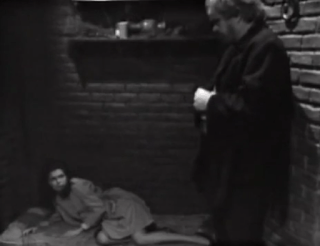
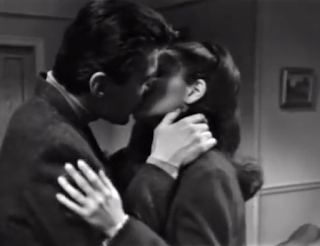
When they enter the shack, Roger teasingly says “I should have carried you over the threshold.” Vicki instantly responds “But you are married.” With a sour look, he answers “If you can call it that.” After a bit of conversation about Roger’s unhappy domestic situation, they sit close together. Vicki tells Roger that she wonders if his son, strange and troubled boy David, got his unscrupulousness from his mother. “You’re nothing like that,” she says. While they huddle together, Vicki asks Roger to tell her all about himself.

Vicki and Roger getting cozy. Screenshot by Dark Shadows Before I Die

Despite her previous wariness of him and her prompt reminder to him today of his marital status, it would seem that Roger could make quite a bit of progress with Vicki if he were to forget his other methods of persuasion and concentrate on charm. In episode 78, Roger even took Vicki on a date. That didn’t amount to much, but at the end Roger promised to take Vicki out again and she seemed interested. Watching them together in this one, we wonder if they might at some point get together. Vicki the foundling-turned-governess is obviously modeled on Jane Eyre, and Roger is not only her charge’s father, but the name “Roger” even sounds like “Rochester.” A relationship with Roger wouldn’t involve living happily ever after, but that’s a difference of genre- characters in novels might get happy endings, but characters on soap operas don’t get any endings at all, not unless they’re killed off the show.

In Art Wallace’s original story bible for Dark Shadows, called Shadows on the Wall, Roger was supposed to be killed off early on, while trying to murder Vicki to prevent her exposing a crime of his. It was also supposed to be revealed that Vicki was the illegitimate daughter, not of any member of the ancient and esteemed Collins family, but of the estranged husband of Roger’s sister Liz. That wouldn’t make much sense- the Collinses are the center of the show, and Vicki is the main character. If she’s going to be anyone’s long-lost love child, it should be Liz’. And indeed, Alexandra Moltke Isles and Joan Bennett look very much alike, a resemblance the camera work often emphasizes. But, if Roger isn’t going to die soon, establishing that Vicki is not a blood relative would leave the path open to a marriage between them.

Of course, if Liz is secretly Vicki’s mother, that would be the perfect background for a soap opera engagement between Vicki and Roger. Liz would find herself forced to choose between revealing her terrible secret or allowing her daughter to marry her own uncle. In a later decade, a show might let the characters get married and reveal the family relation years later, but I don’t think ABC’s Standards and Practices department would have signed off on that one in the 1960s.

If there is going to be a Vicki/ Roger romance, it isn’t going to start today. Roger answers Vicki’s question about what he wants in life by saying that at the moment he only wants two things- for them to be rescued, and for her to leave Collinwood. He tells her that he is worried that she is in mortal danger if she stays. David has tried to kill her; he’s tried to kill Roger too, come to that. Previously, Roger has urged her to get away before he succeeds. But today, she isn’t thinking of David. She asks if Roger really thinks Burke is a deadly threat to her. He pauses long enough to make us wonder if he’d been planning to talk about David, then decides to run with what Vicki’s given him. He dwells on Burke’s temper as Vicki has witnessed it and tells her that he has seen even worse displays. When she says that she finds it difficult to believe that Burke would kill her, he says that he’s sure Bill Malloy found that difficult to believe as well. This gets her back to the idea of telling the police about the pen. When she protests that not telling them would be withholding evidence, his charm breaks down and he shouts “Then withhold it, you little idiot!”

His previous attempts at suavity had also ended in name-calling. On those occasions, he could only apologize while Vicki regarded him coolly. This time, he bounces back and continues to press Vicki with claims that he’s thinking of her safety. She is looking very doubtful, though, as if something is dawning on her. After a moment, the sheriff appears at the door. He tells Roger that he and his men were in the area, noticed Roger’s car, and followed the directions on the note he left in the windshield. He notices that Vicki is deep in thought. He asks her what’s on her mind. After a long hesitation, she gives a meaningless response, telling him nothing about the pen. But we know that she has asked herself a question, and that the answer is going to mean trouble for Roger.

Episode 95: My pen is among the missing

Well-meaning governess Vicki is in a hotel restaurant in Bangor, Maine. She is waiting for dashing action hero Burke to drive her the 50 miles to her home in the great house of Collinwood.

Vicki is sitting at a table with Burke’s lawyer, Mr Blair. Blair takes out a pen to mark up some contracts. Vicki tells him that his pen is identical to one she found on the beach at “a place called Lookout Point.” She had earlier told another lawyer, her new friend Frank, that beloved local man Bill Malloy was killed at Lookout Point. Blair doesn’t know that part of it.

Blair tells Vicki that she must be mistaken- there are only six such pens in the world. He has one, Burke has one, and the other four are in South America. Blair tells her that if she found one, it must be Burke’s. He goes on to say that the pen is very expensive, and that if it is Burke’s he would certainly want it back.

Blair hands Vicki the pen. She examines it. A look of alarm crosses her face. She hurriedly assures Blair that, looking at it close up, she can see that it is nothing like the pen she found.

Burke returns to the table. Blair gives him the contracts to sign. He asks Blair to lend him something to write with, saying “My pen is among the missing.” Focused on the contracts, the men do not notice as Vicki’s look of discomfort intensifies.

Burke asks Vicki if she’s ready to go. She excuses herself to make a telephone call. Unable to reach Frank, she calls Collinwood. High-born ne’er-do-well Roger answers. Vicki asks Roger to come to Bangor to get her. Appalled by the notion, Roger asks why he would ask him to inconvenience himself so seriously. She says she thinks she might be in danger. She explains her theory that the pen she found made its way to Lookout Point when Burke dropped it there while murdering Bill Malloy. Roger tells Vicki to wait for him, and rushes out of the house.

Vicki calls Roger to come to her rescue. Screenshot by Dark Shadows Before I Die

Over a period of several episodes, the sheriff questioned Roger, Burke, and drunken artist Sam Evans about Bill’s death. Roger is firmly outlined as the villain, so we suspect him. There were also a number of moments when the show gave us definite reasons to think Sam might be the culprit. At no point did they dwell on the idea that Burke may be responsible, but it would be an interesting twist.

Bill had told Burke he would find evidence to clear his name in connection with a manslaughter charge that sent him to prison years before, and it has never been clear just what Bill could do to deliver on that promise. Perhaps we will learn that Burke discovered that Bill couldn’t deliver on it, and, succumbing to the violent temper he has displayed many times, he reacted by shoving Bill off Lookout Point to his death in the waters below. For all we know, Vicki’s suspicions might be the first step towards exposing Burke as the killer of Bill Malloy.

It’s true that Roger had Burke’s pen and believes that the pen Vicki found will suggest that he was at Lookout Point. But it could easily be that Burke, who after all gave the pen away very blithely when he was having lunch with flighty heiress Carolyn in the same restaurant where he and Vicki are today, in fact owns another one, that Vicki found that other one, and that Roger lost the pen Burke gave Carolyn somewhere else. Roger’s frantic attempts to hide the pen would incline us to believe that he was at Lookout Point with Bill, but it is precisely that belief that would make the revelation that it was Burke who dropped the pen a twist ending.

The pen itself, as the only piece of physical evidence in a whodunit that has been going for ten weeks and shows no signs of ending, gets a great deal of attention. Dark Shadows fans often lament this, and rightly so. At times, the pen falls into Alfred Hitchcock’s famous category of a “MacGuffin,” the thing that everyone in the story is urgently trying to get hold of. In a 90 minute action movie, just about anything can be a MacGuffin- a cache of diamonds, a secret document, the Maltese Falcon, etc. But when the story goes on for months and it involves a mystery we’re supposed to be trying to solve, the thing people are trying to get their hands on can’t be just anything.

Of course, if we’re watching an inverted mystery where we see the case from the villain’s point of view, there will be excitement any time s/he suddenly realizes s/he left a piece of evidence unconcealed. Some of Roger’s scenes with the pen play this way, but since we didn’t see what happened to Bill Malloy and haven’t been told anything definite, they don’t quite close the loop.

There are two things a piece of evidence has to be if it is to work in the place the story gives to Burke’s pen. First, it has to be a clue that will solve the mystery. Roger’s behavior concerning the pen certainly reinforces our suspicions of him, but it is easy to think of many other ways it could have been left where it was. Even if we leave aside the possibility that it is a duplicate Burke dropped, we have to remember it was several days after Bill’s death that Vicki found the pen. Who knows what sort of creature might have been attracted to its shiny surface, carried it from wherever it was originally left, and deposited on the beach long after Bill was already dead.

Second, and more importantly, the object has to connect one substantive story element to another. The crucial piece of evidence in Dark Shadows’ first mystery story met this requirement. Strange and troubled boy David had tried to kill his father, Roger, by tampering with the brakes on his car. David had trouble getting rid of the bleeder valve, and was eventually caught with it in his possession. We’ve seen David reading a magazine about mechanics and playing with mechanical toys, and have seen Roger refusing to take an interest in machinery. So a piece of hardware in David’s possession reminds us of the estrangement between father and son. Moreover, while Roger is not interested in the workings of his car, he is avidly concerned with it as a marker of his status. Burke envies him that status, and hangs around the car. When Burke comes to be involved in the story of Roger’s crash, the prominence of a piece of the car brings that envy to mind. That the same object represents Roger’s conflicts with David and with Burke associates those conflicts with each other in our minds, and sets us up to expect them to merge, as indeed they do.

Burke’s pen has no such associations. It’s something he shares with Mr Blair, who is barely a character on the show, and with four other men whom we have never seen and whose names we’ve never heard. Neither Burke nor anyone else we’ve seen is a calligrapher, or a writer, or any other person who would come to mind when we hear about pens. So the story doesn’t establish a specific symbolic charge for a pen considered as a pen.

Of course, the show was made in 1966, so there is an inevitable symbolism associated with any cylindrical object. Zach Weinersmith explained this the other day in a Saturday Morning Breakfast Cereal comic:

https://www.smbc-comics.com/comic/dongworld

I think the writers intentionally put their fair share of Freudianism into the scripts, and I can’t imagine Louis Edmonds didn’t expect some in the audience to watch his portrayal of Roger’s panicked obsession with where Burke’s pen is and think in those terms. Indeed, while Weinersmith talks about the period 1890-1970 and singles out the 1930s as a peak, it was in the 1960s, the age of Tennessee Williams, Edward Albee, and Peter Shaffer, that Freudianism peaked in its influence on the New York theater world where the people involved in making Dark Shadows were most at home. So this episode would be a case in point for Weinersmith’s hypothesis.

Episode 94: The Sproatening

This is the first episode credited to writer Ron Sproat. Before long, Francis Swann will leave Dark Shadows, and for several months the only credited writers will be Sproat and Malcolm Marmorstein. Marmorstein will write 82 episodes and leave in August of 1967. Sproat will write hundreds and will stay with the show until 1969.

Today’s setup might remind us of the show’s first writer, Art Wallace. It’s shaped like one of Wallace’s diptych episodes, intercutting between two contrasting groups of characters. This time, we cut back and forth between, on the one hand, a dull but pleasant dinner date between well-meaning governess Vicki and instantly forgettable lawyer Frank at a restaurant in Bangor and, on the other hand, an extremely uncomfortable dinner date between hardworking fisherman Joe and flighty heiress Carolyn at the Blue Whale in Collinsport.

In Bangor, Vicki and Frank smile at each other while Vicki tells the sorts of stories she’s been telling all along. Vicki hopes Frank will be able to aid her in her effort to learn the identity of her birth parents, a quest she has been on since episode 1. Frank’s father Richard briefly joins him and Vicki at their table. Amid good wishes for the two of them, Richard delivers a cautionary message about Vicki’s research. Later, he talks privately with Frank. He strongly approves of Vicki as someone to date, but is chary of many aspects of the research Frank has volunteered to do for her.

Frank’s father stops by the table. Screenshot by Dark Shadows Before I Die

In Collinsport, Joe and Carolyn are bickering about Carolyn’s obsession with dashing action hero Burke Devlin when Maggie Evans, The Nicest Girl in Town, enters the tavern with her father, drunken artist Sam Evans. Carolyn invites the Evanses to join them at their table. Carolyn eventually starts talking about Burke again, prompting Joe to ask her to dance. Away from the Evanses, Joe tells Carolyn he is tired of her falling bacxk on him when Burke isn’t available. Carolyn storms out. Joe takes her home, then returns to the tavern, and he and Maggie start a conversation they both seem to be enjoying hugely.

Carolyn, Joe, and the Evanses at the Blue Whale. Screenshot by Dark Shadows Before I Die

By intercutting scenes, Wallace’s diptychs usually achieve a contrast that brings into focus details of the psychology of the characters and their relationships to each other that we might not have thought about had we watched the scenes straight through. In Sproat’s hands, today’s episode doesn’t do that so much as it comments his own position as a new writer joining an established show.

Vicki has learned nothing about her origins since episode 1, and there is no prospect she ever will. In Frank, she has found a potential boyfriend. In the ears of the audience, Richard’s advice to Frank to pursue Vicki energetically but to pursue her inquiries only circumspectly is a recommendation that the show drop an old, unproductive old storyline and to develop a new one.

Carolyn and Joe’s relationship is another story element that has been in place from the beginning and that has not advanced in any way. We have never seen any reason for them to be a couple, and are simply impatient with scenes where they sit around and make each other miserable. Joe recently had a date with Maggie, and it was sweet to watch those two having fun together. So today’s scenes in the Blue Whale make it emphatically clear that the time has come to drop the Carolyn and Joe story and move on to a new phase where Maggie and Joe are together.

Sproat not only makes himself visible in this episode, he also provides mirrors for critics and commentators. When Richard shows up and interrupts the ten thousandth* sad story the audience has heard about the Hammond Foundling Home, Frank and Vicki seem to be having a pleasant enough time with each other. It is possible that viewers who weren’t watching on many of the days when Vicki told those previous stories are having a pleasant enough time with the episode. But on any given day, only so much of your audience will consist of new viewers and people with short-term memory loss. A time will come when you have to move on to something new, and Richard is the in-universe representative of those who would say that time is already upon us.

In the Blue Whale, the Evanses represent the critics. Joe and Carolyn leave the table twice to dance. The first time, they look happy, and Sam tells Maggie that there is no chance of Joe and Carolyn splitting up. Sam is a chronic pessimist. If he makes a prediction, we take it that it would be bad news for that prediction to come true. In this context, to say that Joe will never break it off with Carolyn is to say that the show will never become more interesting. The second time Joe and Carolyn dance, they are obviously giving up on each other. Maggie, almost as much the optimist as her father is a pessimist, gives a little smile. Joe and Carolyn’s quarrel is embarrassing for her to watch, but it’s good news for her that she’s getting a boyfriend, and maybe a storyline. It’s also good news for us that the show is open to exploring fresh topics.

I don’t think that Richard and the Evanses are so much Sproat’s attempt to impose particular readings on the audience as they are the results of his analysis of the reactions thoughtful viewers are likely to have. If so, I have one data point in support of his theory. In their discussion about this episode on their blog Dark Shadows Before I Die, John and Christine Scoleri actually find themselves playing the roles of optimistic and pessimistic critic as Sproat scripted them for the Evanses. Here are John as Maggie and Christine as Sam:

John: Have we finally seen the end of the Joe/Carolyn relationship? Now that it’s clear to Joe that Carolyn only comes running to him when she’s jealous, I think he’s had enough of her. The only offenses on Maggie’s record are the bad blonde wig she started with, and calling Vicki a jerk when they first met. But other than that, she’s far less maintenance than Carolyn, so hopefully the change will do Joe some good, provided his job working for the Collins fishery isn’t in jeopardy…

Christine: It’s a soap opera, so I expect the relationship to go through its death throes before the last gasp. Joe’s a glutton for punishment, so I don’t think it’s over yet.

http://dsb4idie.blogspot.com/2016/11/episode-94-11366.html

The Scoleris always do a good job of pretending not to know what’s coming next even when they demonstrably do know. So there is a bit of role-playing to start with. But they are such patient and insightful critics that I don’t think they would just start imitating the characters, certainly not unintentionally. It’s more likely that this exchange represents evidence that Sproat was right about the ways people were likely to read the episode.

*A rough approximation. Could be the twelve thousandth, I haven’t counted.

Episode 93: A little wrong about David

Strange and troubled boy David Collins talks with his father, high-born ne’er-do-well Roger, about David’s governess, the well-meaning Vicki. David wants Vicki to stay on. Puzzled by this, Roger lists some of the cruelties David has meted out to Vicki. David explains that he has changed his mind about her since he did those things. Roger asks why. David explains that Vicki has seen the ghost of beloved local man Bill Malloy, and that if she sees the ghost again, it might reveal that Roger murdered Bill. Roger responds to this remark by slapping David across the face. David is shocked, and runs to his aunt, reclusive matriarch Liz, to complain.

Roger is well-established as an abusive parent. He has time and again spoken openly of his hatred for his son, and more than once we have seen him manipulate the rage with which he has filled David so that the boy will do his dirty work for him. This is the first time we’ve seen him engage in physical violence. David’s disbelieving reaction and his assumption that he has the right to complain support the idea that Roger has previously limited himself to psychological abuse.

The actors are such pros that I find it hard to imagine Louis Edmonds really made contact with David Henesy when he swung his hand. But Henesy visibly flinches a second before the slap, as if he expected to be hit. Maybe Edmonds came close enough in dress rehearsal that Henesy couldn’t help being scared.

Roger hits David. Screenshot by Dark Shadows Before I Die

When David runs to Liz, he finds that she is busy trying to reason with her own strange and troubled child, flighty heiress Carolyn. Carolyn is annoyed by David’s interruption, and dismisses his claims about Roger out of hand. Even after Roger proclaims that he did hit David and will do it again if he doesn’t stop babbling about ghosts, Carolyn says that she believes David made the whole thing up. Liz sends Roger, but not Carolyn, out of the room, and talks to David about the incident. Liz walks him back to his room, not saying much as he seethes and says that he wishes his father were dead.

Liz returns to her conversation with Carolyn, trying to talk her out of her obsession with the family’s arch-nemesis, dashing action hero Burke Devlin. Liz understands the fascination- how could she not? Carolyn is a vigorous young woman, and she’s already broken up with the only other attractive man on the show, hardworking young fisherman Joe. So Liz shares some information about how miserable her marriage to Carolyn’s father was, tells her that Joe reminds her of the man she wishes she had married instead, and urges her to try to patch things up with him.

Roger reappears and pouts to his sister Liz. He claims that Vicki is a bad influence on David and demands that Liz fire her. Liz refuses to do so, or to take anything Roger says at all seriously. When he refers to the idea that he might take David and leave her house, she tells him she is sure that her money means more to him than does his son. His response to that is to slam his hand on the piano and to concede her point.

The Liz/ Roger moments today focus on Dark Shadows‘ most characteristic relationship, that between a Bossy Big Sister and her Bratty Little Brother. Liz fails to address Roger’s hitting David for the same reason she fails to address his psychological abuse of the boy- facing either problem would require acknowledging that Roger is a father and that he has the responsibilities of a grown man. Liz is deeply invested in treating him like a naughty little boy whose behavior she will try to correct when the two of them are alone together, but for whom she will always cover when the grownups are around.

Her cutting remark about Roger’s attachment to her money shows the same pattern. When it’s just the two of them, Liz scolds him for living off her. But when there was a prospect he would face consequences for his spendthrift ways, she borrowed against everything she has to pay his way out of trouble.

In a world of Bossy Big Sisters and Bratty Little Brothers, David is adrift. He’s bratty enough, but has no sister. The obvious candidate for a substitute big sister, his cousin Carolyn, makes it clear today she couldn’t be less interested in David. Regular viewers know that Roger and David moved into the house not long before episode 1, that Carolyn didn’t grow up with David, and that she was not happy when he ended her long reign as an only child. Aunt Liz likes David very much, but she has spent too much time protecting Roger from accountability to protect anyone from Roger. Vicki is determined to befriend David, and now that she has seen a ghost there is a chance she will succeed. But she is far too mentally healthy to reenact with him the pattern the Collinses of Collinwood are bred to expect. To accept Vicki’s friendship, David will have to learn an altogether new way of relating to another person. 

Episode 92: It’s hard to believe there was ever any gaiety at Collinwood

The only episode of the series to take place entirely outside of the town of Collinsport and the great house of Collinwood, this one is set in Bangor, Maine.

Well-meaning governess Vicki has gone to that town in search of information about herself. When she asks her employer, reclusive matriarch Liz, even the most basic questions about why she decided to hire her and how she knew she existed, Liz becomes evasive, then flatly and transparently lies to her. Vicki has found an old document in the house that may shed light not only on the matters Liz has already refused to discuss, but even on her questions about her birth family. Sure that Liz won’t give her any information about the document, she decides to take it to Liz’ lawyers, the firm of Garner and Garner.

Vicki meets Garner and Garner. Screenshot by Dark Shadows Before I Die

Lawyers on soap operas don’t always follow the rules that bind their counterparts in our universe, but at least in this episode Garner and Garner are not going to tell Vicki anything their client does not want her to know. Indeed, the Garners are realistic enough to present a problem. One of them is Frank Garner, a young lawyer who is going to date Vicki for a few months. As played by Conard Fowkes, Frank is very much the sort of fellow you would expect to meet in a law office in Bangor, Maine. In this phase Dark Shadows still has some room for low-key stories and naturalistic acting, but no TV series this side of C-SPAN would be able to accommodate a character like Frank.

It’s a shame Frank isn’t more suited to Dark Shadows. The show urgently needs more young men in the cast. At this point, the only male actors between the ages of 11 and 40 they have who have appeared more than once are Joel Crothers as hardworking young fisherman Joe Haskell, Mitch Ryan as dashing action hero Burke Devlin, and Dana Elcar as Sheriff Patterson. Sheriff Patterson is supposed to be older than the 39 year old Elcar, and is coded as an authority figure who is unavailable for dating. So Joe and Burke have to provide the male points on all of the love triangles.

I think Frank could have been saved had he been played by a different actor. However dull the dialogue the writers might give him, he is on screen enough that a sufficiently charismatic performer could have grabbed our attention. And maybe stimulated the imagination of the writers, so that he would have had interesting things to say and do. Harvey Keitel had danced in the background at The Blue Whale in episode 33, and so must have been available for a speaking part on the show. Keitel’s quiet, brooding intensity always convinces an audience that a character who is saying very little is thinking deeply and feeling strongly and planning mighty things. Keitel would have been quite powerful as Frank.

Fowkes brought a light tone to his performance, and that is welcome. Dark Shadows always struggled to maintain a bit of sparkle against the background of a setting so gloomy that in this episode Vicki finds it “hard to believe there was ever any real gaiety at Collinwood.” If that line is meant to raise our hopes that a Vicki-Frank relationship will create a bright new mood, it sets us up for instant disappointment. Frank is cheerful and pleasant enough, but he doesn’t project enough personality to change the feeling even of the shots he is in, let alone of the entire series.

Keitel has never been known for lightness. If you wanted that, you could have turned to another Blue Whale dancer- Frederic Forrest, whom we will see in episode 137. Thinking of the goofy charm that Forrest’s character maintained throughout a movie as heavy as Apocalypse Now it’s easy to imagine a breeze of fresh air running through Dark Shadows. Not only would Forrest himself have been fun to watch as Frank, but he might well have brought out some of the most under-utilized aspects of Vicki’s character. A handful of times in these early months, Vicki is allowed to make jokes, usually in her scenes with strange and troubled boy David. David will not be amused, but the audience can see that Alexandra Moltke Isles is capable of being extremely funny. A relationship between a character played by Forrest and one played by Mrs Isles might have given the writers abundant opportunities to showcase that side of her. A pairing with the earnest, cheerful, but entirely humorless Frank represents a death sentence for Funny Vicki.

Episode 91: Everything she knows

Well-meaning governess Vicki, fresh from imprisonment at the hands of strange and troubled boy David Collins, gets a few days off work to visit Bangor, Maine. Flighty heiress Carolyn had agreed to drive her to the bus station in the town of Collinsport. Carolyn doesn’t have a job, go to school, or seem to have anything else to do, so why she and Vicki don’t just take a road trip together is unclear.

They wait for the bus at the local restaurant. From there, Carolyn telephones dashing action hero Burke Devlin, her family’s arch-nemesis and the object of her own obsessive crush, and invites him to join the two of them at their table.

Carolyn tells Burke that Vicki has recently seen the ghost of beloved local man Bill Malloy. Vicki tries not to give Burke any additional information. When Burke learns of Vicki’s plans, he volunteers to take her to Bangor in his car. She declines, but he won’t take no for an answer. I don’t drive, and I admire the way this scene shows how hard it can be for a non-driver to decline a ride.

When Burke leaves to get Vicki’s bags, Carolyn blows up at her. Carolyn tells Vicki that she must have known she came to town hoping to see Burke and spend the evening with him. Vicki did not know any such thing. After all, Burke has openly declared his intention of forcing Carolyn’s entire family into bankruptcy and disgrace, and she has expressed remorse for her infatuation with him. When Carolyn makes it clear she is still chasing Burke, Vicki doesn’t know what to say.

The Collinsport Historical Society says that Carolyn spends this week alienating the audience, and her passive-aggressive behavior towards Vicki is indeed exasperating. Watching the scene in the restaurant, it makes perfect sense that Vicki would decide that escaping Carolyn is worth the risk of getting in trouble with her employers by spending an hour with Burke.

Back home at the great house of Collinwood, Carolyn hears her mother, reclusive matriarch Liz, playing the piano. She makes a lot of noise when she comes in, ensuring that her mother will call her into the drawing room. Once there, Carolyn puts on a great show of being upset. She gives partial, teasing answers to each of her mother’s questions, drawing her in as best she can. She finally declares that Vicki is not to be trusted. She reveals that Vicki is in a car with Burke, probably telling him everything she knows about the Collinses and Collinwood. We then cut to Vicki and Burke in the car, where she is telling him everything she knows about her recent sighting of Bill Malloy’s ghost in the house.

Burke asks Vicki about Bill’s ghost. Screenshot by Dark Shadows Before I Die

Again, the scene in the restaurant explains Vicki’s behavior. Carolyn had told Burke so much about it that it would be hard for Vicki or anyone else to see much point in trying to keep the rest of the story from him. When Burke wants her to say that the ghost accused someone in the house of murder, she insists that it only said it was someone in Collinsport, not Collinwood.

Carolyn has always been tempestuous, and Vicki has always been quick to forgive her. Perhaps now that the relationship between Vicki and David is about to enter a quieter, more complicated phase, the makers of the show wanted to ensure that there would be a continual source of conflict within the house. That might explain why they have chosen to feature Carolyn’s nastier side so heavily this week.

Episode 90: In this house, nothing is impossible

The one storyline in the first 42 weeks of Dark Shadows that has a satisfactory beginning, middle, and end is the transformation of strange and troubled boy David Collins from the deadly enemy of his governess, the well-meaning Victoria Winters, to her faithful friend. That storyline reaches a turning point in today’s episode.

Last Friday, David imprisoned Vicki in an abandoned room deep in the closed off section of the great house of Collinwood. From the other side of the locked door, he taunted her that she would remain trapped there until she died. After she was freed from the room, Vicki decided that she would leave her position unless she could see something new in David that would convince her she could reach him.

In today’s teaser, David visits Vicki in her bedroom and tries to deny that he wanted to kill her. She quotes several remarks he has made to her over the months she has been at Collinwood in which David indicated that he would very much like to kill her, leading up to his declaration that when she dies he won’t even go to her funeral. He retracts that one, explaining that “I like funerals.”

After a few more minutes of this charming conversation, Vicki mentions that, while trapped in the room, she saw the ghost of beloved local man Bill Malloy. David’s attitude changes abruptly. He pleads with her to continue as his governess.

David’s cousin, flighty heiress Carolyn, walks into Vicki’s room in time to hear David begging Vicki to stay in the house. Stunned, she asks what brought this reversal about. Vicki explains that she told David that she saw a ghost, and that “Any friend of a ghost’s is a friend of David’s.” Carolyn wants Vicki to stay, and tries to argue that what David has said is enough to prove that she can become his friend. Vicki is not at all persuaded of this, and is still inclined to go away.

Vicki’s skepticism about David’s sudden friendliness after so much extreme hostility is a sign of intelligence. Her next actions suggest that the Dumb Vicki of later years is not far away.

Gruff caretaker Matthew is replacing the lock on the door that separates the unused part of the house from the rest of it. Matthew leaves for a moment in the middle of this job to attend to other business. Vicki and Carolyn take advantage of his absence to slip through the lockless door and make their way to the room where Vicki was trapped.

While the girls are in the closed-off section, Matthew returns to work on the door. David asks him what would happen if someone were behind that door now- would they be able to get out once he finishes putting the new lock on? Matthew dismisses him without an answer. It would seem to be a question Vicki and Carolyn might have considered asking before they sneaked into the disused wing.

Once they are in the room, Vicki behaves even less sensibly. She tells Carolyn that while she was trapped there, she tried to use a piece of paper to slide the room key under the door. Carolyn asks her to explain what she means. So she recreates the situation. She puts the key in the lock on the outside of the door, closes the door, pushes a bobby pin into the keyhole from the inside so that the key falls onto the floor outside, then slides a piece of paper under the door. The paper slides under the key. To her surprise, this time she is able to fit it under the door. Evidently she had expected to imprison herself and Carolyn in the room.

Fortunately, the two of them are able to make their way back to the main part of the house. They find David waiting for them in Vicki’s room. He says that he was worried about Vicki. The girls wonder if his concern is genuine. He looks up at Vicki, stares into her eyes, and says “I love you, Miss Winters!” Then he rushes out of the room.

David declares his love for Vicki

Thunderstruck, Vicki asks Carolyn if David had ever said those words to anyone or anything before. Looking stiffly off into the distance, Carolyn tells her that he said them once, to a kitten he had. Vicki asks what happened to the kitten. Carolyn tells her that David drowned it.

In Wednesday’s episode, David’s father, high-born ne’er-do-well Roger Collins, had called his son an “incipient psychopath.” Carolyn’s closing line would seem to corroborate that diagnosis. Nor is it the only thing that deepens the sense of danger around David.

David has a couple of interactions with Matthew. David’s aunt, reclusive matriarch Liz, owns the house and has ordered Matthew to change the lock. David asks what reason she gave. Matthew says Liz told him that Vicki somehow made her way in the closed-off part of the house and got herself trapped there. Matthew takes it that Vicki was “snoopin’ around.” In Matthew’s scale of values, “snoopin’ around where you ain’t no call to be” is the cardinal sin. And Liz warned Vicki long ago that Matthew is a “strange and violent man” who might be dangerous to her if he thinks she is overly inquisitive.

We catch a glimpse of Matthew’s violent side today. When David tells him that Vicki saw the ghost of Bill Malloy, he becomes intensely agitated. He grabs the boy by the arm, shakes him, and struggles with himself before he can let go.

Liz is fond of Vicki and has a sense of responsibility for her. Yet given the choice between telling the truth about David’s terrible behavior or defaming Vicki and thereby exposing her to Matthew’s wrath, it’s under the bus for Vicki. That Liz tells the cover story she has devised to shield David from any consequences for his murderous actions to Matthew of all people is not only cruel to Vicki, but a sign of Liz’ extreme unwillingness to face unpleasant facts. Matthew is fanatically loyal to Liz and to the Collins family in general. He is the very last person in the world to use any information against them. Yet Liz can’t bring herself to tell even him the truth about David.

This is not the first time Liz has lied to Matthew to cover up a murder attempt by David. The first time we saw Thayer David in the role of Matthew was in episode 38. In that one, Liz told him to take the blame for an auto crash that might have killed Roger. He is to say that he failed to check the brakes. She refuses to tell him why she wants him to tell this lie. We know the truth- David tampered with the brakes in order to kill his father, and Liz has decided to conceal this fact. Since then, she has behaved as if she never knew of David’s crime.

Liz is not only protecting David- she is protecting herself from a fact she cannot bring herself to face. Liz has all the power in the family, Roger openly hates David, and Carolyn is too selfish to do much for her little cousin. We can see no prospect that anyone will rein David in before he does something Liz can’t hide from the police. Since attempted murder doesn’t qualify, I suppose we have to wonder whether David is on track to succeed in murder. Vicki’s efforts to make an emotional connection with her charge may be his last chance to avoid a hideous future.

Episode 89: Money talks

In these early months of Dark Shadows, we hear that all the money made in the town of Collinsport finds its way to the old dark house on the top of the hill, where it does nobody any good.

The house itself is full of examples of wealth going to waste. Each of the last few episodes have involved long treks through abandoned corridors and visits to forgotten rooms. Everywhere you turn in these dank spaces, years of accumulated dust bury vases, paintings, antique furniture, oriental rugs, and other apparently valuable objects.

The Collins family is headed by a woman who hasn’t left the house in eighteen years. Reclusive matriarch Liz shares her home with her brother Roger, a spectacularly irresponsible man who squandered his entire inheritance and now holds a position in the family business which seems to involve little or no work. It is difficult to imagine that they run a dynamic enterprise that is taking advantage of the economic boom of the 1960s.

At the same time, Liz seems to have a vigilant concern for the security of her employees. Her only household servant, gruff caretaker Matthew, often brings up the fact that she gave him a cottage on the grounds of the great estate and assured him he would have it for the rest of his life. When plant manager Bill Malloy comes to the house to ask Liz to approve the acquisition of some new machinery for the cannery, her first question is how many men will lose their jobs as a result of it. Only when he assures her that the answer is zero does she agree to the purchase. So we might imagine that the attitude of local wage-earners towards the Collinses will be two-fold- on the one hand, gratitude that they go out of their way to ensure that the people working for them keep what they have, but on the other frustration with their failure to create opportunities for them to move ahead at a time when working people everywhere else in the USA were experiencing the fastest rise in real incomes in the nation’s history.

The relationship between hardworking young fisherman Joe and flighty heiress Carolyn occasionally seems like it will dramatize this situation. Joe is a local boy, and like everyone else in town, he works for the Collinses. Liz has taken a liking to him, and wants him to marry her daughter and have a career as an executive with the firm. He would be glad to marry Carolyn, but is not interested in that career- he wants to buy his own fishing boat and build his own business around it. Liz keeps trying to pull him deeper into her family’s firm, but he keeps insisting on his plan to go his own way. Joe mentions a friend with whom he wants to go into partnership. We never see this friend or anyone else who is working with Joe, and Carolyn doesn’t show the slightest interest in Joe’s plans. Since he doesn’t have anyone to talk to about his ideas, beyond a couple of scenes when he shakes his head at Liz and says “I’m sorry, Mrs Stoddard, but my mind’s made up,” the story of his attempt to diversify Collinsport’s economy doesn’t go anywhere. Earlier this week, the Joe/ Carolyn relationship met its long-awaited demise.

Joe has moved on to a relationship with Maggie Evans, The Nicest Girl in Town. The daughter of drunken artist Sam Evans, Maggie runs the restaurant in the Collinsport Inn. She and Joe are representatives of Collinsport’s working class. During their first date, Maggie demonstrated an encyclopedic knowledge of sail-rigging, which may not be the most useful thing for a commercial fisherman in the age of diesel, but her interest in the sea raises our hopes that she might be a partner to Joe in his ambitions. Together, they might show us what it has meant for the town that the Collinses control so much wealth and do so little with it.

In a comment on Danny Horn’s blog Dark Shadows Every Day, I mentioned another way the show could have done more with this theme. I imagined that they might have expanded the part played by the only African American actor to deliver lines on Dark Shadows, Beverly Hope Atkinson.

The opportunities they missed came into view in episode 563, when Beverly Hope Atkinson appears as the unnamed nurse who keeps Nicholas Blair out of Joe’s hospital room but lets Maggie in. Unnamed Nurse lights up when she sees Maggie and greets her by name; they seem to be old friends.

In the first 42 weeks of the show, when the supernatural was in the background and the stories were slow, it would have been easy to have a couple of tea party scenes at the Evans cottage where Maggie and her lifelong friend, Unnamed Nurse, recap whatever is going on. Those scenes could have led to a whole exploration of the tension between the working-class people in the village and the jerks in the big house on the hill. That in turn could have led to the introduction of Unnamed Nurse’s family, headed by Unnamed’s parents, Mr and Mrs Nurse, including her brothers, Young Mr Nurse and Master Nurse, and her sister, Miss Nurse. We could then have seen the ancestors of the Nurse family in each of the flashback segments and analogues of them in Parallel Time.

I try to keep my contributions to Dark Shadows fanfic modest, so I didn’t try to think up a new name for Unnamed Nurse. My point is that the makers of the show did not need any more sets or many more characters to create a much more spacious world in the imaginations of the audience. The Evans cottage by itself, as an instance of a working-class home in Collinsport, is almost enough to make us think of a whole town of people teeming with ambitions, resentments, plans, and frustrations. Just a few small scenes there shedding light on some underused themes could have got us the rest of the way.

Another character who brings the Collinses’ deficiencies as commercial leaders of Collinsport into view is dashing action hero Burke Devlin. Himself born into Collinsport’s poorest class, Burke has gone away and somehow made himself very rich. The whole time he was in Collinsport he was penniless. He left town when he was sent to prison. Only five years after his release from prison, he is a millionaire many times over, in a position to buy up the Collinses’ debts and claim all of their assets. The show has dwelt on this timeline often enough that they have started making awkward attempts to explain how he got so rich so quickly. But it seems that we are supposed to feel that it was simply getting clear of Collinsport that opened the doors to wealth for him. He went to South America, he went to New York, he went to an oil field, he went someplace, but all that really matters is that he went far from the stifling influence of the Collinses and their gloomy house.

Now, Burke is moving to destroy the Collinses and supplant them at the head of local industry. Today, he and his lawyer meet with some of the key men from the Collins cannery and fishing fleet. He wants to recruit them to work for a competing firm he is buying. When the lawyer tells him the men may be too loyal to Liz to take his offer, Burke recites a list of the tired cliches that wealthy villains spout when boasting to their henchmen of the power their money gives them: “Money talks. Money buys loyalty. Everyone has their price. Name it and you can buy them. Some just come a little higher than others, that’s all, but everyone is for sale.” Too bad Cabaret didn’t get to Broadway until three weeks after this episode was broadcast, or he might have closed with a few bars of “Money Makes the World Go Around.”

The men are offended when Burke says he wants them to leave the Collinses and come to work for him. They pride themselves on their loyalty to the Collinses. If they feel that way, it’s a mystery why they agreed to come to a meeting with Burke in the first place- everyone in town knows about his vendetta against the Collinses. They start to leave, but stay long enough to hear Burke offer them higher wages than the Collinses can pay, and a profit-sharing plan.

Screenshot by Dark Shadows Before I Die

The most senior of the men present, Amos Fitch, stops by the house to tell Liz and Roger about the meeting. Apparently the other men are more rational economic actors than Amos, and they are considering Burke’s offer.

After the meeting has broken up, Burke spends a few more minutes expounding to his lawyer on his theme that anyone will do anything if you dangle enough money in front of them. He interrupts himself before he can literally say that all people are whores and gives the lawyer a check, telling him that it’s always good to have some extra loyalty around. Apparently he decided that leaving a two-dollar bill on the night-stand might be too subtle. The lawyer reacts with distaste to Burke’s crassness, but takes the check.

Burke’s first attempt to buy someone’s loyalty took place all the way back in episode 3. He met Joe in the local tavern and offered him enough money to buy a fishing boat in return for information on the Collinses. When Joe refused, Burke told him that he himself got his start when a strange man approached him in a sleazy bar and offered him a lot of money to do something he wasn’t very specific about. He accepted, and that led him directly to great riches. That’s wonderful career advice, “A guy in a bar flashes some dough, you don’t ask no questions, honey, just leave with him.” Sounds like a guaranteed path to success. Anyway, it’s obvious in that one that Burke is trying to lure Joe into something dishonorable. We already care about Joe, so if he were to be tempted we would be in suspense until he proved his uprightness.

Contrast Burke’s attempt to buy Joe’s services back then with today’s attempt to hire this group. We’ve never seen or even heard of any of the men whom Burke is trying to lure. So if the conflict over control of the sardine-packing business is a test of their moral rectitude, it’s none of our concern. On the other hand, if it were a choice between a prosperous future for the town that does not include the Collins family or a stagnant future that does, there might be real suspense.

The Collinses are our point of view characters and the story cannot continue if they are thoroughly defeated, so if we enjoy watching the show we will root for them no matter how strong a case their antagonist may make for his position. On the other hand, we do care about Maggie and Joe, and are ready to care about characters who are friends of theirs. Therefore, if we see that a plan will be good for the working people in town, it won’t be easy for us to hope Liz and Roger will foil it. If the show can put us in that situation, we will feel suspense as we watch the events of the story and look for a way to resolve the tension that our mixed feelings have created. That’s how every thriller works- we may want the good guy to beat the bad guy eventually, but not until we’re done enjoying the contest between them.

Think again about Burke’s temptation of Joe in episode 3. Joe earns a few points with the audience by rejecting Burke’s offer out of hand. If he’d considered it, we would have paid attention to him until he made his decision, but only to him- a temptation story works only if the person or people being tempted find themselves isolated from everyone else. If he ultimately rejected the offer, the story ends and leads nowhere. If he’d accepted it, we would be disappointed in him and lose interest in his subsequent doings. He wouldn’t become interesting again until he either went through a redemption story, which would again tend to isolate him from the rest of the cast, or became a villain, which isn’t what they want the character for right now. But if, instead of a moral test, he had been presented with a plausible business decision, we could have had a story that would have given us a virtual tour of Collinsport and given us a feeling that we know the place, even if we didn’t actually see any new sets.

So that’s why I wish Dark Shadows had done more with the relationship between the Collinses and the rest of Collinsport. Not that I suppose the writers had deep political and sociological insights that I long to have heard, but that putting your characters in a bigger world allows you to tell bigger stories.

Episode 88: Restless souls

Well-meaning governess Vicki and flighty heiress Carolyn are in the drawing room at the great house of Collinwood, talking about Vicki’s recent experience of imprisonment. Vicki’s charge, strange, troubled boy David, lured her to a room in the abandoned west wing of the house and locked her in. As Vicki declares that she saw the ghost of beloved local man Bill Malloy in the room, reclusive matriarch Liz appears in the doorway and reacts with shock.

Liz protests that the idea of ghosts is nonsense. Vicki says she’d always believed that, but that what she saw has convinced her otherwise. Liz repeats to Vicki what her brother, high-born ne’er-do-well Roger, has told her. Roger found Vicki locked in a room in the west wing where David, his son, had left her as a kind of prank. Vicki protests that it was no prank, that she believes David wanted to kill her, and that the time has come for her to leave her position as his governess. Roger comes in, and heartily endorses Vicki’s plan to go away.

Liz sends Vicki and Carolyn out of the room, and quizzes Roger about how he found Vicki. In yesterday’s episode, it seemed that Carolyn does not know about the secret passage from the drawing room to the west wing. Today, Roger lies to Liz to conceal the fact that he used that passage. We’re left wondering if even Liz, who owns the house and has lived there all her life, might not know that it is there. Roger is clearly not inclined to build anything; it must be an old feature of the house that he somehow learned about. If, as Liz’ younger brother, he knows about it and she does not, he must have decided to keep it a secret from her. How he learned about the passage, why he decided to hide it from Liz, what use he may have made of it in the past, and what plans he may yet have for it in the future would all seem to be fruitful questions to build stories around.

Upstairs, Carolyn pleads with Vicki to stay. After Carolyn keeps steering the conversation back to her own problems and Vicki’s usefulness to her, Vicki asks in exasperation “Didn’t anybody miss me?” Less than a minute later, Carolyn is talking about her boyfriend troubles again, giving Vicki a clear answer to that question.

Liz asks Roger if he’s ever seen a ghost in Collinwood. Roger is startled by the question. He says he isn’t sure. He’s seen too many inexplicable things there to be sure that none of them were ghosts, and he tells Liz that he knows she can’t say anything different about her own experience. This is the most candid conversation the two of them have had up to this point, and by far the most candid either of them has been about the supernatural side of the household. We’d better enjoy it while it lasts- when Ron Sproat and Malcolm Marmorstein take over the writing duties in a few weeks, the idea of either Liz or Roger talking openly about ghosts will become unthinkable.

At Roger’s suggestion, he and Liz make their way to the room where David trapped Vicki. They find some things of David’s strewn about, confirming that he knew the room well and deliberately set out to confine Vicki there. Roger airily says that “I suppose it’s a horrible thing for a father to say about his own son, but I think that David is an incipient psychopath.” Roger has been saying equally horrible things about David from the first episode on, so this isn’t an especially dramatic thing for returning viewers to hear. Liz listens to him intently, asking if this is why he believes Vicki ought to leave the house. He says that yes, on the pattern of David’s previous behavior he expects him to continue to pose a danger to Vicki.

They also find evidence confirming Vicki’s story about the ghost of Bill Malloy. She had said that the spirit appeared dripping water and seaweed on the floor; Liz finds wet seaweed there, apparently convincing her that Vicki’s story is true and Bill’s spirit is roaming about trying to set an injustice right.

Screenshot by Dark Shadows Before I Die

Back in the drawing room, Liz makes some general remarks about ghosts. Carolyn and Vicki come in. Carolyn asks Liz to talk Vicki into staying. Liz says that she would like for Vicki to stay, but that she won’t try to influence her decision. Roger urges her to go. Vicki says that she wants to know why David hates her, and that her decision depends on her next conversation with him.

Episode 87: She came to us from nowhere, and now it seems she has disappeared into nowhere

Hardworking young fisherman Joe is spending the evening with Maggie, The Nicest Girl in Town. It’s their first date. Maggie impresses him with her knowledge of ships, and he sings a verse of “What Do You Do With a Drunken Sailor?” It may not sound like much, but the actors, Kathryn Leigh Scott and Joel Crothers, sell it so well that we’ll be rooting for Joe and Maggie for years to come. The final moment of the scene comes after Joe leaves. Maggie looks directly into the camera and says to the audience, “Goodnight, pal.”

Goodnight, pal

In the great house of Collinwood, high-born ne’er-do-well Roger Collins greets his niece, flighty heiress Carolyn, on her return home. Carolyn is upset because Joe has broken off their relationship and is having a date with Maggie. The story of Joe and Carolyn was a bore, largely because the two of them never had a scene with any fraction of the sweetness we see between Joe and Maggie today. There was nothing at stake in their quarrels, because they had nothing to lose if they simply gave up on each other.

Roger tells Carolyn that well-meaning governess Vicki hasn’t been seen for hours, and that he promised Carolyn’s mother, reclusive matriarch Liz, that he would sit up waiting for Vicki’s return. Carolyn is worried as well, and asks Roger why he isn’t actively searching for her. He says she’s probably fine. When Carolyn says that people don’t just disappear, he reminds her of family friend Bill Malloy, who disappeared not so long ago, but then turned up. Considering that Bill turned up in the form of a corpse washed ashore by the tide, it is perhaps unsurprising that Carolyn does not find Roger’s analogy particularly comforting.

After Roger persuades Carolyn to toddle off to bed, he makes sure he’s alone (well, alone except for the stagehand in the lower left-hand corner of the screen.)

Once assured that no one mentioned in the script can see him, Roger returns to the drawing room and opens a secret passage we’ve never seen before. After he disappears into it, Carolyn comes to the drawing room and is baffled at his absence.

The suggestion that Carolyn doesn’t know about the secret passage is characteristic of the show. From the beginning, Vicki has represented our point of view. She started off knowing nothing about the other characters, and everything had to be explained to her while she was on camera. If Vicki knows just what we know, Carolyn, who grew up in the house where most of the action is set, can be presumed to know a great deal we do not. When they reveal a secret to us, they can amplify its importance by showing that Carolyn isn’t in on it. They’ve done this several times, mostly in situations having to do with the murky origins of Roger’s feud with dashing action hero Burke Devlin. Carolyn’s ignorance of the secret passage is particularly effective- it’s right there in the most important room of the only house she’s ever lived in. If she doesn’t know about it, it must be a very well-kept secret indeed.

We go with Roger into the secret passage. He shines his flashlight directly into the camera, creating a halo of light around it. This would not seem to be a desirable visual effect, yet we will see it many, many times in the years to come. This is the second appearance of the effect. The first time came when Roger’s son, strange and troubled boy David, was leading Vicki into the abandoned Old House in episode 70. Now we see it when Roger himself is entering another abandoned space, one where he might meet Vicki.

Halo

It’s hard to believe that the repeated use of this effect was altogether unintentional.

All the more so because of what follows Roger’s entry into the passageway. His journey through it actually does seem to wind through a very large space. In the opening narration, Vicki had said that the house is made up of 80 rooms, retconning the total of 40 given in the second episode. Roger’s trek up one flight of stairs, down another, up a spiral staircase, around corners, past windows, etc etc, seems like it must take him past enough space for at least that many. Perhaps the sequence would be a bit more attractive with less time spent focused on Roger’s feet, but all in all it is as effective a creation of space as Dark Shadows would ever do. If there had been Daytime Emmy Awards in 1966, Lela Swift would have had every right to expect to win Best Director for conjuring up this illusion of vast, winding corridors without editing or going outside the tiny studio space available to her.

Roger does indeed discover Vicki’s whereabouts. He hears her calling for David from behind a locked door, promising David not to tell anyone he imprisoned her there if he will let her out now. Roger does not simply let Vicki out. Instead, he makes some loud noises, then puts on a ghostly, wavering voice and calls out to Vicki that she is in great danger as long as she stays in Collinwood. He seems to be having trouble keeping a straight face when he makes these spooky sounds. Vicki isn’t laughing, and returning viewers aren’t either- in Friday’s episode, she and we saw the ghost of Bill Malloy in the room, and heard that ghost warn her that she would be killed if she stayed in the house much longer.

Once he’s had his fun, Roger opens the door. After another flashlight halo, Vicki recognizes him. Alexandra Moltke Isles gives us one of the finest moments of acting in the entire series, when Vicki throws her arms around Roger, her bodily movement as smooth as any ballet dancer’s but her voice jagged, and says that “David is a monster, you were right!” Up to this point, Roger has been brutally hostile to his son, Vicki heroically friendly to him. Her determination to befriend David has become so central to her character that hearing her make this declaration makes it seem that she is permanently broken.

Broken Vicki

Vicki struggles to hold back her sobbing long enough to tell Roger that she saw the ghost of Bill Malloy. That’s an episode-ending sting- Roger wants everyone to forget about Bill’s death, and if his ghost starts popping up he is unlikely to get that wish.

Stunned Roger

Mrs Isles was a “head actor,” one who found the character’s innermost psychological motivation and worked outward from that. That heavily interiorized style would be one of the things that left her in the dust, along with similar performers like Joel Crothers and Don Briscoe, in the period when Dark Shadows was a hyper-fast paced, wildly zany show about vampires and werewolves and time-travel and God knows what. But in the period when Art Wallace and Francis Swann were writing finely etched character studies, she consistently excelled. In this little turn, she shows that when it was logical for her character to go big, she could go as big as any of the stars of the show in those later days.