Episode 199: About as welcome as poison ivy

Yesterday’s episode ended with a powerful scene in which Maggie Evans, The Nicest Girl in Town, learned the terrible secret her father, drunken artist Sam Evans, has been keeping for the last ten years. Today begins with a reprise of that scene.

Sam has admitted that one night he saw a car barreling down the highway, swerving wildly from lane to lane. It hit and killed a man, then sped off. Sam could see the driver, high-born ne’er-do-well Roger Collins. Dashing action hero Burke Devlin was passed out in the back seat, and Roger’s future wife, blonde fire witch Laura Murdoch, was also in the car. The night after the collision, Roger showed up at the Evans cottage and offered Sam $15,000 for some paintings.*

Sam tells Maggie that he knew this was a bribe to secure his silence. He explains that at that time, Maggie’s mother was very sick with the illness that would ultimately take her life, and that he had no way of earning enough money to meet even the family’s basic expenses. With the money from Roger, he was able to give Maggie’s mother everything he had always wanted her to have. The more Sam explains that he traded his conscience for money, the more Maggie looks down at herself and sees her waitress’ uniform. Apparently she can’t help thinking about where the household income has been coming from in the years since Sam’s big sale, and assessing Sam’s current contribution to their balance of expenses.

Maggie talks slowly, choosing her words with care and her themes with tact. She acknowledges that it would have been hard to refuse Roger’s money under the circumstances, and Sam exclaims that it would have been impossible. Maggie turns away with a look of distress, as if she suspects that another sort of person might have found it entirely possible to say no to Roger. She leaves that topic alone, and focuses on how shocked she is that Sam kept quiet when Burke was tried, convicted, and sentenced to five years in prison on the premise that he had been the driver.

Sam asks Maggie what he can do or say to regain her respect. She suggests he go to Burke and confess to him. Sam asks if she wants him to go to jail; she says no, of course she doesn’t want that. He swears he will quit drinking; wearily, she tells him she hopes he sticks with it this time. Eventually she stops responding to what he says, and just answers his pleas by announcing that she has a date to get ready for.

This exchange is divided into two scenes. The second begins with some repetition of points from the first, but that actually works to strengthen the drama- it shows us that Sam is desperate to find some way of making things right with Maggie that doesn’t involve volunteering for a prison sentence.** When Maggie has left for her date, we see Sam stew around for a moment. Finally, he picks up the telephone and calls Burke. By that time, we can see that he really has exhausted every possible alternative.

In between the two Sam/ Maggie scenes, we see Burke having dinner with well-meaning governess Vicki at Collinsport’s only night spot, The Blue Whale. Vicki is telling Burke everything she knows about the current doings at the great house of Collinwood. She is worried about reclusive matriarch Liz, who hasn’t been herself lately, and uncomfortable around Liz’ houseguest, seagoing con man Jason McGuire. Burke has never heard of Jason. As the Collins family’s sworn enemy, Burke of course listens attentively to all the intelligence Vicki has gathered. One does wonder what the Collinses think of their governess blabbing so much to Burke, who casually mentions in response to one of Vicki’s expressions of concern for Liz that he is trying to drive her out of business.

Jason shows up in the tavern and approaches Vicki. She introduces him to Burke. While they are exchanging pleasantries, a young man enters and smiles. He calls to Jason, who hastens away from Burke and Vicki to talk alone with him.

The young man leers at Vicki. Burke gets up and says he wants to confront the young man, but Vicki insists he sit back down. The young man continues leering at Vicki, and Jason pleads with him to stop. The man’s tone and bearing are threatening, and his habit of referring to himself in the third person while talking about the things to which “Willie” is entitled emphasizes the note of menace. When another customer brushes against him, Willie jumps up. Three men, Jason, Bob the bartender, and a background player*** restrain him from punching the guy. Burke and Vicki comment on Jason’s choice of friends.

Willie forlornly watches a man leave, taking with him his chance to beat him up

Actor James Hall does a fine job of showing Willie as a dangerously unstable man. His staring at Vicki unsettles everyone, a fact which seems to please him. As soon as he stops talking, the airy manner he adopts when he declares that his current lodgings are “not Willie’s style” or that “Willie is not a patient man,” disappears and his face settles into a look of depression. The brush that sets him off into his spasm of violence is so light and so brief as to be noticeable only in a prison laundry. When Jason, Bob, and the man from the background hold him and he realizes he has missed his chance to beat someone up, his rage at once gives way to a hollow look of yearning and sorrow, as if he is in mourning for the violence that might have been. He would be right at home on a cross-country killing spree, but it’s hard to see what use Jason would have for him. Jason is a con man and blackmailer, two forms of criminality that require the ability to gain some measure of trust from a victim, and no one would trust Hall’s Willie for even a fraction of a second.

If it turns out that Jason has more than one piece of compromising information on Liz, Willie might make sense. Let’s say that, when she and her long-absent husband lived together, they found themselves implicated in a number of Jason’s crimes, and some of those involved hyper-violent hoodlums. Then when Liz sees Willie, she might find herself falling back into an old trap and try to figure out a new way to free herself from it. But if all Jason knows about Liz is what he has threatened to reveal in his three conversations with her so far, Willie would seem to be an unsolvable puzzle.

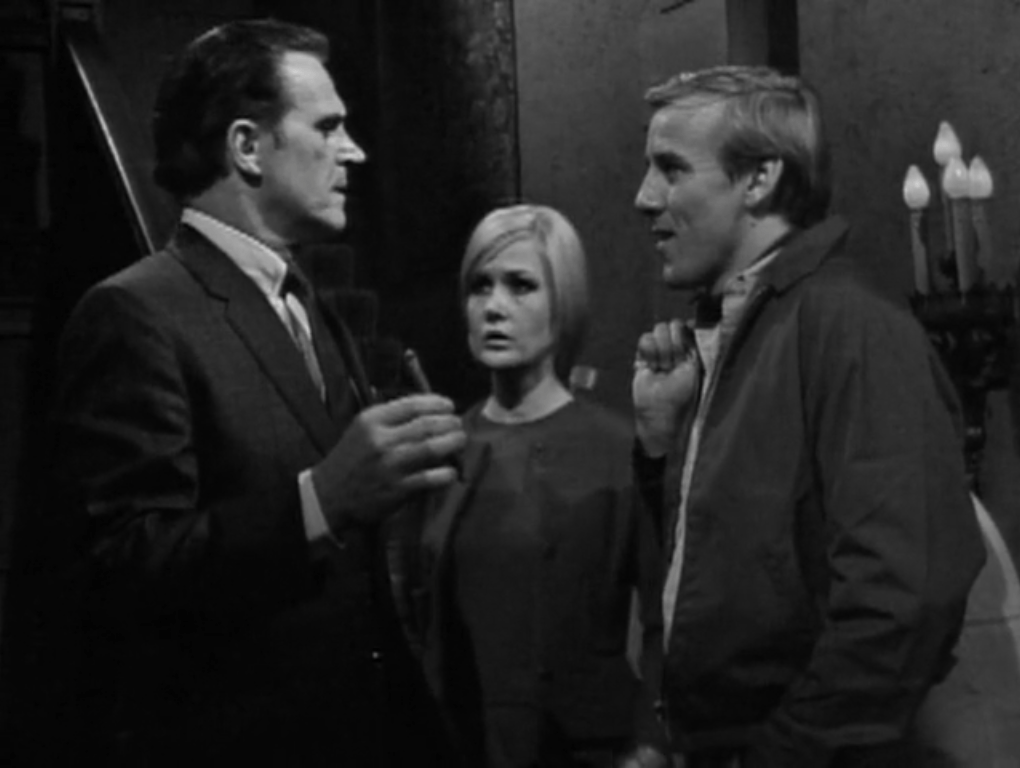
Burke shows up at the Evans cottage and tells Sam that he received his message. Since Sam had told the clerk at Burke’s hotel that he was calling in connection with an emergency, Burke keeps pressing him to explain what he wanted to say. Sam keeps stalling. Despite his promise to Maggie a few minutes ago to quit drinking, his stalling involves a couple of shots of booze. Finally Sam screws up his courage and tells Burke everything. Burke declares “I knew it!”

*According to the Bureau of Labor Statistics online CPI calculator, $15,000 in the summer of 1956 would have the same purchasing power as $165,905.41 in March of 2023.

**I am curious as to what Sam’s legal position would actually have been. He tells Maggie that neither he nor Roger said anything about the accident when he gave him the money; Sam simply assumed he was taking a bribe. Since Roger did receive the paintings, and famed art dealer Portia Fitzsimmons has told Sam that the paintings would now be worth a great deal of money, only Sam’s confession of his corrupt motive would suggest that he did anything ten years ago that it might be possible to prosecute him for. Besides, he never committed perjury or lied to law enforcement- he never said anything at all. It would seem the most they could have got him on at the time would have been failure to report an accident, and surely the statute of limitations on that misdemeanor would have expired after ten years.

His more recent behavior would seem to present a more serious problem. Ever since Burke came back to town in episode 1, Sam and Roger have been talking to each other about the accident and its aftermath, meeting in public places and confirming over and over that the money was a bribe. Moreover, Sam has spent the last few days blackmailing Roger, threatening to go to Burke unless Roger produces the paintings in time for him to have Portia Fitzsimmons show them in her gallery. Roger has not been able to find the paintings. So going to Burke, or even to the police, could be interpreted as an act in furtherance of Sam’s blackmail scheme, and therefore as itself felonious. It is no wonder that when Sam went to the telephone, my wife, Mrs Acilius, was shouting at the screen “Call a lawyer!”

***Who according to the Dark Shadows wiki worked under the name “Frank Reich.” Since “Frankreich” is the German name for France, I assumed that “Frank Reich” was an obvious pseudonym. But it turns out there are a number of people in the world whose actual given name is “Frank Reich,” some of them well-known, so who can say.

Episode 186: An extraordinary ordinary life

Hardworking young fisherman Joe Haskell is having a drink at the bar in Collinsport’s tavern, The Blue Whale. Dashing action hero Burke Devlin enters and annoys Joe by sitting next to him. Burke and Joe had some conflicts earlier in the series, and Joe had formed a decided dislike of Burke in those days. The conflicts are no longer generating any action, so Burke has been trying to befriend Joe. Joe isn’t having it.

Burke tells Joe that he hears he has been having some adventures. Joe says that he doesn’t know what Burke is talking about, and isn’t sure he cares. Burke says that he has heard that Joe and parapsychologist Dr Guthrie went to the old graveyard north of town, opened a couple of graves, and found them empty. This is true, and since the only people who knew about it were either sworn to secrecy or strangers to Burke Joe is mystified as to how he found out.

Burke tells him that well-meaning governess Vicki told him. “Vicki wouldn’t tell you that,” says Joe. Burke explains that she had to tell him, because she needed his help. Strange and troubled boy David Collins adores Burke, and Vicki is the leader of a group who are afraid that David’s mother, blonde fire witch Laura Murdoch Collins, is going to burn David alive.

Burke dated Laura years ago, and was still hung up on her when she came back to town. He’d been urging David to get closer to his mother and to go live with her. He several times made it clear that he hoped to marry Laura and become David’s stepfather. Vicki laid out the evidence that she, Dr Guthrie, and the rest of her group have assembled in support of their view about Laura’s unearthly nature and horrifying plans. Since he heard Vicki out, Burke has joined her side.

Joe is taking all this in when we hear a tinkling sound and a muffled voice. The bartender comes to him and says “Mr Haskell, there’s a call for you.” I believe this is only the third time we’ve heard the bartender speak, after #3 and #156.

We see Joe take the call. He is shocked by what he hears. He returns to his spot and tells Burke that Dr Guthrie is dead. His car ran off the road and burst into flames.

Joe mentions Vicki and David, and Burke is alarmed at the thought that Vicki and David might have been with Guthrie. Joe calms him, explaining that Guthrie was on his way to meet Vicki and David. They, along with drunken artist Sam Evans, are waiting for Guthrie at the long-abandoned Old House on the grounds of the estate of Collinwood. They planned to hold a séance there to contact the ghost of Josette Collins, in hopes that Josette, who has been giving them hints and clues all along, will be able to tell them how to defeat Laura. Burke insists on going to the Old House with Joe.

Joe and Burke exchange all this information in normal conversational tones punctuated with shouts. We don’t see any other customers, but the bartender is right there, and while they are on the way out we even see him react to their mention of the séance.

Bob the bartender, wishing those two would keep their gobs shut

I’m sure they are relying on the bartender’s professional discretion. Still, they are catching on that Laura is extremely dangerous, participating in séances can wreck the reputation of people in the businesses Joe and Burke are in, and Joe and Guthrie’s grave-opening expedition was quite obviously something that could get them sent to jail. You’d think they would want to spare him the responsibility for so much sensitive information. It’s just inconsiderate to dump all that on a guy in return for the tips you give him for two beers.

At the Old House, Vicki, David, and Sam spend more than one scene waiting for Guthrie to show up. There is quite a bit of filler in this episode; when Sam says “I hate waiting like this!,” we can sympathize. Even after Joe and Burke show up with the news of Guthrie’s death, there is yet another scene of filler, in which Sam rants about Laura as the cause of Guthrie’s death and can’t decide whether he is willing to join Vicki and David in going through with the séance.

Of course they do go through with it. A ghost begins speaking through David, but it is not the spirit of Josette. It is David Radcliffe.

David Collins had not heard of David Radcliffe, but Vicki and others know that in 1867, Laura Murdoch Radcliffe burned herself alive with her young son David. A contemporary newspaper account reported that David Radcliffe happily joined his mother in the flames, refusing to be rescued. Vicki and her group believe that the current Laura Murdoch Collins is a reincarnation of that other Laura Murdoch, and that, as a humanoid Phoenix, she achieves a cyclical immortality by burning herself alive and rising from the ashes. They fear that Laura Murdoch Collins will take David Collins into the flames with her, and that he, like his namesake, will choose to burn to death.

They do not know whether David Radcliffe shared his mother’s immortality, or whether David Collins will rise again if he burns with his mother. The show has repeatedly identified ghosts as unquiet spirits of the dead, so David Radcliffe’s appearance as a ghost speaking through David Collins would by itself militate against the idea that Laura’s resurrections are shared by her sons. In his speech, David Radcliffe describes himself being held by his mother while the fire rages and wanting to be with her forever, but ends with an tortured cry as he asks where she has gone. In agony, David screams and collapses.

This scene is a remarkable tour de force for David Henesy, and completes the audience’s understanding of what Laura is and what danger she represents. Her son is a means to the end of her own immortality, not a partner in that immortality. That Laura Murdoch Collins gave her son the same name her previous incarnation gave to the son she killed for her own sake shows that it was her plan all along to make him a human sacrifice to her inhuman survival. If Vicki can rescue David from the fate Laura has in store for him, she will not only prolong his life, but give him an altogether new life and give him herself as the mother of that life.

So, there are two sources of suspense. First, what further obstacles will Vicki encounter on the way to rescuing David, and what will be lost as she makes her way through them? There might be further deaths- Guthrie might have been the most readily disposable character on the show at the end of last week, but there are several others without whom Dark Shadows could go on just fine. There could also be lots of changes in relationships among characters, or in the personalities of characters we like as they are.

That brings us to the second source of suspense. It is a question that has been on the minds of regular viewers since the Phoenix story began approaching its climax. What will the show be about once Laura is gone? The only consistently interesting relationship on Dark Shadows so far has been that between Vicki and David, and once Vicki has established herself as David’s de facto mother that is going to be defined pretty securely. There might be periodic threats to their friendship, but once Vicki has managed to replace David’s mother there won’t be much doubt that she can overcome any lesser disruptions.

Art Wallace’s original story bible for the series, Shadows on the Wall, called for Laura Robin Collins to die under mysterious circumstances and for Vicki to be put on trial for her murder. That does not sound promising. We’ve spent months of episodes, most of them dismally slow-paced, figuring out information about Laura. Most of the characters now know as much about her as we do. An entire narrative arc spent rehashing what they’ve already rehashed beyond endurance would be impossible for even the most devoted fans to watch.

Vicki is to some extent based on Jane Eyre, a governess who ends by marrying her charge’s father, Mr Rochester. David’s father is named Roger, which is as close as they could get to “Rochester” without making people miss Eddie Anderson. They brought up the idea of Vicki and Roger going on dates in #72, #78, and #96, but in each case Roger was merely trying to keep Vicki from making trouble for him, very possibly by killing her.

Further, the show has been hinting very heavily from the first day that Roger is Vicki’s uncle, the biological daughter of his sister Liz. Wallace McBride mentions the single most compelling piece of evidence:

In Dark Shadows, your reflection always tells the truth.

Duality was a series theme from the very first episode, which implemented a shocking amount of symbolism in its photography. As a daily series, it was never designed to withstand the scrutiny of re-runs, let alone the far-flung fantasy concept of “home video.” The series was as disposable as a newspaper, something to be enjoyed for a few minutes and then forgotten. The writers and directors of Dark Shadows did not get that memo, though, and set about creating afternoon entertainment that was more psychologically complex than it had any right to be.

The first episode established this dynamic immediately. Victoria Winters is riding on a train through the night, her reflection in the glass beside her. We discover that she’s a “foundling,” anonymously abandoned to the state as an infant. She’s traveling to Collinsport, Maine, to take a job — and to learn the truth about her own mysterious past.

In other words, she’s looking for the real Victoria Winters — represented throughout this episode by her own reflection. We see Victoria reflected back in the window of the train carriage, the mirror in the restaurant of the Collinsport Inn, and in a mirror (in a flashback!) at her bedroom at the foundling home.

Most telling is the reveal in the episode’s final scene. When she arrives at her destination, the doors of Collinwood open to show Elizabeth Collins-Stoddard standing in the entrance, looking very much like Victoria’s reflection. (For me, this is all the evidence I’ve ever needed that Liz was Victoria’s mother.)

In Dark Shadows, Your Reflection Always Tells the Truth.” Wallace McBride, Collinsport Historical Society, 18 April 2020

Among soap opera characters, attempted murder is frequently a prelude to romance, and an engagement between two people who are, unknown to themselves, closely related can build suspense as we wonder whether a third person who does know the truth will tell before it is too late.

But as Roger’s character develops it becomes ever clearer that he is not interested in marrying anyone. He is a narcissist, a coward, and devoid of family feeling. Worst of all, he’s spent all of his money. If she marries him, Vicki will either join him as his sister Liz’ charity case or get a blue-collar job and support him in a style to which he has no conceivable intention of becoming accustomed. That might work on another show, but it doesn’t sound at all right for Dark Shadows.

There are some odds and ends lying around from previous storylines, but those didn’t take off the first time we saw them and aren’t likely to be any more exciting now. Why is Liz a recluse? They haven’t shown us anyplace she’d be interested in going. Will Burke be avenged on Roger? Not if it requires writing Roger off the show- he’s hilarious. Will Joe marry Maggie Evans, The Nicest Girl in Town and daughter of Sam? Why not, they’re happy together and no one is against it. Will a serious romance blossom between Vicki and instantly forgettable young lawyer Frank? That’s such an urgent question that no one has noticed Frank isn’t on the show anymore. There just isn’t an episode’s worth of story in any of those questions. You may as well ask whether any more of Burke’s custom-made fountain pens will show up in town, or what happened to the dartboard Roger used to have in his office, back when he had an office.

Once it finishes with Laura, Dark Shadows is going to need a reboot. Both Laura’s storyline and the one that immediately preceded her, that of crazed groundskeeper Matthew Morgan, led us into the supernatural back-world of the show’s universe. That’s clearly where Dark Shadows 2.0 will be heading, and probably in a way too dynamic for the wispy presences of Josette and the Widows to survive. There may also be an attempt to mine some of the leftover pieces from Shadows on the Wall, but it’s hard to see how anything in there will get you very far.

Episode 166: The most harmful thing of all

Every episode of Dark Shadows begins with a voiceover narration. This is how today’s goes:

My name is Victoria Winters. The brightness of the morning cannot mask the fact that the night has been marked by a restless, fitful sleep, especially for one young woman who has been disturbed by strange premonitions and events that she does not fully understand.

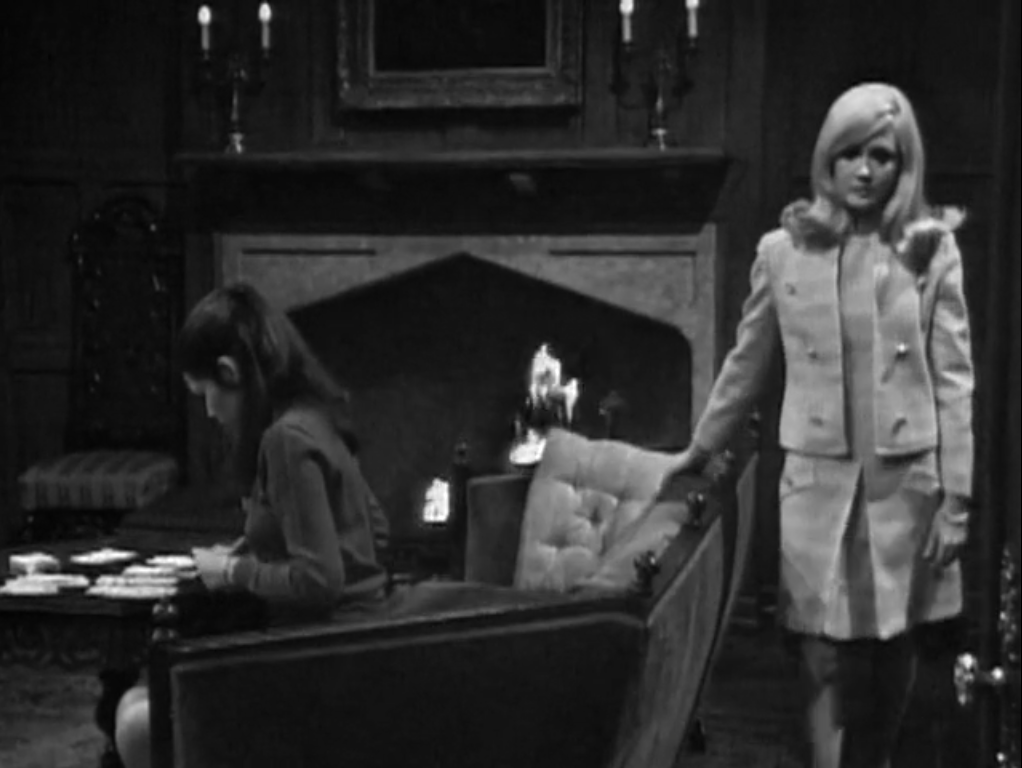
We then see the drawing room of the great house at Collinwood, where two young women are both showing signs of disturbance. There’s no way of telling which one the narration is referring to. Flighty heiress Carolyn is pacing and talking, while well-meaning governess Vicki is clenched tight playing solitaire. This sloppy mismatch is the first sign that we’re dealing with a script by Malcolm Marmorstein, the worst writer on Dark Shadows.

Disturbed by strange premonitions and events

Vicki and Carolyn are worried about strange and troubled boy David. David has spent the night with his mother, blonde fire witch Laura, and is not back yet. They are convinced that Laura is dangerous, but cannot be sure how or to whom. Marmorstein’s awkward dialogue stumbles up to a climax in which Vicki tells Carolyn that visiting parapsychologist Dr Peter Guthrie had said he was inclined to organize a séance. Considering that he first discussed that idea in a conversation with the two of them yesterday, Vicki’s announcement of this as news and Carolyn’s incredulous reaction will leave returning viewers mystified.

David comes home. He’s fine. He tells Vicki that he sensed the presence of the ghost of Josette Collins watching over him in his mother’s cottage, and that he knows he is safe wherever Josette is. What the audience knows, but neither Vicki nor David does, is that Laura and Josette had a confrontation while he was sleeping, and that Josette retreated. Josette is not strong enough to defeat Laura by herself. When David goes to sit by the fire and stare at it in a trance-like state, as his mother habitually does, we wonder how Vicki and the others will put together a strong enough force to help Josette save David. That’s a suspenseful sequence, effectively realized.

Hardworking young fisherman Joe comes to the house on a business matter. He and Carolyn have a conversation about their defunct romance. Carolyn says that she has matured since those days, and that she is free to give it another try. Joe says he is not free. For a show with so many ghosts and ghoulies, it’s surprising that Dark Shadows inspires the greatest fear in its fans when they threaten to bore us yet again with a tedious dead-end storyline like the Carolyn/ Joe relationship. It’s certainly a relief when Joe is so firm as to leave no doubt that we’re finally done with that.

Joe has transferred his affections to Maggie Evans, The Nicest Girl in Town. We dissolve to an extreme closeup of the laughing mouth of Maggie’s father, drunken artist Sam Evans. Sam is in the local tavern, The Blue Whale, with a drink in his hand, a crony on either side of him, and some music we haven’t heard before on the jukebox.

Glad Sam

Maggie and Joe are at a table, where he is trying to make her jealous by telling her of Carolyn’s interest in him, and she can’t stop watching her father and fretting about his drinking. The two of them talk a bit about how Sam’s drinking has reversed the roles of parent and child. That’s the big theme of Maggie in the first 42 weeks of the show, that she is an Adult Child of an Alcoholic. It’s because she’s had to cope with Sam’s addiction that Maggie is so nice to everyone, and also because of it that she has a habit of starting her lines with a little laugh that doesn’t always make sense in context. As the show goes on, Sam drinks a lot less and Maggie gets involved in a wider variety of stories, but that weird little laugh, the union card of many an ACoA, stays with the character to the end of her time on the the series.

Maggie leaves Joe alone at the table while she confronts Sam. She doesn’t stop him drinking, but she does manage to wreck the good mood he and his buddies had going. In the course of their talk, they recap the conversation Sam had with Dr Guthrie Thursday.

Dashing action hero Burke Devlin comes in and sits down with Joe while Maggie is scolding Sam. The two of them have been at odds over Carolyn, and now discover that neither of them is interested in her any longer. Joe seems irritated that his list of reasons to dislike Burke has grown shorter.

When Maggie returns to the table, Burke exchanges a few friendly words with her. He then goes to the bar to buy Sam a drink. Maggie voices her dismay at this plan, and even Bob the bartender gives a dark look at the idea of serving Sam yet more booze. But Burke ignores them both.

Burke wants to know about the conversation Sam had with Dr Guthrie. They recap the conversation Sam had with Maggie a few minutes before. Burke is in love with Laura, and may be under her influence. This conversation raises the prospect that Burke will be an ally of Laura’s against Vicki and her team. Its similarity to the conversation Maggie and Sam had so shortly before suggests that the Evanses may also make themselves more useful to Laura than to the good guys. The repetition grates hard enough on the audience that it is an inefficient way of making that point, but the point itself does add to the suspense.

Most episodes of Dark Shadows have only five credited actors and no extras. This one has seven credited actors and a bunch of extras, including featured background player Bob O’Connell as the bartender. There have been several episodes the last couple of weeks with only four actors; apparently they’ve been saving up to splurge on this one. It is by no means the dullest installment of this period of the show, but neither are there any of the thrills or major story developments you would expect from a high-budget episode. Frankly, it’s rather worrying that this is what they lay out the big bucks for now. Is this as exciting as the show is going to get?

Episode 156: Why is my baby crying?

At the end of Friday’s episode, we saw reclusive matriarch Liz start to fall down the stairs, then saw her sprawled on the floor below. Today begins with a recreation of that scene, but instead of merely starting to fall, actress Joan Bennett tumbles far enough forward that she must really have gone down. It’s an impressive stunt.

Dark Shadows first stunt performer: Joan Bennett

Most of the episode is taken up with Liz’ demented condition and the reactions of the members of the household to it. The audience knows that Liz’ troubles are the result of a spell cast on her by blonde fire witch Laura. At moments Liz is almost able to figure that out herself, but no one else has a clue what is going on. The whole episode is full of standout moments for Liz. If there had been Daytime Emmy Awards in 1967, this would have been the episode Dan Curtis Productions would have sent to the voters to get Joan Bennett her Best Actress award.

At one point, Liz begins to recover her memory and is about to take action against Laura. Before she can reach anyone, a ghostly figure appears in her room. Afterward, she has a mad scene, indicating that she has been rendered powerless.

The ghostly sighting raises some questions about Laura. Is it Laura’s ghost she sees? Or another ghost allied with Laura? Or has her abuse of Liz’ brain led it to produce this hallucination on its own? The show is very indefinite about what exactly Laura is and how she operates, giving us the chance to have a lot of fun speculating about her.

This episode is replete with notable firsts. In addition to the first real stunt of the series, it features the first scene in which Bob O’Connell, as the bartender in The Blue Whale, has lines to deliver.

In that same scene at The Blue Whale, we hear music coming out of the jukebox that we haven’t heard before. It is a medley of Lennon-McCartney tunes rendered in “smooth jazz” style by Bud Shank.

It’s also the first time a conversation on the landing at the top of the stairs leading up from the foyer is photographed straight-on. Several times, we had seen characters talking to each other up there, but always before the camera had been angled up from the floor below. That had created the sense that the conversation was removed from the main course of the action. Today, it’s just another part of the set.

It is the first time we see Liz’ room. Two notable firsts take place there. A favorite prop of Dark Shadows fandom, the so-called “Ralston-Purina lamp,”* has been seen several times in the Collinsport Inn. In Liz’ room today, it makes the first of many appearances in the great house of Collinwood.

The Ralston-Purina lamp

The ghostly figure in Liz’ room is played by Susan Sullivan, who has been acting in primetime on network television more or less continuously for the last 55 years. During the other hours, she writes plays and performs in Dark Shadows audio dramas.

A play she wrote under the title “What Friends Do” was produced by Smartphone Theater and posted on Youtube. The cast is made up of Dark Shadows alums Susan Sullivan, Kathryn Leigh Scott, Mitch Ryan, and David Selby. It’s about four friends in a retirement community during the Covid pandemic, and it’s terrific. The Q & A after includes a lot of stuff that Dark Shadows fans will find irresistible, including a little bit about today’s episode.

The voice that says “Dark Shadows is a Dan Curtis production” at the end of the closing credits does not sound like ABC staff announcer Bob Lloyd. It’s higher-pitched and faster than his delivery, and the vowels are flatter than he articulates them. Perhaps it’s a tape fault distorting Lloyd’s voice, or perhaps he had a cold that day. If it was someone else, it’s another first. The Dark Shadows wiki doesn’t say anything about it, so I assume the surviving records and the published books that use them don’t say it was someone else.

*So-called because its red-and-white checked pattern looks like the logo of the Ralston-Purina animal food company.

Episode 129: Woman in flames

Maggie Evans, The Nicest Girl in Town, is worried about her father, drunken artist Sam. Maggie’s boyfriend, hardworking young fisherman Joe, is with Maggie at the Evans Cottage, waiting for Sam to come back from his current binge.

Maggie is particularly worried about Sam’s attitude towards a mysterious woman who has recently returned to town. Maggie doesn’t know who the woman is, but yesterday, Sam and the audience found out. She is Laura Collins, estranged wife of high-born ne’er-do-well Roger Collins. Laura is the other witness to an incident ten years ago that Roger paid Sam not to tell the police about. It was his guilt about that bribe that started Sam drinking in the first place, and he is terrified that his secret will come out. As Maggie and Joe talk about Sam, Sam is in the tavern with Roger, trying to figure out why Laura has come back to town.

Roger goes home to the great house of Collinwood and tells his sister, reclusive matriarch Liz, that Laura has come back to town. Liz wonders why Roger is afraid of Laura. Roger denies being afraid of her, and Liz loses interest in the question. She wonders what Laura wants. At the thought that Laura might want to see strange and troubled boy David, the son she shares with Roger, Liz expresses emphatic opposition. Liz thinks of Laura as a severely disturbed woman, and is convinced that seeing his mother would only harm David.

Sam returns to the Evans Cottage. Joe sees that he is massively drunk, and whispers an offer to Maggie to help her take care of him. She declines, saying that she has plenty of experience. Sam insists on starting a painting. Maggie can’t stop him, and goes to bed.

Sam lights a cigarette and stares raptly into the flame, as we saw Laura do yesterday. He then goes to the canvas and makes painterly motions with great rapidity.

Drawn to the flame. Screenshot by Dark Shadows Before I Die

The following morning, Maggie wakes Sam up. He lies passed out on the couch, a liquor bottle that had been mostly full the night before empty on the floor beside him. In response to his protests, she refuses to leave for work with him unconscious. On her way to make coffee for him, she sees the painting he did the night before. She remarks that it is not in any style she’s ever seen him use before, and he doesn’t remember a thing about it. It depicts a woman in flames. He reacts to the painting with horror.

A woman in flames. Screenshot by Dark Shadows Before I Die.

Dark Shadows has already shown us portraits as powerful objects, even as a locus for the natural and supernatural. Just on Monday, the ghost of Josette Collins (which, like Maggie Evans, is played by Kathryn Leigh Scott) emerged from the portrait of Josette in the Old House and brought about the climax of a story arc that began in episode 38. Now we see where these eerie portraits come from.

We will see more portraits created by possessed artists in the years to come. Something else happens in this episode for the first time, but not the last. The bartender at The Blue Whale, who has been addressed variously as “Bill,” “Joe,” “Mike,” “Andy,” and “Punchy,” today answers to “Bob.” That’s the name they settle on, perhaps because the actor’s name is Bob O’Connell.

Episode 63: The world around it

Each episode of Dark Shadows begins with a voiceover. In this phase of the show, the voiceovers are all narrated by Alexandra Moltke Isles in character as Victoria Winters, well-meaning governess, and are brief passages of almost purely decorative prose, meant only to set a mood and to vanish from the audience’s memory as soon as the action starts. Art Wallace and Francis Swann, the writers credited for the first 97 episodes, were old pros who had been turning out scripts for decades, and were good at staying out of their own way. That’s why I haven’t yet said anything about any of the opening voiceovers- when Wallace or Swann set out to write something forgettable, they succeeded. By the time I started writing, I had no recollection of them whatever.

Today’s opening voiceover is unusually substantive, so much so that it threatens to leave a trace in the audience’s mind:

My name is Victoria Winters. Once again it is quiet in Collinwood. There is no sound but the ticking of the great clock in the entrance hall. And the lonely footsteps of a woman who hasn’t left its grounds in eighteen years. A woman whose life is limited to musty corridors and the endless beat of a grandfather clock. A beat that seems to ignore the vitality of the world around it.

Vicki names herself, names the estate where she lives, talks about how quiet it is, mentions the clock, tells the audience that the lady of the house is a recluse who hasn’t left home in eighteen years, complains about the air quality in the house, brings the clock up again, and assures us that interesting things are happening everywhere except here. It leaves us wondering why Vicki is so hung up on the clock, why she doesn’t run the vacuum cleaner herself, and why, if the entire world surrounding Collinwood is chock full of vitality, they don’t turn the camera in some other direction.

That’s the sort of thing we’re going to get from Wallace and Swann’s immediate successors, Ron Sproat and Malcolm Marmorstein. In writing their opening voiceovers, Sproat and Marmorstein fell between two stools. They didn’t write brief, deliberately forgettable passages as Wallace and Swann had done; nor did they integrate the opening voiceovers into the action of the show, as would happen in later years when the story is moving very fast and the episodes start with detailed recaps of events so far. Instead, Sproat and Marmorstein saw the voiceovers as vehicles for long passages of flowery, over-developed imagery. Those are certainly no more effective at setting a mood than were Wallace and Swann’s brief remarks, but they do both try the patience of the audience and linger as distractions. That’s one of the things that prejudices viewers against the character of Vicki- since so many episodes from the Sproat/ Marmorstein era start with Vicki rambling on about the weather or making vague remarks about “one small boy” or whatever, the first impression she leaves on viewers who start watching with episodes from that period is that of a prattling fool.

While Wallace and Swann are the only writers whose names have appeared in the credits thus far, it is very possible that others not credited contributed additional bits. I may be wrong, but my nose catches a whiff of Marmorstein in these six strange, distracting sentences. The description of the clock while we’re looking at it, the specified number of years since reclusive matriarch Liz has left the estate, the evocation of the “musty corridors,” the yearning glance at the eventful world outside, are all typical of Marmorstein’s attempts to turn the voiceovers into freestanding dramatic monologues, but without identifiable characters or plot development.

Today’s episode doesn’t shed much light on Vicki’s relationship to the clock or on the standards of cleanliness in the great house of Collinwood. Instead, it’s a kaleidoscope episode, in which each change of scene varies the combination of characters who interact on each set. The action plays out on two sets this time, the foyer/ drawing room representing the downstairs of the great house, and the Blue Whale tavern, representing the low and bustling life of the village. Because the sets typify the “musty corridors” inside the house and the “vitality of the world around it,” the episode is also a diptych of sorts- not Art Wallace’s usual diptych contrasting two pairs of people, but a diptych contrasting two places and the attitudes those places inspire in the people who spend time in them.

The five pieces tumbling about in today’s kaleidoscope are reclusive matriarch Liz, tightly-wound handyman Matthew, flighty heiress Carolyn, hardworking young fisherman Joe, and Maggie, the nicest girl in town. The regular bartender at the Blue Whale gets a fair bit of screen time as well. In the first 63 episodes, he’s answered to names including “Joe,” Andy,” “Mike,” and “Punchy.” Today, Joe the fisherman calls the bartender “Punchy,” a name he called him most recently in episode 56, the same episode where drunken artist Sam calls him “Mike.” Maybe we’re supposed to think that the young men know the bartender as “Punchy,” the older men as “Mike.” Eventually the show settles on the name “Bob” for him, perhaps because the performer’s name was Bob O’Connell. In one episode (#319,) Sam calls him “Ba-ba-roony,” giving rise to the idea that his name is Bob Rooney.

Liz appears only at Collinwood, of course; Joe and the bartender appear only in the bar. The others migrate back and forth between the two sets. We first see Carolyn with Joe in the bar, talking about what a flop their date has been and how pointless their whole relationship is. Maggie interrupts this thrilling conversation, looking for her father, Sam the drunken artist. After puzzling Carolyn and Joe with a number of cryptic remarks, Maggie gives up looking for her father and goes to Collinwood to look for high-born ne’er-do-well Roger. Roger isn’t home, so she winds up talking to Liz. This is the 63rd episode, and it’s the first time we’ve seen these two major characters together.

Screenshot by Dark Shadows Before I Die

We first see Matthew in Collinwood, telling Liz how much he wants to help her. He then goes to the bar, where Carolyn and Joe see him. Matthew is looking for dashing action hero Burke Devlin, whom he hates. He implies to Carolyn and Joe that Burke is to blame for the death of beloved local man Bill Malloy. Joe doesn’t like Burke any more than Matthew does. The instant he hears Matthew’s idea, he is all in on it. Carolyn resists the suggestion.

Carolyn goes home to Collinwood. Maggie has explained to Liz that Burke has been saying terrible things about her father, that she can’t find her father to ask him about Burke’s allegations, and that Roger might know something about them. Liz urges Maggie to believe in her father, and to regard Burke as a dangerous, unscrupulous man capable of many dark deeds. Hearing the last part of this, Carolyn asks her mother if she believes that Burke is capable of murder. Yes, Liz says, she does believe that he is capable of that.