
For nineteen weeks from November 1967 to March 1968, Dark Shadows was a costume drama set in the late eighteenth century. Among the more interesting characters introduced in that period were fanatical witchfinder the Rev’d Mr Trask; roguish naval officer Nathan Forbes; fast-talking con artist Suki Forbes; and streetwalkers Ruby Tate and Maude Browning. All five of these characters were murdered by vampire Barnabas Collins, and all five of them are among those who return today for an impromptu trial of Barnabas.
Barnabas killed Trask by luring him to his basement and bricking him up in an alcove, as Montresor did to Fortunato in Edgar Allan Poe’s 1846 story “The Cask of Amontillado.” Some other characters invited themselves to the basement yesterday and held a séance there. As a result of the séance, the bricks fell away and Trask came back to life. Now, Trask has confined Barnabas to the same alcove. He declares that he will give him a trial before he bricks him up.
In the eighteenth century, Trask was the prosecutor in the trial of time traveling governess Vicki Winters. Victoria was convicted of witchcraft and sentenced to death. Vicki’s trip from the 1960s to the 1790s inverted Barnabas’ displacement in time; as Vicki’s witchcraft trial was so chaotic it did not seem to follow rules of any kind, neither does the murder trial Trask improvises for Barnabas fit any conceivable model of procedure. Vicki’s trial stretched over two weeks, from #427 to #437; Barnabas’ begins and ends today, during the second half of the episode.
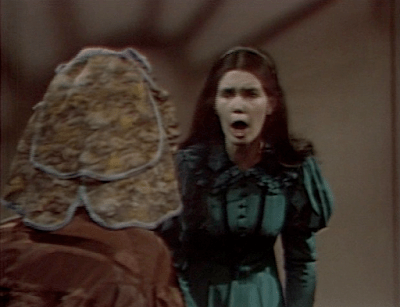
Trask conjures up Nathan, Suki, Ruby, Maude, and Barnabas’ first homicide victim, his uncle Jeremiah, to serve as a jury; he conjures up a man named Ezra Simpson, of whom we have never previously heard, to act as judge. Trask is the prosecutor, and Nathan is his sole witness. This court of “the damned!,” as Trask calls them, recalls the rogues who confront Jabez Stone as jurors and judge in Stephen Vincent Benét’s 1936 story “The Devil and Daniel Webster.” Unlike Jabez Stone, however, Barnabas does not have a right to counsel.

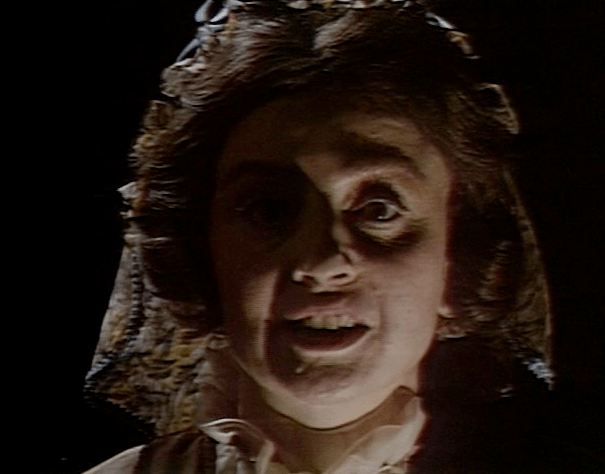
Trask asks Nathan how he died. After Nathan says that Barnabas strangled him, Trask asks him how Suki died. Barnabas objects that Nathan shouldn’t be allowed to speak for others; regular viewers sympathize with this, since Suki, played today as she was originally by Jane Draper, was sensational every second she was on screen, and when we saw Miss Draper again we were happy to think that she would have another chance to show what she could do. Barnabas also shouts at one point that he is innocent; this is less likely to attract the audience’s sympathy. Mrs Acilius and I certainly got a good laugh from it.
Barnabas asks to be allowed to present a defense. Trask invites him to question Nathan. He is about to do so when Nathan smiles at him, turns around, and vanishes. Trask explains that Nathan has already said all that needs to be said. Later, Trask looks at the recompleted wall and laughs with vicious glee, delighted at what is behind it.
Barnabas has neither the powers nor the limitations of a vampire now. The effects of the curse went into remission when mad scientists Eric Lang and Julia Hoffman created a man from parts scavenged from the cemetery and connected Barnabas to him as they electrified him and brought him to life. Barnabas named this man Adam.
Now Adam has escaped from the horribly abusive home Barnabas and Julia provided for him. He has found a friend in Sam Evans, an artist who was blinded when Barnabas enlisted him in one of his hare-brained schemes. Sam is teaching Adam to speak, and is so impressed with his ability to learn that he wonders aloud if he will be able to teach him to paint professionally.
Adam develops a sudden pain in his wrists. He moans “Barnabas! Hurt!” A shot of Barnabas hanging by his wrists in the basement alcove is laid over a closeup of Adam. Evidently the bond between them is such that Adam can sense Barnabas’ pain, even though they are miles apart. Apparently it is mid-1840s day on Dark Shadows; the scene in Barnabas’ house recalls “The Cask of Amontillado,” and the scene at Sam’s house is based on Alexandre Dumas’ 1846 novella The Corsican Brothers. “The Devil and Daniel Webster” was set in that decade or a bit earlier, and while Frankenstein was written in 1818 many adaptations of it, including the one Dark Shadows creator Dan Curtis would make in 1973, are set in the 1840s.
Adam becomes agitated. He cannot explain what is happening to him, no matter how patiently Sam asks. Sam’s son-in-law-to-be Joe Haskell comes in; Adam brushes against Joe as he runs out the door. Though Joe is a tall and sturdy man, Adam is so tremendously strong that this casual contact sends him flying.
It dawns on Joe that Adam is the man who abducted heiress Carolyn Collins Stoddard and then fell from the cliff on Widows’ Hill. Sam calmly replies that he had already figured that out. Joe is shocked that Sam hasn’t called the police; Sam replies that Adam is as disabled as he is, and that he means no one any harm. Joe is not at all convinced of the second of these points, and worries that “Barnabas! Hurt!” might not have reflected a fear that Barnabas is hurt, as Sam thinks it does, but might rather express Adam’s resolution to hurt Barnabas. Joel Crothers and David Ford bring out the full comic value of this scene; Mrs Acilius laughed at the blandness with which Ford’s Sam confirms that he knows who Adam is.
Joe goes to Barnabas’ house to warn him, but finds it locked and apparently empty. Later, Julia goes there too. She has a key, and lets herself in. She doesn’t see any evidence that Barnabas is or has been home; she goes downstairs, and is mystified to see that the alcove wall, which was broken when she was there for the séance, is now bricked up again.
Several times, Dark Shadows has contrasted Barnabas’ home, the Old House on the great estate of Collinwood, with the Evans cottage, a working class residence in the village of Collinsport. Today they draw this contrast in sharp relief. The basement of the Old House is always dark, but even the upstairs is lit by candles today; the scenes in the Evans cottage, taking place at the same time, are sunlit. The basement is the most haunted part of the most haunted house on the haunted estate, and eight characters in costume dress materialize from thin air there; the Evans cottage is a part of the modern world where Sam and Joe can use reason to arrive at agreement about facts, even if they make different judgments about the significance of those facts. When Julia and Joe go to the Old House, each wanders about alone, finding no one to talk to; at the Evans cottage, even Adam is able to have a conversation, and while there he can receive a message from Barnabas by some mysterious means. Trask seizes control of the basement of the Old House to make a parody of the criminal justice system and enact his vengeance on Barnabas; in the Evans cottage, Sam refuses to call the sheriff because he wants to shield Adam from punishment for the crimes he inadvertently committed.



 Dark Shadows Commentary