Episode 17: Such a strange question

Another of the diptych episodes in which Art Wallace excels. This time we have two pair of contrasting scenes.

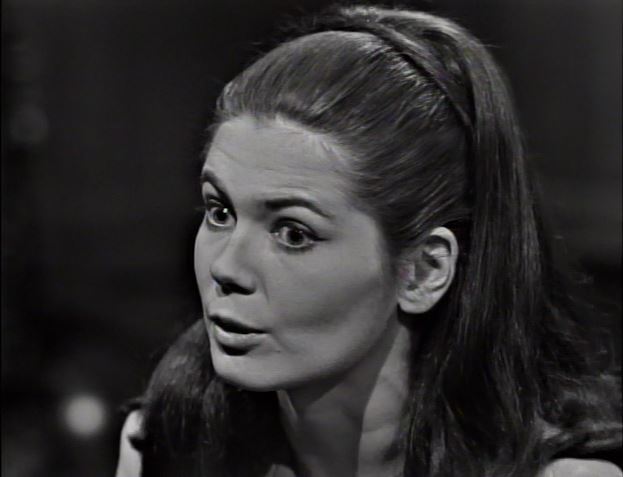
David, thinking he has succeeded in his attempt to murder his father by tampering with the brakes on his car, awakes from a nightmare and walk out through a feature no nine-year-old boy’s bedroom should be without, a full window that opens on a ledge above a two hundred foot drop to the sea. Elizabeth stops him before he can jump. David is hysterical, Elizabeth frantic to console him.

Juxtaposed with the wrenching scene between David and Elizabeth is a very light scene between Roger and his doctor. Roger is in the doctor’s office, pitying himself for his minor injuries. The doctor is overly friendly and relentlessly makes little jokes at which he himself seems to be quite amused. Roger is annoyed with the doctor’s manner and impatient with his work. The self-contained, self-satisfied, ultimately trivial Roger seems to live in a different world than the one where his son is suffering so grievously.

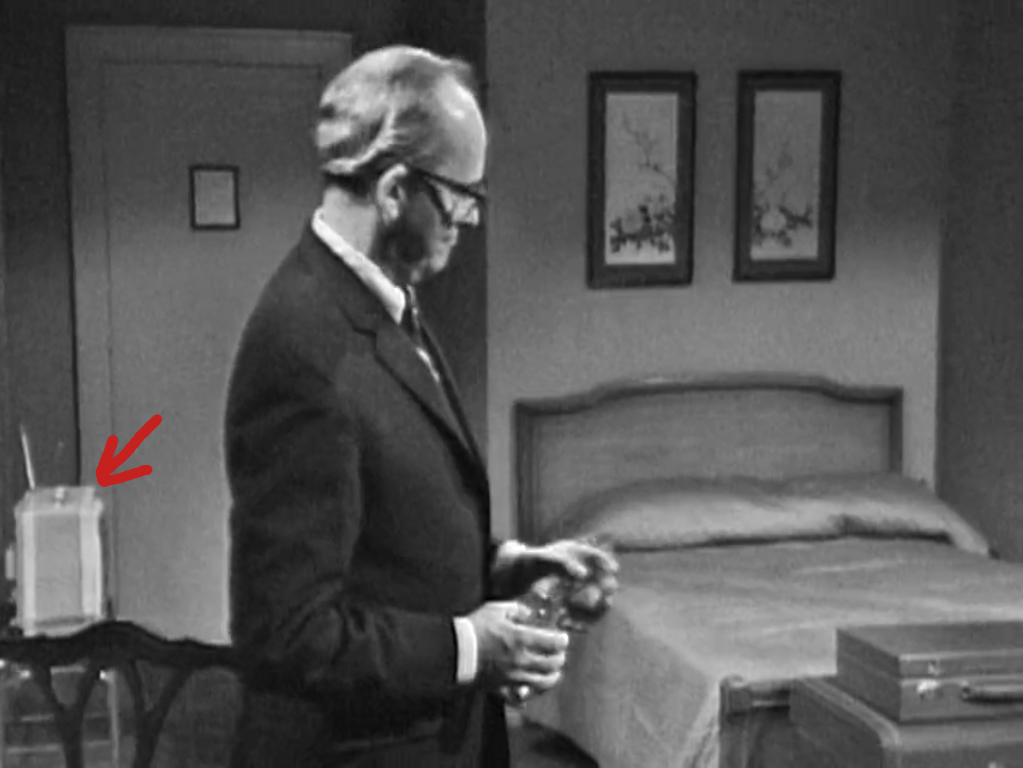
Then we have two scenes of teacher and student. Bill Malloy explains hydraulic braking systems to Roger and a scene in the drawing room where Elizabeth tells stories from family history to David. Since Malloy’s explanation advances the mystery story that is the main thread of the show at the moment, it is fascinating, and since the early history of the family is not (yet!) relevant, Elizabeth’s stories are intentionally presented as tedious. Here’s how I put it in the comments on John and Christine Scoleri’s Dark Shadows Before I Die:

Bill Malloy was a talented guy. His explanation of a hydraulic braking system, supplemented by that admirably drawn schematic, was not only crystal clear, but genuinely interesting.

There’s a structural justification for it- Liz’s lecture to David about Isaac Collins in front of Isaac’s portrait is deliberately presented as boring. So including another lecture supported by a single illustration and making it urgently interesting shows that what’s boring isn’t the format, but the relevance of the content to the story.

That venture into educational programming is a fine example of the freewheeling experimentation the series was doing in these early weeks. Some of those experiments come up again. The final 2 seconds of the episode is the first time a character looks directly into the camera, a trick they will use to advantage many times down the line.

Also, the date 1690 is interesting, not only because the portrait is ludicrously anachronistic- the man is wearing clothes from and is painted in a style that date from 200 years after that date- but also because we will hear about that period again, near the end of the series. Most likely that’s a coincidence, but I suppose it’s possible someone connected to the show in its final months remembered that the 1690s were supposed to be important in the history of the family.

Episode 16: This is no place for young people

Dark Shadows begins its first mystery story as the characters try to figure out who tampered with Roger’s brakes, sending his car off the road but causing him only minor injuries. It is an inverted mystery, of the type that would a few years later be stamped with the name of Columbo. The audience knows who committed the crime, the suspense comes from wondering how and when the perpetrator will be caught.

In this case the would-be killer is the victim’s nine year old son David, a boy whose father openly tells him that he hates him and who is frantic with terror that he will be “sent away,” which to him brings up something frightening and unexplained about his mother. David removed the distributor valve from the brake system of his father’s car so that the brakes would fail at the moment when the car approached a particularly dangerous turn on the side of the steep hill leading down from the house.

David has kept the valve, intending to use it to frame someone else for his crime. His first choice of patsy is his governess, the point of view character for this part of the series, Victoria Winters. That plan was foiled when Vicki caught him trying to plant the valve in her underwear drawer. Later, David will try to plant the valve on someone else, but for now he is stuck keeping it in his possession.

I made some remarks about this episode on John and Christine Scoleri’s Dark Shadows Before I Die:

A few disconnected thoughts:

1. The dancers at the Blue Whale are so bizarre in this one it really feels like watching footage from an alien world. Considering that so many members of the cast came from Broadway or were on their way to Broadway, it is baffling that the extras defined “dancing” as something you do by violently jerking your shoulders from side to side while wearing a huge grin. A few years before, aspiring Broadway players might have assumed teenagers dancing to rock ‘n’ roll in a Maine fishing village would look like that, but by 1966 there were enough people in the New York theater world taking pop music seriously that it’s hard to explain what we see in the background of these scenes as anything but sincere ineptitude.

2. Carolyn’s fantasy about being hit over the head and dragged out of Collinwood goes a long way towards explaining the men she gets involved with later in the series…

3. This is only the second appearance of the kitchen/ dining area that was introduced in episode 5. I think we see more of it in this episode than in any other. Between Mrs Stoddard’s comings and goings, Vicki’s business with the tea things, and the scenes with Matthew, it’s established as a substantial space.

Episode 15: I think he’s beginning to trust me

I left two comments about this episode on John and Christine Scoleri’s Dark Shadows Before I Die. A long one about its place in the overall development of the show’s stories:

This is a vitally important episode. The scene in David’s room is the first of many in which David Henesy and Alexandra Moltke Isles act their way out of weak writing to establish a relationship between two characters who can always make a connection with each other. Their body language, tones of voice, etc, triumph over some remarkably tedious dialogue to show us what people look like when they’re starting to trust each other. The growth of that relationship is really the only story that works in the first 42 weeks of the show. The big events involving characters we’ve only heard about or who will soon be recast matter insofar as they represent developments in that story, and other events don’t matter at all.

The scene that Liz and Roger play out in the drawing room while Vicki and David are talking upstairs is important in its own way. That these conversations are going on simultaneously is an example of the mirroring of Vicki and Liz that is such a strong motif in the first 42. Vicki is open and uncomplicated as she tries to talk David down from his superheated hostility to his father; Liz is guarded and double-minded as she tries to talk Roger back up to fear of Devlin. In the contrast between the two women, we see the difference between the innocent one with no past, and the frightened one with nothing but a past.

The contrast between father and son plays out in those scenes, and also in the two brief scenes between them. Roger’s narcissism renders him utterly childish, making no effort to take his son’s feelings into account or to understand Devlin’s motives. David’s fear and pain drive him to mimic adult behavior with absurd and indeed horrifying results. Liz tries to make Roger grow up, as Vicki tries to free David to be a child, but Roger’s inability to take anyone’s feelings but his own seriously dooms both efforts.

The moments between Liz and Vicki call for comment. Later on in the series, these characters will be stuck in many frustrating scenes where they inexplicably fail to pass on information that would resolve story points. At first glance, Vicki’s failure to tell Roger about Burke’s presence in the garage and Liz’s failure to pass the word of it on to him after Vicki tells her may seem to be the first of those failures. But Vicki has no reason to trust Roger, and very little to suspect Burke of wrongdoing. On what she’s seen of Roger so far, she can only assume that if she tells him what she saw he will jump to the most sinister possible conclusion and enlist her in his mad campaign against Burke. Liz seems relatively reasonable, at least on the topic of Burke Devlin, so by telling her Vicki is both satisfying an obligation and reducing the likelihood that she will be a party to slander. Indeed, Liz and Vicki tell each other quite a bit about themselves, much more than they will later on.

And a short one about a point that bothers many viewers:

Oh, and Liz’s failure to repeat Vicki’s news to Roger isn’t a problem. Liz is deeply preoccupied, and Vicki’s report wouldn’t be particularly interesting to anyone who hadn’t been watching the show.

Episode 14: We’re all pals again

We see David looking for a place to hide a small metal valve. He settles on Vicki’s underwear drawer. She catches him going through it; he runs off, and she finds nothing missing. She would apparently rather not think about what he was doing in that particular drawer. Later, he will claim that he was trying to slip a present into the drawer- a seashell, at first; then, a magazine.

Alone in the upstairs hallway, Vicki sees the locked door to the closed-off part of the house open and close, apparently by itself. At first, she thinks it’s David playing a prank on her, but he comes out of his room so soon after that there doesn’t seem to be any way he could have done it. The show has been using the idea of ghosts in episode after episode to suggest that something big is about to happen; now, for the first time, we see an event that is either a supernatural manifestation or an elaborate, Scooby Doo-esque hoax perpetrated by some unknown person for some unknown reason. So what she’s doing now- looking for David, trying to figure out what he’s been up to- is directly connected to something that is disturbing the supernatural back-world of Collinwood. It may be a while before the back-world erupts into the foreground, and even longer before it crowds out everything else and becomes the whole show. But that little valve represents the first irretrievable step on the path that will lead to what Dark Shadows became.

This is also the first episode in which Vicki gets to make someone laugh. Carolyn says that she and Joe will probably go to a movie, because “What else is there to do in this town?” To which Vicki replies “You could get into a fight in a bar.” It’s also the last episode in which Vicki is allowed to make a joke. Humorlessness one of the things that will eventually squeeze the life out of the character. Alexandra Moltke Isles delivers her one good joke well enough that it clearly could have been otherwise. Those of us who wish Vicki had stayed at the center of the show all the way through can’t help but feel sad that it wasn’t to be.

Episode 10: To the death of the monster

Carolyn is in Burke’s hotel room, where he charms her and tricks her into believing that he’s planning to leave town soon. I suppose the definition of “dashing” would be a charming fellow who makes things happen, things you wouldn’t have predicted and of which you aren’t sure you can approve. Burke is at his most dashing in scenes where he’s trying to enlist the women and children of Collinwood to his side. With Carolyn here, with Vicki back in episode 7, most of all with David in episode 30, we wonder what exactly he’s trying to do. He’s not so good with the men- when he tries to recruit Joe Haskell to his intelligence-gathering operation in episode 3, he ends up baldly offering him a bribe.

Liz and Roger are in the drawing room, where she demands he be less openly hostile to his son David. Unknown to them, David and his toy robot (a Horikawa “Attacking Martian,” which sold for $4.22 in 1966, not including two D batteries) are hiding behind a chair listening to Roger’s brutal denunciations of the boy. Unknown, that is, until Roger goes to the brandy bottle for his second drink, when the Attacking Martian starts attacking Roger.

Roger all but assaults David in response. David flees his father’s rage. He runs out of the house, telling Roger he hopes Burke Devlin gets even with him. Roger is as bleak and maladroit in these interactions as Burke is glittering and skillful in his handling of Carolyn. Again we see Art Wallace’s use of intercut scenes to bring out a comparison between characters.

After the second part of the scene in Burke’s room, David slips back into the house to find his Aunt Elizabeth asleep in a chair, muttering about ghosts. After all the talk about ghosts in the first two weeks, Elizabeth’s muttering about them seems significant- perhaps we are to think that her dream is a message from the ghosts who linger about the house, a sign that something is happening that will stir them up. Elizabeth awakes, and sees that David is in front of her, smeared with grease and holding a small object. He won’t answer any questions or let her see what he has in his hand. Before she can pursue the matter, Carolyn appears in the foyer, bringing an unexpected guest- Burke Devlin. Confronted with this shocking sight, she forgets all about David.

Episode 5: Good morning, you lovely people

This episode features the first appearance of one of my favorite sets, the kitchen at Collinwood. There’s an intimacy to hanging out in the kitchen, whether you’re actually sharing a meal or not, that makes it a natural place for people to exchange information.

Vicki and Carolyn do share a great deal of information with each other during their breakfast. By the end of it, we know everything Vicki knows about her origins, and enough about what was happening at Collinwood during her infancy to see the possible resolutions to the mystery about her.

David Henesy also has a heavy load of acting to do in this one as David Collins packs Vicki’s bags and calls for his mother. The script doesn’t give him much help in making these actions compelling, but Henesy’s face projects such intense emotions that his scenes move the audience powerfully.

My usual themes: Bossy Big Sister/ Bratty Little Brother

In 281 of the posts that follow, I link to comments I made on Danny Horn’s blog, “Dark Shadows Every Day.”

Not all of these comments were absolutely unique. Several times it occurred to me that a Dark Shadows features a number of older sisters who clean up messes that their misbehaving younger brothers make, and that a variety of male-female relationships on the show take on the dynamic of a bossy big sister and her bratty little brother. Danny doesn’t cover the first 209 episodes of the show, when we learn that Roger Collins has managed to squander his entire inheritance, half of the family fortune, and that his older sister Elizabeth Collins Stoddard has gone deeply into debt to contain the damage that his irresponsibility has done to the family business. Elizabeth takes Roger into her house, and alternates between demanding that he reform his ways and enabling his ongoing bad conduct. She takes charge of the raising of Roger’s son David and puts Roger to work in the family business, setting bounds to Roger’s crapulence but also insulating him from its consequences.

My first remarks about this theme were in a comment on episode 565:

Watching this episode, I just realized the main relationship in DARK SHADOWS- Bossy Big Sister/ Bratty Little Brother. Liz and Roger are literally that, and each one’s struggle to safeguard their relationship by keeping the other in the dark about their shameful secrets is the background of every storyline in the first 209 episodes. Carolyn and David become the functional equivalent of a Bossy Big Sister and a Bratty Little Brother, and that’s the development that makes Carolyn a relatable character.

In Julia and Barnabas, we have the supreme example of such a relationship. They fall into it naturally; Julia is used to giving orders, and Barnabas is used to disobeying them. From the moment Julia lit her cigarette on the candles in the old house, she’s been Barnabas’ Bossy Big Sister, pursuing one plan after another meant for his own good. He’s been alternately pouting at her, raging against her, and clinging to her, at once resenting her demands on him and craving her validation for his narcissism. The climax of the episode, when they both know that a he-vampire is roaming about in search of a victim but it occurs to neither Julia nor Barnabas that Julia might be in danger, shows how deeply they have embedded themselves in these roles. Barnabas won’t even let Vicki walk to her car alone, and Julia, hearing the dognoise, understands why. But when Julia tells Barnabas that she will close up the lab and leave shortly after he goes out to join Willie, implying that she’s going to walk all the way back to the Great House by herself, he just leaves. Of course nothing will happen to Big Sis, she’ll always be OK.

That’s also why I don’t see how slashfic positing a sexual relationship between Barnabas and Julia can work. They are so much Bossy Big Sister and Bratty Little Brother that no matter how much time they spent telling themselves that they aren’t actually related, it would still be impossibly weird to try to be something else to each other.

I returned to the theme in a remark about episode 572, where Jonathan Frid gives a line-reading so pouty that I wonder if he was consciously trying to depict Barnabas as a bratty little brother to Julia:

I love the way Jonathan Frid pouts the line “I was afraid your visit would be pointless.” He’s every inch the bratty little brother upset that his big sister went out when he didn’t want her to go.

By episode 648, the idea has moved me to fanfic:

Cavada Humphrey looks quite a bit like Jonathan Frid. I wonder what 1795 would have been like if Barnabas had had an older sister who bossed him around, stood around during his ridiculously childish fits of petulance, occasionally acted as his conscience, and time and again serve as his enabler and protector. It would have been funny to see Grayson Hall’s Countess express disapproval of such a relationship.

Heck, that older sister could have been Sarah. Just because she’s a child in her ghost form doesn’t mean she has to have died at that age. Maybe she comes back in the form in which her relationship to her brother took its permanent shape, when she was about nine and he was about seven. Of course, that possibility is foreclosed at Sarah’s first appearance, when she tells Maggie not to let her “big brother” know she saw her, but I suppose they could have retconned that away with a phony flashback where she says “little brother.”

I revisited these points a few times- Danny’s blog consists of over a thousand posts, one each for episodes 210-1245, plus a few dozen about properties related to Dark Shadows, and each post has its own discussion thread. So it isn’t bad netiquette to repeat yourself a bit from one thread to another- there is always a chance someone who didn’t see a comment previously posted elsewhere will take an interest when you post a similar one. But I did try to keep from making a bore of myself to those who read everything.

I could have mentioned some other bossy big sister/ bratty little brother combos. In a comment on the 1897 storyline, I alluded to the relationship between Judith Collins Trask and her feckless younger brothers. Judith’s arc doesn’t really allow her to be a bossy big sister to any of her three bratty little brothers. But each of them does find himself attached to at least one woman who is stronger than he is, and who might well treat him as Elizabeth does Roger and as Julia does Barnabas.

It’s a shame Terry Crawford wasn’t a more accomplished actress in the 1960s- in the scripts Beth fluctuates between indulging Quentin in his every vice and insisting that he clean up his act. That’s the bossy big sister/ bratty little brother dynamic we’ve seen so many times, but unlike any previous pair who have enacted it Beth and Quentin are lovers and are not social equals. It would be interesting to explore the dynamic in that context, but Ms Crawford’s performance is so wooden that you sometimes have to think about her scenes after it is over and call to memory the dialogue and the visual composition before it strikes you what the point was.

Pansy Faye isn’t on the show very long, unfortunately but she’s clearly in the driver’s seat in her relationship with her thoroughly clownish husband Carl Collins. And Edward Collins is much the weaker personality in his connections with both his estranged wife Laura and with Kitty Soames. So each of those men was looking for a woman who was forceful enough to take charge of him, but indulgent enough to allow him to continue in all his established habits.

I also made only one brief reference to the bossy big sister/ bratty little brother dynamic in the discussions of the 1840 storyline. That’s rather odd- after all, in that one Julia actually presents herself to the family as Barnabas’ sister, and he is forced to go along with the pretense.

I did not refer to the theme in my comments on posts about “The Haunting of Collinwood” by the ghost of Quentin, and I made only a single reference to it in my comments on posts about the “Re-Haunting of Collinwood” by the ghost of mini-Quentin Gerard. Indeed, that single reference is to Julia’s failure to focus her bossiness on Barnabas. I dropped the ball there, I think- the relationship between David and Amy in the original “Haunting of Collinwood” is at its most interesting when it mixes elements of the bossy big sister/ bratty little brother dynamic with other types of interaction, while the bland, lifeless relationships between David and Hallie on the one hand and between Tad and Carrie on the other in the “Re-Haunting of Collinwood” could benefit from some kind of structure.

I also left the theme unmentioned in my comments regarding the show’s dying days, the 1841 Parallel Time storyline of episodes 1199-1245. That’s understandable- the show did not develop any bossy big sister/ bratty little brother relationships in that period. But there was an implicit one- Miss Julia Collins was the sister of Justin Collins, and she had functioned as head of the household during his years of madness. Justin dies a few episodes into the story, without sharing a scene with Julia, and she is left as a bossy big sister with no bratty brother to whom she can attach herself. Meanwhile, Bramwell is a thoroughly bratty man with no big sister. It’s rather sad for the loyal audience, having enjoyed so many scenes in which Grayson Hall and Jonathan Frid had enormous fun with the bossy big sister/ bratty little brother pattern, seeing them drift separately through these dreary episodes.

The closest we get to a bossy big sister/ bratty little brother scene in the dying days of the show is also the one genuinely irresistible moment of that segment. In episode 1215, Flora Collins (Joan Bennett) and her son Morgan (Keith Prentice) are walking through the woods on their way to Biddleford’s Creek. He whines about the pointlessness of the trip, she scolds him, and we get a brilliant little glimpse of what their relationship must have been like since he first learned to talk. That authoritative mother/ whiny son moment left me, not only wanting more such scenes between them, but also wishing it had been presented in contrast with a bossy big sister/ bratty little brother relationship elsewhere in the show.