Vampire Barnabas Collins spends most of his time on screen doing a job of acting. He is playing the role of a present-day gentleman from the long-forgotten English branch of the ancient and esteemed Collins family of Collinsport, Maine. His performance has been convincing enough that the Collinses have entrusted him with the long-abandoned Old House on the great estate of Collinwood. He and his sorely bedraggled blood thrall Willie reside there and have restored it to the condition it was in when Barnabas was alive.
Today, another actor comes to Collinwood. She is mad scientist Julia Hoffman. By profession, Julia is a medical doctor with specialties in psychiatry and hematology. She is treating Maggie Evans, The Nicest Girl in Town, who is in a state of complete mental collapse after months as Barnabas’ victim. After Maggie escaped from Barnabas, her family doctor, addled quack Dave Woodard, decided to tell everyone in town that she was dead and send her to Julia’s mental hospital so long as her captor was unknown and at large. So when Julia figures out that the person responsible for Maggie’s woes is an undead monster who dwells at Collinwood, she has to conceal her identity from everyone there and in Collinsport.
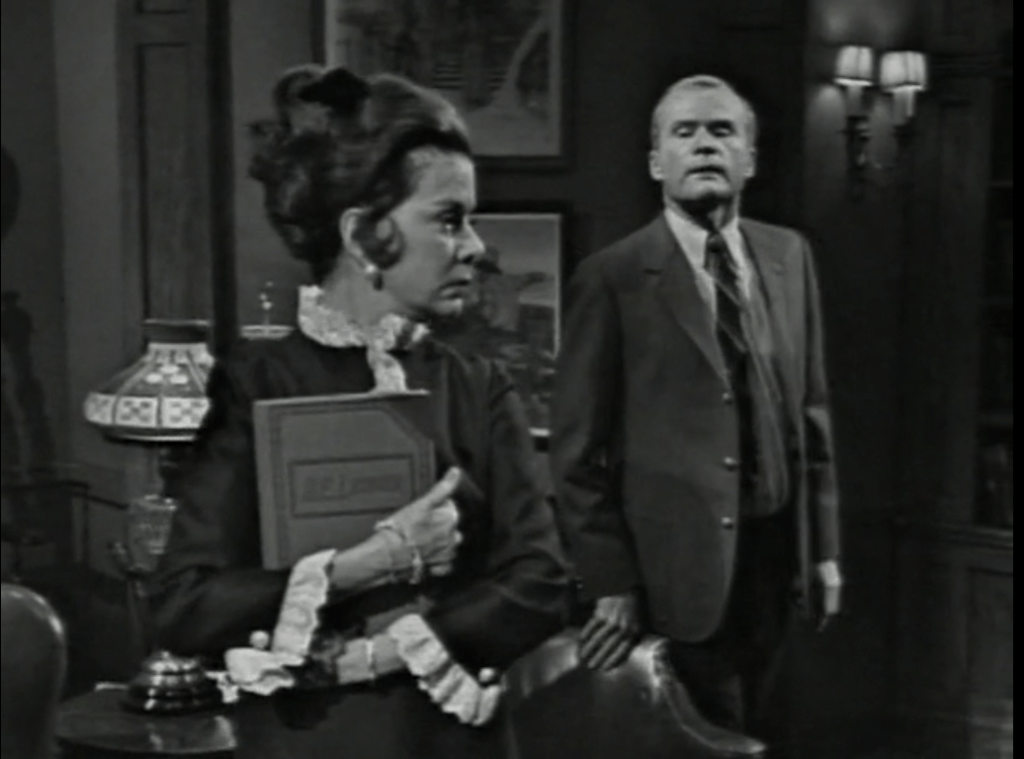
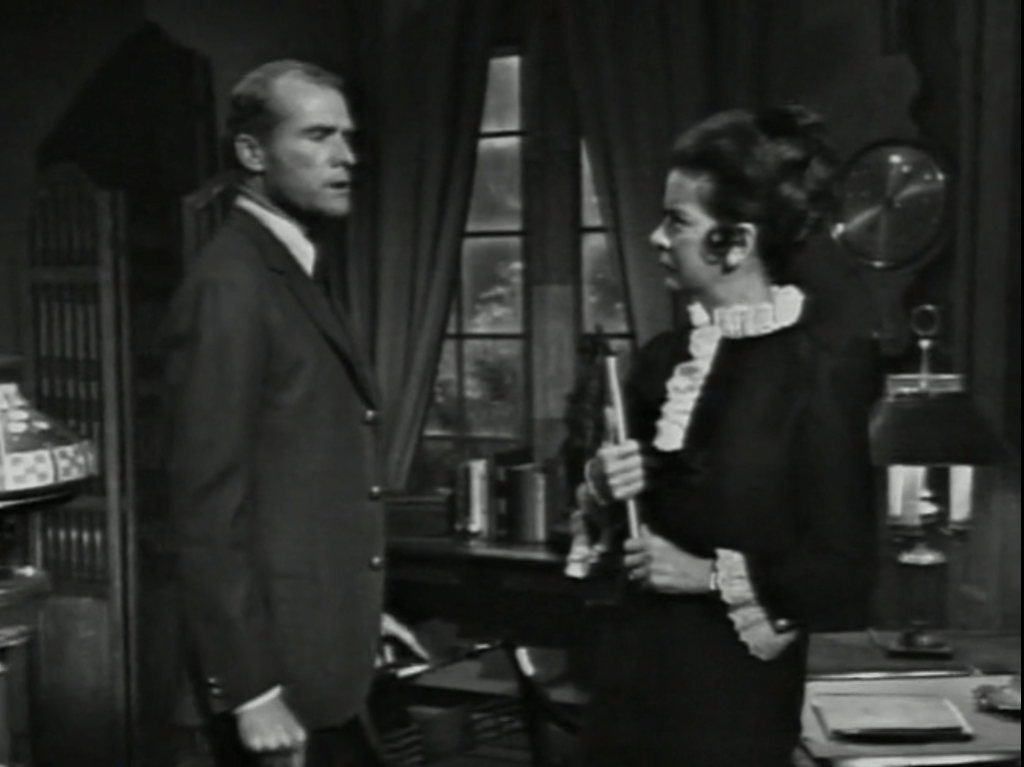
In the drawing room of the great house at Collinwood, Julia tells well-meaning governess Vicki and Vicki’s charge, strange and troubled boy David Collins, that she is an historian writing a book about the Collinses. David immediately exposes a fatal flaw in Woodard’s cockamamie plan when he mentions a girl named Sarah whom he has seen near the Old House. Julia knows that Maggie saw Sarah when she was imprisoned and that Sarah visited Maggie’s father Sam and told him where to find her. If that information had been made public, Vicki and David would have been able to connect Sarah with the Old House, and the police would have suspected Barnabas weeks ago. Returning viewers know that Sarah is the ghost of Barnabas’ sister, a fact onto which Julia cottoned yesterday and of which she finds corroboration today.
Vicki tells Julia how elusive Sarah is
We also know that Barnabas wants Vicki to become his next victim, and that she is already under his influence to a substantial degree. When she and Julia are talking in the drawing room, Vicki waxes enthusiastic about how Barnabas has recreated a past world and committed himself to living in it, and says that this is a fine thing for him. “But not for you?” asks Julia. Vicki looks down, and with a troubled expression says that she supposes not.
When Julia asked “But not for you,” she drew a reaction from my wife, Mrs Acilius. Mrs Acilius said that while Julia may not seem like any kind of therapist in the sessions we’ve seen her have with Maggie, her delivery of that question sounds exactly like every therapist she’s ever had. With Maggie, the mad scientist is very much on the surface of Julia’s manner, but when she is playing the role of Miss Hoffman the historian she can draw on her profession to make herself appealing.
Vicki takes Julia to the Old House and shows her the restored bedroom of Josette Collins. Vicki says that she could stay in that room forever, which is as a matter of fact precisely what Barnabas has in mind for her. Julia feels a chill as the sun sets. Perhaps this is the result of Barnabas coming back to life and rising from his coffin in the basement of the house, or perhaps it is Sarah or another friendly ghost* trying to warn her to get out before the vampire finds her. Whatever its cause, Vicki doesn’t feel it. Again, we don’t know whether this is because Barnabas already has a strong enough hold on Vicki that she is insensitive to warnings about him, or if it is a message specifically for Julia.
Julia wants to leave the room, but Vicki insists on lighting a candle so that they can see it as Josette did. The candle burns long enough for Julia to make the appropriate comments, and then something we cannot see blows it out while Julia feels another chill. The cold still doesn’t reach Vicki.
Julia returns to Woodard’s home office,** where she has stashed Maggie. Maggie has the doll Sarah gave her when she visited her in Barnabas’ dungeon. Julia takes the doll from Maggie, much to Maggie’s displeasure. She holds the doll and says she wants her to listen for the doll’s name. Maggie furrows her brow and asks “Doll talk?” Maggie has been speaking in complete sentences lately, but apparently Julia’s latest antics have been too much for her and she has lost some ground.
Julia orders Maggie to listen and says the names of some of the people at Collinwood. Maggie doesn’t react until she gets to “Barnabas Collins,” at which point Maggie freaks out. Julia holds her and repeats “It is the wrong name” until Maggie stops crying and starts singing “London Bridge.” She then looks away and says “The wrong name for the doll… but the right name for… something else.”
*Sarah’s little cousin, Caspar Collins?
**An exact replica of his office in the hospital as we saw it in #242. Man knows how he likes to have things set up.
Four and a half weeks ago, Maggie Evans, The Nicest Girl in Town, escaped from vampire Barnabas Collins. Barnabas managed to scramble Maggie’s brains sufficiently that she has amnesia covering her time as his victim and much of the rest of her life as well. She is now a patient at a mental hospital called Windcliff, where her care is supervised by Dr Julia Hoffman.
Maggie’s family doctor, addled quack Dave Woodard, is an old friend of Julia’s. He had recommended Maggie be sent to Windcliff. He had also come up with a cockamamie scheme to protect her from her captor by hiding her there and telling everyone in and around the town of Collinsport that she was dead. If he had known that the captor was a vampire, this might have made some kind of sense- no character on Dark Shadows has ever heard of Dracula, so they don’t know how to fight against vampires. But he doesn’t know that, so his plan is just a way for the writers to stall while they try to come up with more plot points.
Today we open with Woodard in Julia’s office, complaining that she isn’t communicating with him about Maggie’s case. She tells him that there have been no developments worth reporting. Returning viewers know that this is a lie, because in a session we saw yesterday Maggie remembered a lot of sense impressions from her time of captivity and Julia told her that they represented tremendous progress. Woodard tells Julia that a lack of new information is no excuse for her failure to return any of his last six phone calls. He says that she seems to be intent on hoarding any information she may glean from Maggie as her own private possession, an impression he describes as frightening.
Julia responds to this characterization with a display of offense, and Woodard apologizes. She then brings up an idea that occurred to her at the end of yesterday’s episode. She says that Maggie’s memory might improve if she takes her to visit Eagle Hill Cemetery, where she was found wandering early in her illness. Woodard objects strongly that Maggie’s condition, as Julia has described it, is so delicate that such a visit might do her permanent harm. Julia retreats and promises she won’t actually take Maggie to the cemetery. This is such a flagrant lie that the camera momentarily goes haywire, focusing on Woodard’s chair rather than his face.
Woodard leaves, and Julia calls Maggie in. She’s already wearing her coat. She asks where Julia is going to take her, and she tells her not to worry about that.
On the great estate of Collinwood, well-meaning governess Vicki is staring vacantly into space while listening to an antique music box Barnabas gave her as part of his plan to subject her to the same treatment he inflicted on Maggie. A knock comes at the door. Vicki closes the music box and goes to answer it. It is her boyfriend, fake Shemp Burke Devlin.
Burke is waging a determined battle against the story, and he is fighting dirty. He doesn’t want Vicki to have anything to do with Barnabas, or with the ghost of Josette Collins. When Vicki says she wants to lay flowers on Josette’s grave in the cemetery, where we know she will cross paths with Maggie and Julia, he resists furiously. When she reminds him that she has had dealings with Josette’s ghost, he says “Or you think you have.” In previous episodes, including yesterday’s and Monday’s, he knew she had, and in an earlier period of the show he knew that several other characters, including some of the most level-headed ones, had also encountered Josette’s ghost. When he starts belittling Vicki for believing in “the spooks of Collinwood,” it therefore comes off as an especially crude instance of gaslighting. The Mrs and I aren’t much for profanity, but we both cussed at the screen when Burke was disgracing himself this way.
Julia and Maggie are in the cemetery. I believe it is the first time we’ve seen the set in a daylight scene. You can see the shadows of the foliage on the soundstage walls, and the corners where the walls meet. I can’t believe the director meant for us to see those things, but I kind of like it- the situation needs a touch of unreality, and the obvious falsity gives it the feeling of a black box theater.
Some of the shadows on the wall that Art Wallace spoke ofCorner of the soundstage
Maggie is agitated. Julia tells her to calm down and that everything is all right. I’m no expert, but I kind of doubt that talk therapy involves a lot of “Calm down!” and “Everything is all right!” It reminded me of this Saturday Night Live sketch from the 90s, in which Patrick Stewart plays “Phil McCracken, Scottish Therapist,” a psychologist who won’t stand for any emotionalism from his patients.
Vicki and Burke see Julia and Maggie in the distance. When Maggie turns to face them, Vicki recognizes her. Julia whisks her away before Burke can see her. When Vicki tells Burke she saw Maggie, he immediately unloads on her with the same garbage he handed her at Collinwood. He declares that Maggie is dead, that Vicki knows she’s dead, that she can’t possibly have seen her, that “there is a resemblance, THAT’S! ALL!” When he asks “What’s wrong with you?” I stopped the streaming and shouted at the screen “She’s wasting her time with you, you ******* ********, that’s what’s wrong with her!” To that, Mrs Acilius said that we should just restart the show and get through the scene.
Part of what makes Burke’s behavior so infuriating is the writer’s fault. A first-time viewer, unaware that what Burke is telling Vicki are delusions that suggest she is crazy are in fact things he knows to be true, might think that he is being reasonable in dismissing ideas about ghosts and the like. But even that viewer will realize that a person ought to be nicer about it. When Vicki says she saw Maggie, Burke could easily have suggested that they go up to the woman and introduce themselves, thinking that a closer look will disabuse her of the notion. But actor Anthony George must also bear part of the blame.
George C. Scott famously told Gene Siskel that there are three things to consider in evaluating an actor’s performance: first is to make the audience believe that the person they are looking at is the sort of person who might do the things the character does. This is in turn dependent on casting- put the wrong person in the part, and all is lost. Second are the choices the actor makes in the key emotional moments. Performers have any number of options as to how they will use their faces, voices, and limbs to show a character’s feelings, and those who make a lasting impression are those who make choices that are at once totally unexpected and perfectly logical. Third is the zest of performance, the actor’s joy in the opportunity to create a character. If that doesn’t come through, nothing else is worth much.
As Burke, Anthony George fails all three of these tests. Burke would have been a difficult part for anyone to take over, both because the originator of the role, Mitch Ryan, was so memorable, and because the character had lost all connection to any ongoing storylines by the time Ryan left. And by his own admission, George knew nothing about soap operas and had no idea how to play a romantic interest on one when he joined Dark Shadows. That’s where he fails the casting part of the believability test.
As for the skill part, George has something going for him. He is always mindful of his physicality, moving only those parts of his body he needs to show us who he is and keeping the rest of himself admirably still. He also keeps his voice remarkably consistent, both by holding a steady level of volume and maintaining a simple, precise pitch. In these and other ways, he shows impressive levels of technical proficiency as an actor, but the result is a mannered, unconvincing performance. His Burke doesn’t seem to be a real person. As a cardboard figure, he becomes an abstract symbol of whatever he’s doing, and when he’s doing something bad he’s hard not to hate.
Since he makes one choice for each resource available to him and sticks with it unvaryingly throughout the episode, he doesn’t give the audience any surprises. Nor does he yield anything to his scene-mates. They always know exactly what’s coming from him. George’s eyes are always watching another actor intently, as he watches Alexandra Moltke Isles intently today, but nothing in her performance can divert him from his plan, not in the smallest particular. When Burke isn’t listening to the other character, as he isn’t listening to Vicki, George’s disconnection from the other actors makes Burke seem like an irredeemable jackass.
Nor does George show any zest for the part. He covers his discomfort with soap acting by plastering on a smile whenever the script allows it, but he is stiff when Burke ought to be loose, cool when he ought to be warm, and loud when he ought to speak with a quiet, nuanced voice. The result is just sad and awkward. When Burke is being pleasant, we can feel sorry for George, but when he has to play the scenes like the ones Burke gets today we just want him to get off the screen and leave us alone.
Compare George’s Burke with Grayson Hall’s Julia, and you will see how an actor can determine an audience’s reaction to a character. Julia is a terrible therapist. She lies repeatedly to Woodard in the beginning, denying the severe breach of ethics and disturbing disregard of public safety involved in covering up what she knows and suspects about Maggie’s experiences and running an unconscionable risk with Maggie’s mental health by taking her to the cemetery. She lies again to Maggie at the end, promising that they will duck into the Tomb of the Collinses only for a moment and then refusing to let her leave there when she starts to show a violent emotional reaction. Her methods are so unorthodox and so harsh that we suspect she is not interested in helping Maggie at all. Because we have known Maggie since episode #1, and Kathryn Leigh Scott’s performance as Maggie renews our fondness for her every time she appears, we ought to feel deep hostility towards Julia.
But we don’t. In fact, Julia quickly becomes (almost) every Dark Shadows fan’s favorite character. The George C. Scott tests tell us why. Hall’s manner is so intense that we can believe her as a mad scientist; her uninhibited use of every facial muscle, of the full range of her vocal output, and of subtle tricks of movement she learned from choreographers when she appeared in musicals may have produced a style that no acting teacher could recommend as a model, but they do mean that every moment she is on screen she is doing something we wouldn’t have predicted; and she’s clearly having a blast. She can do things vastly worse than what makes us hate Burke today, and we will still want her to come back again and again.
Closing Miscellany
The opening voiceovers aren’t usually the best-written parts of the show, but there is a particularly bad bit in today’s: “Hidden deep in the cliffs of Collinwood, the majestic, ancient rocks that separate the Earth from the sea, there is a tiny cove carved by a long-ago sea. No one at Collinwood has seen it, and no one will ever see it.” If no one ever will see it, why bother telling us about it? The narrator tells us that it is because “the Earth knows how to hide its secrets well. Sometimes men, too, must hide secrets.” Does this mean that “no one ever will” discover the secrets the characters are hiding from each other? That isn’t a very promising thing to tell the audience of a soap opera, a genre which is all about unsuccessful attempts to keep secrets and their aftermath.
Maggie tells Julia that she doesn’t recognize the name Collins. She has lived her whole life in the town of Collinsport, where most people are employed by Collins Enterprises, which is owned by the Collins family who live at Collinwood. That’s some pretty widespread amnesia she has.
The show has been going back and forth on the dates when Barnabas and Josette Collins originally lived and died. Today we get a long look at Josette’s tombstone, giving her dates as 1800-1822, and another at the plaque on Barnabas’ little sister Sarah’s resting place in the mausoleum, with the dates 1786-1796. Those dates fit with a remark Barnabas made to his sorely bedraggled blood thrall Willie in #271, that Sarah lived long before he met Josette, but not with his remark in #281 that Josette had been dead for “almost 200 years,” much less with a book we saw in #52 that gave her dates as 1810-1834.
Barnabas Collins has a problem. He wants people to think of him as a mild-mannered and highly respectable English gentleman, but he is in fact a vampire from central Maine. So he leaves it to his sorely bedraggled blood thrall, Willie Loomis, to keep people away from his house while he himself apologizes for Willie’s curtness.
Today, addled quack Dave Woodard has come to Barnabas’ house asking Willie to help him investigate the case of Maggie Evans, The Nicest Girl in Town, who fell gravely ill and then vanished from the hospital. Willie refuses, but Barnabas promises Dr Woodard he will try to persuade Willie to cooperate. Since Barnabas is keeping Maggie in his house and doing various abominable things to her, we wonder how he will contrive to appear helpful.
Elizabeth Collins Stoddard has a problem. She wants people to think of her as an able businesswoman and a faultless model of virtue, but she is in fact being blackmailed. People have started to notice the money Liz is giving seagoing con man Jason McGuire, and they are certainly talking about the fact that Jason is living in her house. Today, Jason tells Liz that the solution to these problems is for the two of them to get married. Liz is not enthusiastic.
Jason has a problem. Before Barnabas enslaved Willie, Willie was Jason’s dangerously unstable henchman. So Jason doesn’t want people to think of Willie at all. But many do remember his violent ways, and suspect him of wrongdoing in connection with Maggie. Jason visits Barnabas’ house and the two of them talk about Willie and the case of Maggie Evans. Jason urges Barnabas to get Willie to cooperate with Dr Woodard.
Barnabas dislikes Jason; Jonathan Frid and Dennis Patrick play all their scenes together as a drawing room comedy about a snob burdened by the presence of an insufferable bounder. The script doesn’t always give them funny lines- today’s certainly doesn’t- but their nonverbal communication is enjoyable to watch. Frid and Patrick have so much fun with their scenes together that you never notice Frid stumbling over his lines. He is so deeply in character that you’d have to follow along with a copy of the script to catch any bobbles. He caps today’s scene with a moment when Barnabas watches Jason leave. His potentially comic expression of pained politeness gives way to a much colder look, the look of someone planning a drastic action.
Before Jason announces to Liz that he is engaged to her, he talks to her about some of Barnabas’ quirks, suggesting that he intends to continue probing into her cousin’s doings. The hour may be coming very soon when Barnabas will decide he has to deal with Jason permanently.
Maggie Evans, The Nicest Girl in Town, suffered from an ailment her doctor, Dave Woodard M. D., could not identify. She then vanished from her hospital room in a manner law enforcement, led by Sheriff George Patterson, could not explain. The opening voiceover says that Maggie’s troubles “mystify the finest minds.” This is the first and last time either Woodard or Patterson is classed with “the finest minds” even among the low-functioning characters who abound in the period when Dark Shadows is being written by Ron Sproat and Malcolm Marmorstein. Well-meaning governess Vicki is still the single smartest character on the show, and she turns into an absolute moron every two or three days.
In the opening teaser, dashing action hero Burke Devlin asks Dr Woodard if his studies of Maggie’s blood samples will help find her. He says that they won’t, but that if he can diagnose her he might be able to help her after she is found. Burke asks if he is about to make a diagnosis. He says that he might be making progress towards that goal. At that point, there is a dramatic musical sting, and we cut to the credits. That’s the hook, a statement that further study is needed.
Dr Woodard tells Burke that he has contacted “Hoffman, one of the best men in the field,” and that he hopes Hoffman will be able to get things moving. Under Burke’s questioning, he admits that he is pessimistic that Hoffman will see anything he has missed. This is the first mention of the name “Hoffman” on Dark Shadows. I believe it is only the second mention* of any surname that is not derived from Irish (as are such names as Collins, Devlin, Malloy, and McGuire,) English (as are names such as Woodard, Patterson, Loomis, Johnson, Stockbridge, and Garner,) Welsh (as are names such as Evans and Morgan,) Scottish (as are the names Adair and Murdoch,) or French (as are the names La Freniere, Bilodeau, and du Près.)** It is certainly the first name we have heard that suggests there might be Jewish people in the universe of Dark Shadows.
We then cut to the study in great house of Collinwood, where high-born ne’er-do-well Roger Collins has to confront his sister, reclusive matriarch Liz. The auditors have told Roger that the books are out of balance at the family business. Roger knows that the reason for this is that Liz is giving money to buy the silence of seagoing con man Jason McGuire. He reminds Liz that he himself was afraid of blackmail for the first 40 weeks of the show, so he knows from personal experience that it is no way to live. Liz refuses Roger’s plea that she tell him her secret. As he probes and she resists, they move around the room at times like fencers, at times like dancers performing a paso doble. Their movements are easily the most interesting element of the episode, a credit to director John Sedwick.
Roger’s first approach to the shielded LizLiz parries Roger’s thrustRoger’s second approach
Roger admits that he hasn’t been much help to Liz over the years, but begs her to let him help her now. Liz won’t tell him anything, but she is touched to see her bratty brother sincerely trying to step up.
Liz goes to the drawing room. The camera is behind her as she approaches the room. Jason is standing at the fireplace under the large portrait, the spot furthest from the camera. Not only does he look as small as possible, but at the moment we first see him he is turned away from us, his head tilted far back as he takes a drink. Jason’s smallness and obscurity, coming so soon after Roger’s speech about the dreariness of blackmail, feels like an acknowledgment that Jason doesn’t have much to offer the audience.***
Coming upon Jason
Liz tells Jason she can’t give him any more money without blowing the secret they share. He amazes her by accepting this information calmly, but she is sure he is not done tormenting her.
Liz returns to the study, where Roger is still sitting. She tells him that she has talked to the auditor and straightened out the books. That sounds like something that would take quite a while, even if you are sitting across from each other, and Liz and the auditor had to do it over the telephone. So how long has Roger been sitting there?
Then we rejoin Burke and Woodard in the doctor’s office, which someone has ransacked. The perpetrator wrenched the metal bars out of the window and stole Maggie’s blood samples. Dr Woodard says that the only way the bars could have been twisted was by someone with the “supernatural strength of madness.” I’m not an expert in mental health, but that does not sound like a conventional psychiatric opinion to me.
*After Lieutenant Costa of the Arizona State Police, whom we saw when Dark Shadows took us to Phoenix in #174.
**It is pretty weird that a show set in Maine has so few French-surnamed characters. We’ve only heard of one working-class Mainer with a French name, Amos Bilodeau. La Freniere was given in #45 as the maiden name of Josette, a grand lady who came from France to marry into the Collins family in a previous century; eventually, Josette’s birth name will be retconned to du Près.
***My wife, Mrs Acilius, was the one who really noticed the visual strategy both in Liz and Roger’s first scene in the study and in Liz’ entry into the drawing room.





 Dark Shadows Commentary