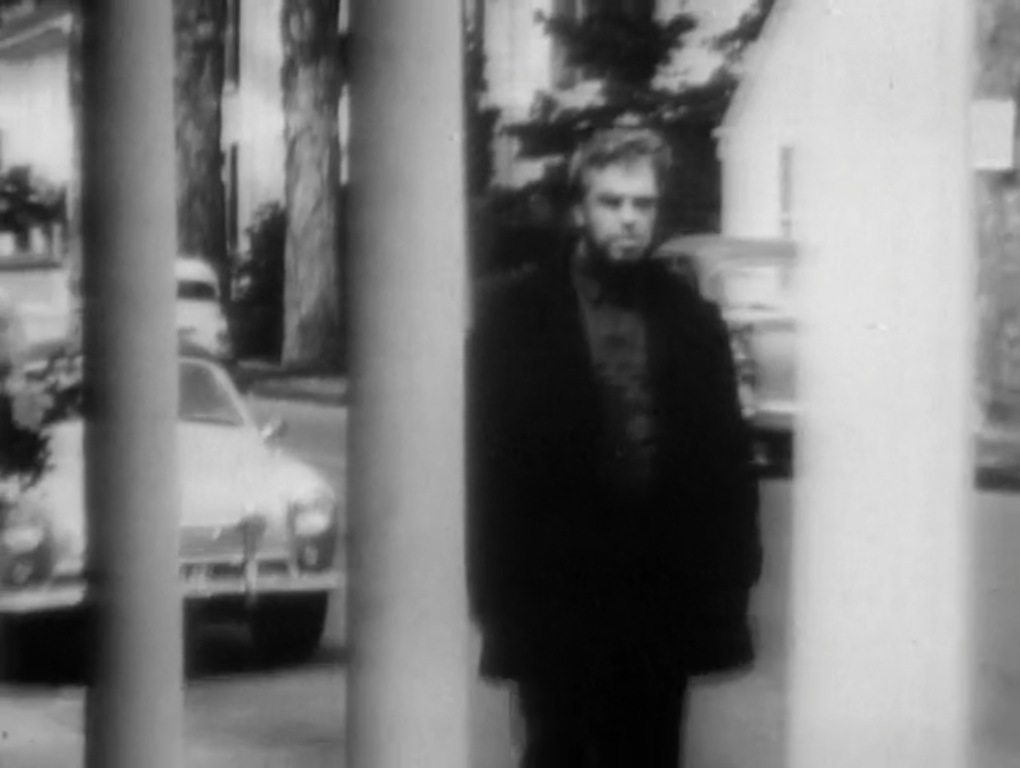
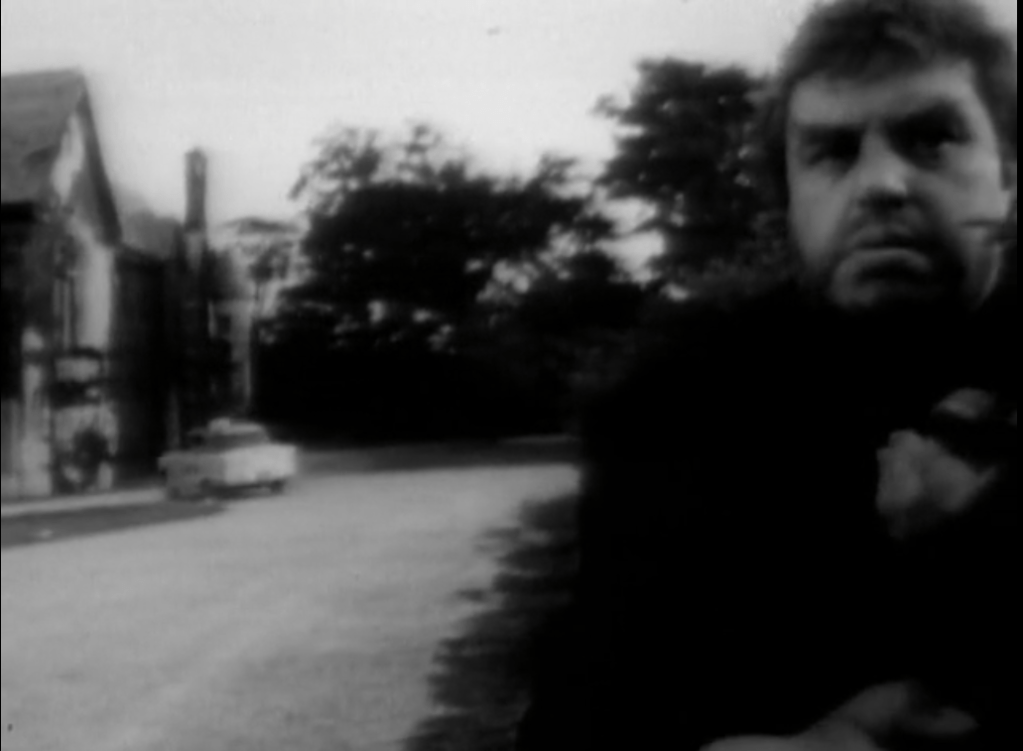
We spend today, not so much with the ancient and esteemed Collins family, but with two of the three members of their household staff. Gruff caretaker Matthew Morgan goes into town so that he can scowl at the family’s nemesis, dashing action hero Burke Devlin. Mrs Sarah Johnson goes to the great house of Collinwood to interview for the position of housekeeper.
During the interview, Mrs Johnson tells reclusive matriarch Liz that “I’m not a gossip.” This will become a frequent refrain of hers in the years to come, and will usually serve as a preface to remarks in which she will blab the entire contents of her mind to anyone who will listen. This time, “I’m not a gossip” is followed immediately by her assertion that in all her years as housekeeper to beloved local man Bill Malloy, she never repeated a word she heard spoken in his house to anyone. It seems to be news to Liz that Bill had ever spoken any words he would want to have kept in confidence. It’s certainly news to the audience. All we’ve heard up to this point was that Bill’s whole life was absorbed in his work. Mrs Johnson set me wondering what we might yet learn about Bill.
Matthew drives Mrs Johnson back to town. He sits down with her as she prepares to have lunch at the restaurant in the Collinsport Inn. Matthew tries to persuade her she would be better off moving in with her daughter than taking a job at Collinwood. He tells her that Collinwood is in fact haunted, and that if she isn’t afraid of its ghosts she ought to be. She is unconvinced.
Matthew gets a great deal of emphasis in this episode. There are two location inserts featuring him- when he walks through downtown Collinsport to the Collinsport Inn, and when the taxi carrying Mrs Johnson pulls up to the outside of the house and we see him trimming bushes. Exterior footage is never commonplace in Dark Shadows, and when we see a character moving around outdoors it’s a sign of something important.
Matthew in townMatthew sees the taxi
Unknown to Matthew or Liz, Mrs Johnson is in fact convinced that Liz’ brother, high-born ne’er-do-well Roger, is responsible for Bill’s death and that Liz is protecting him. She wants to become housekeeper at Collinwood so she can spy on the Collinses for Burke.
After Matthew leaves the restaurant, Mrs Johnson reports to Burke on her interview with Liz. He is dissatisfied with her work as a secret agent. He berates her, as we had seen him berate his henchmen in earlier episodes. They had submitted to his rantings meekly. Mrs Johnson snaps at him, and gets an apology. Evidently we are supposed to expect that she will be a strong character in her own right, not a mere cat’s paw for Burke.
This is the first of many episodes that survives only on kinescope. This has some happy effects. For example, the footage of Matthew walking in downtown Collinsport is preceded by a shot of him going out the front door of the great house. The kinescope’s poorer resolution makes this set look like very much like an outdoor shot itself.
CORRECTION: It turns out this isn’t a kinescope, just a particularly crummy videotape. There’s a kinescope coming up later this week, though.
Well-meaning governess Vicki sits placidly in her bedroom at the great house of Collinwood, sewing and looking out the window. Flighty heiress Carolyn comes in and loudly berates Vicki for spending the day away from her charge, problem child David. Carolyn saw Vicki coming home as a passenger in a car driven by the family’s arch-nemesis, dashing action hero Burke Devlin, and jumped to the conclusion that Vicki was both on a date with Burke and on Burke’s side in his conflict with her family. Vicki is at first bewildered by Carolyn’s rage, and then confronts her with her own record of infatuation with Burke.
This scene shows how well cast Nancy Barrett and Alexandra Moltke Isles were as Carolyn and Vicki respectively. Miss Barrett throws herself completely into whatever her character is supposed to be doing at any given moment, a perfect style for the role of someone who is stormy and unpredictable. Mrs Isles takes a very deliberate approach to her part, working her way from the center of Vicki’s thoughts out to whatever lines she has to deliver. That suits the role of someone who is often baffled by the strange goings-on around her and who gradually gathers the strength to stand up for herself.
Carolyn is on her way to the front door when her mother, reclusive matriarch Liz, asks her where she’s going. Still upset after her confrontation with Vicki, Carolyn snaps at Liz and gives sarcastic answers. Eventually she tells her that Vicki didn’t give David his lessons for the day, that she spent the day with Burke, and that she brought Burke home with her. Alarmed by this report, Liz heads upstairs towards Vicki’s room. Carolyn remembers her latest project, persuading her mother to take Mrs Sarah Johnson onto the domestic staff as a housekeeper. Liz cuts her off, saying that she has no time to think of hiring a housekeeper- all she can think about is firing a governess.
After Liz leaves the foyer to fire Vicki because Carolyn has led her to suspect she might be a spy for Burke, Carolyn picks up the telephone. She tries to call Burke. Evidently the infatuation Vicki had brought up to her is still driving Carolyn to inexplicable actions.
Mrs Johnson is in the restaurant at the Collinsport Inn. In fact, we first see her on the pay-phone there, talking to Burke about her plan to join the staff at Collinwood so she can work as a spy for him. Patrick McCray makes a nice remark about this on his Dark Shadows Daybook:
[P]lanting a spy for Burke Devlin is just the touch of espionage intrigue that Collinwood needs. Finally, someone can actually be the spy that Vicki is suddenly accused of working as. (In the same episode no less, with the irony and subtlety of an anvil landing in your lap.) That kind of duality — especially among the backstairs staff — is a concession to the dramatic thinking that DARK SHADOWS kinda lost over the years. The show gained plot, but it lost those opportunities for characters to reflect one another. As it reached a supernatural frenzy, this earlier, authorial delicacy was a necessary casualty. However, it’s vital to know that a sculpted duality like Mrs. Johnson and Vicki is an instinct buried in the program’s DNA.
I think he paints with a bit of a broad brush when he says that “this earlier authorial delicacy was a necessary casualty.” The frenzied pace of the later years didn’t stop Joe Caldwell or Violet Welles from crafting dramatic miniatures Art Wallace and Francis Swann would have been proud of. While Sam Hall and Gordon Russell were no miniaturists and did often value slam-bang story development over every other consideration, they did take time to show characters in each other’s reflections. Indeed, the whole “1970 Parallel Time” arc is months and months of nothing but “opportunities for characters to reflect one another,” and the actors could often make those reflections interesting (at least the first two or three times you saw them.) Of course, there are also large numbers of episodes written by Ron Sproat and Malcolm Marmorstein, but you can’t blame their shortcomings on excessively rapid pacing.
Mrs Johnson is a difficult customer for Maggie Evans, who runs the restaurant. She sends a sandwich back because she disapproves of the mayonnaise, and the look on Maggie’s face shows us that the cost of that sandwich is coming out of her paycheck. Mrs Johnson insists her meal be served in courses, demands that Maggie sit at her table, and gives her a tip of 10 cents (I checked- 10 cents in October 1966 would have the same purchasing power as 90 cents in October 2022. You could take that to your local hardware store, buy several nails, and still have enough left to operate a gumball machine.) She declares that the death of her late employer, beloved local man Bill Malloy, was no accident, and that according to the Bible someone will have to pay for it. When Carolyn comes into the restaurant, Maggie leaps at the opportunity to leave Mrs Johnson and wait on her.
Clarice Blackburn must have had tremendous fun playing Mrs Johnson in these sequences. The character is exaggerated almost to the level of what would become Dark Shadows’ “Go back to your grave!” house style of acting, so that there is no need to worry about overacting. Besides, so many performers wait tables that one of the standard responses young people in Los Angeles get when they tell people they are actors is “Great! What restaurant?” So it must always be gratifying to play a character who will show the world what a bad restaurant customer looks like.
As Maggie, Kathryn Leigh Scott also has a juicy role today. We usually see her in one of two settings. Either she is in the restaurant, where she is required to be nice to everyone, or she is at home with her father, drunken artist Sam. As the adult child of an alcoholic, she has a thousand habits designed to keep the mood light. When she is dealing with Mrs Johnson, Miss Scott shows us what Maggie looks like when her Nicest Girl In Town persona is stretched to the max.
When she greets Carolyn, Maggie goes right into the chirpiest version of that persona. It’s a version that brings home the continuity between Maggie’s relationship to her father and her relationship to her customers. She speaks the first few syllables of each of her lines through a laugh. Many Dark Shadows fans complain about that as a habit of Kathryn Leigh Scott’s, but it’s a habit of Maggie’s. And if you start watching the series from episode 1, seeing all the scenes in the Evans cottage between Maggie and Sam, you’ll recognize it as something many adult children of alcoholics do. At the risk of giving away a spoiler, I’ll say that Sam will eventually cut back on his drinking, and some time after that will be written out of the show altogether. But Maggie’s character is formed in these weeks, when Sam is drunk all the time. Some of Miss Scott’s other characters on the show have similar habits, but those are the characters who are presented as Maggie Evans by other means, so they would have to be recognizable as her.
Carolyn tries to explain to Maggie, sotto voce, why Mrs Johnson is so upset, and Maggie drops her Nicest Girl In Town voice completely for a second- “I know who she is,” she rasps. Carolyn has been friendly to Maggie, and is equally friendly when she goes to sit with Mrs Johnson and tries to talk her into taking the job as housekeeper at Collinwood, assuming that her mother will offer it to her. After Mrs Johnson leaves, Maggie tells Carolyn that she has never been able to stand her- “She’s always given me the willies. I don’t know why,” she says, looking thoughtfully off into the middle distance.
Carolyn’s friendliness to the working class Maggie and Mrs Johnson is a welcome relief from her terribly snobbish sneer at Vicki as “Little Orphan Annie” who should “go back to your precious foundling home.” And it’s an opportunity for Nancy Barrett to take her performance from one emotional extreme to another within a single episode.
Back in the mansion, Liz confronts Vicki about not giving David his lessons. Vicki replies that Liz’ brother, high-born ne’er-do-well Roger, had said that he would tell Liz that he had taken Vicki on a tour of the cannery and had given David the day off. When Vicki hears Liz on the telephone confirming this with Roger, she blows up at Liz. She objects to being checked up on, she objects to being accused of lying, and, turning to look at the last spot where she had seen Carolyn, she objects to being accused of stealing people’s boyfriends. After she is done with her objections, she walks over to Liz. With their backs to the camera, the women quietly apologize to each other. Vicki explains that her protests mark the only way she can go on living in the house. Liz for the first time calls Vicki by her first name. Hearing this conversation when they are looking away from us is remarkably effective at creating a sense that they are sharing an intimate moment- more is happening between the two of them than even the audience can know.
Mrs Isles and Joan Bennett, as Liz, both play a wide array of emotions in their two scenes together, and do so brilliantly. It’s particularly interesting to compare Liz’ startled reaction to Carolyn’s snapping at her in the foyer when she asks her where she’s going to with her startled reaction to Vicki raising her voice at her in the drawing room when she’s been on the phone with Roger. They are two quite distinct startles. We see Liz from behind when Carolyn startles her. From that angle, we see the muscles in the back of her neck tense, signifying anger. That startle gives way to a parental sternness. The startle Vicki provokes is shown in profile. Liz pulls back a little, suggesting guilt. It leads to a rapid retreat.
Reclusive matriarch Liz calls well-meaning governess Vicki into the drawing room in the great house at Collinwood. She asks Vicki where her charge, problem child David, is. When she tells her David is upstairs in his room, she asks Vicki to close the drawing room doors, explaining that she does not want their conversation overheard.
Of course David comes downstairs and puts his ear to the doors as soon as they are closed. Liz starts talking with her about some recent plot developments, and we hear a commotion outside the doors. Tightly-wound caretaker Matthew has caught David eavesdropping. Liz sends Vicki and David away, and talks to Matthew about events we saw several days ago.
David starts telling Vicki about the ghosts who haunt Collinwood, and shows her a drawing he made of one of them. Vicki is impressed with the drawing, and shows it to Matthew. Matthew accuses David of going to the Old House and copying the portrait hanging there. Vicki has never heard of the Old House- nor has the audience, it’s the first reference to it. David denies Matthew’s accusation, and says that it is a drawing of a ghost he has seen.
Vicki takes the drawing to Liz, who immediately recognizes it as Josette Collins. She opens the family history to the page featuring a portrait of Josette, and asks David if he copied that portrait. Again David insists it is a drawing of an actual ghost he has seen. The day before yesterday, in episode 68, we saw David studying that page, so it is quite plausible that he did copy it. Still, regular viewers will remember that in episode 52 the book opened itself to that same page when no one but the audience could see, so we might also wonder if David is telling the truth.
Flighty heiress Carolyn tries to talk her mother into hiring a housekeeper. When she mentions that one thing a housekeeper might relieve Liz of is her loneliness, she answers wryly, “You forget, dear, I have all of David’s ghosts.” In this reply, we return to the ambiguity of the first weeks of the show, when, in conversations with Vicki, one character after another would use the word “ghost” in a metaphorical sense, to refer to present difficulties resulting from unresolved conflicts in the past. Vicki would invariably respond with some line like “Surely you don’t believe in ghosts!,” as if they were talking about literal ghosts. And each time, the response would be that they did indeed believe in literal ghosts, and that if she stayed in the old dark house on the hill for any length of time she would believe in them too. Aside from the book opening itself in #52, the ghostly manifestations we have seen so far have been equivocal, possibly hoaxes, possibly tricks of the light. Even the incident of the book was small and symbolic. The ghosts could still dissolve into the atmosphere and into mere metaphor.
Determined to befriend David, Vicki agrees to go to the Old House with him to look for ghosts. We are treated to 90 seconds of location footage of Vicki and David walking through the woods to the Old House. This is by far the longest exterior sequence in the entire series, and it is done with extraordinary ambition. Most of Dark Shadows’ exterior shots are not only extremely brief, but are accompanied only by music. In this one, the actors’ voices are dubbed throughout, and multiple sound effects are added.
Vicki and David enter the Old House. As they do so, David shines his flashlight directly into the camera and creates a halo effect. This would not seem desirable, but it will be done dozens of times in episodes to come. It’s probably a mistake here- maybe a mistake most of the time- but they do it so often, there must have been some kind of intentionality behind it.
The first flashlight halo
Vicki and David examine the portrait of Josette hanging above the mantle. Vicki is impressed with its likeness to David’s drawing. David tells her that he has been through every part of the Old House, but denies that the portrait was his model. He tells Vicki of the legend that Josette’s ghost is trapped at Collinwood until another girl falls to her death from Widow’s Hill, and goes on and on about his hope that Vicki will be that girl.
This charming conversation is interrupted when the door suddenly opens. Frightened, David breaks off in the middle of telling Vicki that he wants her to die and clutches at her for safety.
I want you to die! Please save me!
In a moment like this, we can understand why Vicki keeps believing she can reach David. She knows that he is deeply disturbed, and that his violence may well turn against her. But she can also see inside him an awareness that he needs a friend. She has decided to risk his worst in hopes that his sense of that need will eventually break through his rage.
It is Matthew at the door. He scolds Vicki and David for visiting the Old House after he had told them how dangerous it is. The three of them talk a bit about the legends, then Matthew insists on leaving. Vicki turns to David, apparently willing to stay there with him. David looks bitterly at Matthew, and says that there is no point in staying. Josette won’t appear when Matthew is around, because she doesn’t like him. When Matthew says the place should be torn down, David becomes upset and says that he will tell Josette to kill him if he tries it.
The three of them do leave. Then something happens…
We see the vacant parlor of the Old House. The portrait of Josette begins to glow. A figure takes shape, and walks down from the portrait to the floor. It vanishes from the parlor, and reappears outside. It dances among the columns surrounding the house, glowing an unearthly white. Josette has come all the way out of the back-world into the foreground. We can expect her to stick around. Perhaps others will follow where she has led.
Evidently, Johnson and Crock had access to much of the original paperwork generated by the makers of the show. Today’s closing credits are truncated by a technical fault. The only writing credit shown is Art Wallace’s story creator tag. Fandom has jumped to the conclusion that Art Wallace wrote the episode, but the documents show that Francis Swann did. That makes sense- the two of them have been swapping weeks, with Wallace writing five episodes, then Swann writing five. Swann wrote the other four episodes this week, and Wallace wrote next week’s five, so it would be a deviation from the pattern if Wallace wrote this one as well. Since the episode is such a watershed in the development of the show it is tempting to attribute it to the original writer. But clearly, it is Swann who gave us our first looks at the Old House and at Josette.
In yesterday’s episode, Vicki the governess had come downstairs with a sketch of the great house of Collinwood that her charge David made. She showed the sketch to David’s father, Roger. Vicki tells Roger that she had taken the sketch from David’s room without David’s knowledge. Vicki spent the third week of the show trying to make it clear to David that by taking a letter from her room without her permission, he was stealing from her. Viewers who remember those episodes can’t help but wonder why Vicki is being so hypocritical.
Today, Vicki returns the drawing to David. He is surprised that she took the drawing, but pleased when she tells him how good she thinks it is. He’s starting to warm up to her, until she tells him she showed the drawing to Roger and that Roger liked it. At that reference to his hated father, David tears the drawing to pieces. David then brings up her lectures about his taking the letter and tells her she has one standard for children and another for grownups. She apologizes and agrees that she ought not to have touched the drawing. He refuses her apology and tells her he hates her. It goes on like that for a moment, until David’s aunt Liz walks in. At first Vicki tells Liz that what she’s hearing is an argument about the American Revolution, but she then says that David “had every right to be angry” because she took a drawing of his without his permission. David is involved with something else at that moment, but he does glance back at Vicki when she says “he had every right to be angry.”
Later in the series, Vicki will seem to lose quite a few IQ points. While it was foolish of her to take the drawing from David’s room without his permission and almost as foolish to tell him that Roger liked it, I don’t think this is quite a Dumb Vicki moment yet. Even the smartest adults do occasionally forget to respect children’s rights to privacy and to property, and it isn’t easy for anyone to really absorb the fact that a ten year old boy hates his father as intensely as David hates Roger. The most important thing about the scene is that Vicki admits to David that she’s wrong, apologizes to him, and tells Liz that David was in the right. The growth of a friendship between Vicki and David is going to be the most successful story-line of the first 42 weeks, and we can see the seeds of it right here.
Liz has come to David’s room to deliver a package. The package is a gift with a bow on it, brought by a messenger from the village and addressed to David. It’s a crystal ball, sent by David’s idol Burke Devlin. David loves it. Liz points out that Burke is the Collins family’s arch-nemesis, and says that it would be a good idea to send the present back. David pleads to be allowed to keep it, and she relents.
The crystal ball allows David to make all sorts of cryptic pronouncements, and gives the cameramen opportunities to take some ambitious shots. This still is featured on just about every webpage anyone has ever posted about the episode:
In a couple of years, we will see similar images, some of them giving great prominence to reflections of characters who aren’t supposed to cast reflections. For now, it is so unlike any other image in the show that I think we have to regard it as a message to the viewer. Just as David was the first character to look directly into the camera- he did it twice, in episodes 17 and 23, and no other character would do so until Sam did it day before yesterday, in #46- so he is the first one to look into a glass that will present us with a distorted image of his eye. The show seems to be laboring to get us to think about David’s viewpoint, about David as an observer.
The other plot also comes back to David as observer. Joe comes to the house and tells Liz that Bill Malloy didn’t come to work and isn’t at home. That gets everyone worried about Bill. Vicki tells Liz that Bill came to the house the night before, revealing to Liz that Roger lied to her. That gets Liz upset with Roger. David ties this together when he tells Vicki that he looked into the crystal ball and saw that Bill is dead, that his death was violent, and that Roger is responsible.
David is absent from the show for long stretches- today is the first we’ve seen him since #36. So it’s easy to regard him as a secondary character. But, we followed Vicki to Collinwood, and she came there because she had been hired to be David’s governess. The name “Collins” is something everyone on the show regards as terribly important, and David is the only candidate to carry that name into the next generation. They build a lot of story points around Burke, and at times Burke seems to be David’s fantasy come to life. David’s actions precipitated the saga of the bleeder valve, which was after all the first story-line on the show to be resolved. And David will be the fulcrum on which several story arcs will turn in the years to come. So perhaps we should see him as the central figure of the whole series.
David Ford joins the cast as Sam Evans, replacing the woeful Mark Allen. Ford was always one of my favorites. He was one of the reasons I started watching the show when it was on the Sci-Fi channel in the 90s- I remembered him from one of my favorite movies, the musical 1776, where he plays John Hancock.
Marc Masse made a point in his Dark Shadows from the Beginning that I hadn’t thought of before. I’d always thought of Thayer David as the founder of the Dark Shadows house style of acting (“Go back to your grave!”) That isn’t wrong, as we will see when Thayer David joins the cast next week. But David Ford made a much bigger contribution than I realized. Several members of the cast, especially Louis Edmonds and Nancy Barrett,* tend to play their roles in a big, stagy manner, but Ford represents a step beyond them.
Masse writes:
To this point Dark Shadows has been written, directed, and acted solely as a vehicle for television.
Here in episode 35, the style of acting on Dark Shadows takes a theatrical turn with the debut of David Ford, who, with one grand and sweeping wave of the arm and eloquent turn of phrase, will single-handedly transform the acting approach from that of a standard television show to that of a teleplay:
“A façade, my dear boy!”
You have to wonder if that line was an ad lib; it fit in perfectly with the gesture, and thus far Art Wallace has never written with such a fanciful flourish.
Masse also gives some very interesting information about what Ford was doing when he landed the role of Sam Evans, information that points towards an approach to casting that will become a marked feature of the show in the years ahead:
In the year preceding Dark Shadows, Ford was performing on the Hartford Stage in a successful production of the Tennessee Williams play Cat on a Hot Tin Roof in the role of Big Daddy. That’s why when he first appears on Dark Shadows he has that half a beard type style, having fashioned his performance of Big Daddy after the one made famous in the 1958 motion picture adaptation, especially the way he scrunches up his eyes for the effect of dramatic intensity, giving it his best Burl Ives.
There is indeed a good deal of Burl Ives in today’s iteration of Sam, enough that we can assume that Ford was hired in part as a Burl Ives imitator. In future years, we’ll see Jonathan Frid, who looks like Bela Lugosi and walks and talks like Boris Karloff, playing a character who is a mashup of Lugosi’s Dracula and Karloff’s Imhotep.** And Jerry Lacy, who was most famous for his Humphrey Bogart imitation, and whose first role on the show was as a Bogart-inflected lawyer. And David Selby, who, if you listen to him with your eyes closed, you’d swear was Joseph Cotten. And Roger Davis, who Joan Bennett famously described as show business’ answer to the question “What would Henry Fonda be like if he had had no talent?” Ford is the first of that company of mimics, and among the best.
This is also the first episode where Carolyn and David have a scene together, rather odd considering we’ve had 34 episodes mostly set in the house where they are two of the five residents. Carolyn can’t stand the boy to start with, and in this one she’s just found out he tried to murder his father, her beloved uncle Roger. Besides, she’s in a bad mood because Joe called her up and told her he found Vicki in Burke’s hotel room. So they have a shoving match, she tells him he’s a monster, etc. Nancy Barrett and David Henesy ham these scenes up so grandly that it’s hard to imagine why they haven’t been on camera together before, it’s tremendous fun.
This is a bad episode for Alexandra Moltke Isles. Carolyn is nasty to Vicki about Burke, then apologizes and gets mad at herself, all while Vicki stands perfectly still with a smile plastered on her face. Vicki’s own lines are patronizing and inappropriate, starting with “Carolyn, you idiot” and going downhill from there. When Carolyn makes the painful admission that she has a tendency to grab for everything, Vicki delivers a smugly sanctimonious “That’s a good way to end up with nothing.” At the end of the episode, Vicki has a brief confrontation with David, which Mrs Isles plays well enough, but there isn’t much to it.
I think Mrs Isles’ technique was to start with the emotions the character was supposed to be feeling and to project those through whatever dialogue she is given. That’s served her well so far. Dark Shadows was her first professional acting job, and she fits right in with old pros like Joan Bennett and Broadway up-and-comers like Mitch Ryan. But she’s just awful in these scenes. My guess is that she couldn’t figure out what Vicki was feeling or thinking, since no one would do or say the things she does or says in today’s show, and so she just tried to stay out of Nancy Barrett’s way. Or maybe she read the script, thought Vicki was being an ass, and decided to play the character in the most asinine way possible. Either way, I winced to see it.
*Both natives of Louisiana. I doubt that means anything, but as the series goes on and gradually loses all interest in creating an illusion of being Down East someplace near Bar Harbor, I get more and more interested in the geographical origins of the actors. I’ll try to confine that topic to footnotes for the next three years, but when we hear David Selby’s voice we’re going to talk about the idea of a New England Brahmin with a West Virginia accent.
**Imhotep is the title character from The Mummy. Originally I was going to say that Frid moves and sounds “like Boris Karloff’s Mummy,” but that rather overstates the feminine side of his role.
Another of the diptych episodes in which Art Wallace excels. This time we have two pair of contrasting scenes.
David, thinking he has succeeded in his attempt to murder his father by tampering with the brakes on his car, awakes from a nightmare and walk out through a feature no nine-year-old boy’s bedroom should be without, a full window that opens on a ledge above a two hundred foot drop to the sea. Elizabeth stops him before he can jump. David is hysterical, Elizabeth frantic to console him.
Juxtaposed with the wrenching scene between David and Elizabeth is a very light scene between Roger and his doctor. Roger is in the doctor’s office, pitying himself for his minor injuries. The doctor is overly friendly and relentlessly makes little jokes at which he himself seems to be quite amused. Roger is annoyed with the doctor’s manner and impatient with his work. The self-contained, self-satisfied, ultimately trivial Roger seems to live in a different world than the one where his son is suffering so grievously.
Then we have two scenes of teacher and student. Bill Malloy explains hydraulic braking systems to Roger and a scene in the drawing room where Elizabeth tells stories from family history to David. Since Malloy’s explanation advances the mystery story that is the main thread of the show at the moment, it is fascinating, and since the early history of the family is not (yet!) relevant, Elizabeth’s stories are intentionally presented as tedious. Here’s how I put it in the comments on John and Christine Scoleri’s Dark Shadows Before I Die:
Bill Malloy was a talented guy. His explanation of a hydraulic braking system, supplemented by that admirably drawn schematic, was not only crystal clear, but genuinely interesting.
There’s a structural justification for it- Liz’s lecture to David about Isaac Collins in front of Isaac’s portrait is deliberately presented as boring. So including another lecture supported by a single illustration and making it urgently interesting shows that what’s boring isn’t the format, but the relevance of the content to the story.
That venture into educational programming is a fine example of the freewheeling experimentation the series was doing in these early weeks. Some of those experiments come up again. The final 2 seconds of the episode is the first time a character looks directly into the camera, a trick they will use to advantage many times down the line.
Also, the date 1690 is interesting, not only because the portrait is ludicrously anachronistic- the man is wearing clothes from and is painted in a style that date from 200 years after that date- but also because we will hear about that period again, near the end of the series. Most likely that’s a coincidence, but I suppose it’s possible someone connected to the show in its final months remembered that the 1690s were supposed to be important in the history of the family.