Today, everyone has the memory of a goldfish. Heiress Carolyn receives a telepathic message from her mother, the apparently-dead Liz, urging her to go home to the great house of Collinwood and stay inside in order to escape a terrible danger. A few minutes later, she has apparently forgotten the content of this message, as she goes back outside to check on Liz in her coffin.
During her brief stay in Collinwood, Carolyn talked with permanent houseguest Julia. Julia keeps telling her that Liz is dead and that the dead cannot communicate with the living, suggesting that she too has become a goldfish. Julia is a doctor, and Liz is entombed because she mistakenly declared her dead. She had made the same mistake about her several weeks before, and learned nothing from that experience. But she has also attended several séances, built two Frankenstein’s monsters, seen a number of ghosts, and spent a year and a half carrying on a one-sided romance with recovering vampire Barnabas. She also knows that in #592 and #593, Carolyn herself died and came back to life. So it is bizarre that she goes on about the finality of death and the impossibility of communication between the living and the dead.
Carolyn goes back to her mother’s crypt and is attacked by a werewolf. Liz knew she would be buried alive, and so insisted her coffin be equipped with a button that would ring bells everyone at Collinwood could hear. While Carolyn is confronting the werewolf, Liz overcomes her paralysis sufficiently to push this button. That brings Barnabas and Julia.
The werewolf paused in his attack on Carolyn when he saw her silver bracelet; that gave Julia and Barnabas time to arrive while Carolyn was still alive. Barnabas strikes him with the silver head of his cane, causing him to run off. When Carolyn tells of the werewolf’s fascination with the bracelet, Barnabas mentions that the head of the cane is also silver; he grows very thoughtful, apparently realizing that silver has a power over the werewolf. Yet later, when he goes to hunt for the werewolf, he takes a gun but nearly leaves the cane behind. He finally takes it, but his long hesitation shows that he, too, is suffering from goldfishism.
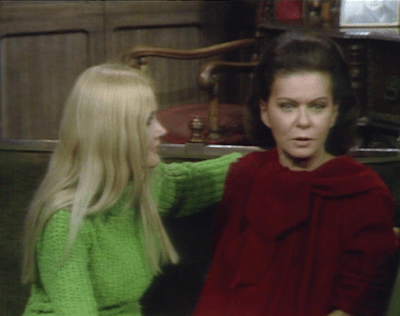
While still in the crypt, Julia had looked at Liz’ body and insisted she was dead. She wrote off the ringing of the bells as a coincidence, perhaps caused by some jostling during Carolyn’s encounter with the werewolf. Later, Liz gets out of the coffin and goes home to Collinwood. There, Julia, Barnabas, and Carolyn are astonished to see her. Julia examines her. After she finds that Liz has what is in Collinsport English called a “pulsebeat,” she seems willing to concede that she might be alive. She then starts giving orders which everyone willingly follows, because she is such a good doctor.
Liz is the one character whose brain seems to be in working order today. She can remember that her trouble started when her brother Roger’s wife Cassandra cast a spell on her. Barnabas and Julia know that Cassandra was in fact a wicked witch named Angelique, and that Barnabas has just returned from a trip back in time during which he destroyed Angelique. They assure her that Cassandra will never return. They can’t tell her why they are sure of this, because they, like the producers of Dark Shadows, have decided that Liz must never know what is really happening around her, lest she become an active participant in the plot. So all they can say is that they just know, and she is of course unconvinced.
It is a relief to wrap up the “Liz will be buried alive” storyline; that was dull from the beginning, and just got duller as it went. It didn’t help that we have seen Liz immobilized by depression twice before. This isn’t even the first time she has been rendered catatonic as the result of a curse placed by an undead blonde fire witch.
It’s also encouraging that Julia and Barnabas have met the werewolf and are engaged with him. They are the show’s chief protagonists, and nothing can really move without their involvement. Now that they are involved with the werewolf, we can stop spinning our wheels.
Frankenstein’s monster Adam has threatened to go on a murder spree unless old world gentleman Barnabas and mad scientist Julia build him a mate. He has further demanded that heiress Carolyn donate the “life force” that will animate his bride. We open today with a reprise of yesterday’s ending in which the experiment begins and immediately goes wrong. Julia announces that unless the mate comes to life in the next sixty seconds, Carolyn will die. They show us a clock. Sixty seconds pass, and the mate doesn’t come to life. So I guess Carolyn is dead now.
When we return from the opening titles, Adam insists on taking Carolyn from the laboratory. Julia says that Carolyn is in a bad way. Using a bit of Collinsport English, she says that Carolyn’s “pulsebeat” is decreasing. Alarmed, Barnabas asks if she might die. Julia reluctantly admits that it is possible. Evidently the opening titles wiped their memories clean of her earlier statement about the sixty seconds that would determine Carolyn’s fate.
Adam and Carolyn share a scene in the upstairs bedroom. Robert Rodan and Nancy Barrett do a wonderful job of acting, enough to save the episode from the “Stinkers” label. As Carolyn describes what she saw while she was unconscious during the experiment, images of sculpted pieces depicting body parts are superimposed on the screen over her face. She says she “saw something in the fog… hazy forms, floating in the air. They began to take shape. A collection of dead things, disconnected, coming toward me, wanting something from me-wanting life. My life!” The superimposed images don’t lead to anything, anymore than anything else in the episode does. But they are typical of the bold visual artistry of director Lela Swift, and evocative of the sort of thing you would see in the more ambitious low-budget films of the period.
Carolyn loses consciousness just before Julia comes in with her medical bag. Julia pronounces Carolyn dead. Adam goes to the basement, where he tells Barnabas he is ready to start his murder spree. Barnabas tries to stop him, and Adam easily beats him down. Adam storms out of the house, passing Julia in the foyer on his way to the great house of Collinwood. Barnabas staggers upstairs and tells Julia what happened. She goes upstairs to retrieve her bag so she can treat his wounds, and finds that Carolyn’s body has vanished from the bed.
In #210, dangerously unstable ruffian Willie Loomis found an old coffin and broke into it, hoping to reap a harvest of hidden jewels. Instead a hand darted out, and Willie became the sorely bedraggled blood thrall of vampire Barnabas Collins.
The next person to open Barnabas’ coffin was Maggie Evans, The Nicest Girl in Town. Barnabas was keeping Maggie prisoner in his house on the great estate of Collinwood as part of his plan to persuade Maggie to forget her personality and turn into his lost love, the gracious Josette. In #250, Maggie decided to drive a stake through Barnabas’ heart, but had the bad luck to set to work a moment before sunset. He awoke, and spent the remaining two weeks of her captivity treating her even more cruelly than he had previously.
In #275, Willie’s onetime friend, seagoing con man Jason McGuire, made his way to Barnabas’ basement and found the coffin. As Willie had done 13 weeks before, Jason jumped to the conclusion the coffin was full of jewels. Willie tried to tell him this was not the case, but could not stop Jason looking inside. As when Maggie made her attempt to stake Barnabas, it is sunset. Again Barnabas’ hand darts forth; this time, he strangles Jason to death.
The first time someone opened Barnabas’ coffin during the day was in #289. Mad scientist Julia Hoffman had collected substantial evidence indicating that Barnabas was a vampire. As final confirmation, she slipped into his house one morning, made her way to the basement, opened the coffin, and reeled away, simultaneously shuddering and giving a look of triumph.
From November 1967 to March 1968, Dark Shadows was a costume drama set in the 1790s. In #410, wicked witch Angelique had just turned Barnabas into a vampire. She went to his coffin with a stake and mallet, regretting her curse and trying to cut its effects short. As Jason and Maggie would do in 1967, Angelique waited until sunset to open the coffin. Barnabas awoke, demanded to know what was going on, and killed her.
Since then, Barnabas’ vampirism has gone into remission and he and Julia have become fast friends. As we begin today, Barnabas is engaged in a desperate battle for Julia’s sake. The new vampire on the block, Tom Jennings, has been feeding on Julia. She is near death, and will herself rise as a vampire unless Tom is destroyed and she is freed from his influence. Barnabas has found Tom in a crypt next to a coffin, and the two of them have an embarrassingly awkward fight scene. The sun rises, and Tom has to leave Barnabas and get into his coffin.
Barnabas stands over Tom’s open coffin with a mallet and stake. He wonders if anyone ever looked down on him in his coffin when he was a vampire. He tells himself no one could have, for they would have destroyed him if they had. This is a strange thing for him to think. Julia eventually told him that she had sneaked a peek at him in his coffin, and he must remember Willie, Maggie, Jason, and Angelique.
Julia is back at Barnabas’ house. Elizabeth Collins Stoddard, mistress of Collinwood and escaped mental patient, is watching over her. She is telling Julia that Barnabas left her to die and that she will be dead any moment. This cheery behavior is the consequence of Liz’ fixation on death and her obsessive fear that Julia and others are part of a conspiracy to bury her alive.
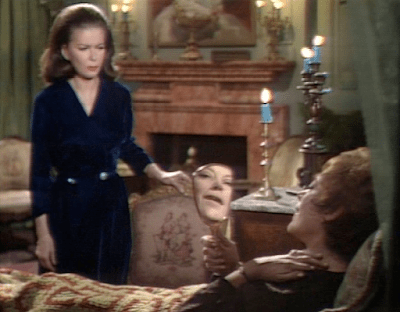
As Barnabas drives the stake through Tom’s heart in the crypt, Julia cries out from her bed, then suddenly gains strength. She asks Liz to bring her a mirror; Julia is delighted to see that Tom’s bite marks are gone.
Barnabas comes back, sends Liz away, and tells Julia that she will be safe from Tom now. Barnabas and Julia are starting to get uncharacteristically mushy over each other when we cut to the downstairs, where Liz looks out the window and sees her brother Roger approaching.
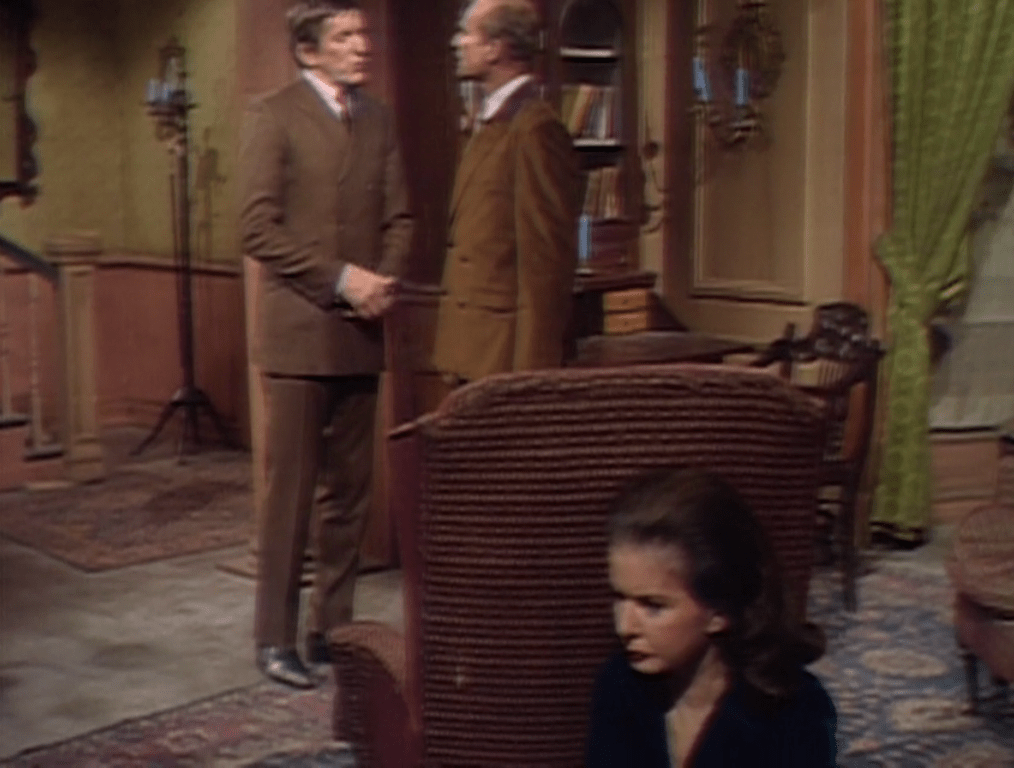
Roger wants to send Liz back to the psychiatric hospital from which she escaped. Liz believes Roger is part of the conspiracy to bury her alive, and that sending her to the hospital will further that goal. So she hides behind an armchair.
Liz hiding.
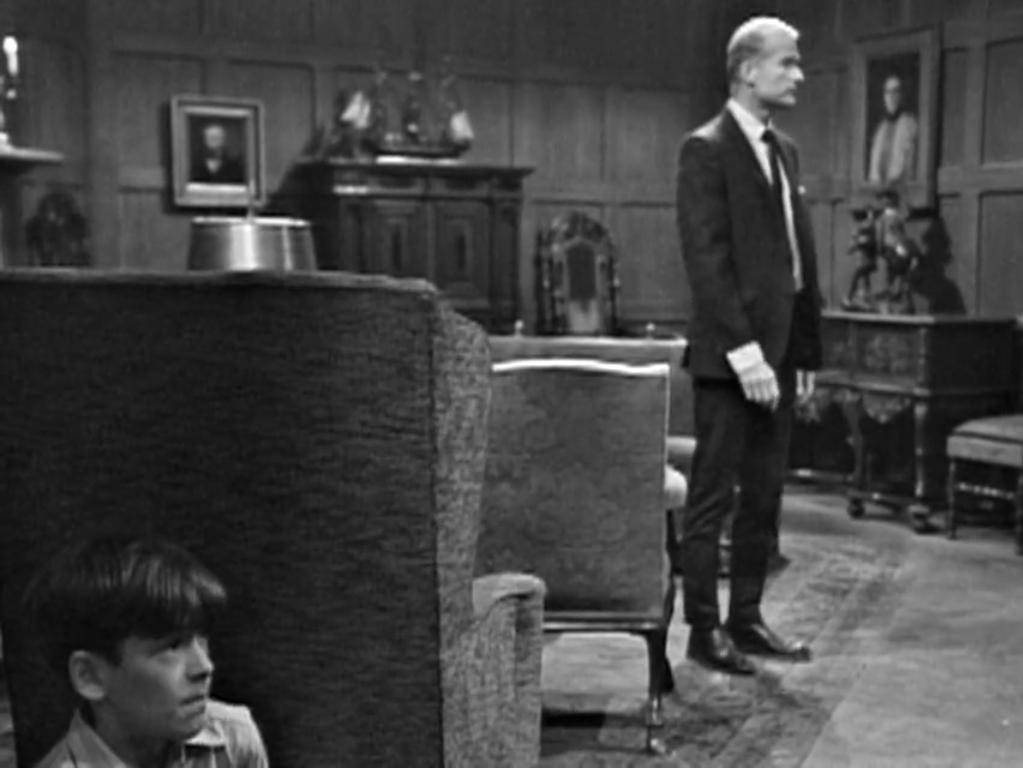
In #10, Liz and Roger had a conversation in the drawing room of the great house of Collinwood while Roger’s son David hid behind an armchair. In that conversation, Roger declared his belief that David should be sent to an institution, a plan which Liz forbade him to pursue. After Liz left the room, Roger caught David behind the armchair.
David found the prospect of institutionalization so terrifying that his next stop was the garage, where he tampered with the brakes of his father’s car in what very nearly turned out to be a successful attempt at patricide. Liz is too upset to develop such an intricate plan, and doesn’t seem to have David’s skills as an auto mechanic. But she shares her nephew’s horror of institutionalization. So after Roger and Barnabas have talked for a moment, she jumps up from behind the chair and starts making accusations.
Liz tells Roger and Barnabas that she saw Julia in a crypt in the family burial ground nearby, and that there was a coffin there. Barnabas is alarmed, since this is the coffin in which Tom’s staked remains now repose. Roger agrees to go to the crypt and to see if there is a coffin. Barnabas offers to go with him.
The suave Nicholas Blair shows up at the front door with a bouquet of flowers. We know that Nicholas is a warlock and that he is behind the renewed outbreak of vampirism, that he was watching while Barnabas staked Tom, and that he is also responsible for some other plots involving Barnabas and Julia. For their part, Barnabas and Julia have every reason to suspect that this is so, and have talked about their suspicions more than once. Nicholas tells Barnabas, Roger, and Liz that he has heard that Julia is ill and has come to visit her. At Liz’ insistence, Barnabas lets Nicholas see Julia while he and Roger go to the crypt.
Nicholas expresses his relief that Julia’s recovery will enable her to return to work soon. The only work Julia has done in the year she has been a houseguest at Collinwood has been in association with the supernatural goings-on she and Barnabas have been entangled in; currently, an agent of Nicholas’ is forcing them to build a Frankenstein’s monster. Nicholas may as well say explicitly that he is behind that scheme and the vampire troubles too. He tells Julia that he thinks he might fall ill and need her help as a doctor; she says that he seems indestructible, a word he receives with pleasure.
Barnabas comes back and tells Julia that the coffin has disappeared. He mentions that it is strange that Nicholas turned up when he did. Julia suggests that Nicholas may be the one who moved the coffin. All of a sudden Barnabas seems to forget everything he knows about Nicholas and dismisses that idea. It’s one of those frustrating moments when the characters seem to have the memory of a goldfish, and it ends the episode on a sour note.
Mad scientist Julia Hoffman is hanging around her new base of operations, the Old House on the great estate of Collinwood. She is getting ready to perform an experiment which, if successful, will convert vampire Barnabas Collins into a real boy. She learned of Barnabas’ existence when treating his former victim Maggie Evans, The Nicest Girl in Town. Julia answers a knock on the front door, and sees her old acquaintance, addled quack Dave Woodard.
Woodard has no idea what Julia is up to. So far as he knows, she is still on board with his own idiotic scheme, in which he, along with Maggie’s father Sam and her fiancé Joe, has told everyone in town that Maggie is dead in hopes that her captor would forget about imprisoning girls and draining their blood. In fact, Julia has told Barnabas that Maggie is alive and has lured him into cooperating with her project by promising to keep Maggie in a state of amnesia so that she will not represent a threat to him.
In yesterday’s episode, Sam and Joe called on Woodard and complained that Julia is staying at Collinwood while Maggie is a hundred miles away. They demanded that Woodard take her out of Julia’s care. Woodard tells Julia today that her conduct is growing “more and more unethical.”
Last week, Julia was able to forestall Woodard’s threat to take her off the case by playing dumb. This time, she has to take him partly into her confidence, telling him that Maggie encountered the supernatural and that her case represents an opportunity to find a crossing point on the boundary between life and death. She dangles the possibility of great fame before him, saying that the doctors who make the breakthrough she sees coming will go down in history. When he presses for details, she says that there is great danger in what she already knows, and that she must not tell him more.
Woodard has been on the show for months, and has been stuck in just two modes the whole time. When he’s with a patient, he makes a show of brisk dissatisfaction, as if trying to convince them that they oughtn’t to take their disease so seriously that they give up. This mode was as far as Richard Woods, the first actor to play Woodard, got in his two appearances (in #219 and #229.) When he is talking with someone else, Woodard struggles to find the words to express his bafflement at the terrible case he is treating. These two modes didn’t make Woodard a source of suspense. They were just filler between his announcements of what the script called for him to do next.
When Julia asks Woodard if, when he was in school, he dreamed of making a major contribution to the science of medicine, he gets a thoughtful look and says “Well, of course.” This is the first moment we have seen Woodard outside his two modes. When Julia tempts him with the idea that he will go down in history as the co-discoverer of the most fundamental truth imaginable, he displays an emotion that might lead to him to any of a number of exciting, story-productive actions. The first scene in the first episode credited to writer Gordon Russell manages the astounding feat of turning Dr Woodard into an interesting character.
We cut to the woods on the estate. We see the ghost of Barnabas’ nine year old sister Sarah sitting on a rock crying. All of Sarah’s previous scenes started with some other character on camera, then proceeded to Sarah making a mysterious entrance. That’s what we would expect of a ghost, after all. This time, Sarah is all by herself at rise. The first time we saw a ghost was in #70, when the ghost of Josette Collins emerged from her portrait and danced around the columns of the Old House. That was a solo appearance as well, but people had been in the Old House talking about Josette immediately before, so she was manifesting herself in response to attention from the living. Here, we see a ghost on her own, processing her emotions, hoping someone will come and hang out with her.
Strange and troubled boy David Collins shows up and asks Sarah why she is crying. She says she can’t find Maggie. David breaks the news to her that Maggie is dead. Sarah laughs, and assures David that she is still alive. When David insists that Maggie is dead, Sarah tells him that he may know “about leaves and everything,” but she knows “who’s dead, and who isn’t.”
Less than a week ago, in #288, David saw a portrait of Sarah and wondered aloud if the girl he has met is her ghost. In the first 39 weeks of the show, he was on intimate terms with Josette and some of the other ghosts. When he first met Barnabas in #212, he asked him if he were a ghost, and was disappointed to hear that he was not. So returning viewers expect David to ask Sarah the same question. Indeed, David has always interacted with ghosts as if they were people with whom he could pass the time of day, share thoughts and feelings, and get to know better from one encounter to the next. Seeing Sarah crying by herself should validate this attitude. But instead, David has developed Soap Opera Goldfish Syndrome, forgetting information which everything we have seen has led us to expect he will remember.
David insists Sarah come home with him to the great house of Collinwood and have dinner with the family. She tries to decline politely, but he will not take “I’ve been dead for centuries” for an answer. He gets Sarah into the foyer, then goes to the drawing room to announce her presence. He finds Julia there, with well-meaning governess Vicki and Vicki’s depressing boyfriend, fake Shemp Burke Devlin. By the time David gets the adults into the foyer, Sarah has disappeared.
Vicki is suffering from an even more frustrating version of Soap Opera Goldfish Syndrome. She had had extensive dealings with the ghosts of Collinwood on many occasions between #85 and #191, and that had been the basis of her bond with David. Vicki’s interactions with the supernatural reached a climax when she led the opposition to David’s mother, undead fire witch Laura Murdoch Collins, from #126 to #191. Since then, Josette has spoken through Vicki at a séance and she has seen Sarah.
But lately, Vicki has started to deny that there are ghosts. This is in response to Burke’s demands. Burke lost his connection to the story months ago, and he’s been trying to gaslight Vicki into dismissing all of her spectral encounters as signs of mental illness so that she will join him on the show’s discard pile of useless characters. In Friday’s episode, Vicki had apparently decided to give in to Burke and make herself believe that there were no supernatural beings at work around Collinwood. As a result, her scenes in that episode were unbearably dreary.
Before David brought Sarah home, Vicki had been dreary again. She’s excited about some old house she saw, and wants Burke to go look at it with her. As David’s governess, Vicki’s compensation consists largely of room and board, so as long as she has her job her interest in any particular piece of real estate isn’t going to lead to story development. If she quits the job and marries Burke, she will be giving up on ever being part of the action again. So her rambling about “the house by the sea” is suspenseful only to fans of Vicki who are afraid she will vanish into the background of the show.
When David starts telling the adults about Sarah, Vicki launches into the same garbage Burke has been giving her, talking down to him about imaginary friends and insinuating that anyone who believes in ghosts is soft in the head. Burke, who had previously been David’s great friend, joins in this abusive behavior. After David indignantly stalks away, Julia gets very uptight and lectures Vicki and Burke about the need to stifle David’s imagination and discourage him from telling them things they don’t already know. This scene is effective, but the effect is claustrophobic- by the end of Julia’s little speech, we feel like the mad scientist is holding us prisoner.
Vicki and Burke decide to leave to look at the house, and Vicki finds Sarah’s cap on the floor. That’s such a great moment that not only do we leave the episode no longer disappointed in David’s goldfish memory, we can even forgive Vicki’s.
The closing credits run over an image of the foyer with Sarah’s cap on the table. My wife, Mrs Acilius, thought it would have been hilarious if Sarah had marched in and taken the cap while the credits were rolling. I’d have liked to see that too, especially if, after putting it back on, Sarah had turned to the camera and put her finger to her lips, telling the audience to keep quiet about what we had seen.




 Dark Shadows Commentary