
Episode 577: I imagined we would discuss Freud

Heiress Carolyn came running when her mother, matriarch Liz, woke her with her screams. Liz was having a nightmare about being buried alive. She tries Carolyn’s patience and ours with her obsession that this will in fact happen to her.

Liz tries to call her lawyer, Richard Garner. Whoever answers the phone tells Liz that Garner is not available, hardly surprising since it is the middle of the night. She responds that if he doesn’t call back within the hour, he need never call again. Since we last saw Garner in #246, and his name hasn’t been mentioned since #271, it seems like he may as well get some sleep.

Liz then calls Tony, a young lawyer in town who used to date Carolyn. Tony comes over and Liz hires him to help with some changes to her will. She dictates excerpts from Edgar Allan Poe’s “The Premature Burial” by way of a codicil protecting her from being buried alive, and he tells her he thinks she’s being weird.

The most prominent reference to Poe on Dark Shadows up to this point was in #442, when vampire Barnabas reenacted the plot of “The Cask of Amontillado” by bricking the fanatical Rev’d Mr Trask up in an alcove in his basement. Like Tony, Trask was played by Jerry Lacy, so it is possible that the writers hope the audience will recognize the connection.

Poe wrote punchy little short stories each of which leaves the reader with a single horrifying image. “The Cask of Amontillado” worked well as the basis for an episode, and the bricking up of Trask is one of the most enduring images in all of Dark Shadows. “The Premature Burial” could have made for the same kind of success, had Liz’ obsession begun and ended within one episode. But it has already gone on longer than that, and there is no end in sight. Each time we come back to it, the situation becomes more familiar and less urgent.

Meanwhile, Carolyn takes a glass of milk and a sandwich to Adam, a Frankenstein’s monster she is hiding in the long-deserted west wing of the house. Adam has little to do but read, and he has become quite intellectual. He is playing both sides of a game of chess when Carolyn arrives, pretending that she is his opponent. When she comes, he attempts a joke, pretending she has left him alone so long he does not remember her name. She is distressed about Liz’ obsessive fear of being buried alive, and so does not recognize that he is joking.

Carolyn looks at the chessboard and asks Adam who he is playing. He says that he is pretending to play her. He is smiling and relaxed when he admits this, and he starts joking again as he tells her about their imaginary games. Adam’s pretending that he did not remember Carolyn’s name was a weak joke, but he is actually pretty funny when he tells her that when he pretends they are playing, she doesn’t do as well as he does. She still does not realize that he is kidding, and reacts with horror. She says she doesn’t play chess; in #357, her uncle Roger mentioned that she does, but that she usually loses to him. Perhaps in the 44 weeks since then, she has given up the game altogether.
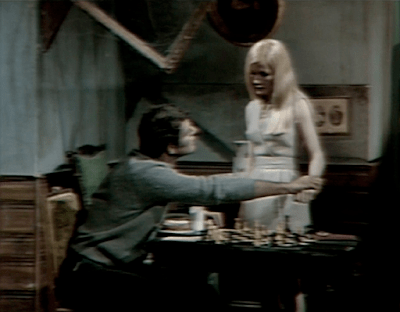
Adam wants Carolyn to play with him for real. Screenshot by Dark Shadows Before I Die.

Adam shows Carolyn the book he has been reading, a volume of Sigmund Freud’s works, and is disappointed she has not already read it. When she tells him she is worried because of Liz’ condition, he invites her to sit down and says “Tell me about your mother,” suggesting that he is ready to set up shop as a psychoanalyst. Adam is being serious now, but this part of the exchange is hilarious.

Carolyn goes out to the terrace and looks at the night sky, wondering if Freud could help her understand what is happening with her mother. I live in the year 2024, and so I have difficulty imagining how people could ever have taken Freud seriously. But he was very very big in the 1960s, and in its first year Dark Shadows gave us a lot of heavy-handed Freudian symbolism and a number of storylines with obvious psychoanalytic themes. Longtime viewers will find it a reassuring sign of continuity that Freud is still around as the thinker “every twentieth century man should read.”

Tony joins Carolyn on the terrace. He greets her and sees that she has a book about Freud. “I don’t have to ask why you’re reading him,” he remarks. Carolyn asks if he is referring to her mother, and Tony’s response is so indiscreet he may as well spinning his finger around his temple and saying “Cuckoo, cuckoo!” It is clear enough that the concept of “confidential communication” is alien to the lawyers in Soap Opera Land, and now we see that “basic respect” is also very much on the optional list. Carolyn tells Tony to do whatever Liz asks, and starts crying.

I was startled by Carolyn’s crying turn, because it is the first time in the two hundred or so episodes she has appeared in thus far Nancy Barrett has given a subpar performance. The actors all had to work under virtually impossible conditions, so I rarely mention it when one of those who usually does well has a bad day at the office, but the 20 seconds or so she spends very obviously not crying in this scene mark the end of an extraordinary streak.

Tony embraces Carolyn and kisses her. Adam’s room in the west wing overlooks the terrace, and he spies on them while they kiss. After Carolyn excuses herself and goes back into the house, Adam comes up behind Tony, grabs him, forbids him to touch Carolyn, and throws him to the ground.
Episode 106: Swann song

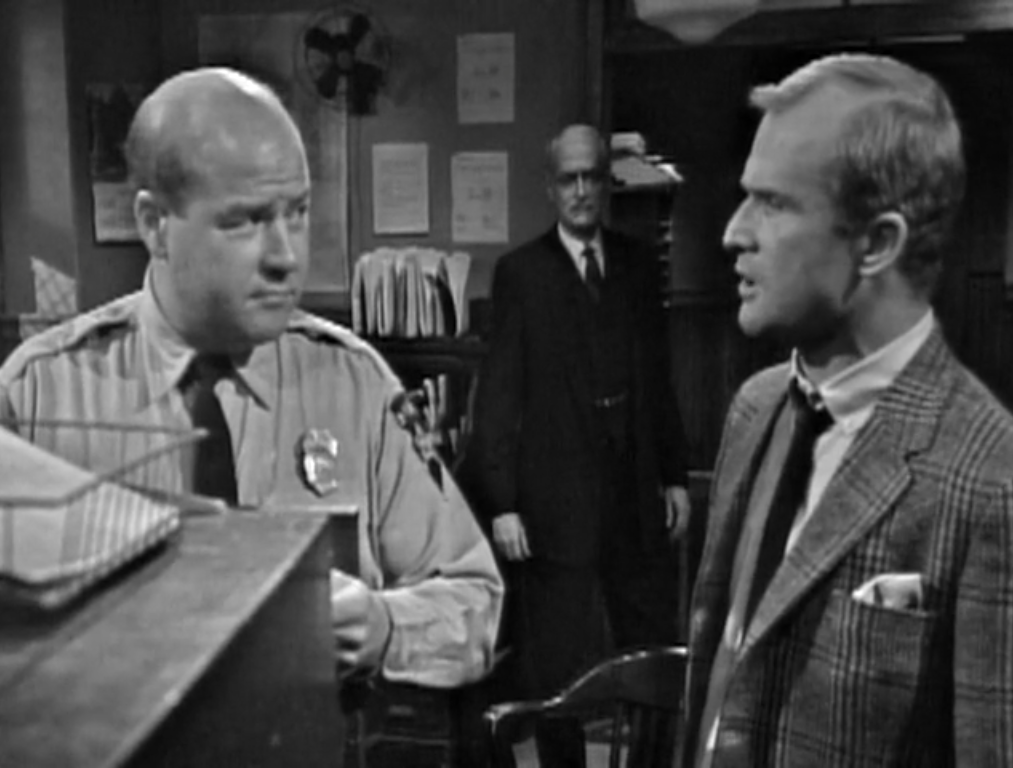
At the end of Friday’s episode, dashing action hero Burke Devlin and the sheriff caught high-born ne’er-do-well Roger Collins digging up a fountain pen from under a rock. It appears to be the fountain pen Roger had stolen from well-meaning governess Vicki. Some think that Roger stole the pen and hid it because it is evidence implicating him in the death of beloved local man Bill Malloy. Today, Roger is in the sheriff’s office.

Accompanied by Richard Garner, the Collins family’s lawyer, Roger talks and talks, admitting that he saw Bill that night, badly injured and face-down in the water. He jumped to the conclusion that Bill was dead, and left the scene without notifying anyone. He also admits that he concealed evidence that he believed the police would find relevant to the investigation. As if that weren’t enough, he admits that he lied to the police time and again, most recently the night before, and is caught in yet another lie when he gives a nonsensical explanation of his plan to meet Bill that night.

Roger begins his confess-a-thon

Garner makes only one feeble attempt to interrupt Roger’s torrent of self-incriminating remarks. When the sheriff questions Vicki, Garner takes the opportunity to ask her some questions of his own, questions which produce even more information that is adverse to his client’s interests. On their site Dark Shadows Before I Die, John and Christine Scoleri feature commentary on Garner’s performance from a lawyer friend of theirs. Setting aside the utter hopelessness of Garner’s work from a real-world perspective, this friend analyzes his conduct by contrast with the standards set by other TV lawyers:

This brief addendum will review the competence of Garner using a “TV Lawyer Competency Rating” (TVLCR) scale. This WAG scale is based on my estimation of how a general audience might rate a TV Lawyer’s performance. I have supplemented these TVLCR scores with some comments reflecting real-world practices.

http://dsb4idie.blogspot.com/2016/11/episode-106-112166.html

Even by those standards, Garner doesn’t come out very well:

Garner strikes me as the go-to civil attorney for the Collins family who got dragged into this murder case just because they are familiar with him. Based on Garner’s poor competency rating as a TV Lawyer, Roger Collins should fire him and instead reach out to Raymond Burr or Andy Griffith.

Soap operas typically generate suspense by sharing information with the audience that some, but not all, of the characters have. We wonder when the secrets will be revealed, and how those to whom they are revealed will react when they finally get the news.

By the end of today’s episode, all of the characters will know almost everything the audience knows. Even what the characters don’t know, they’ve heard of. For example, Roger and drunken artist Sam Evans have not confessed the guilty secrets they share to any of the other characters, but everyone seems to have figured out more or less what they’ve been up to. Not everyone believes in ghosts, but it’s all over town that Vicki and her charge, strange and troubled boy David Collins, have seen ghosts in and around the great house of Collinwood, and even the most skeptical are not in a hurry to hang around the place after dark.

This is the next-to-last episode credited to writer Francis Swann. Swann will fill in for the new writers a week from Wednesday, but today is really the end of the Art Wallace-Francis Swann era of the show. From tomorrow, the new team of Ron Sproat and Malcolm Marmorstein will be holding the reins. By bringing all the characters up to at least our level of knowledge about the ongoing storylines, Swann is clearing the decks for Sproat and Marmorstein to set up their own crises and dilemmas.

Swann’s great strength is his ability to give actors room to show what they can do. Today’s episode is a case in point. Just when Garner’s disastrous intervention in the sheriff’s questioning of Vicki has led us to wonder if he’s all there, he has a moment when he opens his eyes wide and looks out the window. As Hugh Franklin plays it, that’s enough to make us wonder what’s on Garner’s mind, and to think he might be about to do or say something interesting.

Of course stage veteran Louis Edmonds thunders delightfully as the wildly indiscreet Roger, and of course TV stalwart Dana Elcar does an expert job of presenting the sheriff as a skilled professional firmly in control of the situation. There might be a crying need for a defense attorney to intervene when a suspect is blabbing as freely to the police as Roger is to the sheriff, but there is no need for a third actor to get in the way of Edmonds’ and Elcar’s interplay. Standing in the background between those two, Franklin occasionally gives a slight facial expression that underlines some point or other, but never upstages them.

In the first half of the episode, Alexandra Moltke Isles’ Vicki has to give some long speeches full of recapping, and in those she takes the character through several distinct shades of discomfort. She begins with diffident nervousness, builds up to frightened indignation, and ends with pure sadness.

Later, flighty heiress Carolyn comes into the sheriff’s office and pleads with Vicki to say that her beloved Uncle Roger couldn’t be a criminal. In front of the sheriff and Garner, all Vicki will say is that the two of them should leave. As Carolyn, Nancy Barrett makes the most of the melodramatic turn, but Mrs Isles takes possession of the scene with her few words spoken in a quiet, husky voice we haven’t heard before. Those brief remarks cap the progression we saw her making in her speeches earlier, and define the mood she is still in during a conversation between Vicki and Carolyn in Collinwood later. Vicki’s feeling for the pity of it all holds the episode together, and leads us back into the texture of the life of the family at the center of the story.