Episode 446: You have given me nothing I can understand

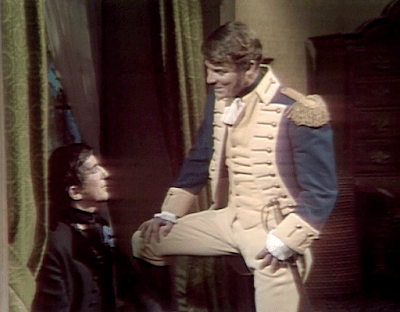
Haughty tyrant Joshua Collins goes to the basement of the Old House on his estate and finds his son Barnabas rising from a coffin. Barnabas explains to his father that he has become a vampire.

Joshua and Barnabas in the coffin room. Screenshot by Dark Shadows Before I Die.

This scene prompts considerable discussion in fandom about gay subtext. In his post about the episode on Dark Shadows Every Day, Danny Horn points out that actors Jonathan Frid and Louis Edmonds were both gay, and speculates that this fact might have had some influence on the way they play Barnabas’ coming out to his father. “I’m not suggesting that this situation is intended to be a metaphor for a gay child talking to his father about his terrible, shameful secret life… But the ‘keep the secret, don’t tell my mother’ part — there’s some resonance, isn’t there? At least, it’s a hook into the story that helps us to get closer, and really feel some of the horror of this moment. A father hands a gun to his son, and says, Kill yourself, so that your mother never finds out.”

Even this tentative raising of the question, with its “I’m not suggesting” and “some resonance” and “at least,” is too much for Patrick McCray. In his Dark Shadows Daybook post about #446, he concedes that “homosexuality is the obvious choice” for an interpretive lens through which to read the scene, but goes on to flatly assert that “this isn’t a veiled metaphor for something like homosexuality.” For him, as for Danny, Barnabas figures in the scene as a murderer first and last, and Joshua as a man finding himself irrevocably severed from the world of rationally explainable phenomena.

For my part, I think that we have to remember that intentionality is always a more complicated thing in a work of art than it is when lawyers are interpreting a contract or cryptographers are cracking a cipher. Certainly the scene is not simply a coming-out scene played in code. Barnabas’ murders do not map onto any metaphor for sexual encounters. While the vampire’s bite is often a metaphor for the sexual act, Barnabas presents his acknowledgement in this scene that he has murdered three women in terms of the secrets he calculated he could keep by killing them and maintains a cold, matter-of-fact tone while doing so. When in the course of the scene Barnabas exasperates Joshua by attempting to murder him, there is nothing erotic between the men. No doubt the scene is at one level meant to be what Danny Horn and Patrick McCray say it is, the point when Joshua realizes he is part of a supernatural horror story and the audience realizes that Barnabas is a cold-blooded killer. As such, it is one of the key moments that defines the 1795 flashback as The Tragedy of Joshua Collins.

But there are other levels of intentionality here as well. One has to do with the word “vampire.” When Barnabas is trying to tell his story to Joshua, his first approach is to give him the facts and leave it to him to apply the correct label. But the facts are so alien to Joshua that they only deepen his confusion. Seeing his father’s bewildered reaction, Barnabas’ frustration mounts until he finally shouts “I am a vampire!”

We have heard this word only once before on Dark Shadows, when wicked witch Angelique mentioned it in #410, but it figured in the show as a metaphor for outness long before it was spoken. In #315, Barnabas’ associate, mad scientist Julia Hoffman, urges him not to murder strange and troubled boy David Collins. She catches herself, breaking off after saying that David deserves better than “to die at the hands of a-” Barnabas grins and teases her, asking “At the hands of a what, doctor?” He dares her to say the word and taunts her for her faux pas in coming so close to using it. Julia and Barnabas have a tacit understanding that they will discuss his vampirism only in euphemisms and circumlocutions. To say the word would be to push beyond the limits of Barnabas’ outness to Julia.

When he tries to avoid calling himself a vampire, Barnabas is trying to establish a relationship in which his father will know enough that he is no longer inclined to ask questions, but not enough to achieve any real understanding of his feelings. When he realizes that he cannot keep from using the embarrassing, ridiculous, utterly necessary word, Barnabas is forced to come out to Joshua in a way he had desperately wanted to avoid.

Moreover, Jonathan Frid’s performance as Barnabas departs starkly from anything else he does on Dark Shadows. After he calls himself a vampire, Frid’s whole body relaxes. His neck, shoulders, and hips are looser than we have ever seen them; even his knees bend a little. His voice shifts a bit away from the old-fashioned mid-Atlantic accent he typically uses as Barnabas, a bit toward twentieth century Hamilton, Ontario. At that point, he is not playing a murderer or a creature from the supernatural or an eighteenth century aristocrat- he is playing himself, enacting a scene from his own life.

Barnabas’ coming out to his father is not today’s only story about information management. Joshua rules his corner of the world by parceling out just that information he thinks people ought to have. We have seen this habit lead to disaster after disaster. In his scene with Barnabas, we see another such instance. Joshua has come to the basement because naval officer/ sleazy operator Nathan Forbes told him that he had seen Barnabas at the Old House, and that Barnabas had attacked Joshua’s second cousin Millicent. After Barnabas admits to his various murders, Joshua brings up the attack on Millicent. Barnabas denies that he had any involvement in that attack, sparking an angry response from Joshua. When Barnabas later asks Joshua why he came to the basement, he swears that Barnabas will never know why.

Had Joshua told Barnabas that Nathan sent him to the basement, the two of them might have figured out that Nathan faked the attack on Millicent as part of his scheme to trick her into agreeing to marry him and to blackmail Joshua into consenting to the marriage. That in turn might have helped Joshua find a way to prevent Nathan from carrying out his evil schemes. But his parsimony with information leaves Joshua believing Nathan’s story about the attack, and therefore puts him and the rest of the Collinses entirely at Nathan’s mercy. When we see the effect that the radical honesty of coming out as a vampire had on Barnabas, we can’t help but wonder how many misfortunes the Collinses might have avoided if they had not lived according to Joshua’s code of truthlessness.

A voice comes from the upstairs. Naomi Collins, wife to Joshua and mother to Barnabas, has entered the house. Joshua leaves his gun with Barnabas and tells him to do the honorable thing, then hastens up to meet her.

Naomi tells Joshua that she he came to the Old House because Nathan told her he had gone there. She insists that Joshua explain what is going on; he pleads with her not to ask. She tells him to think of her; a quiver in his voice, he says “I am thinking of you now.” Naomi is as mystified and as frustrated by Joshua’s refusal to explain himself as Joshua had been with Barnabas’ story, but even as she plays these reactions Joan Bennett also shows us Naomi softening towards her husband. She catches a glimpse of the lover hidden beneath the lord of the manor, peeking out from below the massive superstructure of his pride.

Back in the great house, Nathan is sprawled on the sofa, his boots resting on a polished table, guzzling the Collinses’ fine liqueurs. When Joshua and Naomi return, Nathan offers Joshua a snifter of brandy and invites him to drink it with him in the drawing room. Joshua reacts indignantly, protesting that he is not accustomed to a guest offering him the hospitality of his own house.

This exchange is familiar to longtime viewers. From March to June of 1967, when Dark Shadows was set in contemporary times, the great house was dominated by seagoing con man Jason McGuire, who was blackmailing reclusive matriarch Liz. Several times, most notably in #200 and #264, Jason poured himself a drink and invited Liz’ brother, high-born ne’er-do-well Roger Collins, to join him. Roger would protest that he was not accustomed to being offered a drink of his own brandy in his own house, often drawing the rejoinder that it was Liz’ brandy and Liz’ house, and that he was as much her guest as Jason was.

Roger and Joshua are both played by Louis Edmonds. Roger represents the final stage of decay from the height Joshua represents. He has squandered his entire inheritance, committed acts of cowardice that cost the lives of two men, and let a more or less innocent man go to prison in his place. In #4 he tried to sneak into well-meaning governess Vicki’s room while she slept, and when Liz caught him he told her he didn’t want to be lectured on his “morals,” leaving no doubt that he was looking for some kind of cheap sexual thrill at Vicki’s expense. He openly scorns his responsibilities as a father, cares nothing for the family’s traditions, and the one time we see him working in his office at the headquarters of the family’s business all he does is answer the telephone and tell the caller to contact someone else instead. He drinks constantly, is always the first to give up on a difficult task, makes sarcastic remarks to everyone, and backs down whenever he faces the prospect of a fair fight. In #273, he even admitted to Liz that, had he known what Jason knew about her, he probably would have blackmailed her too.

Joshua’s relentlessly dishonest approach to life may be rooted in fear, and it is never difficult to see that its end result would be to produce a man as craven as Roger. But Joshua himself is as strong as Roger is weak. It is impossible to imagine Roger shaking off an attempt on his life as Joshua shakes off Barnabas’ attempt to strangle him today. While Roger is prepared to sacrifice any member of his family for his own convenience, Joshua will go to any lengths to protect Naomi from the truth of Barnabas’ horrible secret. Nor does Joshua take the easy way out even when he is knuckling under to Nathan. In their scene today, Nathan makes it clear that he is willing to accompany Joshua back to the Old House. Had Roger known what Joshua knows about that basement, he would never have missed an opportunity to send Jason there and let Barnabas do his dirty work for him. But Joshua cuts Nathan off the moment he raises the subject.

Joshua does go back to the coffin room, and he finds Barnabas standing around. He is disappointed that his son has not killed himself. Barnabas tries to explain that he cannot die by a gunshot, but Joshua dismisses his words. He takes the gun himself and, with a display of anguish, shoots Barnabas in the heart. Only thus, he believes, can he keep the unbearable truth from coming to light.
Episode 394: Not a simple woman

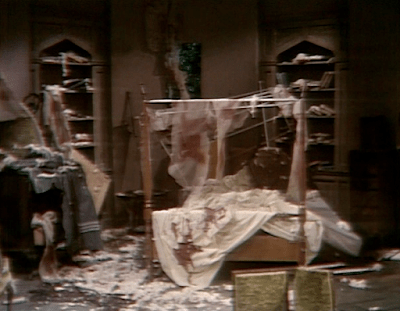
The ghost of Jeremiah Collins has gone to the newly built great house of Collinwood and made a terrible mess in the bedroom that was to be occupied by a house-guest of the Collins family, the Countess DuPrés. Among those who discover the mess is Angelique, who was the countess’ maid before she became the fiancée of Jeremiah’s nephew, Barnabas. Not everyone in the house knows of the change in Angelique’s station, so it is unclear whether she ought to stick with her former role and clean the room herself or start functioning as a member of the family by calling for a servant to do it. Since Angelique is also the wicked witch who raised Jeremiah from the grave, putting her in this awkward position would seem to be a passive-aggressive way for him to get back at her.

Messy room. Screenshot by Dark Shadows Before I Die.

Repressed spinster Abigail Collins, sister of the master of the house, comes into the room. She insults Angelique’s former master, the countess’ brother André, prompting him to leave the room in a huff. Angelique begins to follow André, but Abigail orders her to to stay.

Angelique has taken no care to cover her tracks, and it is obvious to all that something very unusual has been happening around the estate of Collinwood since she arrived. Most of those who have witnessed the strange goings-on are rational, modern people who are reluctant to believe in the supernatural, and the rest have settled on the idea that eccentric governess Victoria Winters is the witch. But Abigail has learned of Angelique’s engagement to Barnabas, has realized that every bizarre occurrence has contributed to making it possible, and has concluded that Angelique is in league with Vicki and the devil.

Up to this point, Abigail has been a figure who did ridiculous things but whom we came to respect as we saw that a person of her time and place might well have interpreted the information available to her as she does. In this scene, she isn’t ridiculous at all. She is mistaken about Vicki, who is a well-meaning innocent. But she has figured Angelique out long before anyone else has even begun to suspect her. Abigail emerges as a character who is smart enough to turn the story in fresh and surprising directions.

Abigail interrogates Angelique. Screenshot by Dark Shadows Before I Die.

Once Abigail has left the room, Angelique summons Jeremiah and tells him she has something for him to do before she will let him return to his grave. Jeremiah has already gone beyond the instructions she gave him, not only in befouling the countess’ room but also in repeatedly showing himself to Naomi Collins, the lady of the house. But I suppose Angelique has such a limited staff she can’t afford to let someone go for overenthusiasm.

We see Barnabas in his new room in the great house. His friend Nathan comes and asks him about the report that he is going to marry Angelique. Barnabas confirms that it is true, and assures Nathan that Angelique is not pregnant.

Nathan is puzzled that Barnabas wants to marry Angelique. Screenshot by Dark Shadows Before I Die.

As written, the scene is a bit of a throwaway, but the actors flirt with each other pretty blatantly throughout the scene. As the screenshot above shows, it begins with Nathan thrusting his crotch into Barnabas’ face while Barnabas smiles appreciatively, and it continues along that line. Considering that Nathan is puzzled that Barnabas wants to marry a woman, even a beautiful one, and that viewers know that Barnabas intends it to be a sham marriage, the flirty tone makes it hard not to recognize a comment on a familiar closet situation. Jonathan Frid and Joel Crothers were both gay, but they had many scenes together and never seemed to be flirting at any other time, so perhaps this comment was intentional on their part and that of director John Sedwick.

After Nathan leaves, Jeremiah appears in Barnabas’ room. He denounces Barnabas for killing him in a duel over the gracious Josette and vows to haunt Barnabas and Josette forever if they marry.

This does not at all reflect the attitude Jeremiah had in life. Jeremiah and Josette married under the influence of a spell Angelique cast on them, and they deeply regretted the pain their elopement brought Barnabas. In his last conversation with Josette before the duel, Jeremiah made it clear that he was going to let Barnabas kill him and that it was all right with him if Josette and Barnabas went on to marry. Jeremiah’s rantings to Barnabas today are Angelique’s words, not his own. This leads us to wonder if she is simply manipulating him as a puppet, or if some fragment of her personality took up residence in Jeremiah when she raised him from the dead. We’ve seen several times that supernatural beings on Dark Shadows are complex phenomena made of parts that work independently and often at cross-purposes with each other, so perhaps when Angelique casts a spell she is dividing herself into parts that will thwart each other’s goals.

Regular viewers know that the segment of the show set in 1795 will show us Barnabas becoming a vampire. We assume that Angelique will be responsible for this transformation. Since the Barnabas we knew in 1967 showed many of the personality traits that Angelique has shown in 1795, seeing her at least use Jeremiah’s reanimated corpse as a mouthpiece for her words and perhaps turn it into a part of herself makes us speculate if the vampiric Barnabas we thought we knew was really Angelique all along.

After Jeremiah leaves Barnabas’ room, Angelique comes in. She tells Barnabas that Abigail is making trouble for them, he tells her about Jeremiah’s apparition, and they decide to marry at once. This three-part sequence in Barnabas’ room- his scenes with Nathan, with Jeremiah, and then with Angelique- mirrors a sequence in Josette’s room in yesterday’s episode, in which she is visited by Jeremiah, then by the countess, then by Angelique. That sequence ended with Angelique telling Josette that she and Barnabas were to be married and thus represented a step towards the wedding. The echo of its structure at the end of today’s installment gives us a sense that the wedding is approaching with irresistible momentum.

Episode 311: Attached to children

Both Danny Horn and Patrick McCray wrote fine blog posts about this episode. I have a few things to add to what they’ve said.

When vampire Barnabas Collins and his sorely bedraggled blood thrall Willie approach the Tomb of the Collinses, strange and troubled boy David hears them talking about mysterious little girl Sarah. Since Sarah had made him promise to keep her connection to the place secret, he opens the panel to the concealed chamber she had shown him and hides there. To his horror, he hears Barnabas order Willie to open the panel. Still trying to keep Sarah’s secret, he hides in the coffin in the center of the chamber while Willie and Barnabas walk around it. He hears them talk about Barnabas’ relationship with Sarah and Willie’s discomfort with the chamber.

They don’t mention that Barnabas is a vampire, or that he was the one who imprisoned Maggie Evans, The Nicest Girl In Town. But they say enough that David should be able to figure out all of Barnabas’ secrets. Once he has heard Barnabas say that he was left to comfort Sarah after their dog was put down, it isn’t much of a leap to conclude that Sarah is his little sister. And once he’s heard Barnabas ask Willie if he is frightened by the “contents” of the chamber, he should know that there is something in there more than can be seen at a first glance.

In episodes #301 and #306, we were reminded of Jason McGuire, whom Barnabas killed and forced Willie to bury in the floor of this chamber. We also saw the chamber itself in #306, so that regular viewers would be sure to think of Jason’s grave. If David should repeat Barnabas’ comment about the chamber’s “contents” at the right time, Jason might yet be exhumed. So Barnabas has created an extreme danger to himself with his big mouth. Since it does not seem that Dark Shadows could continue if either Barnabas or David were to destroy the other, we are in suspense as to how they will get out of this situation.

After Barnabas and Willie leave, David gets out of the coffin and finds he cannot open the panel from the inside. Willie had used a gadget hidden in the stairs to open it, the first time we have seen this device. As David starts to panic, he hears the strains of Sarah’s signature tune, “London Bridge.” He turns away from the panel, looks at the blank walls of the chamber, and starts calling on Sarah.

In his post, Danny Horn asks “Has David just figured out that Sarah’s a ghost?” I think it’s more complicated than that. In #288, David happily considered the possibility that Sarah might be a ghost, and throughout the series he has been on easy terms with several ghosts. So I think he has assumed she was a ghost all along, and was just too tactful to bring it up when he was talking with her.

Back in the great house of Collinwood, well-meaning governess Vicki is on the terrace, worried about David’s disappearance. Barnabas peeks at her through the gate, as he would do if he were not allowed to look at her. Then he just walks up and starts a conversation with her, leaving us to wonder what the whole peeping-Tom act was about.

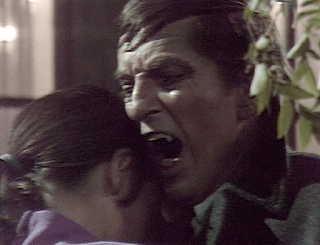
Vicki is so concerned for David that she starts crying. Barnabas tells her to put her head on his shoulder, which she does. He seems to be trying to restrain himself, but she has such a long, pretty neck, and it’s right there, and he’s so very thirsty…

Snack time. Screenshot by Dark Shadows Before I Die.

Patrick McCray says of this moment:

As Barnabas lunges in to bite her, my concern and sympathy is challenged as I ponder her almost athletic lack of awareness. Of course, I’ll inevitably side with the person getting her throat ripped out… but it won’t stop me from wondering why she’s practically painting a landing strip on her neck. Vicki? You have a generation of young people idolizing you.

Today, the discussion isn’t even a metaphor. No, she’s not asking for it. No one is. So, what is the message that we’re supposed to take away from a dangerous conversation like this? For a person constantly asking questions about everything — and never understanding what she hears — Vicki is the picture of unawareness. Evil is evil. An attack is an attack. And awareness is power. Ironic that her would-be attacker, Barnabas, is frequently even more unaware than is she. However, if anyone on a soap paid attention at all, the stories would last ten minutes. But that’s the point. The more the characters lack focus, the more we learn its value. David is the most aware character on the show, and in this episode, he learns the most he ever will in one night. Pity it’s from inside a coffin.

That part of the discussion is too much metaphor to ignore.

Patrick McCray, “The Dark Shadows Daybook: August 22,” The Collinsport Historical Society, 22 August 2018.

Again, I think it’s a more complicated. I think we have to analyze Vicki’s behavior at three levels of intentionality. First, there’s the in-universe level, the sort of analysis of her motives another character in the same story might give if they had the same information we do. If that character saw Vicki’s depressing fiancé Burke angrily telling her she was crazy for saying that she had seen and heard things that we have also seen and heard, refusing to give her even the most basic information about himself and airily dismissing her questions as a morbid preoccupation with “the past,” and telling other people that her imagination will “run wild” unless he monitors and controls her, they might very well think that Vicki is tired of Burke’s abusive ways. To that character, there would be nothing “athletic” about Vicki’s failure to suspect Barnabas- it is perfectly natural for her to want to think the best of a man who has always been pleasant and respectful to her, unlike the blatant villain she is supposed to marry.

The second level of intentionality is of Vicki’s usual function in the narrative. Up to this point, every storyline has come to its climax when Vicki found out what was going on. She is still the audience’s main point of view character, and as such she naturally tends towards the center of the action. All of the action lately has been in the vampire story, so we expect her to involve herself deeply in it. In the first weeks, when it was possible that Barnabas, as the second in a parade of supernatural nemeses, would be destroyed and make way for a third as undead fire witch Laura Murdoch Collins had made way for him, we expected Vicki to be the one who drive the stake into his heart. Now that it is clear he is on the show for the long haul, we are expecting Vicki to become his victim, and presumably to become a vampire herself. As the protagonist, she is actively working to get more deeply involved with Barnabas. She hasn’t yet resorted to “painting a landing strip on her neck,” but she did invite herself to spend the night at Barnabas’ house in #285 and #286, and it wasn’t her fault she left in the morning still having all her blood.

Vicki the unappreciated fiancée wants only a friend who will respect her; Vicki the protagonist wants to be part of the main story. The tension between the incompatible goals of these two aspects of Vicki is expressed in the third level of intentionality, which Alexandra Moltke Isles expresses in the choices that make up her performance. Mrs Isles takes every opportunity to show that Vicki is more strongly drawn to Barnabas than to anyone else, most definitely including Burke. That attraction brings the character back to life. After a few days when she was trying to submit to Burke’s abuse and ignore “the past,” Barnabas asks her to intercede with Burke on his behalf and she comes roaring back, an assertive character who will not give an inch even when Burke makes some good points.

It is the sight of this strong Vicki that introduces a conflict into the audience’s feelings. On the one hand, we don’t want to lose her, and if she does not become a vampire, it’s hard to see a future for her on the show. On the other, it would be a terrible betrayal for Barnabas to repay her trust in him by doing such a thing to her. All the more so because we’ve spent so much time seeing Vicki become close to David, and if she follows the pattern set in Bram Stoker’s Dracula, vampire Vicki will be a threat to all children.

Our sadness at that betrayal would be a deep emotion of exactly the kind soap operas are supposed to create. That so shocking a crime would lead to a more meaningful and more suspenseful story and a richer part for our favorite character would guarantee that we would surprise ourselves by forgiving Barnabas for it and cheering when he and Vicki become a couple. So, I think a savvy audience watching Dark Shadows up to this point would have to expect to see just that story play out.

The Back-Worlds

In 281 of the posts that follow, I link to comments I made on Danny Horn’s blog, “Dark Shadows Every Day.”

I added most of these comments in the months between the shutdown of live theater in March of 2020 and the completion of the blog in April of 2021. But I have added some since.

In the last few days, I’ve added four. They all discuss on the way the show shifts its focus, once the vampire story becomes a hit, in the direction that will come to define it as the months and years go on. The first three of these comments are on posts discussing episodes where Barnabas the vampire is holding Maggie the lovable girl prisoner and trying to brainwash her into becoming his late love Josette, so that he can kill her and turn her into a vampire. This comment is on the post for episode 253, in which the boy David has broken into Barnabas’ house and had a shouting match with Barnabas’ servant Willie:

The scene between David and Willie marks a definitive break from the pre-Barnabas show. David’s great concern is that Barnabas and Willie are “hurting Josette.” By which he means that he can no longer sense the presence of the ghost of Josette. On the contrary, the name “Josette” now refers to something horrible and that horrible thing is a part of Barnabas’ story.

In the first 42 weeks, the ghost of Josette had been the principal supernatural element in the show. Serene, mysterious, uncanny, the ghost fit perfectly into that series, which was something like 99% atmosphere and 1% story. And Josette came out of the background at two key moments, leading the rescue of Vicki from Matthew in 126 and informing the family of the danger Laura represents to David in 149 and 170. And of course when Barnabas first meets David in 212, David tells him that Josette protects the family.

So when Barnabas starts his rampage, regular viewers would at first be waiting for the ghost of Josette to make its move and stop him. By the time David sees the Josette-ified Maggie in 240 and 241, we know that the imperturbable Josette of the first 42 weeks is not coming back. If we do see Josette’s ghost again after we’ve seen Maggie in her wedding dress, it could not have the lightly amused smile in its voice with which it told Vicki not to be afraid of Matthew; it could return only as a terrifying spirit of vengeance. By the time David and Willie finish their confrontation in this episode, the show has told us that the protecting ghost won’t return at all.

This one is on the post for 255, in response to a comment from someone wondering what Barnabas was planning to do if he had succeeded in his evil plan for Maggie. How could he have gone on presenting himself to the rich Collinses as their long-lost cousin from England?:

I think we have to assume that all the “cousin from England” stuff would have gone by the boards if Barnabas had succeeded with Maggie. When they revisited Barnabas’ Josettifying project in HOUSE OF DARK SHADOWS, they had to ask what would come next, and the answer was “He kills everyone and turns the estate into an impenetrable outpost of Hell.”

Some time after they came back from making that movie, the show would send Barnabas and Julia on a two-week visit to the future, to the far-off year 1995, where they find that most of the family is dead, the rest of them are hopelessly insane, and no one dares go to the estate, all because of hideous supernatural doings that took place there a quarter century before. Those two weeks are sensational, the last genuinely great phase of the show, and part of what makes them so great is that they are a logical sequel to the part of the show everyone remembers most clearly.

This one is on the post for 256. In that episode, the hapless Maggie has seen a mysterious little girl playing outside the cell in which Barnabas keeps her. The girl’s name turns out to be Sarah:

I’d say Sarah’s introduction is the single most important moment in the whole show, more important than Barnabas coming out of the box, more important even than Barnabas’ first decision not to kill Julia.

From the beginning they’d been playing with the idea that there was another cast of characters hidden behind the characters we’ve been watching, supernatural characters who can make their influence felt at certain moments. The most prominent of these was the ghost of Josette…

So the show has discarded the old supernatural realm of Josette and the widows, a realm that was, as you say, never more than slightly accessible. With Sarah’s appearance, we are introduced to an entirely new part of the show. Once again we have a set of characters hidden in the supernatural background, but they can interact with the characters from the main continuity more directly and at greater length than Josette and the widows ever could.

The puzzle of Sarah’s connection to Barnabas, and her talk about looking for the members of her family, indicates that this new order of supernatural beings have complex and unsettled relationships with each other, and that characters from the main continuity can have an influence on those relationships. We will have to figure those relationships out in the weeks and months to come, but as soon as Sarah demands Maggie not tell her big brother that she saw her, we know that they might come to enmesh the living beings. Every scene with Sarah, then, is a step leading directly to the time-travel and parallel universe storylines that will come to define the show.

This one, on the post for 279, sums up the major points of the three comments above. It regards an episode in which Barnabas and Willie are planning to host a costume party in which members of the present-day Collins family will come dressed as their forebears from Barnabas’ time, the late eighteenth century. Barnabas has rather surprisingly claimed that this party will be “the most important night of [his] life”:

‘Dude… you rose from the dead. I think the prize for “most important night of my life” is pretty much taken.’

I think he has a point, though. While it is undoubtedly true that the writers, producers, and other creatives never had an elaborate plan that they had agreed on and that they would stick to regarding the future storylines of the show, they did have some memory of the storylines they had already developed. They spent the first 25 weeks building up the ghosts of Josette and of The Widows as presences in the show, a whole second cast of characters existing in a back-world behind the one in which the events we see take place…

Once the vampire story gets going, Josette and the Widows can’t come back. Their distant, mysterious, impassive qualities suited the slow, atmospheric early months of the show, but once you have a ghoul rampaging about sucking people’s blood there’s no place for remote and uncanny presences. To hold the stage while that’s going on, you need to be a dynamic character…

So the old supernatural order of Josette and the Widows is gone. But the idea of a second cast of characters, mostly invisible to us, properly associated with the distant past, but still wielding powerful influence over the events on screen. is stronger than ever. Barnabas had been hidden away, he belongs dead, yet he has irrupted into the present and taken over the story. Sarah is a denizen of the same back-world, she has broken through with Barnabas, and is steadily pulling aside the curtain that conceals their realm from that in which the established characters live and which the audience sees. The audience is going to have to be introduced to more characters from Barnabas and Sarah’s world, and the party is going to serve that function.

Once we’ve learned their names and how they relate to each other, the back-world characters and their time will have to become a concrete part of the show in a way that Josette and the Widows never could. In retrospect, the only way that could end is with an extended flashback. So the party does turn out to be a solid candidate for ‘the most important night of Barnabas’ life’, in that it is a major step towards the time-travel and parallel-universe stories that would come to define the show.

The time-travel and parallel-universe stories put the back-worlds into the foreground and the usual continuity into the background. Those reversal may not have been the only way to resolve the crisis they created by introducing Barnabas and Sarah, but certainly some kind of radical change in the relationship of back-world and usual continuity was unavoidable.

I’d like to say one more thing about a point I make in that final comment. “While it is undoubtedly true that the writers, producers, and other creatives never had an elaborate plan that they had agreed on and that they would stick to regarding the future storylines of the show, they did have some memory of the storylines they had already developed.” Throughout the blog, Danny repeatedly claims never to have seen most of the episodes from the first 42 weeks of the show. At times this claim seems like it must be an exaggeration- for example, at one point he catalogs all 21 episodes (between #42 and #108) which revolve around the questions of what kind of physical contact had with Burke Devlin’s pen and where Burke’s pen is, a catalog that could only have been made by someone who had seen all of those episodes and all those between. Be that as it may, he does vociferously disclaim any interest in the show as it was before the vampire comes along. Which is his privilege, Dark Shadows was a very different show pre-Barnabas and post-Barnabas and there is no reason to assume that a person who likes one of those shows will like the other.

He also stresses the point that there was no advance planning in the writing of the show, that they were making it all up from week to week, often dropping one story abruptly and expanding another just as abruptly as soon as the ratings came in. That should be obvious to anyone who watches the show for any length of time.

However, it can be misleading to stress the impromptu nature of the stories while ignoring the first 42 weeks, especially when you’re considering the period of the show immediately after those weeks. No one knew what was coming, but the producers, the directors, most of the writers, and many of the actors had been with the show from the beginning and knew exactly where they had been. So the idea of a ghostly back-world and the difficulties that come when you have to define the relationship of back-world to main world were very familiar to them, and it would have been clear that redefining that relationship would have major implications for the future of the show.

Another weakness of Danny’s is a tendency to both emphasize intentionality (a fine thing in itself!) and to reduce intentionality to what “the writers” had in mind. In my comments I usually play along with the focus on intentions, even though I don’t tend to favor that myself. -If it were just me, I wouldn’t be so concerned with proving that anyone associated with the show was thinking about the relationship of back-world to main-world in the summer of 1967- it would be enough that the logic of the show leaves them nowhere else to go. But Dark Shadows Every Day is Danny’s blog, so when I’m there I want to play his game as much as possible.

Where I can’t follow is with his tendency to reduce “intentionality” to “the writers.” A TV series has lots of creators- in addition to writers, there are producers, directors, actors, set designers, costumers, camera people, executives representing networks, executives representing studios, etc, etc. Each of those people has to make contributions, and each has a whole bunch of things to think about at any given time. So there’s always a multitude of intentions, and many levels of intentionality, to be considered.