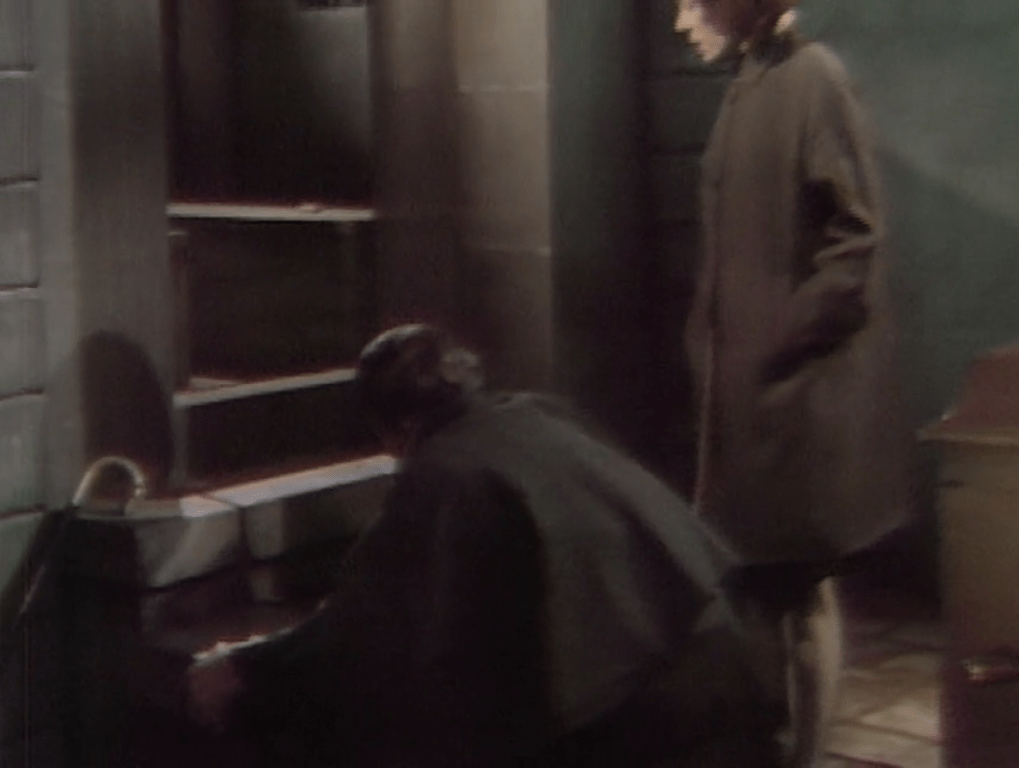
Episode 462: Whole image

In November 1967, Dark Shadows was very rapidly running out of stories to tell. Rather than introduce new characters and new complications to solve this problem, they kept killing off existing characters and foreclosing possible developments, making it impossible not to notice that they were speeding directly towards a blank wall. In #365, they did something no one could have seen coming. Rather than crashing into the wall, they passed right through it and relaunched the show as a costume drama set in the 1790s. The result was a triumph, nineteen weeks of high drama, low farce, lurid horror, pointed satire, and authentic tragedy. Now they are back in contemporary dress, and we are waiting to see what comes next.

Before the costume drama insert, mad scientist Julia was trying to keep well-meaning governess Vicki from falling into the clutches of vampire Barnabas. Julia’s efforts pitted her against many opponents. Vicki regarded Barnabas as a friend, actress Alexandra Moltke Isles was eager to get into the main storyline, the fans wanted to connect the show’s original point of view character with its breakout star, and the writers needed a fresh story to tell. But by repeatedly hypnotizing Vicki and making her subconsciously aware of Barnabas’ horrible secret, Julia was able to hold the line until Vicki disappeared into the 1790s and took the audience, the writers, and Mrs Isles with her.

At the top of today’s episode, Julia is hypnotizing Vicki again. Vicki is in bed, and Julia is extracting memories of her visit to the late eighteenth century, using a post-hypnotic suggestion to sequester those memories from her conscious mind.
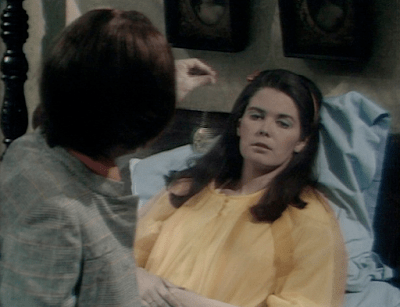
Julia hypnotizes Vicki. Screenshot by Dark Shadows Before I Die.

Vicki has a dream in which the ghost of Jeremiah Collins, who befriended her in 1795, warns her about Barnabas. The ghost’s voice is provided by Addison Powell, whom Danny Horn named on his great blog Dark Shadows Every Day as “THE WORST ACTOR EVER TO APPEAR ON DARK SHADOWS.” I can think of two or three who might finish ahead of Powell in the contest for this title, but his voice performance today is indeed amazingly bad. He delivers his lines on a single shrill note throughout, and has a lot of trouble managing his breath. I suppose his attempts to get through long speeches without inhaling make sense for someone who just emerged from his grave, but the consequent lack of emphasis on any particular words or phrases and the intermittent gasps each time he runs out of oxygen do keep him from establishing the sense of mystery and terror that the scene calls for.

We then cut to the terrace outside the house, where we see Barnabas approaching the door. Julia meets him, with a new haircut.

Julia’s hair. Screenshot by Dark Shadows Before I Die.

This is Grayson Hall’s actual hair; the wig she was wearing in the first scenes had been part of Julia’s costume from her first appearance, in #265. The last time an actress was freed from a wig to perform under her own hair was when Maggie Evans’ tight little blonde hairpiece gave way to Kathryn Leigh Scott’s reddish brown tresses in #20. With that, the wised-up waitress who was everybody’s pal and nobody’s friend became The Nicest Girl in Town. Longtime viewers who remember Maggie’s transformation will recognize what is happening today, when the same device marks a reset of a character. Julia, who yesterday was precisely as hostile to Barnabas and as helpless before him as she was when we left off in November, is today both willing to cooperate with him and very much in control of the situation. He even goes down on one knee to beg her to help him find out what Vicki learned during her sojourn in the eighteenth century. She promises nothing.

Kneeling Barnabas. Screenshot by Dark Shadows Before I Die.

After another visit to Vicki in her room, Julia assures Barnabas that she can use her mastery of hypnosis to cordon off any memories Vicki may have that might pose a threat to him. Unconvinced, Barnabas decides to take matters into his own hands.

Julia tells Barnabas she can control Vicki. Screenshot by Dark Shadows Before I Die.

Barnabas appears in Vicki’s room. She awakens and is surprised to find him at her bedside. She recoils from him as she had been doing in November, when Julia had made her unconsciously aware of his true nature, but, again as she had done in those days, she overcomes her aversion and turns to him. He tells her to come to him. She hesitates, but does. He tells her he can give her peace and make it seem that everything that is distressing her is far away. She embraces him and asks him to do so. It looks very much like a seduction. Considering that Vicki kept embracing Barnabas and pushing her neck towards his teeth before Julia started hypnotizing her, it is an overdue one. Barnabas opens his mouth. He displays the same inner struggle he has shown on previous occasions when he had the chance to bite Vicki, but is still bending his head towards her neck when we fade out for the closing credits.

Barnabas about to bite Vicki. Screenshot by Dark Shadows Before I Die.

Episode 317: Other voices, other tombs

When Dark Shadows began, one of the most important relationships was that between matriarch Elizabeth Collins Stoddard and her brother, high-born ne’er-do-well Roger Collins. Liz and Roger each had a terrible secret to hide. In the work of hiding, they embodied opposite extremes. Liz was motivated to conceal her secret by a fear that she would damage the reputation of the Collins family and the fortunes of its members. Her morbidly intense concern for the family’s position both made her a prisoner in her home and gave her a certain air of nobility. Roger’s motives for hiding his secret were wholly selfish, and he was a symbol of lack of family feeling. So much so that he squandered his entire inheritance, jumped at a chance to sell the ancestral seat to his sworn enemy, and openly hated his own son.

Since Roger was living in Liz’ house as her guest and working in her business as an employee, it fell to her to rein in her impossibly irresponsible younger brother. But the very quality that led her to try to exercise authority over him undercut her efforts to do so. Liz’ devotion to the Collins family compelled her to try to keep Roger on the strait and narrow path, but that same devotion prevented her from taking any action against him so harsh that it might actually deter him from misconduct. Further, her own secret compromised her moral authority and kept her from engaging with anyone outside the family. So she wound up less as a commanding matriarch than as a bossy big sister.

Liz and Roger both let go of their secrets, Roger in #201, Liz in #270. Roger is still far from heroic, but he no longer gives Liz the nightmares he once did. Liz is still mindful of the family’s good name, but there is nothing keeping her from following through on whatever orders she might give. So Liz and Roger’s Bossy Big Sister/ Bratty Little Brother dynamic is no longer a productive story element.

Now, the show is reintroducing the same dynamic with another pair of characters. Mad scientist Julia Hoffman is conducting an experiment which she hopes will turn vampire Barnabas Collins into a real boy. When Barnabas threatens to murder her, she becomes impatient and tells him to stop being ridiculous. When he threatens to murder other people, she threatens to discontinue the experiment unless he starts behaving. He usually responds to Julia’s orders by pouting, sulking, and giving in to her.

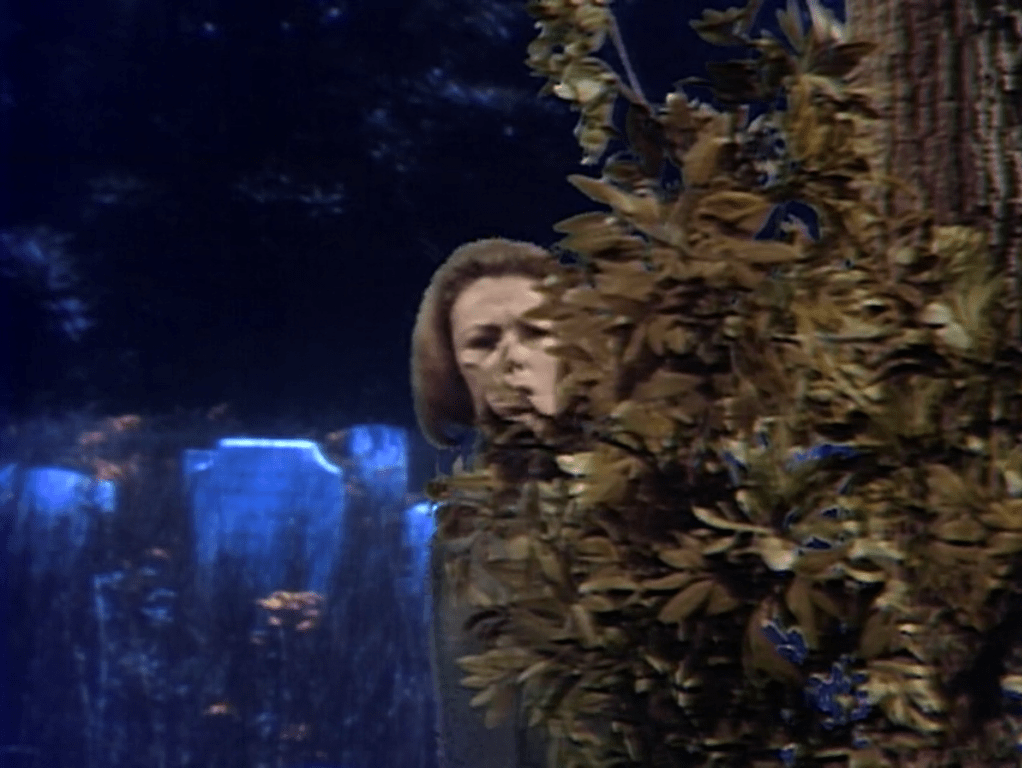
In the opening scene, Julia was in Barnabas’ house. He told her that he was likely to kill Roger’s ten year old son David because he thinks David might know that he is a vampire. Julia demanded that he leave David alone, prompting him to walk out of his own house. She then followed him to the old cemetery north of town, where Barnabas heard her footsteps in the distance and she hid behind a tree.

This woman holds a medical doctorate and is qualified in two unrelated specialties.

Barnabas enters the Tomb of the Collinses. Julia confronts him there, insisting he tell her what secret about the place he is keeping from her. He demands that she leave and threatens to kill her if she does not. He tells her that he ought to stash her corpse nearby, “along with”- then interrupts himself. Regular viewers know that Barnabas killed seagoing con man Jason McGuire in #275 and buried him in the secret chamber inside the tomb in #276. Jason has barely been mentioned since, not once in any scene featuring Julia. When she asks Barnabas what he is talking about, he says “Never mind.”

Julia presses Barnabas with “You’ve shared all your other secrets with me. You have no choice but to share this one with me too.” The logic of this statement eludes me, but all Barnabas can do when Julia has made it is to walk backward away from her, staggering into a corner and pouting at her.

Barnabas, stunned by the force of Julia’s reasoning.

Meanwhile, Sam and Dave are walking through the cemetery.

No, not that Sam and Dave. Local artist Sam Evans and addled quack Dr Dave Woodard have noticed that a series of odd occurrences have taken place in the vicinity of the tomb lately and have come to the cemetery to investigate. They run into the old caretaker, who delays them with his usual warnings about the unquiet spirits of the dead.

Alas, the final appearance of Daniel F. Keyes as the Caretaker.

Back in the tomb, Barnabas is telling Julia everything she wants to know. He lets her into the secret chamber and explains that he was imprisoned there in a coffin for many years, freed only when the luckless Willie Loomis accidentally released him to prey upon the living. Julia listens, showing pity as Barnabas recounts his woes.

Barnabas finds David’s pocket knife, proving that the boy was in the chamber and convincing Barnabas that he must kill him. He takes the knife close to Julia in a gesture that might be threatening, were its blade intact. The broken blade negates the threat and emphasizes Barnabas’ powerlessness before Julia. Since 1967 was the heyday of Freudianism in the USA, it is likely that many in the original audience would have seen it not only as a useless tool, but also as a phallic symbol. As such, not only its brokenness, but also the fact that it was made to be carried by a little boy, would make the point that Barnabas brings no sexual potency to his relationship with Julia. Her own behavior towards him may be childlike, but in her eyes he is a smaller child than she is.

Julia protests, claiming that someone else might have left the knife there. Barnabas dismisses her assertions, but does not regain control of the situation. As they prepare to leave the chamber, he kneels and she stands over him, watching him open the panel.

On his knees before her.

They hear Sam and Dave approach. (Still not the cool ones.) They scurry back into the secret chamber, as David had done when he heard Barnabas and Willie approaching the tomb in #310. They listen to the men discuss the facts that have brought them to the tomb, and grow steadily more alarmed as they realize how close they are to discovering Barnabas’ terrible secret.

This is the first episode not to include any actors who were signed to the show at the time production began. The character of Sam Evans was at that time played by a loud man called Mark Allen; Allen’s last episode was #22, taped on 12 July 1966, and David Ford’s first was #35, taped on 29 July. The Caretaker was introduced in #154, Barnabas in #210,* Dave Woodard in #219,** and Julia in #265.

*As the hand of stand-in Alfred Dillay- Jonathan Frid wouldn’t appear until #211. Though the portrait he sat for was on screen in #204, and was identified as that of Barnabas Collins in #205.

**Played by Richard Woods. Robert Gerringer took over the part in #231.