
In #808, set in the year 1897, the chief villain was sorcerer Count Petofi. Petofi’s henchman Aristide threatened an enemy with “the mysterious shadow he can cast, the shadow that isn’t your own that follows you.” That suggested a borrowing from George MacDonald’s once-famous 1858 novel Phantastes, one of the forerunners of the “fantasy” genre. MacDonald’s protagonist, Anodos (whose name comes from the Greek for “No Way,”) travels through Fairyland. Anodos falls afoul of an ash tree, which uses its magical powers to plague him with an autonomous shadow. The shadow comes and goes as Anodos makes his journey; at times he finds himself morbidly attached to it, at other times full of despair at the sight of it. In a climactic section, he is trapped in a tower, alone with the shadow and afraid he will remain solitary forevermore. He is freed of the shadow in the end.
Though MacDonald’s popularity faded as the years went on, he was still quite popular in some circles in the 1960s, a beneficiary of the enthusiastic endorsements of writers like C. S. Lewis, J. R. R. Tolkien, and W. H. Auden, who admired not only his manner of evoking a dream but also his intense Christian fervor. He still has a following today. Writer Meredith Finch and artists Christine Norrie and Andrew Pepoy adapted Phantastes into a graphic novel in 2022.
Shortly after the shadow is attached to him, Anodos happens upon a cottage in the woods. He enters, and meets a wise woman. She tells him what has happened:
The woman never raised her face, the upper part of which alone I could see distinctly; but, as soon as I stepped within the threshold, she began to read aloud, in a low and not altogether unpleasing voice, from an ancient little volume which she held open with one hand on the table upon which stood the lamp. What she read was something like this:
“So, then, as darkness had no beginning, neither will it ever have an end. So, then, is it eternal. The negation of aught else, is its affirmation. Where the light cannot come, there abideth the darkness. The light doth but hollow a mine out of the infinite extension of the darkness. And ever upon the steps of the light treadeth the darkness; yea, springeth in fountains and wells amidst it, from the secret channels of its mighty sea. Truly, man is but a passing flame, moving unquietly amid the surrounding rest of night; without which he yet could not be, and whereof he is in part compounded.”
As I drew nearer, and she read on, she moved a little to turn a leaf of the dark old volume, and I saw that her face was sallow and slightly forbidding. Her forehead was high, and her black eyes repressedly quiet. But she took no notice of me. This end of the cottage, if cottage it could be called, was destitute of furniture, except the table with the lamp, and the chair on which the woman sat. In one corner was a door, apparently of a cupboard in the wall, but which might lead to a room beyond. Still the irresistible desire which had made me enter the building urged me: I must open that door, and see what was beyond it. I approached, and laid my hand on the rude latch. Then the woman spoke, but without lifting her head or looking at me: “You had better not open that door.” This was uttered quite quietly; and she went on with her reading, partly in silence, partly aloud; but both modes seemed equally intended for herself alone. The prohibition, however, only increased my desire to see; and as she took no further notice, I gently opened the door to its full width, and looked in. At first, I saw nothing worthy of attention. It seemed a common closet, with shelves on each hand, on which stood various little necessaries for the humble uses of a cottage. In one corner stood one or two brooms, in another a hatchet and other common tools; showing that it was in use every hour of the day for household purposes. But, as I looked, I saw that there were no shelves at the back, and that an empty space went in further; its termination appearing to be a faintly glimmering wall or curtain, somewhat less, however, than the width and height of the doorway where I stood. But, as I continued looking, for a few seconds, towards this faintly luminous limit, my eyes came into true relation with their object. All at once, with such a shiver as when one is suddenly conscious of the presence of another in a room where he has, for hours, considered himself alone, I saw that the seemingly luminous extremity was a sky, as of night, beheld through the long perspective of a narrow, dark passage, through what, or built of what, I could not tell. As I gazed, I clearly discerned two or three stars glimmering faintly in the distant blue. But, suddenly, and as if it had been running fast from a far distance for this very point, and had turned the corner without abating its swiftness, a dark figure sped into and along the passage from the blue opening at the remote end. I started back and shuddered, but kept looking, for I could not help it. On and on it came, with a speedy approach but delayed arrival; till, at last, through the many gradations of approach, it seemed to come within the sphere of myself, rushed up to me, and passed me into the cottage. All I could tell of its appearance was, that it seemed to be a dark human figure. Its motion was entirely noiseless, and might be called a gliding, were it not that it appeared that of a runner, but with ghostly feet. I had moved back yet a little to let him pass me, and looked round after him instantly. I could not see him.
“Where is he?” I said, in some alarm, to the woman, who still sat reading.
“There, on the floor, behind you,” she said, pointing with her arm half-outstretched, but not lifting her eyes. I turned and looked, but saw nothing. Then with a feeling that there was yet something behind me, I looked round over my shoulder; and there, on the ground, lay a black shadow, the size of a man. It was so dark, that I could see it in the dim light of the lamp, which shone full upon it, apparently without thinning at all the intensity of its hue.
“I told you,” said the woman, “you had better not look into that closet.”
“What is it?” I said, with a growing sense of horror.
“It is only your shadow that has found you,” she replied. “Everybody’s shadow is ranging up and down looking for him. I believe you call it by a different name in your world: yours has found you, as every person’s is almost certain to do who looks into that closet, especially after meeting one in the forest, whom I dare say you have met.”
Here, for the first time, she lifted her head, and looked full at me: her mouth was full of long, white, shining teeth; and I knew that I was in the house of the ogre. I could not speak, but turned and left the house, with the shadow at my heels. “A nice sort of valet to have,” I said to myself bitterly, as I stepped into the sunshine, and, looking over my shoulder, saw that it lay yet blacker in the full blaze of the sunlight. Indeed, only when I stood between it and the sun, was the blackness at all diminished. I was so bewildered—stunned—both by the event itself and its suddenness, that I could not at all realise to myself what it would be to have such a constant and strange attendance; but with a dim conviction that my present dislike would soon grow to loathing, I took my dreary way through the wood.
The Visionary Novels of George MacDonald: Lilith and Phantastes, edited by Anne Fremantle (Noonday Press, 1954) pages 311-314*
Petofi never got round to casting the mysterious shadow on any of his enemies or doing anything else to remind people of MacDonald’s works. But today wicked witch Angelique picks up on Aristide’s suggestion. One-man wrecking crew Jeb Hawkes, alias Jabe, comes home to the carriage house on the estate of Colllinwood and finds Angelique waiting for him. She tells Jabe she blames him for something that happened to her husband. He denies responsibility. Ignoring his protests, she trims a piece of black construction paper into a crude figure. She places the figure on his chest and tells him it will spell his doom.
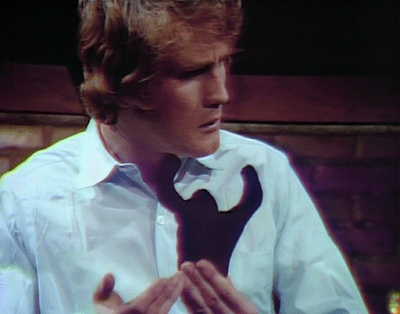
Jabe has no idea how this could be. Angelique thinks aloud for a moment about keeping him guessing, then decides she may as well tell him. She instructs him to look into the fire. When he does, he has a vision of himself asleep in bed (fully clothed, of course, it’s Collinsport) when a shadow in the form of Angelique’s cutout appears, engulfs him, and makes him scream. We cut back to the carriage house, where Jabe keeps telling Angelique that she while she may be able to make him have visions, she can’t cause such a thing to happen in reality. She assures him she can.
The carriage house is a cottage in the woods, so in this scene Angelique combines the roles of the wise woman who explains the shadow curse to Anodos and the ash tree that places it. The cutout is a much sillier visual than was the image Anodos saw in chapter four of Phantastes, when his curse began:
When [the Moon] shone out again, with a brilliancy increased by the contrast, I saw plainly on the path before me—from around which at this spot the trees receded, leaving a small space of green sward—the shadow of a large hand, with knotty joints and protuberances here and there. Especially I remarked, even in the midst of my fear, the bulbous points of the fingers. I looked hurriedly all around, but could see nothing from which such a shadow should fall. Now, however, that I had a direction, however undetermined, in which to project my apprehension, the very sense of danger and need of action overcame that stifling which is the worst property of fear. I reflected in a moment, that if this were indeed a shadow, it was useless to look for the object that cast it in any other direction than between the shadow and the moon. I looked, and peered, and intensified my vision, all to no purpose. I could see nothing of that kind, not even an ash-tree in the neighbourhood. Still the shadow remained; not steady, but moving to and fro, and once I saw the fingers close, and grind themselves close, like the claws of a wild animal, as if in uncontrollable longing for some anticipated prey. There seemed but one mode left of discovering the substance of this shadow. I went forward boldly, though with an inward shudder which I would not heed, to the spot where the shadow lay, threw myself on the ground, laid my head within the form of the hand, and turned my eyes towards the moon. Good heavens! what did I see? I wonder that ever I arose, and that the very shadow of the hand did not hold me where I lay until fear had frozen my brain. I saw the strangest figure; vague, shadowy, almost transparent, in the central parts, and gradually deepening in substance towards the outside, until it ended in extremities capable of casting such a shadow as fell from the hand, through the awful fingers of which I now saw the moon. The hand was uplifted in the attitude of a paw about to strike its prey. But the face, which throbbed with fluctuating and pulsatory visibility—not from changes in the light it reflected, but from changes in its own conditions of reflecting power, the alterations being from within, not from without—it was horrible. I do not know how to describe it. It caused a new sensation. Just as one cannot translate a horrible odour, or a ghastly pain, or a fearful sound, into words, so I cannot describe this new form of awful hideousness. I can only try to describe something that is not it, but seems somewhat parallel to it; or at least is suggested by it. It reminded me of what I had heard of vampires; for the face resembled that of a corpse more than anything else I can think of; especially when I can conceive such a face in motion, but not suggesting any life as the source of the motion. The features were rather handsome than otherwise, except the mouth, which had scarcely a curve in it. The lips were of equal thickness; but the thickness was not at all remarkable, even although they looked slightly swollen. They seemed fixedly open, but were not wide apart. Of course I did not remark these lineaments at the time: I was too horrified for that. I noted them afterwards, when the form returned on my inward sight with a vividness too intense to admit of my doubting the accuracy of the reflex. But the most awful of the features were the eyes. These were alive, yet not with life.
They seemed lighted up with an infinite greed. A gnawing voracity, which devoured the devourer, seemed to be the indwelling and propelling power of the whole ghostly apparition. I lay for a few moments simply imbruted with terror; when another cloud, obscuring the moon, delivered me from the immediately paralysing effects of the presence to the vision of the object of horror, while it added the force of imagination to the power of fear within me; inasmuch as, knowing far worse cause for apprehension than before, I remained equally ignorant from what I had to defend myself, or how to take any precautions: he might be upon me in the darkness any moment. I sprang to my feet, and sped I knew not whither, only away from the spectre. I thought no longer of the path, and often narrowly escaped dashing myself against a tree, in my headlong flight of fear.
The Visionary Novels of George MacDonald: Lilith and Phantastes, edited by Anne Fremantle (Noonday Press, 1954) pages 284-286
The only images of the sky we ever see on Dark Shadows are stock footage and stills; a massive translucent figure looming in front of the moon, an immense shadow itself casting a shadow on the ground below, is far beyond anything they have attempted. So we can understand why they decided to go to the opposite extreme, and try to build an initially unprepossessing prop into something powerful. Moreover, the show at this point has an audience consisting very largely of elementary school students, so the sight of a major character using scissors to trim a figure out of construction paper will be relatable.
The shadow that follows Anodos does not develop the ability to cause physical harm to him. It wears him down psychologically, and is the Reverend MacDonald’s allegory for anxiety resulting from sin. Jabe’s vision tells us that this story will deviate from the source material, and that his shadow will grow in size and intensity until it kills Jabe.
Of course, a story about a dark shadow involves the show making reference to its own title. Around the time Dark Shadows was on the air, it was a fad for teenagers in movie theaters to cheer whenever a character said the title of the film. I wonder if the appearances of Jabe’s unwanted companion prompted many members of the original audience to cheer.
Closing Miscellany
There is a moment that may not mean much to first-time viewers, but that will astonish confirmed fans. Jabe goes into the drawing room of the great house of Collinwood. Matriarch Elizabeth Collins Stoddard introduces him to Angelique, whom she knows only as a fellow rich lady. When Liz starts telling Jabe about Angelique’s stately home, Angelique volunteers that Jabe has been there and that he is close to her husband. Throughout the preceding 193 weeks, characters have been able to count on their enemies to keep their secrets for them. Disclosing information relevant to the plot to Liz is particularly inconceivable, even in the most desperate circumstances. When Angelique disregards these rules, she is going so far against the grain that my wife, Mrs Acilius, wondered for a second if Lara Parker had decided to throw the script away and blow up the show.
Today marks the final appearance of two actors on Dark Shadows. Roger Davis first appeared in #404 as an unpleasant man named Peter Bradford; today he is Peter’s ghost. Mr Davis played several other parts in the interval, all of them selfish, handsy men with an irritating habit of shouting their lines in a voice rising, not from the diaphragm, but from tightened rectal sphincters. Making matters even worse, Mr Davis is a highly trained, accomplished actor who is capable of doing excellent work. Once in a rare while, he deigns to put his skills to use on Dark Shadows, and he was part of one or two of the best scenes on the show. But most of the time, he chooses to put all of that aside and instead assaults his female scene partners on camera and subjects us to his unvarying anal screech. When Angelique dismisses him, we forgive her all her past misdeeds. Mr Davis will be back as the juvenile lead in the feature House of Dark Shadows, but at least we no longer have to dread 4:00 PM on weekdays.
Christopher Bernau also makes his departure as Philip Todd, Jabe’s onetime foster father. The part of Philip didn’t give Bernau much to work with, and he compounded the difficulties by playing him as if he were Jack Benny. But Bernau, too, was a very capable actor, and he was a true professional. A few times he has shown us what he can do, and he will be missed. Later in the 1970s Bernau achieved fame in two parts that harked back to Dark Shadows. He played Dracula on Broadway in 1977. That same year, he joined the cast of The Guiding Light as womanizing rogue Alan Spaulding, a part he played for several years until his death, of AIDS, in 1989. I reminisced about Bernau’s Alan Spaulding on Danny Horn’s great Dark Shadows Every Day:
I was a kid when Bernau joined GUIDING LIGHT. My mother watched that show, and I had several times attempted to watch it with her, but it always defeated me after 5 or 10 minutes. It just seemed like a window into the deepest level of Hell, the frozen cavern where absolutely nothing happens. But Bernau caught my imagination. I could watch entire episodes if he was in them.
Years later, when I watched DARK SHADOWS on the Sci-Fi Channel, I realized what made Bernau so compelling on GUIDING LIGHT. He was doing a Jonathan Frid imitation. Within moments of first seeing Barnabas, I exclaimed “Alan Spaulding!” It was only years later that I learned Bernau had been on DARK SHADOWS.
Comment left 10 December 2020 by Acilius, on Danny Horn, “Episode 888: Little Shop,” 26 June 2016, Dark Shadows Every Day.
Alan Spaulding was such a hit for Bernau that there can be no doubt a Jonathan Frid imitation was a better starting place for him than was a Jack Benny imitation, at least in daytime.
The closing credits run over a view of the landing at the top of the foyer stairs. We see this space straight-on, an unusual angle. Typically they tilt the camera way back and look up at it. Perhaps they are showing off some new equipment.
*I first heard of Phantastes from a January 2022 episode of God and Comics, a podcast that three Episcopal priests did until shortly after one of them flaked off and became a Roman Catholic. When they talked about Anodos’ shadow, I wished I had a Dark Shadows blog, so I could tell people about the connection to this story.
My copy of The Visionary Novels of George MacDonald is one I came across at a charity book sale in May of 2025. I’ve had it on the table next to the spot where I sit when I write these posts ever since. It isn’t my kind of writing. I usually enjoy dry, matter-of-fact prose, while MacDonald was rarely less florid than in the passages above. Besides which, MacDonald was a sometime clergyman whose evangelistic zeal led even the Reverend Misters hosting God and Comics to admit that his books reminded them too much of their day jobs for their taste. For my part, I say there’s a place for everything, and the proper place for MacDonald’s heavy-handed style of preaching is a pulpit in a church I don’t attend.
**As the saying goes, people who call Twitter “X” would have turned you in to the Stasi.



 Dark Shadows Commentary