
Episode 811: A man’s investment in the future

In #797, the ghost of Rroma maiden Julianka appeared and placed a curse on her fellow grievous ethnic stereotype, Magda Rákóczi. Julianka blamed Magda for her death, and decreed that everyone Magda loved would die. Today, Magda is trying to prevent Julianka’s curse from taking the life of her desperately ill infant niece Lenore, daughter of her late sister Jenny. Magda goes to Lenore’s crib in company with Lenore’s father, Quentin Collins. Magda and Quentin try to conjure up Julianka’s ghost to plead for Lenore’s life, but instead they get the ghost of another Rroma woman- Jenny.

Jenny assumes physical form. She picks up Lenore and sings the lullaby “All the Pretty Little Horses.” We’ve heard Jenny sing this almost every time she has been on the show. It appears to be the only song she knows. For his part, Quentin has a phonograph and only one record, which he plays obsessively over and over. When they lived together, their home must have been a pretty grim place, playlist-wise.

Jenny lifts Lenore’s illness, and says that if Quentin looks into his heart he will know what he must do to ensure that Lenore has a bright future. She vanishes, and Quentin mutters dismissively at the idea that his heart will be a source of useful information.

Later, Quentin will have a dream while sleeping in the drawing room at the great house on the estate of Collinwood. Jenny visits and tells him that he must have nothing to do with Lenore and that she must grow up far from Collinwood. So far, dream sequences on Dark Shadows have always represented visits from the supernatural, but this one might be an exception. Jenny did say that the information Quentin needed to help Lenore was already in his heart. He is clearly not the stuff of which good fathers are made, and as Jenny explicitly says in the dream no one has ever been happy at Collinwood. So the advice she gives does seem to be correct. Perhaps this is just Quentin’s own knowledge taking a shape he can recognize.

Quentin goes on dreaming that his brother Edward is choking him. He wakes up to find that Edward is in fact choking him. This might seem like a prophetic dream, but it too might just be a natural expression of Quentin’s own unprocessed knowledge. Edward, because of a magic spell not directly connected with today’s events, is under the mistaken impression that he is a valet formerly in the service of the Earl of Hampshire. Quentin has followed the Collinses’ long-established protocol for dealing with mentally ill family members, and locked Edward up in the room on top of the tower in the great house. He knows this makes Edward miserable, and it is reasonable to suppose that he would expect Edward to express anger about it. Strangulation is Quentin’s own preferred method of expressing anger, especially towards members of his immediate family, so it can’t have been hard for him to see that coming.

Edward’s motivation is not as simple as Quentin’s would be if their positions were reversed. The evil Gregory Trask has been visiting Edward in the tower room, and has told him that Quentin is determined to keep him imprisoned in that room forever. He asks him to kill Quentin. Edward apparently has decided to comply.

Earlier in the episode, Edward had been more punctilious about cooperating with Trask. Trask presented him with a document to sign, promising that by signing it he would secure his freedom. Edward read the document, even after Trask very loudly insisted that it was unnecessary to do so. When Edward saw that it involved making Trask guardian of his son, Edward protested that he had no son. Trask said that this did not matter, but Edward would not be moved. Edward later tells Quentin about this encounter.

The tower room is a re-dress of the set used as the bedroom of strange and troubled boy David Collins in the parts of Dark Shadows set in the 1960s. Today it includes the bed from that set, and we see Edward trying to sleep in it. This is a powerful image for longtime viewers. Louis Edmonds plays Edward in this costume drama segment and David’s father Roger in contemporary dress. Edward is the father of Jamison, who like David Collins is played by David Henesy. Not only has the spell robbed Edward of the memory of Jamison and of his role as a father, it has reduced him to curling up in a bed made for a boy rather than a man.
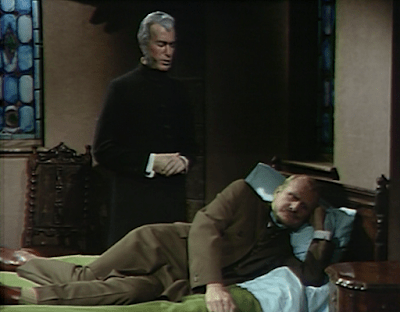
Edward in the child’s bed. Screenshot by Dark Shadows Before I Die.

Roger was, for the first year of Dark Shadows, a spectacularly bad father. He openly hated David and exploited David’s miseries to try to manipulate him into doing his own criminal dirty work. He was indifferent to the family’s name and the fate of its businesses, would go to any lengths to hide from the consequences of his actions, had killed someone, and was an alcoholic. Edward shares none of these shortcomings. On the contrary, he goes to the opposite extreme. He is as brave as Roger is cowardly and tenderly loves his children, Jamison and Nora. But he is also stuffy, name-proud, and money-grubbing. The contrast with Roger shows these failings, not simply as negatives, but as the overgrowth of the virtues that separate Edward from Roger. Though Louis Edmonds and Jerry Lacy are such accomplished comic actors that Edward’s scenes with Trask are funny enough to be worthy of a staging of the Jeeves and Wooster stories, Edward’s loss of his identity as father of Jamison and Nora is a genuine tragedy.

Quentin is fond of Jamison, and once he learns that his children exist he seems to wish them well. Nonetheless, he shares most of the other vices of early Roger. As Edward shows us what Roger might have been had he had stronger moral fiber, Quentin is Roger with his vices magnified by black magic. When Jenny tells Quentin that he must not raise Lenore, longtime viewers remember Roger as he was when first we knew him, and remember how grim David’s future seemed at that time. It was only after well-meaning governess Vicki became the chief adult influence in his life that we could have hopes for David. So we cannot doubt that Jenny is right.

This is the last of 21 episodes of Dark Shadows directed by executive producer Dan Curtis. When Curtis first took the helm in #457, he had no experience as a director, and it showed. But he learned very quickly. This one looks great and the scenes play very smoothly. He would later direct the feature films House of Dark Shadows and Night of Dark Shadows, as well as six episodes of the 1991 prime time revival of Dark Shadows and many other productions.

Episode 810: Not with pity

Charity Trask is in the drawing room of the great house on the estate of Collinwood trying to call the police when her abusive step-uncle, Quentin Collins, comes out of a secret panel and takes the telephone from her. He tells her that there is no longer any point in telling the police about Tessie, the injured woman upstairs. Tessie won’t be telling them anything. She has died. Apparently the sheriff of Collinsport is the same in 1897 as are his counterparts in other periods when Dark Shadows has been set- if you’re already dead, it’s too late for them to take an interest in you.

Charity says that Quentin killed Tessie. Charity knows that Quentin is a werewolf. He locks the door to the room and asks “Are you afraid to be locked in alone with a beast, a murderer, a creature of the supernatural?” This would seem to be rather an odd question, especially since he spent yesterday’s whole episode threatening to kill her.

Charity says that her father, Gregory Trask, will see to it that Quentin is brought to justice. Quentin takes a paper from his pocket and shows it to Charity. It is a confession to the murder of Charity’s mother, signed by her father. Charity claims that it was fabricated by Satan, which is what her father told her when she first saw it, and that Trask repeatedly tried to destroy it. This only convinces Quentin that the confession is true. He says that if either Charity or her father tells the police about him, he will hand over the paper. He adds “Now, Charity, I may hang for murder, but your father will be dancing at the end of a rope, too.”

Dark Shadows is set in the state of Maine, which in our universe abolished capital punishment in 1887. That used to be true in the show’s universe, as well. In #101, broadcast and set in November 1966, high-born ne’er-do-well Roger Collins told his son, strange and troubled boy David, that “They don’t hang people anymore. Not in this state, anyway.” But by the time the show left the 1960s for its first costume drama segment a year later, characters were already afraid of being sentenced to death. The morbid fascination of the gallows is so much of a piece with the show’s exaggerated melodrama that there must be a death penalty, no matter when or where the action is supposed to be taking place.

Quentin tells Charity that there is a chance- a small chance, he concedes- that he will be cured of lycanthropy before the next full Moon, so that she need not feel that she is an accessory to murder if she doesn’t turn him in right away. Miserable, frightened, and confused, she takes this seriously enough that she remains quiet at least through this episode.

We cut to a hiding place where a man known as Aristide is looking at himself in a mirror and primping his hair, moving his fingers through it with an exaggerated daintiness. We pan to broad ethnic stereotype Magda Rákóczi , who impatiently asks “Did you send for me so there would be two of us to admire you?” Aristide has some business to discuss relating to plot points not directly involved in this episode, and he and Magda trade menacing insinuations about the danger each faces from the various supernatural forces at work in the area. Magda says that what the ziganophobic Aristide calls her “Gypsy cunning” will protect her, and Aristide says that an amulet he wears around his neck will protect him.

Magda replies “All right, we’ve both got something to protect us. I go now,” and starts to leave. Aristide stops her, and says that she must recover the severed hand of Count Petofi. She says that a man named Tim Shaw stole the hand and ran off with it, and she has no way of knowing where Tim is. Aristide says she must find out and bring it soon, “before time runs out.” She asks “Before time runs out for who? You mean when Petofi comes back!” In fact, Aristide means more than that- his master, 150 year old sorcerer Count Petofi, will die in a matter of days unless he is reunited with the hand that was cut from his right arm a century before, in 1797. If he does recover the hand in time, he will become immortal. Magda fears Petofi and hates him, and would doubtless make any sacrifice to keep the hand away from him if she knew these were the stakes. So Aristide is mortified that he let slip the phrase “before time runs out,” and is anxious to avoid saying anything else.

Back at Collinwood, Quentin confers with a Mrs Fillmore. Mrs Fillmore has been looking after the twin children Quentin’s wife Jenny bore him after he left her and before he murdered her. This is the first time we have seen Mrs Fillmore. It is also the first confirmation we have had that Quentin has seen Mrs Fillmore. He didn’t know about the twins until #798, when the boy twin was already dead as the result of a curse that a woman named Julianka placed on Magda, who is Jenny’s sister. Now Mrs Fillmore tells Quentin that the girl is suffering the same symptoms the boy showed before he died, and that the doctor is at a loss what to do for her. Quentin says he will look for someone who might be able to help, and they both exit.

Charity is alone in the drawing room, making an earnest effort to get drunk. Magda enters and expresses surprise that the unbendingly prudish Charity has been drinking. Charity replies that she merely ate some chocolates that were filled with brandy. At the sight of an empty snifter, she says that after eating the chocolates she poured herself a small brandy. She then picks up and drinks another, regular-sized brandy. Charity starts talking about how terrible life at Collinwood is. Magda mentions Tim Shaw, who was once Charity’s fiancé and who was framed for her mother’s murder. Charity wonders if Magda can use the Tarot cards to find Tim and bring him back. She asks if Tim will have to tell the truth if he comes back, and Magda assures her that he will. Magda may assume that the truth Charity wants is about the end of her relationship with Tim; she does not know that Charity is desperate to revert to believing that Tim, not her father, murdered her mother.

Magda asks Charity to tell her as much as she can about Tim. Charity says that when Tim was a boy, his closest friend was named Stephen Simmons, and that “He and Stephen Simmons used to always say they would go to San Francisco when they grew up.” Magda asks where Stephen Simmons is now, and Charity says she thinks he lives in Worcester, Massachusetts. She goes to her bedroom to look for a Christmas card Stephen sent her last year, hoping it may have his current address.

Quentin returns and finds Magda. He asks Magda how she knew about his daughter. She asks what he means. When Quentin tells her that the girl is suffering the same symptoms that her brother showed immediately before his death, they rack their brains to come up with a potential defense against Julianka’s curse. Magda remembers Aristide’s amulet. It is capable of warding off vampires and witches- perhaps it will defend against Julianka as well. Magda tells Quentin where Aristide is hiding, and he decides to go to Aristide and rob him of the amulet.

Aristide is asleep when Quentin arrives. He awakens before Quentin can take the amulet, and declares “This pendant protects me from witches, warlocks, and unnatural spirits.” Quentin asks “How does it do against flesh and blood, Aristide?” Aristide draws a curvy piece of wood with no sharp edges and replies “For flesh and blood, I have The Dancing Lady.” The piece of wood is supposed to be a knife. When Aristide first displayed it in #792, he called it “The Dancing Girl.” Perhaps this is a case of Soap Opera Rapid Aging Syndrome, and in a couple of weeks it will be The Dancing Dowager, then The Dancing Crone. At any rate, Quentin replies “Then let her dance, Aristide, let her dance.” Quentin wins the subsequent fistfight. He knocks Aristide senseless, then takes the amulet from him.

Quentin and Magda go to Mrs Fillmore’s house, the first time we have seen this set. Appropriately for a member of the Collins family, the baby sleeps in a cradle shaped like a coffin.

Collins coffin cradle. Screenshot by Dark Shadows Before I Die.

Quentin talks with Mrs Fillmore about little “Lenore,” a name we have not heard before today. The only other girl of Lenore’s generation in the Collins family is the daughter of Quentin’s brother Edward, and she is named Nora. Since the name “Lenore” became popular outside Greece because speakers of English and French thought it was an alternative form of “Nora,” that would suggest rather a limited imagination regarding girl’s names on the part of whoever chose them.

But it is appropriate that Quentin and Edward have children with similar names. They are two variations on Dark Shadows’ first archvillain, Roger, whose evil largely expressed itself in his amazingly bad parenting of David. Edward’s attentive and caring interactions with Nora and her brother Jamison show that he is a less villainous Roger, while Quentin’s frequent assaults on his adult family members are among the evidence that he is an even worse version of the same character. Jamison is the only child we have seen Quentin interact with, and he is fond of him. But while we were still in the 1960s, Quentin’s ghost was possessing and killing the children at Collinwood, and in #710, only two weeks into the 1897 flashback, he and his fellow Satanist Evan Hanley used Jamison as a “sacrificial lamb” in a ritual meant to exploit his innocence for their own sinister purposes. Clearly, Quentin is no more to be trusted with the care of a child than was the early Roger.

Quentin asks Mrs Fillmore to leave him and Magda alone with Lenore. They apply the amulet, and it does not seem to work. Magda tries to raise the spirit of Julianka. After some pleadings and whatnot, there is thunder, wind, and other signs of ghostly presence. Magda cries out in hope that Julianka has come with pity. A figure materializes and says “Not with pity, Magda.” But the figure is not Julianka. It is Jenny.

In #804, we saw a photograph of Jenny in Quentin’s room. It was a full length picture in a period-appropriate costume, not just Marie Wallace’s professional headshot, raising a hope that we would see Miss Wallace again before too long. But after a week and a half, those hopes had begun to fade. Perhaps they took the picture months ago and never got around to using it when Jenny was on the show. If they had done that, they wouldn’t be above sticking in a scene of Quentin looking at the picture and discussing it with his distant cousin Barnabas the vampire so that they could get their money’s worth out of it. When Miss Wallace does in fact return, the show sends us out on a high note.