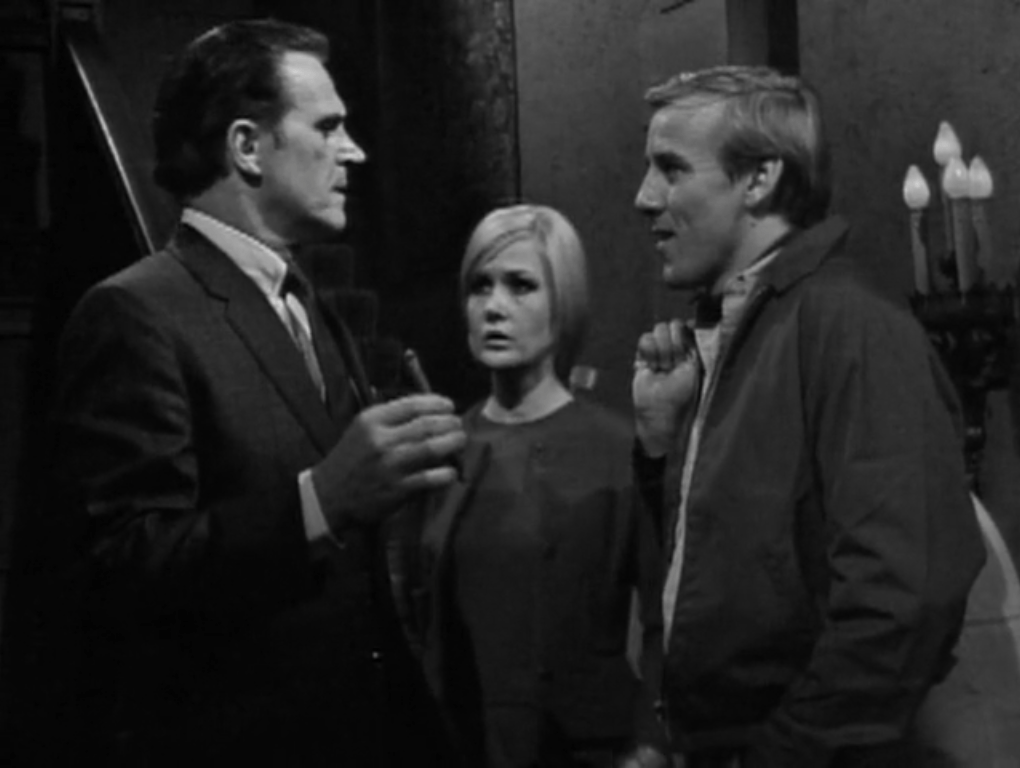
Episode 271: A secret you had no right to keep

A wedding is being held in the drawing room of the great house at Collinwood. Matriarch Liz is marrying seagoing con man Jason. Carolyn, Liz’s daughter by her first husband, Paul Stoddard, has a pistol in her purse, which she is planning to use to shoot Jason before the ceremony can be completed. Well-meaning governess Vicki is distressed, because Liz confided in her in #259 that she is marrying Jason only because he is blackmailing her. Liz killed Stoddard long ago and Jason buried the body in the basement, facts he will reveal if she does not comply with his demands. The other guests hate Jason, but they share neither Vicki’s understanding of the situation nor Carolyn’s sense of initiative, so they just stand around and scowl.

When the judge asks Liz if she takes Jason to be her lawful wedded husband, she exclaims that she cannot. She points to him and declares “I killed Paul Stoddard and that man was my accomplice.” Carolyn drops the gun, Vicki flashes a defiant look at Jason, and everyone else is stunned.

Vicki triumphant

The judge excuses himself. He claims that he might be required to act as a judicial officer in a case that could arise from what Liz is about to say. That may not make sense in terms of the laws or canons of judicial conduct actually in effect in the State of Maine in 1967, where what he has already heard would be far too much to avoid being called as a witness. But it fits nicely with the logic of Soap Opera Law, in which neither the police nor the courts may be notified of any criminal matter until the prime suspect has completed his or her own investigation.

Carolyn says “You killed my father.” Before Liz can say much in response, Carolyn announces that she was about to kill Jason. Vicki’s boyfriend, Fake Shemp Burke Devlin, finds Carolyn’s gun. For some reason, Burke holds the gun up. He points it at whomever he is facing. When Jason announces he will be leaving the room, Burke is pointing the gun at him and forbids him to go. Again, giving orders to a person on whom you have a deadly weapon trained may be a felony in our world, but it is all well and good under Soap Opera Law.

Liz mentions that Vicki already knows that she killed Stoddard and that Jason has been blackmailing her. This prompts Liz’ brother Roger to tell Vicki “That was a secret you had no right to keep.” Liz responds that, had Vicki told anyone, she would have denied it and sent her away. Liz then describes the events of the night eighteen years before when she and Stoddard had their final showdown. We see them in flashback, on this same set.

Stoddard told Liz he was leaving her, never to return. She replied that she did not object to his going, but that the suitcase full of bonds, jewels, and other valuable assets he was planning to take was Carolyn’s property and would have to stay.

When the show started, just over a year ago, Stoddard’s disappearance had been 18 years in the past. So it still is, moving its date from 1948 to 1949. At that time, Stoddard was last seen six months before Carolyn was born. Later, they would say she was a newborn when her father vanished. In the flashback today, he answers Liz’ assertion of Carolyn’s right to the contents of the suitcase by saying that he has been putting up with the child for two years. We saw her birth-date as 1946 the other day, so apparently they are planning to stick with the idea that she was a toddler when Stoddard was last seen.

Stoddard and Liz quarrel over the suitcase. He confirms that he and his friend Jason have a plan to convert its contents into a big bundle of cash. He is walking away from her when she takes a poker from the fireplace and hits him on the back of the head. This may be another deed entirely unjustifiable by real-world law, but under Soap Opera Law any act committed against a man who openly despises his two-year old daughter and tries to steal from her is outside the jurisdiction of the courts.

Stoddard fell to the floor, bled, and remained very still after Liz hit him. Shocked by what she had done, she reeled out of the drawing room and closed the doors behind her. As she stood in the foyer wishing she were dead, Jason entered the house. Liz sent him into the drawing room to look at Stoddard. He came out, told her Stoddard was dead, and offered to bury him for her. After all, everyone in town knew he was leaving- there need be no scandal to cloud Carolyn’s future.

Liz asks why Jason wants to help her- he was Stoddard’s friend, planning to help Stoddard steal from her. Jason explains that Stoddard is beyond help now. Liz goes along with his plan.

In this flashback, Jason’s Irish accent is convincingly realistic. It sounds like he’s from Antrim, or someplace else in Norn Iron. That’s a contrast with what we’ve heard so far, when he’s been more than a little reminiscent of this guy:

Hearts, moons, clo-o-overs

My in-universe, fanfic theory is that Jason hadn’t been home or spent much time with other Irishmen in the years between 1949 and 1967, and so his accent drifted into a music hall Oyrish. My out-of-universe theory is that Dennis Patrick spent some time with a dialect coach after joining the show, but by the time he had learned to sound plausible Jason’s silly accent was already such an established part of the character that he couldn’t change it.

When Jason was done with his work downstairs, he showed Liz the storage room where he buried Stoddard in the floor. We got a long, long look at that floor in #249, when it was clean and tidy and there were many boxes and crates on it. When Jason left it to Liz “18 years ago,” there was dirt piled up all over the floor, a shovel in the corner, and few boxes or crates. Evidently Liz cleaned it up herself and organized its contents at some point. That doesn’t fit with the idea she had before #249, that a person entering the room would immediately discover her secret. Since Liz had often gone into the room in the early months of the show, it never had made sense she would believe such a thing, but it is annoying to be reminded of it.

In voiceover, Liz tells us that when Jason left her with the key to the room she knew she would be a prisoner of the house forever. The episode then ends, after less than 18 minutes of scripted content. That’s the shortest installment so far. The closing credits roll slowly, so slowly that they run out of music. The names scroll by in silence for 25 seconds before ABC staff announcer Bob Lloyd says “Dark Shadows is a Dan Curtis production.”

That cannot have been Plan A. This episode has eight speaking parts, two segments of events set in different decades, voiceover narration, a costume change, etc. So there was plenty of stuff that might have proven impossible in dress rehearsal, requiring a quick rewrite that might have left them running a little short. But they’ve been ambitious before, and have never ended up like this. So I suspect that the late script change that got them into trouble was more complicated than that.

Art Wallace’s original story bible for Dark Shadows, titled Shadows on the Wall, called for the mystery of Vicki’s parentage to be resolved at the same time as the blackmail plot. Wallace’s first idea was that Vicki would be shown to be the illegitimate daughter of Paul Stoddard, and that Liz’ interest in her well-being began with guilt after she responded to the news of Vicki’s existence by attacking Stoddard. Wallace also said that if it were more story-productive, they could say that Vicki was Liz’ illegitimate daughter.

Casting Alexandra Moltke Isles as Vicki committed them to that second course of action. Famously, when Joan Bennett first saw Mrs Isles on set she mistook her for her daughter, and the show has often capitalized on their resemblance to present Vicki as a reflection of Liz. For example, notice how the two women stand in this shot from today’s episode:

Pay particular attention to their legs- it’s the same posture

Moreover, the ghost of Josette Collins took a lively interest in Vicki in the first 39 weeks of the show, and Josette is specifically a protector of members of the Collins family. If Vicki is Paul’s illegitimate daughter, she is not a Collins and not linked to Josette.

The only advantage we’ve ever seen of establishing Vicki as a non-Collins would be the possibility of a romance between her and Roger. Since Vicki the foundling-turned-governess is Jane Eyre and Roger the father of her charge is Mr Rochester, this is an obvious direction to go. The show took a few feints towards such a relationship in the early days, but those clearly led nowhere. Vicki came to town in #1 on the same train as Burke, so they are fated to get together. Roger and Burke openly hate each other and often seem to secretly love each other, making for a potentially explosive love triangle if Vicki comes between them, but neither Roger and Burke’s much-advertised enmity nor their barely concealed homoerotic connection ever developed into a very interesting story. The whole thing fizzled out completely months ago. So there doesn’t seem to be a point in resolving the question of Vicki’s parentage any other way than with Liz admitting maternity.

So the first question is, when did they decide that this episode would not include that admission? The short running time would seem to suggest that it was only a few days before taping.

The second question is, why did they make that decision? Liz’ line today that she would fire Vicki if she had betrayed her secret, coupled with all the remarks she has been making to Vicki in the last few weeks about how Carolyn is the one and only person she really cares about, would suggest that the producers and writers are thinking of moving away from the idea of Vicki as Liz’ natural daughter. But the directors are still committed to it, as are the actresses.

We begin to suspect that the producers and writers are hoping that the viewers who have joined the show since the vampire came on in April won’t care about Vicki’s origin, so that they can just drop the whole thing. Since the only storylines they have going are the blackmail arc, which Liz is bringing to its end with her confession today, and the vampire arc, in which nothing at all is happening at the moment, you might think they would be glad to fill some screen time with Vicki and the rest of them reorienting themselves around a newly revealed family relationship. But, maybe not!

Episode 202: You and I wouldn’t be friends

There is only one ongoing story on Dark Shadows right now, and it doesn’t seem to have much of a future. Seagoing con man Jason McGuire is blackmailing reclusive matriarch Liz, threatening to reveal that she killed her husband Paul Stoddard eighteen years ago and that he buried Stoddard’s body in the basement of the great house of Collinwood. Not only was all of that clear when Liz and Jason had their first conversation several days ago, but yesterday we heard Jason on the telephone making it clear that he is bluffing. If Liz calls the police, he will get out of town as fast as he can. So whatever Liz does in response to Jason’s so-frequently repeated threat, the story can go only so far before it reaches a dead end.

Looking at Jason, audiences at the time would have recognized actor Dennis Patrick as a frequent guest star on prime time television shows and might have suspected that he was too big a name to stay on a daytime soap opera for very long. They would not have known that Patrick always made it a point to have an end date in place anytime he agreed to guest on a soap or that when he played Jason he did not have a contract, and was free to walk away any time he wanted. Seeing him share so many scenes with Joan Bennett, who had been a major movie star for a number of years, they might have thought it was possible he could stick around, but the show so quickly burned through what little story the two of them had that it wouldn’t have seemed likely.

So, what comes next? Alexandra Moltke Isles’ opening voiceover, delivered as always in character as well-meaning governess Vicki, gives us a hint:

My name is Victoria Winters. The foundations of Collinwood house a frightful secret, a secret that has lain dormant for eighteen years, a secret awakened by a stranger. But there is another stranger, one who is to awaken and unleash a force that will affect the lives of everyone.

This other stranger is Jason’s henchman, dangerously unstable ruffian Willie Loomis. At the beginning of this episode, Willie is drinking at the bar in Collinsport’s only night spot, The Blue Whale. There are three other customers in the tavern, an old man at the bar and a young couple in the background* bowing to each other at irregular intervals. If we assume, as I suppose we must, that these movements represent an attempt at dancing, we might wonder if the force Willie is destined to awaken and unleash is choreography.

Maggie Evans, The Nicest Girl in Town, enters. She looks around for a long moment, then slowly makes her way to a table. Willie tells Bob the bartender he wants to buy Maggie a drink. Bob goes to her table, and we see them have a conversation in the course of which Bob gestures to Willie and Maggie shakes her head no. When Bob returns to the bar, Willie tells him that “A good bartender wouldn’t have asked any questions!” Not even what kind of drink the lady would like, apparently. So maybe he’s going to awaken and unleash the force of unconsumed beverages.

Willie goes to Maggie’s table and sits down. When she protests that she’s waiting for someone, he sneers that no one tells him where to sit.** As Willie, James Hall is doing a great job of establishing himself as a clear and present danger to everyone he meets. Maybe Willie was right about one thing- a good bartender would notice Maggie’s discomfort and order Willie out of the bar. It’s obvious that Willie wants to awaken and unleash the force of sexual assault.

Maggie’s boyfriend, hardworking young fisherman Joe, enters. Willie refuses to leave the table and tells Joe to go wait at the bar. Joe squares up for a fight. He and Willie are about to start throwing punches when Jason comes into the bar and commands Willie to back off. At that, Willie awakens and unleashes the force of doing as he is told.

Jason apologizes to Maggie and Joe for Willie’s behavior and tells Bob he wants to treat everyone to a round of drinks. Joe mentions that Maggie’s father, drunken artist Sam, will be sad he missed a free drink. Maggie says that Sam won’t be drinking tonight, because New York art dealer Portia Fitzsimmons is pressing him for more paintings. Evidently Sam will be working more and drinking less now that he is no longer connected to any ongoing storyline.

At the bar, Willie complains to Jason that he’s come to help him, but hasn’t got any money out of the operation yet. Jason gives him some cash and tells him to be patient. The time has not yet come for Willie’s brawn to complement Jason’s brains.

Hall’s Willie does not spend any time processing his emotions or any energy concealing them. When he is getting ready to fight, he displays unfiltered rage; the instant he has to forgo the idea of beating up Joe and raping Maggie, he lowers his eyes and a look of deepest despair comes over him. Much as we hate Willie when he is menacing our friends, the transparency and intensity of his feelings makes it easy to watch him when he is feeling sorry for himself. Why is this strange, horrible man the way he is, and what will he do next? So when he awakens and unleashes the force of whining, it proves to be a strong enough force to keep us watching for a few minutes.

Those are good minutes for Dennis Patrick as well. Monotonous as Patrick’s scenes with Joan Bennett were, his scenes with other members of the cast usually had some element of unpredictability. We don’t know what is going on between Jason and Willie, and Jason himself doesn’t really know what Willie is going to do from one moment to the next. So it’s fun to watch Jason scramble to keep his associate in line. Also, we have a chance to root for Jason, at least for the duration of his two shots with Willie, since his control over Willie is what prevents violence against characters we care about.

Jason’s remark about Willie’s brawn raises the question of what exactly he wants Willie for. Liz is giving Jason everything she has, bit by bit, in response to his blackmail. If that is the whole plan, there doesn’t seem to be any need for brawn at all. Of course, Hall is a short, slender man, so much so that only his well-realized portrait of a violent felon keeps Willie’s confrontation with the substantially taller and more muscular Joe from looking ridiculous. Only Jason’s intervention prevented Willie from awakening and unleashing the force of badly losing a bar fight. Still, we keep wondering what the next phase of Jason’s evil plan will be.

Back at Collinwood, Jason is in the study, smoking a fine cigar. Flighty heiress Carolyn enters, and remarks that the cigar is one of her Uncle Roger’s favorites. Jason says that he knows of even finer cigars, and says that his whole philosophy of life is finding the good things and squeezing whatever he can out of them. Carolyn agrees that he has described himself well, neither hiding her disgust nor disturbing his complacent attitude.

Jason has identified himself as a friend of Carolyn’s father, the long-missing Paul Stoddard. Carolyn explains that she knows very little about her father, and asks Jason to tell her about him. He doesn’t really tell her anything she doesn’t already know, but does remark that “Paul Stoddard and I were very much alike.” He delivers that line in a way that suggests it might become significant. Once Carolyn gets up to go, Jason assures her that he does have stories about Stoddard to tell her some other time. Once she is gone and we are wondering if he really knew Stoddard at all, he steals three more of Roger’s cigars.

When we were watching this episode, my wife, Mrs Acilius, surmised that Carolyn asked Jason about her father less because she wanted to learn about him than because she wanted to figure Jason out. It is strange that she follows her obvious disapproval of Jason’s “philosophy of life” with “I never knew my father…,” unless it is a ploy to get Jason to talk about himself. And indeed, he does tell her far more about himself than about Stoddard. So that may well have been on Nancy Barrett’s mind when she was playing the scene.

A knock comes at the front door. Carolyn opens it to find Willie, identifying himself as a friend of Jason’s and announcing that he has decided to accept Jason’s invitation to stay at Collinwood. Jason is crestfallen to see that he has lost his control over Willie, and we are appalled to see Maggie’s would-be assailant moving into Carolyn’s house.

*This is the man in that couple. He would be a very familiar face on TV for a long time after this. He isn’t listed on either the Dark Shadows wiki or the imdb entry for this episode, and I can’t quite place him.

Hey look, it’s that guy! The one who was on those cop shows, you remember.

UPDATED 7 February 2024: I just spotted him in an episode of Columbo! His name is Paul Jenkins.

Paul R. Jenkins as Sergeant Douglas and Peter Falk as Lieutenant Columbo in The Most Dangerous Match (1973)

Jenkins appeared in a number of feature films, among them Rosemary’s Baby, Chinatown, and Network, and did guest spots on dozens of TV shows, among them the Dark Shadows-adjacent Falcon Crest. Evidently he was friends with Sidney Poitier, the two of them worked together on multiple projects, including Poitier’s 1992 film Sneakers. Most of the images of Jenkins I can find online come from a 1972 episode of M*A*S*H where he played an American NCO who keeps a Korean woman as a slave. This still from The Secrets of Isis illustrates his Wikipedia entry, and the civilian clothing from the 1970s is more typical of his on-screen appearance than was the 1950s Army uniform he wore on M*A*S*H:

Paul R. Jenkins, 1975.

**For some reason, Willie addresses Maggie as “Speedball.” “Listen, Speedball!” he commands. I wonder if Vladimir Nabokov considered Listen, Speedball as the title for a sequel to his Speak, Memory.

Episode 77: Burke Devlin, Burke Devlin, Burke Devlin!

Screenshot by the Dark Shadows wiki

Yesterday, dashing action hero Burke Devlin announced to the ancient and esteemed Collins family that he intends to drive them out of business and take all their holdings. He then muddied the waters by offering to pay them an inflated price for their dilapidated old house. Still, everyone came away with the impression that Burke had openly declared himself to be the deadly enemy of the Collinses.

Problem child David Collins wasn’t in that episode, and he refuses to believe the characters who were when they tell him that his idol Burke has said that he is out to strip the Collinses of their assets. The only person David likes, aside from Burke, is his aunt, reclusive matriarch Liz. He struggles when forced to choose sides between them. His misery and frustration grow palpably throughout the episode.

At least David can still do something he likes. His cousin, flighty heiress Carolyn, tries to get him to return a photograph of Burke that he stole. While she is in his room, he taunts Carolyn with the idea that Burke isn’t really attracted to her, but that he prefers well-meaning governess Vicki. This infuriates Carolyn, much to David’s satisfaction.

The photo itself is a bit of a mystery. It shows Burke striking oil:

Screenshot by The Collinsport Historical Society

The show has repeatedly told us that Burke grew up poor, that he was still poor when he went to prison, and that he was penniless, despised, and alone in the world when he got out of prison just five years ago. Yet now, he owns a corporate raiding firm, and is a millionaire many times over. They’ve dwelt on this time frame so much that even a soap opera audience is likely to start wondering how he got so rich so quickly. The photo may be an attempt to answer that question. Everyone knows that if you strike oil, you can become a millionaire overnight. Of course, you would have to own the mineral rights to the land the oil is on to profit from such a discovery, and would also need to secure drilling equipment and to hire a crew to operate it if you’re going to make the strike in the first place. How an indigent person fresh out of the state penitentiary is supposed to have paid for those things is not really easier to explain than how he could start a private equity concern.

Both yesterday’s episode and today’s include references to Liz’ estranged husband, Carolyn’s father Paul Stoddard. Yesterday’s included a reference to another character we have yet to see, Laura Collins. Laura is David’s mother, the estranged wife of high-born ne’er-do-well Roger Collins, and the onetime fiancee of Burke. These two had been mentioned only a handful of times in the first months of the show, and neither was given a name until well into it. That they are coming up more often now might lead us to wonder if we will be meeting one or both of them sooner or later.

A story idea: Adam in New York

In 281 of the posts that follow, I link to comments I made on Danny Horn’s “Dark Shadows Every Day.”

In a number of these comments, I explained particular ways I had of correcting Dark Shadows in my head while I watched it. I rarely bothered telling people about times when I didn’t notice bloopers because I had put the words in the right order while hearing them, or other small corrections. I did mention times when I thought out major changes. Many of those changes could only be called fanfic.

Perhaps the most ambitious piece of fanfic I shared there, and certainly the longest, was my response to the show’s failure to resolve the story of Adam, the Frankenstein’s monster-like creature. My idea, if presented at the right time, would also have tied up the show’s most embarrassing loose end:

Here’s an idea I had today for a story that would save Vicki.

It would be a TV movie airing late in 1969. Start with a prologue set in Collinwood at that time. Adam returns, looking for Barnabas and Julia. He’s very well-spoken and accomplished now, but still socially awkward, still prone to fits of anger, and in need of help to get papers that he needs to establish a legal identity.

He finds that Barnabas and Julia are gone. He also happens upon some mumbo-jumbo that dislocates him in time and space.

It plops him down in NYC in 1945. With his facial scars, everyone assumes he’s a returning GI injured in the war. He meets a young woman, supporting herself by work at a magazine about handheld machines, trying to establish independence from her wealthy family back in Maine. This woman, played by Alexandra Moltke Isles, is Elizabeth [Collins.]*

Adam and Elizabeth slide into a love affair. She has another boyfriend, a dashing young naval officer named Paul Stoddard. Elizabeth is frustrated with both Adam and Paul; Adam refuses to talk about his background, and while Paul says many words when asked about himself, he doesn’t really give significantly more information than Adam does. Paul is slick, charming, and familiar with all the most fashionable night spots, but he does show signs of a nasty side. Besides, he rooms with a disreputable young sailor named Jason McGuire who keeps turning up at the most disconcerting moments.

For his part, Adam is sincere, passionate, and attentive, but given to quick flashes of anger. He’s just as quick to apologize and sometimes blubbers like a giant baby with remorse for his harsh words, but he’s so big and so strong that when he is carried away in his fits of anger Elizabeth can’t help but be afraid of him. Besides, he’s not a lot of fun on a Saturday night. He doesn’t have a nickel to his name, and his idea of an exciting weekend is an impromptu seminar on Freud’s TOTEM AND TABOO, followed by a couple of games of chess.

Elizabeth’s mother, played by Joan Bennett, comes to town. Mrs Collins is appalled by Adam’s scars, impatient with his refusal to discuss his background, and contemptuous of his obvious poverty. Paul’s effortless charm and sparkling wit, packaged in the naval dress uniform he makes sure he’s wearing when she first sees him, fit far more tidily into her vision of a son-in-law. Mrs Collins presses her daughter to spurn Adam and pursue Paul, and for a time Elizabeth tries to comply with her wishes.

Yet she cannot forget Adam. Paul realizes this, and sees his chance at an easy life slipping away. We see him in a dive in Greenwich Village telling Jason McGuire that Elizabeth and her inheritance are going to end up with the scar-faced scholar. He and McGuire review Adam’s weaknesses, and decide they can exploit Elizabeth’s concern about his temper. They trick her into believing that Adam is on the run from the law, having beaten his wife to death. They lead her to believe that it’s just a matter of time before his occasional verbal outbursts give way to physical abuse, and that when that happens it will be too late- he will kill her. Believing this, Elizabeth gives Paul another chance, but still cannot break things off with Adam.

Adam does not know what Paul and Jason have led Elizabeth to believe. He knows only that she has become distant from him, and that she is still seeing Paul. He becomes angry and shouts at Elizabeth. He reaches for an object; she believes it is a blunt instrument with which he will kill her. In a moment of panic, she grabs a gun she has been studying for an article the magazine has assigned her to write and shoots him. As he lies motionless on her floor, she discovers that he wasn’t reaching for a weapon at all- he was reaching for a love letter that he had written to her. She realizes that he was no threat to her, that she has shot him for no reason.

She flees to Paul and Jason’s apartment, telling them that she has killed Adam. Paul calms her and promises to take care of matters so that she will not be suspected of any crime. Paul and Jason go to her apartment and find it empty. There are bloodstains on the carpet where Adam fell, and a trail of bloodstains leading down the hallway out the front door. They follow the stains and find Adam nursing a serious, but clearly not fatal, wound. They lead Adam back to Elizabeth’s apartment. They draw on their naval training to remove the bullet, clean and dress the wound. After a conversation. Adam admits that there is no point in his pursuing Elizabeth, and he agrees to leave town. Paul gives Adam some money and promises to tell Elizabeth that he is all right and that he doesn’t hold a grudge. Adam shakes Paul’s hand and leaves.

Paul and Jason clean the bloodstains. They then return to their own apartment. On the way they exchange a look that begins as nervous, and ends with two broad grins. Elizabeth asks why they were away so long. They tell her that it takes quite a while to dispose of a corpse. She sobs. Paul holds her.

Paul and Elizabeth announce their engagement. A few weeks later, the doctor informs Elizabeth that she is pregnant. The child must be Adam’s. Paul is not interested in raising any child, and certainly not interested in splitting the estate with a child not even his own. He orders Elizabeth to give the baby up. She refuses. He points out that she wouldn’t be able to do much mothering if she were in prison for murder. She sobs. In the final scene, we see Elizabeth outside on a snowy day, holding a basket and writing a note. In voiceover, we hear the contents of the note: “Her name is Victoria. I cannot take care of her.”

*Originally I wrote “Stoddard” here.

My usual themes: Gay subtext

In 281 of the posts that follow, I link to comments I made on Danny Horn’s blog, “Dark Shadows Every Day.”

Not all of these comments were absolutely unique. Several times, I picked up on one of Danny’s favorite topics, gay subtext in Dark Shadows. Usually I claimed that there was even more of this in the show than he identified.

Danny writes intricate, deeply considered analyses of episodes 210 through 1245 of Dark Shadows. He does not cover episodes 1-209, and frequently claims that there are many episodes among them he has never seen. He does refer several times to a plot point that stretched across many episodes in those 42 weeks, the story of Roger Collins and his obsessive interest in where Burke Devlin’s pen is. Burke has sworn to expose the nature of his former relationship with Roger, exposure which Roger fears will lead to his disgrace and imprisonment.

Driven by that fear, Roger alternately takes and loses Burke’s pen. He keeps returning to where the pen is, and his obsessive attention to the pen, moving it from one hiding place to another, holding it in his hands, staring at it, shifting it between his coat pocket and his pants pocket, dropping it out of his clothes to a place where people can see it, putting it in darkened corners of his house, burying it in the soil of the grounds of his home, digging it up again to put it in yet another place, leads directly to his arrest. Danny does not appear to find any gay subtext in this, even in the post in which he gives synopses of 21 episodes where Burke’s pen is the main theme. Instead, Burke’s pen is, for him, a symbol of the dangerous boring-ness of the first 42 weeks of the show. For an audience in 1966, watching what was at that point a rather ambitiously literate show and living in a country where Freudianism was enormously influential, I suspect a man obsessed with where another man’s pen is would have seemed likely to be dealing with psychological issues concerning male genitalia, even if he weren’t played by Louis Edmonds.

Though there may not be any posts about the first 209 episodes, the comment threads range over the whole series and over topics far beyond it. So, the Burke/ Roger relationship came up in a thread responding to Danny’s post on episode 1008. In response to that discussion, I wrote the following:

There is a dispute among the characters as to whether Burke or Roger was driving when the car hit Hanson. This hardly matters. It was Burke’s car, and even if he gave the keys to Roger, he would have done so knowing that Roger was as drunk and as unfit to drive as he was. A fact like that wouldn’t necessarily have kept Burke out of jail even if it were known at the time, and ten years later, after witnesses’ memories had faded, physical evidence had been lost, and statutes of limitations had expired, the whole basis of the “Revenge of Burke Devlin” storyline is sheer nonsense.

But let’s look at another question about the identities of the people in that car. The public story is that the three people in it were a pair of lovers and their friend, and that after the collision the lovers broke up and one of them ended up married to the friend. Maybe that’s true- but maybe the lovers were Roger and Burke, and Laura was the friend who was along for the ride. That’s the secret Roger is so desperate to cover up when Burke comes back to town.

It also explains why Burke “investigates” the matter personally, rather than handing it over to the high-priced private investigating firms the show goes out of its way to tell us he is in the habit of retaining. He isn’t trying to uncover established facts about the past- he’s trying to fabricate a new past, in which will stand a different sort of relationship than the one he and Roger actually shared. Perhaps, as a deeply closeted 1960s guy, Devlin has it in mind to remake the past so that he and Roger did not have a sexual relationship at all; by rewriting his history with Roger, he may hope to free himself of his same-sex desires and the threat they pose to his macho identity. Perhaps, at another level of his mind, he wants to free himself, not of his desires, but of that macho identity, and of the social norms and personal inhibitions that keep him from living openly as a gay man. In that way, Burke is the first of Dark Shadows’ would-be time travelers, embarking on a quest to erase a past he cannot tolerate and to replace it with one that will enable him to have a sustainable set of intimate relationships.

This would also explain Burke’s attitude towards other major characters. Carolyn and Laura are nothing to him but weapons to use against Roger and instruments to use in inscribing a new past. His relationship with Vicki doesn’t really get started until there’s no reason for either of them to be on the show anymore; it’s boring for that reason, but if we think of Burke using Vicki as a beard we can find an interest in its very lifelessness.

Moreover, we can connect Burke’s closeted homosexuality to his weirdly feckless efforts against Barnabas. He never figures out what Barnabas is, but he immediately sees what Barnabas is not- that is, he is not trying to be a perfect example of Heterosexual Male, 1960s edition. He responds to Barnabas with undisguised loathing, but not with any real jealousy about his attentions to Vicki. It’s Barnabas’ freedom from convention that he envies. Once we postulate a B/R sexual relationship before the crash that killed Hanson, we can draw a direct line from Burke’s return to town in episode 1 to the night he spent hiding behind a tree near the Old House waiting to see Barnabas come and go in episode 304.

I suppose there might be a reason they chose the name “Burke Devlin” for the character- not only was the actor who played “Burke Devlin” in the film “The Tarnished Angels” Rock Hudson, but that Burke Devlin is involved in a love triangle in which his strongest feelings seem to be for the husband of the woman with whom he is ostensibly involved. That Devlin is at first fascinated by the husband, has a falling-out with him, then turns his attentions to the wife.

Strong as the gay subtext in the whole development of Burke Devlin’s character is, there are other times when it is even closer to the surface. I wrote this about the beginning of the “Leviathans” storyline:

So far, this has been the gayest storyline the show has taken on yet.

In 899, the sailor offers to buy Paul a drink, and Paul shouts “I buy my own drinks!” This isn’t subtext- any man getting that reaction in a bar will know that the other fellow has interpreted his offer as including more than the drink. Paul apologizes and becomes friendly, indicating that he is willing to abandon that interpretation and set aside the hostility that accompanied it.

In this episode, we’re back in the same bar. Barnabas beckons Paul to his table with his index finger. I invite any man who doesn’t think we are intended to read this as a reference to a sexual come-on to try that move on a homophobic tough guy in a bar.

Paul’s face shows his inner struggle as he tries to resist Barnabas’ advances, but he can’t. Barnabas coaxes him into reminiscing about yet another night in the same bar, when a casual encounter with yet another guy led to something that seemed at the time like a little harmless tomfoolery, but that has now grown into a threat to his relationship with his family, his standing in the community, his physical well-being, and everything else.

Indeed, there are moments in the Leviathans story when the gay men in the cast seem to be having a bit of fun with the barely-coded gay themes:

Every time Barnabas addresses Philip as “Philip,” I see a little twinkle in Jonathan Frid’s eyes. By 1969, female impersonators had been imitating Bette Davis’ commands to Leslie Howard in OF HUMAN BONDAGE, where his character’s name is “Philip,” for thirty years. I knew gay men who were still making each other laugh as late as the 1980s by quoting lines beginning “Philip!” If Bernau hadn’t stayed so perfectly in character, I doubt Frid would have been able to keep from a giggling fit that would have brought the house down.

Christopher Bernau’s decision to play an antique dealer using a voice and mannerisms derived from a Jack Benny imitation led many of Danny’s commenters to bring up Bernau’s own sexuality and wonder whether he was simply incapable of staying in the closet. As it sometimes does in discussions of obviously gay actors playing men partnered with women on American TV in this period, The Paul Lynde Show (1972-1973) came up. I had altogether too much to say about this:

The reference to Paul Lynde in the original post reminds me of THE PAUL LYNDE SHOW, a sitcom which aired on ABC in the 1972-1973 season. It’s a fascinating artifact. Lynde’s character has a wife and two daughters. The opening sequence sets the tone- it flashes through several readily identifiable scenario (falling off a bicycle, etc) which end with Lynde falling into one or another kind of trap. Lynde plays each of those little vignettes with the same series of expressions on his face, the first a grim look of deep-seated misery, the last an explosion of panic. Each episode focuses on Lynde’s character stumbling into some kind of excruciatingly awkward situation, suffering through a rapidly escalating series of embarrassments, and finally escaping from it with his dignity annihilated but his wife and daughters feeling sorry for him.

It’s routine for people to cite that show as an example of how clueless the entertainment industry and the public who consumed its products were about gay people in the old days, but it is so plausible a version of what it might have been like for Paul Lynde to have married a woman that can’t imagine it wasn’t intentional on some level. You can read it as an exploration of a gay man and a woman who’ve ended up married to each other for whatever reason, and who have resolved to do what they can to make a marriage work. After all, they like each other, they want their daughters to know where home is, and they have a position to maintain within the community. They show the result as something that’s pretty nearly tolerable for all concerned, but at no point does it look like something great. Lynde’s daily frustrations, confusions, and humiliations are the basis of the comedy, but they could just as easily have been explored in a drama that makes their source explicit. It certainly gives academics interested in Queer Theory a lot to write about.

If the public wasn’t in fact as oblivious to gayness as is sometimes suggested, it would have been even more daring- or more clueless- to cast Christopher Bernau as a married man than you suggest. Especially so considering that he’s supposed to be an antique dealer, an occupation often stereotyped as a province of gay men. His performance in this episode is not as obviously gay as was his performance in episode 890- even if you were in an all-male porn video, it would be a challenge to be as obviously gay as Bernau is in episode 890- but it’s pretty darned flamboyant.

Maybe they had seen so many other gay actors play heterosexual characters convincingly enough that it didn’t occur to them that he would have a problem. Joel Crothers has been mentioned several times, but I would also bring up Louis Edmonds. As Edward Collins, he is perfectly credible in his scenes with Kathryn Leigh Scott’s Kitty Soames. And as Roger in 1966, he was credible both as a slimy guy coming on to Vicki and as the estranged husband of Laura.

The reference at the beginning of the last paragraph above to the late Mr Bernau having “a problem” is rather silly, and I regret it. It hadn’t struck me yet that he was doing a Jack Benny imitation, or that he would have expected a Jack Benny imitation to read in something like the way Jack Benny’s own performances did in his heyday. That the Jack Benny type shifted from an image of a rich, ineffectual man to an image of a gay man, and that Bernau was not thinking in terms of that shift at the end of the 1960s, is itself an interesting topic, far more so than my crude underestimate of Bernau’s acting ability (ability with which I was quite familiar!)

The Leviathans storyline was followed by the 1970 Parallel Time storyline, to which I usually refer as “Meet Another Angelique.” The A-story throughout that segment is an adaptation of Daphne Du Maurier’s Rebecca. I engaged in a bit of imaginary recasting concerning that story:

Daphne du Maurier was bisexual, and a lot of people have written a lot of criticism of REBECCA based on the idea that what drove de Winter to kill his wife was that she was sleeping with women as well as with other men.

I’m skeptical about that interpretation. Maybe du Maurier had planned to put that in the book, but once the story turned out to be about the second Mrs de Winter’s struggle with feelings of inadequacy, the events that actually took place between Rebecca and Maxim during their marriage are relegated to a secondary importance. As for Mrs Danvers, the most important thing about her in the novel is her ambiguity. The second Mrs de Winter is terrified of her, but she would be terrified of anyone. Since she is the narrator, we have no way of knowing what Mrs Danvers is actually thinking or doing.

Of course, Hitchcock and Judith Anderson made Mrs Danvers’ erotic attachment to Rebecca the central theme of the movie. The second Mrs de Winter finds that Maxim has become unavailable to her as soon as they arrived at Manderley. The only powerful emotion she encounters anywhere in her new environment is Mrs Danvers’ passionate attachment to Rebecca. That passion is just one more thing she can’t understand.

Grayson Hall is good as Hoffman, but I wish Clarice Blackburn had played the housekeeper. First, because she joined the cast thinking that Mrs Johnson would be based on Mrs Danvers, so that she had spent a few years preparing for the role. Second, she was in real life partnered with a woman, so it would have been good to see an actual lesbian play a homoerotic-inflected role.

Episode 587: In Which I Just Can’t Even With This

A story idea of mine which, done as a TV movie in late 1968, might have saved Vicki as a character, resolved the mystery of her origins, and given Adam an appropriate send-off. 

Episode 587: In Which I Just Can’t Even With This