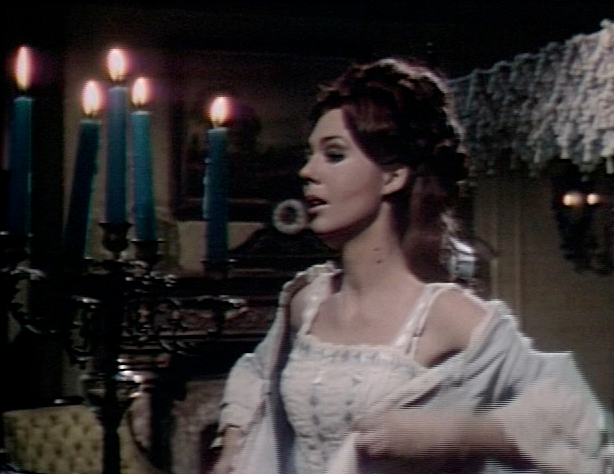
Fluttery heiress Millicent Collins thought that she had a bright future to look forward to when she became engaged to young naval officer Nathan Forbes. That prospect shattered when she discovered that Nathan was already married. Making matters worse, Nathan’s wife, Suki, had presented herself to the Collinses as his sister, and he had gone along with this imposture. Suki is now dead, strangled in an apparently empty house, her body discovered by Nathan when no one else was anywhere near and he had a great deal to gain by her death. For some reason, no one seriously suspects Nathan of the murder, but the whole thing rather tends to cast him in a poor light.
Millicent has recently seen her second cousin, Barnabas Collins. Barnabas’ father, haughty tyrant Joshua, has put the word about that Barnabas has gone to England. Like most people in and around the village of Collinsport, Millicent had believed this story. But the other night she spotted Barnabas in the cemetery. Now she is determined to find Barnabas and recruit him to avenge her honor by fighting a duel with Nathan. She is indignant that Joshua and his wife Naomi keep insisting that she did not really see Barnabas, and that he is not available to fight Nathan.
As it happens, Barnabas did not go to England. Joshua invented that story to cover up the fact that Barnabas had died. Joshua believed that Barnabas died of the plague, and that if that became known the men would not show up to work at the family’s shipyard.
Today, Millicent hears for the first time that Barnabas has died. The news comes from an unpleasant young man named Peter, who is acting as attorney for accused witch Victoria Winters. Peter comes to the great house of Collinwood looking for much put-upon servant Ben Stokes, hoping that Ben will testify for Vicki. Millicent is uninterested in Peter’s mission, but asks him to look for Barnabas. Peter has heard that Barnabas is dead, and passes that information along to Millicent. Since she has seen Barnabas with her own eyes, she simply laughs at this.
As it happens, Peter and Millicent are both right. Barnabas is dead, most of the time. At night he rises as a vampire and preys upon the living. No one but his friend Ben knows this.
In her scene with Peter, Nancy Barrett’s Millicent is slightly, cheerfully crazy. She doesn’t get much support from Roger Davis as Peter, and winds up playing the part a little bit bigger than she might have wished. In her next scene, she has a partner who helps her stay on firm ground.
Millicent answers the front door, as she had done when Peter knocked. This time she is appalled to find that it is Nathan. He puts his foot in the door and refuses to leave until she has heard him out.
Nathan spins a tale to Millicent that he and Suki were in the process of divorcing. We know this is false, and Millicent should as well. When they became engaged, Nathan insisted on the earliest possible wedding date. Since Suki did not show up with a final decree, Nathan could not have been sure that the divorce would be official by that date. Of course, we also know that there was no divorce in the offing; Nathan had abandoned Suki, she had tracked him down, and when she found out about Millicent, she planned to force Nathan to send as much of Millicent’s vast inheritance her way as possible.
Millicent doesn’t know about those details, but she is quite sure Nathan is lying. When he tries to embrace her, she takes a letter opener and tries to stab him.

Millicent is not supposed to be particularly brainy, but she is a smart character in every sense that matters. She absorbs the facts presented to her, interprets them reasonably, forms plans, and pursues those plans by means which, if her interpretations are correct, might well succeed. She believes, correctly, that Nathan has mistreated her and made her look like a fool. She believes, as a young lady of the late 18th century well might, that matters can be set right only by Nathan’s violent death. Having seen Barnabas and knowing that he once fought a duel, she hoped that he would be her avenger. Since Barnabas is being kept from her for no reason she can fathom, she has decided to take matters into her own hands. Her actions may not be the optimal response to the situation, but we can follow her train of thought at each point and are in suspense as to what it will lead her to do next.
Joshua interrupts Millicent before she can accomplish her purpose. He sends her out of the room and confronts Nathan. He tells Nathan he will soon inform the Navy department of what he has done, and that he is sure they will share his eagerness to resolve the issue discreetly. Joshua’s horror of scandal, which we have seen many times, most spectacularly in his cover-up of Barnabas’ death, explains his willingness to believe that Nathan is innocent of Suki’s murder. There would be no way to settle that entirely out of the public eye.
Joel Crothers brought a great deal of wholesome charm to the role of the scoundrel Nathan. We are impressed when Millicent does not give him an inch, even though we can see that she is tempted to do so. We can understand why Joshua several times seems to have to remind himself that he disapproves of Nathan. When, as Joshua, he says he does not believe Nathan killed Suki, Louis Edmonds gives a little smile which flashes real affection for the man he is condemning. It is a testament to Crothers’ talent that his partners are able to achieve these subtle effects in the scenes they share with him in the drawing room.
We cut to the cemetery, where Ben is digging a grave in a heavy fog. Peter shows up to shout at him about testifying for Vicki. Thayer David answers him with an impressive simplicity. Roger Davis is as loud and monotonous as he usually is, but David’s Ben doesn’t waste the tiniest energy on any uncalled-for displays with his voice or face or gestures. It really is a master class in acting under difficult circumstances.
Joshua shows up and shoos Peter away. Joshua insists on going with Ben into the secret chamber where Barnabas’ coffin is hidden. The other night he went into the chamber alone, opened the coffin, and found it empty. Today he goes in with Ben and opens the coffin again. Unaware of the vampire curse, he is as shocked to find the body there as he had earlier been to find it missing.




 Dark Shadows Commentary