Episode 773: Tear up the card

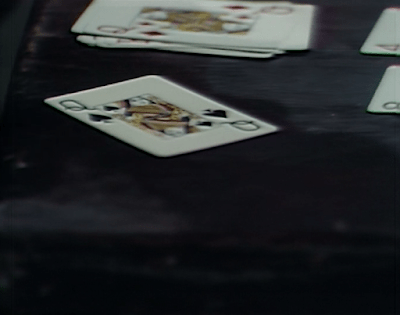
A little over two weeks ago, Dark Shadows started an homage to The Manchurian Candidate, with some touches added from Pushkin’s The Queen of Spades. The overwhelmingly evil Rev’d Gregory Trask, keeper of a sadistic cult disguised as a boarding school, coerced Satanist Evan Hanley into casting a spell on Tim Shaw, one of the teachers at the school. When Tim sees the Queen of Spades, he will be prompted to poison Trask’s wife Minerva.

The whole point of employing an assassin is to give yourself an unbreakable alibi. Since Tim will not remember Evan or the spell once he has killed Minerva, the logical thing would seem to be to arrange it so that Tim poisons Minerva in front of several witnesses and that he still has the vial of poison on him when he is caught. But instead, Evan himself turns up as Minerva is in her death throes, and he is the only witness. After Evan erases Tim’s memory, Tim defeats Evan in a sword fight, then runs away, taking the poison with him. Tim flees to his only friend, fellow teacher Rachel Drummond, and tells her that if it is a matter of Evan’s word against his, he will have no chance in court. Later, Evan confronts Rachel and roughs her up, trying to intimidate her out of helping Tim in any way.
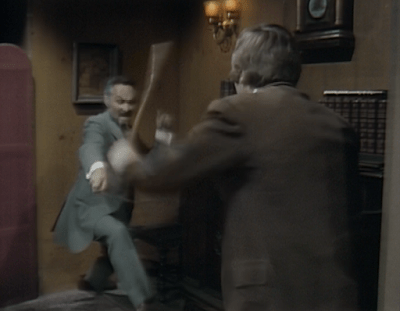
Evan is reduced to having a sword fight with Tim. Screenshot by Dark Shadows Before I Die.

Absent witnesses to accuse Tim on his behalf or an alibi for himself, Evan may as well have skipped the whole brainwashing bit. Had he simply strangled Minerva and claimed he saw Tim do it, he would be in exactly the position he is in now.

The problem for Evan’s plan is that it is taking place at this point in the series. The segment of Dark Shadows set in the year 1897 is stuffed to bursting with vivid characters, each of them involved in at least one dynamic storyline. That makes it, from most points of view, the best part of the show, but it also makes it very difficult to get a bunch of people together. Any two characters you put in the same scene are likely to join plot threads together in new and consequential ways. That makes for a lot of excitement, but it makes it very difficult to do just one thing at a time.

For example, say Tim had insisted on bringing Minerva the poisoned tea while in the drawing room at the great house of Collinwood with rich spinster Judith Collins, Judith’s brother Edward, and Minerva’s daughter Charity, while maidservant Beth waits on the company. Trask is apparently scheming to marry Judith and get her money once Minerva is out of the way. Put her in Minerva’s death scene, and you accelerate that part of the story, perhaps beyond the pace you are prepared to follow up. Edward is starting to suspect that his distant cousin, recently arrived Barnabas Collins, might be a vampire. Those suspicions are the result of two qualities in which Edward is no more than average, his ability to notice the obvious and his concern for his son. But if you make him a participant in another story about a crime, any remarks he might make that would display any brainpower whatever would transform him into the show’s resident sleuth. Beth and Charity are both blood thralls of Barnabas’; if either of them were in the room while the poisoning took place, we would therefore expect them to go directly to him and start wondering how he would react to the news. That would shift our focus to him, subordinating the Tim and Minerva story to the Barnabas story. Virtually every other character is disqualified from serving as a witness for similar reasons, leaving Evan to do the honors himself.

In a comment on Danny Horn’s post about this episode at Dark Shadows Every Day, I summed up my view of both this story and of the 1962 film The Manchurian Candidate:

Two of the things that make THE MANCHURIAN CANDIDATE work so well are that we don’t see any of Raymond Shaw’s training, and that when he sees the Queen of Diamonds he goes into a trance that strips him of all personality.

The training scenes here show why the first of those was so important. Not only are the scenes tedious, they force us to realize that the very idea we most have to take seriously is in fact preposterous. Whatever power you might imagine hypnosis or drugs or other conditioning techniques to have, they obviously couldn’t turn a human brain into a digital computer.

And Tim’s talkativeness while in his trance shows why the second element is essential. Raymond might do absolutely anything when he’s in his hyper-suggestible state. A bartender mentions the phrase “Go jump in a lake” and Raymond jumps in the nearest lake. That’s terrifying, because it is terrifying to think of what people might do who had no mind or will controlling their actions from moment to moment. But Tim’s endless chit-chat doesn’t suggest a soulless automaton. There seems to be a mind in there, it just isn’t a very nice or very interesting mind.

Don Briscoe’s performance doesn’t add much to this unpromising material. I can’t think of anything he might have done to make it work, and neither could he. Anyway, I’m glad it’s over.

Comment left 8 November 2020 by Acilius on “Episode 773: The Persecution and Assassination of Minerva Trask as Performed by Tim Shaw under the Direction of the Marquis de Sade,” Danny Horn, Dark Shadows Every Day, 21 November 2015
Episode 772: Apologies are the Devil’s invention

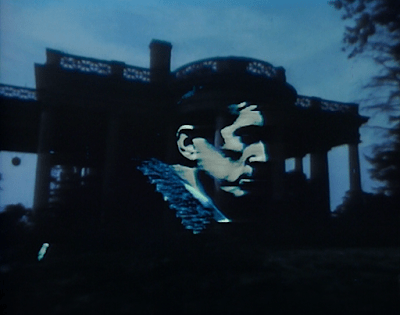
The opening voiceover plays over this image, a type of visual effect we have not seen before at the beginning of an episode:

A transparent sticker of Barnabas superimposed on the exterior of the Old House. Screenshot by Dark Shadows Before I Die.

Barnabas Collins has bitten dimwitted servant Dirk Wilkins, turning Dirk into a vampire like himself. Barnabas has been out all night, searching for Dirk’s hiding place. He hopes to expose Dirk and frame him for his own crimes.

Barnabas comes home to the Old House on the estate of Collinwood to find that Dirk seems to be trying to do the same thing to him. There is a blood-drained corpse in an armchair in his front parlor. It is that of Miss Pansy Faye, Cockney showgirl and Dirk’s first victim.

Barnabas’ distant cousins live in the great house on the estate. One of them, prankster Carl Collins, brought Pansy home with the intention of making her his bride. No sooner does Barnabas discover Pansy’s remains than Carl starts banging on the front door, shouting that he wants to speak with her.

Barnabas hides what’s left of Pansy in a secret chamber behind a bookcase, then lets Carl in. Grisly as the circumstances are, one person lying to another about the presence of a third nearby is a stock situation from farce, and John Karlen and Jonathan Frid play the scene with the particular brand of desperate seriousness that only works in farce. Barnabas persuades Carl to go away and search the grounds of the estate.

That takes a few minutes, starting from what the opening voiceover told us in so many words was “an hour before dawn.” In what remains of that hour, Barnabas takes Pansy’s body to a cemetery and buries her in a shallow grave between tombstones, telling her to “rest in peace.”

Barnabas buries Pansy. Screenshot by Dark Shadows Before I Die.

Barnabas comes home, and finds Carl, who has in the interval not only gone to the great house, the groundskeeper’s cottage, and a house on the estate which is currently occupied by a school, but has also gone into the village of Collinsport and made inquiries about Pansy. A speedy bunch, the Collinses.

Before Barnabas returned to the house, Carl had heard Pansy’s disembodied voice singing the song she had so memorably performed for Barnabas in yesterday’s episode. He had spoken to Pansy’s voice telling her that his grandmother’s will gave him a house to live in and that she could live there with him. This is puzzling for returning viewers. In #714, it was made perfectly clear that the will did not mention Carl at all. Edith Collins left her entire estate to Carl’s sister Judith, and the only one of the brothers who was mentioned was Quentin, who received no money or negotiable assets of any kind but who was guaranteed the right to stay at Collinwood as long as he pleased. Perhaps they are retconning that away, perhaps Carl is lying to Pansy, or perhaps Carl is losing his grip on reality.

Whether or not we are supposed to doubt Carl’s sanity, Barnabas talks Carl into suspecting that he might have hallucinated Pansy’s voice. Carl leaves, and Barnabas has time to return to his coffin before dawn.

The rest of the episode is taken up with doings at the school Carl had visited. We saw Carl questioning Charity Trask, daughter of the school’s master, the overwhelmingly evil Gregory Trask. The prim Charity was exasperated that Carl kept asking about Pansy after she had already denied having seen her. The scene is an interesting one- Charity and Pansy are such total opposites that it is a shame they never met. It would be amusing to see them juxtaposed.

Charity is engaged to marry Tim Shaw, a teacher at the school. Neither of them is happy about this situation. Tim was in love with Rachel Drummond, another of the teachers, and Charity is Barnabas’ blood thrall. But Gregory blackmailed Tim and bullied Charity into accepting the arrangement.

Charity’s mother, prudish Minerva Trask, does not like Tim or want him as a son-in-law. She urges Charity to set her sights on Carl. Charity says that she would rather marry Barnabas; Minerva says that her instincts are sound, but that she ought not to settle for a cousin of the rich Collinses when one of the brothers is available. Even if they have retconned Carl into owning a house, he is clearly not a rich man, so this reveals that Minerva knows as little about his financial position as she does about the curse under which Barnabas labors.

Charity tries to engage Tim in conversation, and is baffled that he is not willing to talk to her. Indeed, he does not seem like himself at all. Not only is he dismissive with Charity, but when Minerva confronts him he is bold and insolent, a far cry from the broken man we have seen interacting with the Trasks previously. When Charity tells him their engagement is off, he does not express the relief that she and we expect, but puts on a stagey voice we have not heard him use before and marches off to apologize to her mother.

There is a reason for Tim’s behavior. Gregory enlisted warlock Evan Hanley to brainwash Tim so that he would kill Minerva. There is some business with the Queen of Spades, first when Tim mutters the phrase “Queen of Spades,” then when Evan sends him a note on which is scrawled “Queen of Spades,” and lastly when he walks in on Minerva playing solitaire and sees her turn up the Queen of Spades. Many viewers in 1969 would have remembered Richard Condon’s 1959 novel The Manchurian Candidate and its 1962 film version. In Condon’s novel, Raymond Shaw became a robot capable of murder when he saw the Queen of Hearts; in the film, the card was the Queen of Diamonds. Many first time viewers, seeing Tim Shaw’s reaction to the Queen of Spades, would have made the connection and understood why he ends the episode by poisoning Minerva’s tea.

Is this your card? Screenshot by Dark Shadows Before I Die.

Tim Shaw differs from Raymond Shaw in that he is under a spell for a long while, including the whole time we see him today, and he can talk and act independently while it operates on him. Raymond simply became catatonic when he saw the card and remained that way until he heard a command. He then executed the command and came back to himself once he was finished. Tim’s behavior may suggest a nod to another literary work, Pushkin’s story “The Queen of Spades.” That tale, which Tchaikovsky turned into an opera and which in 1949 was made into a feature film, is about a timid man who inadvertently kills a powerful woman and loses control of himself as a consequence. Like Tim, Captain Herman is coerced into marrying a woman he does not love. Presented with an opportunity to get out of the marriage, he finds himself making extraordinary efforts to go through with it, efforts which bring about his ultimate downfall.