An information management day. Old world gentleman Barnabas Collins has told his distant cousin, Roger Collins, about a parallel universe that is occasionally visible in a room in the long disused east wing of the great house of Collinwood. Today, Roger tells his sister Elizabeth about the room. Liz owns the house. We might wonder if she will have questions about what effect the presence of a spare universe on the premises will have on her property taxes.
Roger talks about the phenomenon while standing in the room with permanent houseguest Julia Hoffman, MD. He is incredulous when he notices that Julia is not listening to him. She cannot tell him what has distracted her. Unknown to Roger and Liz, Barnabas is a vampire. Julia has devised a treatment that is supposed to put this curse in remission, but it is not working at all. She has given him the last of the injections, and the only difference in Barnabas is that he is getting sick and feeling an unusually intense bloodlust.
Caretaker Chris Jennings, another distant cousin, comes stumbling home to his cottage on the grounds of the estate. He finds his girlfriend and ex-fiancée Sabrina Stuart waiting for him. Chris is another patient Julia has been unable to help. He is a werewolf. There was a full moon last night. Sabrina tells Chris he killed a man named Bruno. Chris is distressed that he killed anyone, but Sabrina points out that Bruno knew of his secret and was trying to use him to kill others. He was holding her and a man named Rumson prisoner, and when the police searched Bruno’s premises after his death they found Sabrina and Rumson imprisoned there. Sabrina keeps telling Chris she wants to marry him. Most of the time they will live ordinary lives, but one night out of 28 she will just have to lock him up in a special cell. Chris won’t hear of this.
My wife, Mrs Acilius, is a great one for love stories and an admirer of actress Lisa Blake Richards. Chris and Sabrina have run out of road on Dark Shadows, and are obviously going to be written out soon. Mrs Acilius wishes they could ride off into the sunset accompanied by the sound of wedding bells. So when Chris refused to marry Sabrina, she exclaimed “Stupid man!” I pointed out something Chris knows but does not mention to Sabrina, that his curse is hereditary. Any male descendants he has will also be werewolves. Mrs A conceded that this does complicate matters.
Roger saw Chris at Bruno’s place when he rescued him and Carolyn shortly before moonrise last night. Chris was at that time in the throes that precede his transformation. Chris ran off before Roger or Carolyn could see what became of him. Roger comes to the cottage to check on him.
Chris is in the back changing out of his bloody clothes, so Sabrina answers the door. She tells Roger that Chris is there and that she was with him all night, watching over him because he was ill. After what he saw of Chris at Bruno’s, Roger has no doubt that Chris needed a nurse, and he tells Sabrina that he is glad he had such a charming one. The audience can understand that Sabrina wants to conceal Chris’ lycanthropy from Roger, but surely it cannot be wise for her to claim that she was in the cottage overnight. Not only are her true whereabouts known to everyone who was in or around the police station the night before, but since Roger was the one who found Bruno’s body and he found it on the grounds of Collinwood, even police as inept as the ones in Collinsport are likely to follow up with him. Besides, her imprisonment with Rumson is a sensational story, of interest to the press. Maybe we will move on to the next phase of the show before the facts come to light, but Sabrina can’t know that.
Sabrina is determined to persuade Chris to resume their engagement. She goes to the one person whose opinion Chris seems to respect, Barnabas. When she knocks on his door, Barnabas hides behind a partition. When Sabrina first arrived, she had seen Barnabas through the window of his front parlor, so she lets herself in. He finally gives up on hiding and pleads with her to leave. She ignores what he is saying and keeps talking. She plows ahead with her idea about how Barnabas can help her and Chris become a happy married couple. Barnabas struggles to resist his urge for blood, but cannot. He bites Sabrina, much to her surprise. Miss Richards’ understated exclamation of “Barnabas!” when he shows his fangs and goes for her neck is very nicely done, it really sounds like a woman puzzled that a trusted friend is violating her personal space.
Sabrina staggers back to Chris’ cottage. She collapses in his chair, and he sees the puncture wounds on her neck. They are much bigger than the marks we’ve seen on Barnabas’ previous victims. I suppose he really was a lot hungrier than usual. Chris doesn’t know that Barnabas is a vampire, and the cliffhanger leaves us wondering whether he can avoid finding out.
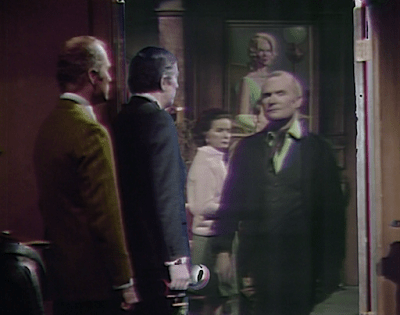
Probably the most memorable shot in the episode is a very impressive bit of videotape editing. Roger and Barnabas are standing at the door to the Parallel Time room, watching Roger’s counterpart interact with Liz’ and Chris’. Parallel Roger walks toward the door. He exits the room, not into the space Roger and Barnabas occupy, but into the hallway as it exists in Parallel Time. He vanishes from their view, and the effect also winks out in the room, leaving Roger and Barnabas looking into the bare, dark chamber it is in the house they know.
Dark Shadows spent a few months trying to put a story together from some themes drawn from the works of H. P. Lovecraft. A race of Elder Gods known as the Leviathan People wanted to escape from their long captivity in the underworld, retake the Earth, and destroy humankind. To that end, they controlled the minds of several people in and around the village of Collinsport, formed them into a cult, and entrusted them with the care of a fast-growing, shape-shifting monster. When the monster was able to assume the form of a grown man, he was supposed to be joined to heiress Carolyn Collins Stoddard in an unholy ceremony that would transform Carolyn into the same sort of being he was, and mark the beginning of the Time of the Leviathan People.
In #965, the unholy ceremony was underway. But the monster, who when he first appeared as an adult invited people to “Call me Jabe,” had decided he would rather become a human than turn Carolyn into a Leviathan. So he called to Carolyn’s distant cousin, old world gentleman Barnabas Collins, to whisk her away from the scene while he used the Leviathan sceptre to smash the Leviathan box, causing the Leviathan altar to explode and the Leviathan high priest to declare that the time of the Leviathans was over. He told Jabe that he had not only ruined the Leviathans’ grand design, but had doomed himself. His squamous, rugose, and paleogean form was his only true form; the tall young man is just a projection that cannot survive on its own.
Evidently, the original plan was that Jabe’s rebellion would begin a second half of the Leviathan arc. In that half, the chief villain would be a Leviathan who had been roaming the Earth for centuries and who wielded powers as great as Jabe’s even though he could not fulfill Jabe’s intended role as harbinger of Leviathan world dominion. The battle that Barnabas, Jabe, and their allies waged against that villain would involve a trip back in time to the 1790s, during a brief visit to which period Barnabas had first encountered the Leviathans. That return to the 1790s would tie the Leviathans into the tales that have become basic to the show’s backstory, including the stories of the gracious Josette, well-meaning governess Vicki, and Barnabas’ first vampire curse.
They abandoned that plan in some haste. The Leviathan arc never came together as a coherent story, and it was a flop in the ratings. So they never introduced the second Leviathan villain. In his place, they brought back suave warlock Nicholas Blair, who had been one of the villains in 1968, and made him the high priest of the cult and Jabe’s supervisor. When we hear about past deeds that Nicholas could not have done, they nonsensically attribute them either to Mr Strak, a character whose whole point was that he was only on the show once and could never be seen or heard of again, or to Jabe himself, who is four months old. The ghost who was supposed to usher in the return to the eighteenth century turns up in two episodes, does some shouting, then meets wicked witch Angelique, who tells him that he is irrelevant to the story and causes him to disappear forever.
Now, the show is gearing up to tell a story about a parallel universe that Barnabas has found in the east wing of the great house of Collinwood. But all the actors we need to kick that story off are in the cast of the film House of Dark Shadows, which had started principal photography by the time this episode was taped. So we have to find a way to take the characters left over from the Leviathan arc and make a story out of whatever it is they are doing.
Even though Nicholas has said in so many words that the Leviathan segment is over, he and his henchman Bruno are still hanging around Collinsport. They are joined by a third stooge, Angelique’s estranged husband Sky Rumson. Sky had been a fabulously successful publisher because of the deal he made when he met Nicholas and sold his soul to him, but now that the Leviathans have been defeated his enterprises are going under. Sky has apparently been crashing at Bruno’s place.
Bruno and Sky are holding a young woman named Sabrina Stuart prisoner. Sabrina had shown up and offered Bruno a packet of cash to leave Collinsport and forget about her fiancé, Chris Jennings, whom he knows to be a werewolf. Bruno refused to leave, saying that he hopes to exploit Chris’ curse for his own evil purposes. Sabrina then drew a gun on him. Before she could shoot, Sky bumbled in and distracted her. Bruno ordered Sky to guard Sabrina while he contacted Nicholas. Sky resented Bruno’s commands, but obeyed them anyway.
When Sky gets Sabrina into Bruno’s back room, she asks him what they are going to do to Chris. Sky lampshades the fact that there is no reason for him to be on the show when he says that he has never heard of Chris and has no idea what is going on. After Bruno and Nicholas have conferred, Sabrina tells Sky that they seem to have forgotten about him. Sky protests that this is impossible, since Nicholas had promised to talk with him about his future. He goes out to the front room, and sees that Sabrina was right. Bruno and Nicholas have in fact left without him.
Sky finds Angelique sitting in the corner, waiting for him. She left him when she learned that he was a pawn of the Leviathans and he tried to set fire to her. She taunts him for his reduced circumstances:
ANGELIQUE: From tycoon to lackey. My, how the mighty are fallen.
SKY: Angelique, what are you doing here?
ANGELIQUE: Oh, I came to see you, Sky.
SKY: How did you know where to find me?
ANGELIQUE: Oh, I’ve been keeping a very close watch on your activities. Tell me-how does it feel to be a has-been?
SKY: What are you talking about?
ANGELIQUE: That’s what you are, you know.
SKY: I said, what are you talking about?
ANGELIQUE: Every one of your business ventures is a disaster. There’s nothing you can do about it, because all you are now is Nicholas Blair’s slave.
SKY: That’s not true! I’m very important to him!
ANGELIQUE: Oh, don’t be absurd. Consider right now, what you’re doing- what he has you doing. Keeping guard over a helpless young girl. You’re not important to Nicholas. He doesn’t care anything about you.
SKY: That’s not true.
ANGELIQUE: What does Nicholas plan to do with that girl anyway? Or hasn’t he consulted you?
SKY: Angelique, shut up!
ANGELIQUE: What’s the matter, Sky? Am I making you unhappy?
SKY: Get off my back!
ANGELIQUE: [Chuckling] Oh, you’ve grown quite thin-skinned in your declining days, haven’t you?
Shall I tell you how it’s all going to end? Nicholas is going to find some ingenious way of doing himself in, he always does. And then you’re going to be alone. All alone. With no one to turn to. And then… Someone’s going to put you out of your misery. Who knows? It may even be me. Well, I better not keep you any longer. I know you have an important job to do in the next room.
Angelique’s sarcastic characterization of guarding Sabrina as “an important job” not only reflects the lowly status of the work compared to the executive responsibilities Sky recently had as the head of a big business. The story has passed Sabrina and Chris by as completely as it has passed by Sky, Nicholas, and Bruno. Chris knows that on nights of the full moon, he will become an animal who, if not restrained, will kill at least one random person. Both magical and scientific means to relieve him of his curse have failed, but he has friends who will keep him cooped up on those nights so that he doesn’t hurt anyone. Yet he persistently refuses to let them do so. He is deliberately choosing to be a serial murderer. Not only is there no moral ambiguity about him, he has no plans or goals to draw our curiosity and win our sympathies in spite of ourselves. He is a simply and tediously bad person, and to the extent that livelier characters go along with him we like them less. Since Sabrina has no interest in anything other than her relationship with Chris, the two of them are both useless.
Nicholas is puzzled that Jabe continues to exist. He thinks that Jabe’s love for Carolyn, whom he has married, is giving him such a strong will to live that he has managed to hold onto his humanoid form for so long. As Angelique indicated when she told Sky that “Nicholas is going to find some ingenious way of doing himself in, he always does,” Nicholas’ run on the show in 1968 ended with the total failure of all his efforts and his abrupt recall to Hell. But he hopes that he can turn things around for himself. He was only seconded to the Leviathans by his real boss, Satan. He thinks he might be able to get his career back on track in Satan’s organization if he can be the one to destroy Jabe. To that end, he wants to use the werewolf to kill Carolyn, thereby depriving Jabe of his zest for life and making him fade away.
Siccing the werewolf on Carolyn is a typical Nicholas scheme. Even in his monstrous form, Jabe was defenseless against werewolves. So all Nicholas has to do is set the werewolf on him. Bringing Carolyn into it only increases the chances of failure. Moreover, Jabe is likely to be killed off soon, so we might have been willing to believe Nicholas would be the one to do it. But Carolyn has been a core member of the cast since the first week, so once Nicholas promulgates a scheme that involves her death, regular viewers know nothing will come of it.
Moreover, Nicholas has only a short time to make good his designs on Jabe. Angelique blames Jabe for Sky’s involvement with the Leviathans, and has taken a page from George MacDonald’s 1858 novel Phantastes by plaguing him with an autonomous shadow that occasionally appears to him. The shadow that attached itself to Anodos, MacDonald’s protagonist, was an allegory for anxiety as a consequence of unredeemed sin, but the shadow Angelique imposes on Jabe is a direct threat to his physical survival. It grows in size and intensity at each appearance, and when it engulfs Jabe entirely it will kill him.
In the drawing room of the great house of Collinwood, Jabe calls on Angelique to relieve him of the shadow. Nicholas comes instead. Jabe asks him for help against the shadow. He refuses. He does say that he very much hopes that he, not Angelique, is the one who finishes Jabe off, but he will not try to remove the shadow even to improve his own odds of success. Again, we are left wondering why the camera keeps settling on Nicholas if he won’t take action to change the direction of the plot.
Angelique appears to Jabe after Nicholas has gone. Jabe pleads with her to lift the shadow, and she says no. He tells her he had nothing to do with Sky’s recruitment to the Leviathan cult, and that he barely knows Sky. Angelique knows these things to be true, so she pauses before she answers him. She tells him he was the center of the Leviathan conspiracy, so she blames him for everything done in the course of it.
We end up at Bruno’s place. Sky has told Chris that Sabrina is being held prisoner there, and has given him the key. Chris lets himself in and opens a closet. He finds Sky in it, strung up by his wrists and bleeding. Sky begs for help, and Bruno appears. He holds a gun on Chris and greets him with “Good evening, Mr Jennings! Sabrina and I have been waiting for you.”
Writer Gordon Russell deserves a lot of credit for taking this unpromising material and coming up with a well-constructed script with a fast pace and intelligent dialogue. The actors also do a good job, all of them except the woefully inept Geoffrey Scott as Sky.
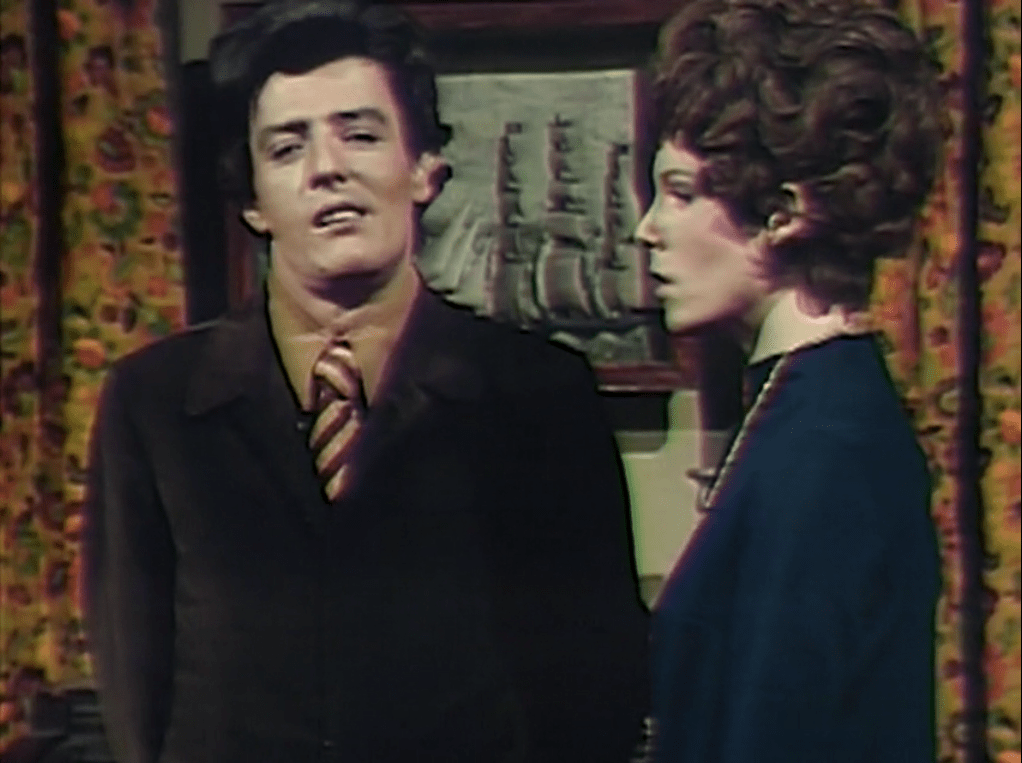
But director Henry Kaplan really does let everyone down. The episode starts with a fantastically bad job of blocking. Bruno and Sabrina are standing at right angles to each other, enabling us to see both of their faces.
Right angle pose.
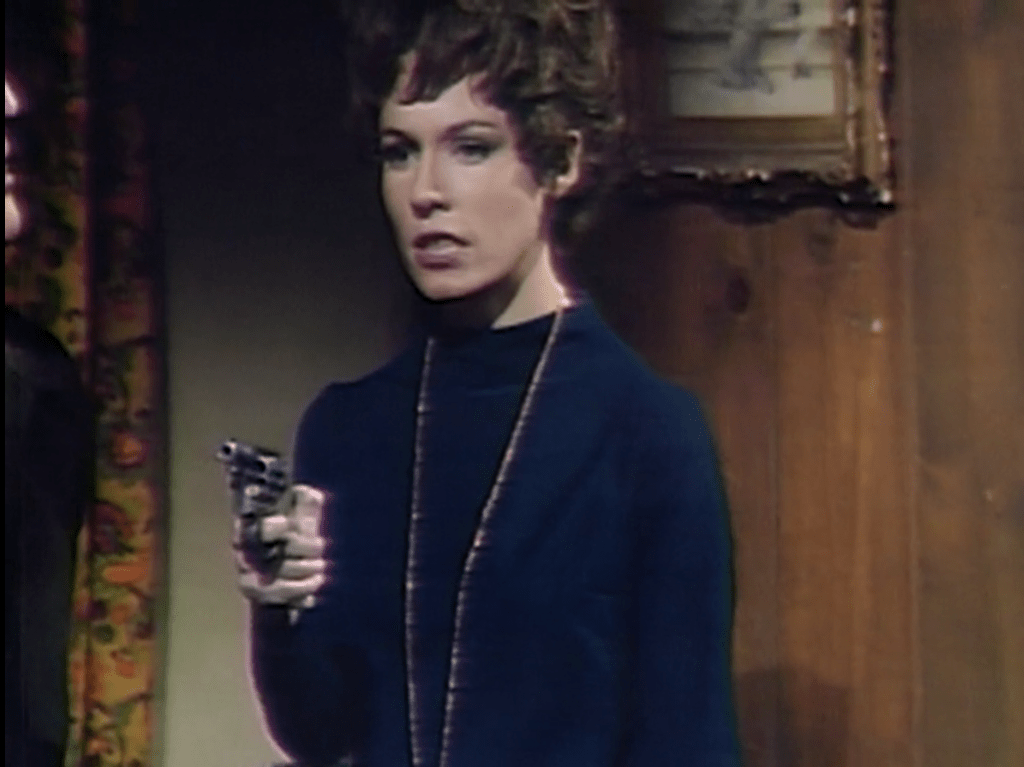
Unfortunately, this pose means that when Sabrina draws her gun, she is not pointing it at Bruno, but holding it in front of him and threatening to fire it into the wall. Kaplan’s habit of relying heavily on closeups in lieu of a visual strategy does nothing to obscure this, and viewers who missed yesterday may be genuinely puzzled as to who or what Bruno is afraid Sabrina will shoot.
Heiress Carolyn Collins Stoddard and her new husband, who answers to the name of Jeb Hawkes even though when he first appeared he wanted to be called Jabe, have given up on their honeymoon. Jabe is being plagued by a magical shadow that follows him about, as does the shadow that plagues the protagonist of George MacDonald’s 1858 novel Phantastes. Jabe woke up in the bed he and Carolyn were sharing on their wedding night, saw the shadow, and insisted they flee the hotel at once. Since then, they have fled many hotels, and Jabe has kept refusing to explain why. Only after Jabe has ordered Carolyn out of his place in the carriage house on the estate of Collinwood and told her he doesn’t want her anymore does she see the shadow and find out what is going on.
The wedding night scene was the first time we saw two people in bed together on Dark Shadows. Jabe’s shirtlessness, another novelty, emphasized that he and Carolyn had had sex. For its first years, Dark Shadows was as chaste as any daytime soap of the 1960s; there were long stretches when you could not prove that sex even existed in its universe. But it’s the 1970s now, and Carolyn wants more than one experience of connubial intercourse.
Carolyn is determined to help Jabe fight the shadow. He won’t tell her where it came from. She suggests a series of people who might be possible allies in their battle; he responds to each name with a demand that she forget the person. She grows frustrated. She says she will try to enlist the aid of suave warlock Nicholas Blair. Jabe can block this only by going off himself to meet with Nicholas’ henchman Bruno and plead for help against the shadow.
As Jabe is leaving, governess Maggie Evans enters. Maggie brightly asks Carolyn how married life is treating her. When she does not get the usual enthusiastic response, she repeats the question in an uncertain tone. When Carolyn dodges that, Maggie changes the subject. It emerges that Maggie has a dinner date with old world gentleman Barnabas Collins. Carolyn responds, “Oh, maybe someday, you and Barnabas…”
They’ve made something recently of a budding romance between Maggie and Barnabas. As Jabe is keeping terrible secrets from Carolyn, so Barnabas is keeping a terrible secret from Maggie. All of Jabe’s secrets stem from a storyline that never took off, that is now extinct, and that we didn’t particularly want to hear about even when it was going on, so we can sympathize with his reluctance to bring it back up.
But Barnabas’ secret presents immediate practical difficulties. He is a vampire. Where are they going to go for dinner? If they go to a restaurant where the cuisine might appeal to Maggie, there won’t be anything for Barnabas. If they go to the docks and he drinks the blood of a sex worker, there won’t be anything on the menu for her. Also, the most famous storyline on the whole series, the one that first made it a hit, was in May and June of 1967, when Barnabas fed on Maggie, imprisoned her, and tortured her in hopes of erasing her personality and replacing it with that of his lost love Josette. The memory of that has repeatedly been wiped from Maggie’s mind, but even viewers who joined the show long after it ended are aware of it. In fact, right now they are gearing up to take most of the principal cast to Tarrytown, New York to film a feature film adaptation of that story. The sight of Maggie falling in love with Barnabas would therefore be at least a little queasy-making for much of the audience.
Carolyn and Jabe, Barnabas and Maggie, are only two of the troubled couples in this springtime episode. Sabrina Stuart wants to marry werewolf Chris Jennings. She talks with Chris’ great-grandfather, Quentin Collins. There is a strong family resemblance between great-grandfather and great-grandson, in that they are both twenty nine years old. Apparently, at least- Quentin is in fact a centenarian, but the magic spells that put his own lycanthropy in remission also immunized him against aging.
Sabrina says that there is no hope for Chris as long as Bruno is hanging around. Bruno knows that Chris is a werewolf, and has evil plans for him. She tells Quentin that she wants to offer Bruno money to go away and forget about Chris. Quentin doubts this will work, but agrees to go with Sabrina. He promises to come back in an hour. Of course, we know that if he were actually going to go with her he wouldn’t go away in the interim. We probably wouldn’t even have this planning scene, we would find them already on their way to Bruno’s. So the suspense is about what will happen to prevent Quentin meeting Sabrina at the appointed time.
We cut to Bruno’s place. Jabe is there, telling Bruno he needs Nicholas’ help. Bruno ridicules Jabe, saying that Nicholas has no interest in helping him. He also tells him that it wouldn’t matter if someone did help him- he’s going to die soon anyway. When the storyline in which he was introduced ended, he lost the power that enabled him to live. Jabe insists that he can will himself to stay alive. The longer he stays with Bruno, the more opportunities Bruno has to be nasty to him. Bruno says that Carolyn will soon be a young widow, and that she will “need a lot of consoling.” Bruno is in the same amorous mood as everyone else in the episode, and he speculates that he himself might give her some of that consoling. This angers Jabe further.
Quentin makes it all the way to Sabrina’s door when a trident appears on his hand. Returning viewers know that this is the sign of a spell that was cast on him and Maggie, causing them to have an intense passion for one another at irregular intervals. He turns away from Sabrina’s door and goes to call on Maggie. We see the two of them on the terrace at Collinwood. The terrace is often a place for smooching, but it is usually rather stagey, decorous smooching. This is a real make-out session.
Quentin and Maggie getting busy (pronounced “bizz-ay.”)
Sabrina gives up on Quentin an hour after he was supposed to come to her apartment and goes to Bruno’s alone. When Bruno tells her that the money won’t persuade him to forget about Chris, she draws a pistol and announces that she is going to kill him. We cut to the credits.
Again, we know that if Sabrina were really going to shoot Bruno, she wouldn’t have said anything- she would just have taken the gun from her purse and opened fire. My wife, Mrs Acilius, pointed out that the suspense this generates is not whether she will make good her threat, but what will happen to prevent her doing so.
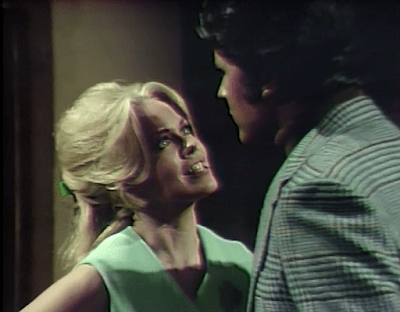
Heiress Carolyn Collins Stoddard talks her friend Sabrina Stuart into wearing a wig over her prematurely gray hair. Sabrina’s ex-fiancé Chris Jennings sees Sabrina with the wig and is suddenly attracted to her again. Sabrina knows that Chris is a werewolf. She disregards both Chris’ lycanthropy and the fact that he is more interested in her wig than in her and starts talking to him about renewing their engagement.
A villain named Bruno has evil plans for the werewolf. He knows that the werewolf is a man who is close to Sabrina, and when he sees her with Chris he realizes it is him. At the end of the episode, he abducts Chris at gunpoint.
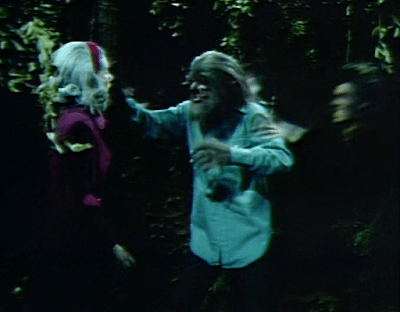
A werewolf is prowling through the woods on the great estate of Collinwood, and Sabrina Stuart, a young woman with white hair, sees him. She knows that when the moon is not full, the werewolf is her ex-fiancé Chris Jennings. She screams at the sight of him. This would be an understandable reaction if the werewolf were scary looking, but since he is a man whose face and hands are covered with hairy makeup appliances while the rest of him is wearing clothes, he is a just cute little doggie who might like a bickie. Television, they say, is a visual medium; that means that the images you put on the screen will stimulate the audience’s imaginations. If you are telling a story about a monster, you must show only enough of him to get them to wonder what terrible things he might do. Once you’ve shown so much that they start to laugh, you’re sunk.
Sabrina composes herself, and tries to reason with the werewolf. He stands there listening to her attentively, being the goodest little boy. This ends when a man emerges from the brush and jumps him. The man shoots the werewolf, who yips and runs away. Sabrina is upset with the man, who is surprised she does not regard him as her rescuer. She identifies herself by name.
The man’s name is Bruno, and he works for another monster, one whom we see only when he is masquerading as a young man. That monster once said he wanted to be called Jabe, but everyone very inconsiderately keeps calling him Jeb instead. Jabe has told Bruno that he is vulnerable to werewolves. Bruno disregarded Jabe’s report that only silver bullets can kill a werewolf, and fired regular ammunition. Jabe is upset about this.
Bruno tells him all is not lost. Since Sabrina was not afraid of the werewolf, his human form must be that of a man to whom she is close. Bruno says Sabrina has a brother, and thinks out loud that he ought to just go ahead and kill him. Regular viewers know that Sabrina’s brother, though he is not a werewolf, is a character played by Roger Davis, so we’re all for Bruno’s idea. But Jabe vetoes it, saying that if a werewolf is killed while in human form he will turn into the wolf and remain in that form forever. That’s new information on Dark Shadows, though there had been so many werewolf movies by 1970 I can’t imagine it was original.
Old world gentleman Barnabas Collins stops by the antique shop where Jabe lives. Barnabas had been the leader of the cult that serves Jabe, but has become disaffected. Jabe knows this. Each wants to kill the other, but neither has been able to make a substantive move. Jabe demands Barnabas do something about the werewolf, in the process exposing his vulnerability. Barnabas is friendly with Chris and knows all about him, so this exposure makes it possible for him and Jabe to join battle.
In the closing credits, writer Violet Welles’ name is misspelled “Wells.” Today’s script is not up to her usual standards; maybe “Violet Wells” was her guild-approved pseudonym.
Maggie Evans, governess in the great house on the estate of Collinwood, is being held prisoner in a big mausoleum somewhere. Her captor appears to be a young man, but is actually a monster from beyond space and time. He is associated with the Leviathan People, a race of Elder Gods who are planning to take the earth away from humankind with the aid of some people whom they control and whom they have formed into a cult. The cultists call the monster Jeb, even though when we first saw him he said he wanted to be called Jabe.
Jabe orders Maggie to open a wooden box and look inside. He makes it clear to her that she is supposed to be under his control after she has done this, so she plays along. He lets her go, with orders that she is to spy on old world gentleman Barnabas Collins, a leader of the cult who has become disaffected from it and is working against Jabe.
Back in the great house, Maggie tells Barnabas what happened. Barnabas’ best friend, mad scientist Julia Hoffman, enters; he tells Julia that Maggie is their new ally in the fight against the Leviathans. When Barnabas was still loyal to the Leviathans, he tried to absorb Julia into the cult. That effort failed, and Barnabas explained that “certain people” were immune from absorption because of their “genetic structure.” Since Julia is the only Jewish character on the show, this sounded jarringly like a claim that the Leviathans were a restricted club. Evidently Maggie is now among those “certain people.” Since Maggie has a Welsh name and is played by a Minnesota-born actress of Scandinavian descent, that retroactively takes some of the anti-Semitic edge off Barnabas’ earlier remark for viewers who remember that episode (unless she converted.)
Maggie had taken an apologetic tone when she told Julia she wanted to be alone with Barnabas; Julia is very circumspect when she comes in at the end of their conversation. For a long time now, the show has been working on the idea that Julia wants a romantic relationship with Barnabas and is sad that he does not share her desire; for the last couple of weeks, they have been hinting that Barnabas and Maggie are getting pretty cozy. Regular viewers will be interested to see Grayson Hall playing Julia being a good sport about losing Barnabas to Maggie, and Kathryn Leigh Scott playing Maggie wishing she didn’t have to hurt her friend’s feelings.
We learned yesterday that Jabe is vulnerable to werewolves. As luck would have it, there is a werewolf at large in the Collinsport area. He is Chris Jennings, and Barnabas and Julia have been trying to cure him of the effects of his curse. He had been spending the nights of the full moon in a cell at Windcliff, a mental hospital Julia is in charge of, but last month came back to the caretaker’s cottage on the grounds of Collinwood. He couldn’t stand being cooped up, and chose to go back to his old practice of killing someone at random every month.
Julia and Barnabas don’t know that Chris is a weapon they can use against Jabe, and they want him to go back to Windcliff. The moon will be full tonight, so they are particularly anxious. But his onetime fiancée, Sabrina Stuart, has a different idea. She has been in contact with an expert on lycanthropy, and he has shipped her the only surviving specimen of the Moon Poppy. She brings the potted plant to Chris and tells him that the flower will open when the moon starts to rise. If he eats it while it is blooming, he will be cured. Otherwise, he will lose his chance- the plant will be dead before morning.
Chris’ transformation begins with moonrise, and once he has become the wolf he has no will of his own. When Barnabas stops by to take him to Windcliff, he points this out to Chris. But Chris is determined to try Sabrina’s cure. He is like every addict who talks himself into believing that this time, it will be different. Of course his determination fails him at the last moment, and by the time he can reach for the opening flower, it is a hairy paw, not a hand, that stretches towards it.
The flower cure and Chris the unlikable protagonist are both borrowings from the 1941 film The Wolf Man. Jabe lives in an antique shop; there’s an antique shop in that movie, too. There were some hints early on that werewolves were a threat to the Leviathans; evidently they had planned to bring these two stories together all along.
Closing Miscellany
Sometimes the closing credits are on cards, one after another; other times, they are on a continuous roll. Through the first year of the show, when they were on a roll costume supplier Ohrbach’s would be misspelled “Orhbach’s.” We haven’t seen that misspelling for a long time, but it’s back today. It will keep cropping up for the rest of the series.
Barnabas and Julia find a fake letter from Maggie saying that she’s been away visiting her Aunt Louise in Quebec. This is the first time we’ve heard of any members of Maggie’s family other than her late parents. Since the letter is a phony meant to cover up her abduction and neither Julia nor Barnabas seems to have heard of Louise before, it is possible there is no such person. Still, Maggie has been a major character since the first episode, so it does get longtime viewers thinking about how little we know about her background.
This is only marginally relevant to the episode, but I can’t resist bringing it up. The other day, a Twitter user named Zach Wilson (whose bio describes him as “watcher of TV, all of it, one episode at a time”) posted an image of pages of TV Guide from 22 April 1966 with the question “What would you watch?” An Educational TV station in whatever market it was running a WGBH-Boston produced telecast of the Boston Theater Company’s production of Gertrude Stein’s “Yes is for a Very Young Man,” starring Lisa Blake Richards. The Harvard Crimson had reviewed the stage production in November 1965; they said that “the play was lousy,” but they praised the cast for making the most of a bad script, singling out Miss Richards for the “outstanding job” she did “with a whining, pathetic character.” Sabrina isn’t exactly Lady MacBeth, either, and Miss Richards had her work cut out for her finding a way to make us want to see more of her.
Yesterday, Amanda Harris told the story of a suicide attempt she made in 1897. A supernatural being whom she calls “Mr Best” thwarted this attempt, and told her that he would arrange for her not only to avoid death, but to remain young, for the years that it had been ordained she would live. If in that time she could reconnect with her lost love, rakish Quentin Collins, she and he would never die. Now it is 1970, and Amanda’s time is up. Mr Best is at her door. Amanda has found Quentin, but he has amnesia and is not ready to resume their relationship as Mr Best’s terms require.
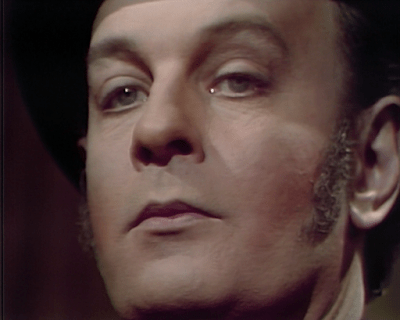
Mr Best has changed startlingly since we met him in the flashback that showed us Amanda’s story. Then he was warm and solicitous; today he is truculent and cold. Even his makeup is different. A pale coloring suggests sunken cheeks, making him look corpse-like.
Amanda has reversed her own attitude as well. In 1897, Mr Best lamented her wish for death and pleaded with her to stay alive; now it is Amanda’s turn to beg Mr Best for more time while he shows impatience with her. When she tells him about Quentin’s amnesia, he asks brusquely “Are you making this up?” It merits a laugh that the story of Dark Shadows has become so far-fetched that even Death Incarnate finds it hard to believe. But Mr Best does soften, and gives Amanda seven more days to get Quentin to tell her he loves her.
Quentin’s own perpetual youth is the result of a magical portrait that immunized him from the effects both of aging and of the werewolf curse that was placed on him in 1897. Quentin’s great-grandson Chris Jennings has inherited that curse. Mad scientist Julia Hoffman had learned that artist Charles Delaware Tate was still alive, and hoped he would paint a portrait of Chris that would free him from lycanthropy. Tate told Chris he no longer had the gift, but Chris forced him to paint his picture anyway. The moon rose, Chris transformed, and as the wolf he murdered Tate.
One of Chris’ surviving victims is his ex-fiancée, Sabrina Stuart. Sabrina saw him transform, and as a result was struck dumb for years and went prematurely gray. She can talk now, but she’s still gray. She shows up today at the great house of Collinwood where she calls on heiress Carolyn Collins Stoddard. Carolyn tells Sabrina that she doesn’t love Chris and never will, but that she realizes Sabrina loves him. This adds to a growing list of reasons the show has given us to doubt that Chris will be on much longer. His premeditated murder of Tate establishes him as a pure villain. A villain’s function is to create problems for other characters to solve, and Chris has been too passive and too dependent on Julia to be an interesting villain. His relationship with Carolyn gave him a connection to the core cast, but Carolyn’s conversation with Sabrina makes it clear that that is gone now.
Sabrina insists Carolyn go on a road trip with her. She takes her to Tate’s house and leads her into the room where Chris murdered the artist. She tells her that a man was just killed there. Carolyn asks Sabrina if Chris did it. Sabrina looks pained, and says “Not Chris!” This further undermines Chris’ position. As long as Sabrina was mute, we could wonder whether she would blow the whistle on Chris once she regained the power of speech and if so what the consequences of that would be. But now we see that she is still in denial about him, and can set aside any hope that she might generate a story for him.
Carolyn asks Sabrina how she knows about the murder. No answer is forthcoming, and there doesn’t seem to be any way she could know. Evidently Sabrina has now developed some kind of clairvoyance about Chris’ murders. Since she is apparently determined to use that power to limit Chris’ relevance to the story, it is yet another reason to suspect he will be written out soon.
Julia enters the crime scene. She and Carolyn are surprised to see each other. Sabrina announces that Julia knows all about Chris, and gets upset about it. Julia, a psychiatrist by profession, slaps her in the face, the accepted treatment for angry women in 1960s television shows. Sabrina quiets down, and Julia sends her away with Carolyn. Once they are gone, she settles in at Tate’s desk and starts rummaging through his papers.
Julia wants to cure Quentin of his amnesia. She looked through an old Collins family photo album, and found that two pictures of him had gone missing. She is puzzled as to who took them; this is a continuity error, since in #686 and #687 there was a whole thing about ghosts removing photos relevant to Quentin from albums after Julia had looked through them. Be that as it may, Julia discovers in Tate’s papers that he had painted over Quentin’s portrait and that it is now in a big house on an island nearby.
We see a man holding a telephone and reciting lines of dialogue. He puts the phone down, looks at Julia, and recites more lines in the same unmodulated voice. Grayson Hall stays in character with her responses, and plays Julia asking to see the painting, but the man does not do anything that could be called acting. Dark Shadows has featured its share of lousy performances, but I cannot recall a member of the cast simply enunciating words as if he were in a neurologist’s office demonstrating that he had memorized the unrelated syllables given him to reproduce. It is genuinely bizarre.
The man’s name is Geoffrey Scott, and if anyone had told him he was supposed to act he would be playing a character called Sky Rumson. I suppose “Rumson” is a good name for a character who is identified with a house on the beach, since beach houses are what Rumson, New Jersey is known for, though the beach might not be front of mind in early January in central Maine. Sky is a go-go businessman, and his lines to Julia are about what a great hurry he is in.
Sky shows Julia the painting that covers the portrait of Quentin. He tells her that it isn’t very good. Indeed it is not particularly distinguished, but it is far superior to any of Tate’s other works, some of which they want us to regard as museum pieces. Sky says that he bought the painting for his wife, who has an unaccountable fondness for it. He shows Julia a painting of Mrs Rumson. Julia has seen the painting before, and knows the model very well. It is a portrait of her old frenemy, wicked witch Angelique.
For regular viewers, this ending will be as satisfying and as logical as Geoffrey Scott’s phonetic rendering of his dialogue is disconcerting and inexplicable. Eight weeks ago, the show returned to contemporary dress after a long stay in 1897, beginning a new clutch of stories. Angelique is often absent from the show for extended periods, but she always turns up sooner or later. None of the three major storylines- Chris’ werewolf curse, Amanda’s attempt to rekindle her romance with Quentin, and the menace of the secret cult devoted to supernatural beings known as the Leviathans- is very closely connected to either of the other two, and none of them has any particular sense of urgency. Angelique’s vast powers and maniacal narcissism make it easy for the writers to inject her into every plot and accelerate them all towards a common resolution. In the 1897 segment, they moderated both her might and her mania, so that they can now keep her on indefinitely without overwhelming the show. Angelique is not what Julia expected to find, but she may be just what the doctor ordered.
At the end of 1968 and beginning of 1969, two supernatural menaces were growing in tandem. The malign ghost of Quentin Collins was becoming steadily more powerful until it made the estate of Collinwood uninhabitable. As Quentin’s power grew, the curse that made Chris Jennings a werewolf also gained force, so that Chris could no longer be sure of keeping his human form even on nights without a full Moon. By the end of February, the Collins family had evacuated the great house on the estate, and Chris was in his lupine form permanently.
Trying to contact Quentin’s ghost, recovering vampire Barnabas Collins meditated on a set of I Ching wands. To his surprise, Barnabas found himself relocated in time to the year 1897, when he was a vampire and Quentin was a living being. Over the next eight months, Dark Shadows was a costume drama set in that year. Barnabas learned that Quentin had been a werewolf, and that he was Chris’ great-grandfather. He also learned that a magical portrait painted by an artist named Charles Delaware Tate had freed Quentin of the effects of the werewolf curse. In #839, we saw that the characters in the 1960s are aware of time passing in Barnabas’ absence; we also saw the haunting of Collinwood break in that episode. The characters remember what happened in the previous episodes, and are relieved that Quentin has found peace and they can now move back into the great house. We did not hear anything about Chris at that time. Last we saw him he was locked up in the hidden chamber inside the old Collins mausoleum in the cemetery north of town. For all we know, he’s still there.
When Barnabas went to the past, his entranced body remained in place sitting before the I Ching wands in the basement of his home, the Old House on the grounds of Collinwood. In September, mad scientist Julia Hoffman and Professor Timothy Eliot Stokes were visiting the basement and saw Barnabas’ body vanish before their eyes. Julia then sat down to meditate on the wands, and found herself transported back to 1897. She was there for a couple of weeks, during which time she initiated a treatment for Barnabas like the one that had freed him of the effects of the vampire curse for a while early in 1968. She snapped back to 1969 before the treatment was completed, but other friends of his were able to pick up where Julia left off and finish it successfully.
The portrait of Quentin would appear to have been destroyed in a fire in #883. Some unspecified supernatural agency whisked Barnabas out of the year 1897 at the end of #884, but it did not send him to 1969. Instead, he found himself in 1796, the year he first became a vampire. Amid some sinister doings, Barnabas found himself in a mysterious clearing in the woods where he saw a massive stone structure. Two hooded figures stood by this cairn. He was unable to resist or escape them. He lost consciousness, and they laid him on the cairn. They used it as an altar, covering him with foliage and consecrating him to whatever unknown beings they served. When he awoke, he knew all about the hooded figures and the cult they represented. They greeted him as their master. He spoke a ritual formula, gave some orders, and prepared to leave the eighteenth century.
The Returns
On Tuesday, we saw that Julia has been hanging around the Old House for the five weeks since she returned to 1969. She explained to heiress Carolyn Collins Stoddard that Barnabas would have to reappear in the place from which he disappeared. So she locked the basement from the outside, evidently expecting to hear Barnabas calling to be let out. There is another way out of the basement, a tunnel from the prison cell there to the beach outside, but Julia must have forgotten about that.
At the opening of today’s episode, we learn that Julia was right about Barnabas reappearing in the place from which he disappeared. But she does not know that the last place the audience saw him was at the cairn. The cairn opens, and Barnabas materializes in front of it. He delivers an incantation, and goes on his way.
We cut to the great house at Collinwood, where Julia is showing Stokes a painting she bought yesterday. It is one of Tate’s works, a landscape painted sometime around 1949. Seeing that Tate was still doing work as good as any he ever did only twenty years ago, Julia wonders if he might still be alive in 1969. Stokes scoffs at this possibility, since Tate would be a hundred years old or more, but Julia is determined to search for him. When Stokes asks why she is so interested, she says that she cannot tell him, because it is a confidential favor she is doing for a friend.
While Stokes knows about the haunting of Collinwood and about Barnabas’ trip back in time, he does not know that Chris is the werewolf. If he did, he would probably turn him in to the police. So Julia can’t very well tell him that she is hoping Tate will be able to paint a portrait that will do for him what Quentin’s portrait did 72 years earlier. Fortunately for her, Stokes readily accepts her refusal to explain herself.
Stokes tells Julia about a project of his own. He says that local physician Dr Reeves has enlisted him to help with a patient. Stokes is a scholar of occult lore, not a clinician or therapist of any kind. Reeves’ decision to enlist Stokes’ aid would admit of either of two possible explanations. It could be something that often happens on soap operas, a genre in which all forms of authority tend to become interchangeable with each other, so that scholars can function as doctors, doctors can function as lawyers, and anyone who dresses up for work can function as a cop. The other possibility is that Reeves has caught on that the village of Collinsport is rife with supernatural phenomena and has decided that Stokes’ expertise might enable him to diagnose his patient. Julia’s amused disbelief when Stokes announces that he is going to see “a patient” counts against the first possibility. She is closer than any other character in the parts of Dark Shadows to a representative of the audience’s point of view, so if she is still aware of Stokes as someone whose competence is limited to a specific field we are as well. So we can assume that Dr Reeves has concluded that there is something uncanny about what ails his patient.
Stokes identifies the patient to Julia as Sabrina Stuart, a young woman who, a few years previously, was discovered with a head of white hair and without the ability to speak. He says that he and Reeves have managed to get her to start saying words but that she cannot describe the origin of her trauma. Julia knows that Sabrina’s trouble began when she saw Chris transform into the wolf, and so she is alarmed at the prospect that she will begin talking. She tries to persuade Stokes to give up, but he is nothing daunted.
Stokes exits, and Chris enters. Julia scolds him for having checked himself out of Windcliff, the mental hospital she controls. This is the first we learn that he left the hidden chamber in the mausoleum; it is also the first we learn that he has reverted to human form. He acknowledged that he can change back to the wolf at any time, and that something has to be done, but he can’t take solitary confinement any longer. Longtime viewers, remembering that every time he changes he kills people, will find this to be a stupefyingly selfish decision. It alienates whatever sympathy we may have for Chris.
Chris tells Julia that even if he is cured, he will not be truly free so long as Sabrina is around. He does not say what he plans to do about Sabrina, but if he is willing to commit all the murders that will surely follow from his decision to leave the hospital we can’t help but suspect it won’t be good for her.
We cut to Sabrina’s room in the facility where she is staying. Stokes is providing her with a sort of therapy. The audience will be surprised to see Sabrina again. Sabrina, played by Lisa Blake Richards, appeared in episodes #692, #697, and #698. The show went to 1897 in #701; Miss Richards could easily have been cast in a part in the costume drama segment, but was not. Surely no one could have expected that she would be waiting for us when we returned to contemporary dress, but here she is.
Miss Richards is pleasant enough, but she bears an ill omen. Julia and Stokes talk about Sabrina’s brother Ned, to whom Stokes refers as “a rather surly fellow.” That’s putting it mildly. Not only does he shout at his scene partners and violate their physical space, traits common to all characters played by Roger Davis, but he had a habit of groping his sister’s breasts and rubbing his cheeks on her face. These habits led us to wonder how much of Sabrina’s catatonia was a symptom of the shock of seeing Chris’ transformation and how much was the result of her brother’s constant abuse. Julia is already threatening to bring back Tate, another of Mr Davis’ characters. If Roger Davis winds up playing two parts concurrently, the show might become entirely unwatchable.
Dr Reeves is another character we haven’t seen for a long time. Fred Stewart appeared as Dr Reeves in #17, where he treats Roger Collins after an auto wreck, and in #158, where he examines Elizabeth Collins Stoddard after she has fallen down the stairs. Actors have been returning from long absences lately; Miss Richards’ surprising reappearance today reminds us of all-time champ Alfred Hinckley, unseen since his turn as a train conductor in episode #1, who came back as a doctor in #868, and of John Harkins, who played a policeman in a scene set in Phoenix, Arizona in #174 and returned as a very different law enforcement officer from another faraway place in #878. Perhaps the reference to Dr Reeves means that Stewart will rejoin the cast. Stewart didn’t have much to offer, but I’ll take a thousand of him over one Roger Davis any day.
Be that as it may, what I really wonder about is where writer Gordon Russell found Dr Reeves’ name. Neither he nor any other member of the writing staff was connected with the show when Dr Reeves appeared, and line producer Peter Miner just started three weeks ago. Executive producer Dan Curtis and director Lela Swift were with the show from the beginning, but Curtis was busy getting ready to make the feature film that became House of Dark Shadows at this time, and Swift doesn’t seem to have interacted much with the writers. Even Harriet Rohr, Costello’s assistant who often attended table reads and seems to have helped with continuity, wasn’t around much at this period. So there must have been pieces of paper floating around listing seldom-seen characters and other points of trivia for the writers’ reference. I’m sure fandom would go nuts if those papers ever turned up!
During their therapy session, Sabrina suddenly looks at Stokes and asks him who Carolyn Stoddard is. She then declares that Carolyn is in danger, and demands to meet with her at once.
As it happens, Carolyn dated Chris for a while around New Year’s 1969. Stokes knows Carolyn well enough that he must have been at least dimly aware of this. Ned is obsessed with his hostility to Chris and is rarely far from Sabrina, so Stokes must have heard about Chris and Sabrina’s relationship. But Stokes does not make the connection. He can’t imagine why Sabrina is suddenly talking about Carolyn.
Back at the great house, Chris and Carolyn have a conversation. She is irked that he went away for so long without a word to her. It’s understandable he does not want her to know that he is the werewolf, but why can’t he tell her he was confined to a mental institution? It isn’t as if he is worried about making a good impression on her. On the contrary, everything he says to her is part of his effort to convince her he does not want to renew their relationship.
That terrible beating
By this time, Julia has moved on to her chief concern. She has heard a heartbeat pounding from the portrait of Barnabas that hangs in the foyer of the great house, a sign that he is near. Julia goes to the Old House and finds Barnabas coming down the stairs. She is delighted to see him, but puzzled he is not locked in the basement. He tells her he returned by means of the I Ching. She is sure this cannot be true.
Julia had already returned to 1969 when sorcerer Count Petofi used the I Ching to project himself into that year for a few minutes in #872 and #873 in a way altogether unlike the one Barnabas had used. No one in 1969 saw Petofi while he was then, nor did Barnabas or any of his allies know about the trip. But Julia herself went back to 1897 by yet another radically different I Ching-mediated path, and both of them really ought to be aware that they are dealing with forces that work unpredictably. So it does not make much sense that Julia is so certain whatever it is that is released when one contemplates the I Ching could send Barnabas only to the basement.
Barnabas does not return any of Julia’s warm emotional displays. When she bursts into a smile and hugs him, he stands still and stares icily ahead. This is quite startling to regular viewers, who have seen the two of them grow quite cozy over the last year and a half.
Barnabas also refuses to answer any of Julia’s questions about what happened in the last weeks of the 1897 story. This will be even more startling. Barnabas and Julia gave each other huge amounts of information even when they first met and he saw her as an enemy. Since they became fast friends in the summer of 1968, their conversations have been the heart of the show. The show burned through so much story in the final weeks of the 1897 segment that it brings us up very short when Barnabas declares that he is too tired to talk about any of it. He won’t even say that everything was settled- his only explanation of anything is that he returned because he wanted to. For all he tells Julia today, their enemies might have triumphed completely in 1897.
While Julia is looking at him, Barnabas picks up a box that he has placed on the mantel. This seems to be a way of calling her attention to it, so she politely asks what it is. He becomes flustered and demands she disregard it. Returning viewers know that it is the one thing he brought with him from his encounter with the hooded figures in 1796. In his conversation with them, he said that it must not be opened until the proper time, lest their whole vast eternal plan come to ruin. Barnabas’ function in the story is to make a mess of everything, so of course he leaves the box out in the open and waves it in front of the face of the world’s most inquisitive person.
Meanwhile, Carolyn visits Sabrina. Sabrina insists Stokes leave them alone; when he does, she insists Carolyn not repeat their conversation to Stokes. She tells Carolyn that Chris, even though he is good, will kill her if they stay together.
We would be hard put to defend the idea that Chris is good, or to regret it if Stokes or any other law-abiding person were in a position to end his reign of terror. It is also surprising that Sabrina, who can barely say her own name when Stokes is working with her, talks quite fluently once he is out of the room. Maybe Dr Reeves was not so wise to choose him as Sabrina’s therapist.
Back in the Old House, Julia tells Barnabas that “Today, I was given reason to believe that Charles Delaware Tate may still be alive.” Barnabas replies “There’s no reason to believe that’s true.” That flat contradiction, with the jarring repetition of the word “reason,” shows that Barnabas is not only evading Julia’s questions, he is rejecting her personally in a way that he did not do even before they became friends, when he kept plotting to kill her. At least in those days he always listened closely to what she said, knowing that her great intelligence made her a danger to him. In this exchange he is treating her as if her words were beneath notice.
Julia sticks with the topic, and Barnabas says that even if Tate were still alive he would be “a hundred and totally useless!” That’s pretty rich coming from Barnabas, who himself is at least twice that age and would be in an awkward spot if he had to explain what use he is to anyone. But Julia only says that they must look into the matter.
A careless lie
Chris enters. He is delighted to see Barnabas, on whom he has pinned all his hopes. Barnabas tells him that “In all the time I was in the past, I found no solution for you. I am afraid there’s nothing that I can possibly do.” He follows that with “I must ask you to excuse me, I’m very tired,” and toddles off to bed.
Julia and Chris leave the house together. She tells him why she thinks Barnabas was lying. Chris goes home, and Julia goes back into the house, through the unlocked front door. She picks up the box, which is still on the table in the middle of the living room. As she heard Barnabas’ heartbeat coming from his portrait in the great house, so she hears breathing coming from inside the box. One wonders what other bodily functions will audibly manifest in objets d’art around Collinwood.
Barnabas Collins, old world gentleman extraordinaire, and Julia Hoffman, MD, are helping mysterious drifter Chris Jennings cover up the fact that he is a werewolf, responsible for a great many violent deaths. Lately Chris has started transforming into his lupine shape even on nights when the moon is not full, and this morning they find that he has not changed back even after dawn.
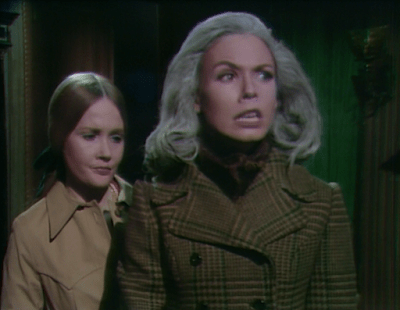
As if that did not present enough difficulty to Julia and Barnabas, one of Chris’ surviving victims is in town. She is his onetime fiancée, Sabrina Stuart. Two years ago, Sabrina saw Chris as the werewolf. She hasn’t told anyone about him, because she hasn’t been able to speak since. Her hair turned white, her skin turned pale, and she has been nearly catatonic.
Others have encountered the werewolf, and none has had this reaction. It’s true that Chris’ cousin Joe had to be taken to a mental hospital after he saw the transformation, but Joe had just been through a very long train of supernaturally induced traumas that had shattered his sensibilities and taken away everything he cared about. Seeing Chris change was just the last step in that process. Sabrina, as we see in a flashback segment today, was fine until she encountered Chris as the werewolf, and she didn’t even see the transformation itself. Yet here she is two years later, unspeaking, immobilized, and wearing the same makeup that Eli Wallach wore as Mr Freeze in the 1960s Batman TV show.
In a comment on Danny Horn’s post about this episode at Dark Shadows Every Day, “Cole” speculates that the show might have meant to tell us that the real reason Sabrina’s condition is less to do with what happened that on night in Chris’ apartment than with her brother and sole caretaker, Ned, played by Roger Davis:
I am once more getting through the Ned/Sabrina scenes thanks to this blog and the comments here; and although I still have to frequently avert my eyes from the screen to hold back the nausea, I keep concentrating on the dialogue while speculating further on JRM’s theory.
It does seem that we– and Julia– might be meant to feel especially concerned by Ned’s refusal to even consider allowing Sabrina to stay at Windcliff. He even says (or, rather, since it is Roger Davis, he SCREAMS), ”I won’t be separated from her!”
I don’t think his character is meant to be overly suspicious of Julia and Barnabas so the vehemence behind his already rather alarming declaration becomes more baffling unless the viewer concludes he has … extremely unnatural feelings of possessiveness towards sad, PTSD-afflicted Sabrina.
It is almost half as frustrating as it is disturbing because, with any other actors, we would surely know for certain how to interpret these scenes.
We would perhaps recognize that when Sabrina stares pleadingly at Julia once Ned leaves the room, that her muteness is caused as much by her horror at being an ongoing victim of her brother’s unspeakable abuse as by having once witnessed Chris’s transformation into a werewolf. We wouldn’t wonder, instead if the actress, Lisa Richards, is actually pleading with Hall to help her endure Davis’s deliberate act of molesting and assaulting her through out these scenes.
If it wasn’t Roger Davis in this role, we would know who Ned is really meant to be since there is no way any of the other regular male cast members would willingly subject their costars to type of abuse Davis is inflicting on Richards.
If it were … say, Jerry Lacy who was currently playing “Ned Stuart” in a manner even remotely similar to Roger Davis’s ‘interpretation’ of the role, we would recognize at once that the character of Ned is obviously scripted to be an incestuous rapist (and I am sure Lacy would still keep his hands professionally and respectfully away from Lisa Richards’s/”Sabrina’s” breasts, instead using actual acting techniques to portray his character’s warped nature). But with Davis ..
It really could be, as Mary commented below, that he is trying to get the poor actress to break character. And how could we expect other than that he would use his usual disgusting and violent Drumph-like/”‘you can grab them by the pussy” sense of Curtis-granted entitlement to assault her as “Ned,” regardless of the intent of the writer and director.
Either way, what a horrifically mistaken choice in casting.
Lisa Richards: fifty years later, I am thinking of you and hoping you weren’t forced to endure PTSD after filming these scenes with Davis.
Comment left 29 August 2021 by “Cole” on “Episode 698: Sister Act,” Dark Shadows Every Day, Danny Horn, 8 August 2015
When I mentally recast the many parts Roger Davis played on Dark Shadows, I divide them between two men who were background players in the show’s first months. I imagine Fredric Forrest playing the two characters with aliases, Peter Bradford (a.k.a. Jeff Clark) and Charles Delaware Tate (a.k.a. Harrison Monroe.) Forrest excelled both as a quietly intense man under pressure and as a sweet, goofy, overgrown kid. In the hands of an actor who, unlike Mr Davis, could project those qualities, those two unloved characters might both have become fan favorites. His other two parts, Ned Stuart and Dirk Wilkins, would have been perfect for Harvey Keitel, who is unsurpassed as a man who is agitated by a deep anger that he himself barely understands and that he certainly cannot explain to anyone else. Not that it’s any secret why Ned is angry at Chris, but when he takes a break from pawing at Sabrina’s face and breasts he handles her so roughly that he is obviously angry with her, and that is something he isn’t going to be giving any thought.
Mr Davis’ behavior wasn’t much better in episodes directed by Lela Swift and others, but it is little surprise director Henry Kaplan didn’t rein him in. Kaplan directed with a conductor’s baton, and actresses complain that he would jab them with it. When the person in charge has that light a regard for women’s personal space, it’s no wonder a creep like Mr Davis felt free to rub himself all over Ms Richards.
Chris Jennings is a werewolf, a fact which old world gentleman Barnabas Collins is helping him conceal. Two years ago, Chris’ fiancée Sabrina Stuart chanced to see him transform; she hasn’t been able to speak since. Her hair turned white, and she is in a nearly catatonic state. Sabrina’s brother, a very loud man named Ned, has brought her to the village of Collinsport and keeps demanding that Chris visit them and explain what happened.
There is a full moon tonight, so Barnabas has sealed Chris up in the secret chamber hidden in the old Collins family mausoleum. He tells Chris that he will try to persuade the Stuarts to leave town and forget about him. Chris tells him that is impossible; Barnabas seems to believe he can pull it off.
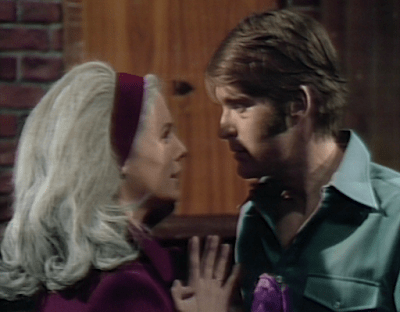
In the Stuarts’ suite at the Collinsport Inn, Barnabas tells Ned that he is harming Sabrina by taking her along on his mission to confront Chris and that he ought to take her home and move on with his life. Preposterous as this is, Ned makes it seem credible. To be more precise, it is actor Roger Davis who makes it seem credible. He rubs himself all over Lisa Blake Richards’ scalp, face, and chest while she is required to remain motionless. To the extent that we accept them as their characters, we are forced to think of Ned as a caretaker who abuses his disabled sister sexually; to the extent that we recognize Mr Davis’ behavior as typical of his previous performances on Dark Shadows, we wonder how bad things were for women in show business in the late 1960s that Miss Richards didn’t contact the union and bring him up on charges. It isn’t every performer who can make an audience sympathize with an ex-vampire’s attempt to keep a woman in a comatose state lest she endanger his werewolf buddy, but you can always trust Mr Davis to enlist the viewers’ support for any plot development that will get him off the screen.
I wonder how much of that look is Barnabas reacting to Ned’s story and how much is Jonathan Frid wondering if he should stop tape and call Equity. Screenshot by Dark Shadows Before I Die.
There are also some indications that the show is firming up some of its world-building. For the first time, we hear the name “Edward Collins” as the grandfather of the senior generation now resident at the great house of Collinwood. We hear that Edward was the father of Jamison Collins and the brother of Quentin Collins. Quentin was first mentioned months ago as Jamison’s uncle, but on Friday Barnabas had a line identifying him as his brother, suggesting some behind-the-scenes wavering about this point. Quentin’s ghost is the chief villain in the current A story, and we heard several weeks ago that he wants to turn strange and troubled boy David Collins into a replica of Jamison, so these relationships are important to the action.
Longtime viewers will have fond memories when stuffy Roger Collins sees a book open by itself on the table in the drawing room of the great house. The same book opened itself on the same table in #52, one of the first unmistakable signs that ghosts were at work. No one but the audience was around to see that, but when it happened again in #182, Roger was there. It jolted him out of his refusal to face the facts about the supernatural menace operating at that time.



 Dark Shadows Commentary