In the great house on the estate of Collinwood, reclusive matriarch Liz and instantly forgettable young lawyer Frank worry about where well-meaning governess Vicki has got to. Since Vicki is a witness in the investigation of the death of beloved local man Bill Malloy, and she has been the target of at least two attempted assassinations in the last 24 hours, the sheriff and his men are searching the grounds of Collinwood looking for her.
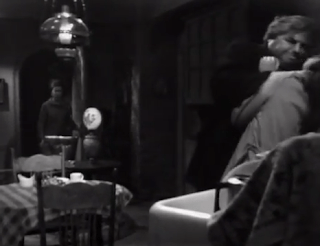
As it happens, gruff caretaker Matthew is holding Vicki prisoner in his cottage on the estate. Matthew had blurted out a confession that he killed Bill, and has now decided he must kill Vicki to keep her quiet. Vicki tries to persuade Matthew that he will be better off with her alive, but he will not change his mind. As he is putting his hands around her neck with the stated intention of breaking it, the door opens. Liz enters. Startled, Matthew unhands Vicki. She tells Liz that Matthew killed Bill and is about to kill her.
Art Wallace’s original story bible for Dark Shadows, which circulates under the title Shadows on the Wall, had called for Liz’ brother, high-born ne’er-do-well Roger, to be exposed as a murderer and a deadly threat to Vicki. Roger would fall to his death in the course of his final attempt on Vicki’s life. That was still possible a week ago.
Now that we’ve heard Matthew’s confessions, we know that Roger isn’t going anywhere. Not only does that keep one of the show’s most engaging actors, Louis Edmonds, in the cast; it also opens a long list of story possibilities. Perhaps Roger and Vicki will reenact the climax of Jane Eyre, and the dark-haired governess will marry her charge’s father. Perhaps the horrendous relationship between Roger and his son, strange and troubled boy David, will improve in some way, or perhaps David will make another attempt to kill his father. Certainly we can expect more scenes between Roger and Liz, as the show plays out the first of its signature relationships between Bossy Big Sister and Bratty Little Brother.
Further, Liz tells Frank and the sheriff that there are three residences on the estate- the great house, the Old House, and the caretaker’s cottage. One of Matthew’s previous attacks on Vicki took place at the Old House, and we’ve twice seen a ghost there who is clearly marked as someone who will be coming back again. Vicki is trapped in the caretaker’s cottage now, and the great house is the main setting for the series. By listing the three locations in this way, Liz is telling the audience to expect to see more of each of these sets, not just in this storyline but in the stories to come.
Dashing action hero Burke Devlin visits the sheriff in his office. He brings the sheriff up to date on the recent threats well-meaning governess Vicki has faced. He also tells the sheriff that Vicki had found a pen belonging to Burke on a beach, and that he thinks that high-born ne’er-do-well Roger Collins dropped the pen there while murdering beloved local man Bill Malloy. Burke also thinks that Roger is the one who has been menacing Vicki. He asks the sheriff if he will play along with a scheme that might put some “concrete evidence” behind his beliefs.
In the great house of Collinwood, Roger faces a series of very sharply pointed questions about Vicki’s problems from his sister, reclusive matriarch Liz. He denies everything, including things Liz can prove to be true. He tries to say that Vicki is untrustworthy because she claims to have seen a ghost dripping wet seaweed on the floor in the west wing of the house. Liz reminds Roger that they investigated that claim, and found the wet seaweed just where Vicki said it would be.
The sheriff and Burke show up at the house. In the mood established by their conversation, Liz and Roger are left feeling trapped and small, as this shot none-too-subtly shows:
The sheriff asks to see Vicki. Liz explains that she gave her a sedative and sent her to bed. He then questions Roger and Liz about the stories Burke has told. Liz downplays Vicki’s experiences; Roger makes another attempt to sell the idea that Vicki is nuts because she claims to have seen a ghost. When Burke brings up the topic of the pen, Liz is at a loss- it is the first she has heard of it. Roger tries to brazen it out. When Burke produces a pen identical to the one Vicki found, he flails and finally denies that the pens are at all alike. The sheriff asks Liz to send both Vicki and flighty heiress Carolyn to his office first thing in the morning to examine the pen.
Liz tells Roger that she is confident Carolyn and Vicki will tell the sheriff the truth. When he tells her he needs time to think, she replies that he doesn’t need any time to think of more lies. He declares that there is something he must attend to immediately, and rushes out of the house. Liz watches her little brother leave the house, frustrated in her attempts first to correct his behavior, then to shield him from its consequences.
Roger goes to the peak of Widow’s Hill. He had stolen the pen Vicki found and buried it under a rock there. He digs it up. As he looks at it, Burke and the sheriff appear and thank him for saving them a lot of trouble.
Art Wallace’s original story bible for Dark Shadows had called for Roger to have his final scene on this spot. Vicki was to have found evidence that would send Roger to prison, he was to attempt to kill her by throwing her off the peak of Widow’s Hill. She would avoid that fate when Roger instead went over the cliff himself. As it has worked out, Louis Edmonds is too appealing an actor to lose. So Roger stays on the show as a suspect in an investigation, perhaps as a defendant in a trial. It won’t be the last time Dark Shadows extends an attractive villain’s stay on the show by playing out different events on the set where his story was originally meant to end.
High-born ne’er do-well Roger Collins is desperate to get rid of his son’s governess, the well-meaning Vicki, before she discovers his dark deeds. Sometimes he’s simply unpleasant to her. Twice he’s offered to bribe her to leave. Once he pretended to be a ghost in order to scare her off, not knowing that she had just seen a real ghost who warned her to leave the house before she was killed. Occasionally he turns on his very considerable charm in his efforts to convince her that she ought to leave; she usually sees through these efforts quickly, and he is left in a weaker position than he was before.
Yesterday, Vicki was in Bangor, Maine, fifty miles from her home in the great house of Collinwood. While waiting for dashing action hero Burke Devlin to give her a ride home, she realized that the pen she found on the beach some weeks ago must have belonged to Burke, and jumped to the conclusion that Burke dropped it there while murdering beloved local man Bill Malloy. Frightened, she called Roger to come and get her.
Today, Roger is driving Vicki home in a heavy rainstorm. Returning viewers know that Roger was in possession of such a pen, that he lost it the night Bill died, and that he is terrified the pen Vicki found will lead to disaster for him. We also know that he is a vicious man who will stick at nothing to protect himself.
Vicki knows none of these things, but she does know that Roger and Burke are sworn enemies. Therefore, she is surprised when Roger tells her that the pen isn’t really evidence of anything. After all, it was two days after Bill’s death that she found it- Burke could have dropped it there after Bill went into the water, or long before. She is even more surprised when he urges her to forget the whole matter and never again to mention the pen to anyone. Roger can imagine a scenario in which Burke might have killed Bill, and even says that he thinks it is likely, but he tells her that with no more evidence than she has there is nothing to be gained by challenging the coroner’s verdict that Bill’s death was an accident.
When Vicki asks Roger why he is leaving the main road in the midst of the storm, we might wonder if he has laid some dastardly plot. On the dark, flooded back way, they quickly find themselves trapped. Roger leaves Vicki in the car while he takes his flashlight to look for shelter. He returns and describes an abandoned shack he claims to have spotted just then. His description of it is so detailed that we cannot help but suspect that he has been there before, and that it figures in an evil plan of his. Roger defuses that suspicion, though, when on his own initiative he leaves a note inside the windshield of the car directing any passersby to the shack.
When they enter the shack, Roger teasingly says “I should have carried you over the threshold.” Vicki instantly responds “But you are married.” With a sour look, he answers “If you can call it that.” After a bit of conversation about Roger’s unhappy domestic situation, they sit close together. Vicki tells Roger that she wonders if his son, strange and troubled boy David, got his unscrupulousness from his mother. “You’re nothing like that,” she says. While they huddle together, Vicki asks Roger to tell her all about himself.
Despite her previous wariness of him and her prompt reminder to him today of his marital status, it would seem that Roger could make quite a bit of progress with Vicki if he were to forget his other methods of persuasion and concentrate on charm. In episode 78, Roger even took Vicki on a date. That didn’t amount to much, but at the end Roger promised to take Vicki out again and she seemed interested. Watching them together in this one, we wonder if they might at some point get together. Vicki the foundling-turned-governess is obviously modeled on Jane Eyre, and Roger is not only her charge’s father, but the name “Roger” even sounds like “Rochester.” A relationship with Roger wouldn’t involve living happily ever after, but that’s a difference of genre- characters in novels might get happy endings, but characters on soap operas don’t get any endings at all, not unless they’re killed off the show.
In Art Wallace’s original story bible for Dark Shadows, called Shadows on the Wall, Roger was supposed to be killed off early on, while trying to murder Vicki to prevent her exposing a crime of his. It was also supposed to be revealed that Vicki was the illegitimate daughter, not of any member of the ancient and esteemed Collins family, but of the estranged husband of Roger’s sister Liz. That wouldn’t make much sense- the Collinses are the center of the show, and Vicki is the main character. If she’s going to be anyone’s long-lost love child, it should be Liz’. And indeed, Alexandra Moltke Isles and Joan Bennett look very much alike, a resemblance the camera work often emphasizes. But, if Roger isn’t going to die soon, establishing that Vicki is not a blood relative would leave the path open to a marriage between them.
Of course, if Liz is secretly Vicki’s mother, that would be the perfect background for a soap opera engagement between Vicki and Roger. Liz would find herself forced to choose between revealing her terrible secret or allowing her daughter to marry her own uncle. In a later decade, a show might let the characters get married and reveal the family relation years later, but I don’t think ABC’s Standards and Practices department would have signed off on that one in the 1960s.
If there is going to be a Vicki/ Roger romance, it isn’t going to start today. Roger answers Vicki’s question about what he wants in life by saying that at the moment he only wants two things- for them to be rescued, and for her to leave Collinwood. He tells her that he is worried that she is in mortal danger if she stays. David has tried to kill her; he’s tried to kill Roger too, come to that. Previously, Roger has urged her to get away before he succeeds. But today, she isn’t thinking of David. She asks if Roger really thinks Burke is a deadly threat to her. He pauses long enough to make us wonder if he’d been planning to talk about David, then decides to run with what Vicki’s given him. He dwells on Burke’s temper as Vicki has witnessed it and tells her that he has seen even worse displays. When she says that she finds it difficult to believe that Burke would kill her, he says that he’s sure Bill Malloy found that difficult to believe as well. This gets her back to the idea of telling the police about the pen. When she protests that not telling them would be withholding evidence, his charm breaks down and he shouts “Then withhold it, you little idiot!”
His previous attempts at suavity had also ended in name-calling. On those occasions, he could only apologize while Vicki regarded him coolly. This time, he bounces back and continues to press Vicki with claims that he’s thinking of her safety. She is looking very doubtful, though, as if something is dawning on her. After a moment, the sheriff appears at the door. He tells Roger that he and his men were in the area, noticed Roger’s car, and followed the directions on the note he left in the windshield. He notices that Vicki is deep in thought. He asks her what’s on her mind. After a long hesitation, she gives a meaningless response, telling him nothing about the pen. But we know that she has asked herself a question, and that the answer is going to mean trouble for Roger.
Last week’s episodes established that high-born ne’er-do-well Roger Collins and dashing action hero Burke Devlin are both unpredictable men capable of real cruelty, and that our point of view character, well-meaning governess Vicki Winters, is about to find herself in the middle of a conflict between them. Today, we see that Roger and Burke’s conflict will take the form of a lot of prattling about a fountain pen.
As we open, Vicki is starting a math lesson with her charge, “strange and troubled boy” David Collins. David, son of Roger, has been studying his crystal ball, hoping to find evidence implicating his hated father in murder. Unknown to either of them, Vicki may have stumbled upon just such evidence. While taking a walk on the beach at Lookout Point, she found a fountain pen that Roger may have left there during a homicide. All Vicki knows is that the pen looks nice. She is in a happy mood, and teases David with jokes about the pen. As usual, David refuses to laugh or to cheer up in any way, but he is impressed that the pen looks to be very pricey.
Vicki reclaiming the pen from David
In the restaurant at the Collinsport Inn, Burke invites himself to sit at the sheriff’s table. Perhaps Burke has a crystal ball of his own- he has somehow developed a theory that Roger left the pen on the beach at Lookout Point while killing beloved local man Bill Malloy. The sheriff is unimpressed with Burke’s theory and bored with the whole topic of the pen. In this, he is the voice of the audience. On his blog Dark Shadows Every Day, Danny Horn lists 21 episodes that are largely or entirely dedicated to talking about the pen. I believe it is uncontroversial among Dark Shadows fans to say that 21 episodes was too many for this theme.
Knowing that Vicki has the pen, Roger is close to panic. He succeeds in his second attempt to steal it from David’s room. Between the two attempts, he has offered Vicki thousands of dollars in cash if she will go away and take a job with friends of his in Florida. He has also complied with Burke’s telephoned demand that he go to town and participate in a confrontation about the pen. During this confrontation, the sheriff happens by and earns a cheer from all of us by telling Burke to find another topic.
As the Saga of the Pen begins, the idea that Roger will be exposed as a murderer generates a measure of excitement. Our desire to see justice triumph is in conflict with the fact that Roger is so much fun to watch that we don’t want him to face any consequences that will remove him from the core cast. That is the sort of conflict an audience experiences as suspense.
Today, though, the suspense is blunted. The coroner has ruled Bill Malloy’s death an accident, so the sheriff doesn’t have a case to investigate. Even if there were still a homicide case pending, there is no way of proving that the pen was left on the beach that night. Bill died many days before Vicki found the pen. In that interval, a person, an animal, or the tides could have moved the pen a great distance.
Roger’s conflict with Burke is similarly unconvincing. Burke has searched Lookout Point and knows the pen isn’t there now, and he has no reason to think that it ever was there. He had no reason to summon Roger to town, nor did Roger have any reason to come.
At times, the writing seems to be deliberately tedious. Both the word “pen” and images of the pen are repeated countless times. The sheriff’s exasperation with the topic gets a great deal of screen time, and Roger’s labeling of it as an “endless conversation” is the only memorable phrase in his whole scene with Burke.
The pen was first introduced in episode #42, the second episode written by Francis Swann. Episodes 1-40 were all credited to Art Wallace, who also wrote the original series bible, Shadows on the Wall. Neither the death of Bill Malloy nor the pen is in Shadows on the Wall; those may have been among Swann’s contributions. This is Wallace’s last week on the show. Swann will stick around for another month, leaving after episode #113. I wonder if the tedious parts of today’s script are Wallace’s refusal to try to make Swann’s inspiration interesting, or if they are a positive warning to Swann and the writers who are about to come on board that the Saga of the Pen is going to bore the audience silly unless they rethink it radically.
Marc Masse’s Dark Shadows from the Beginning is in one of its accessible phases now, and his discussion of episode 2 includes some interesting comparisons between the finished episode and Art Wallace’s story bible for the series, Shadows on the Wall. For example:
Here is Art Wallace’s introductory description of Joe in Shadows on the Wall: “Joe Haskell is twenty-one. A rugged New Englander with a deep love of the sea, Joe is a young man of natural dignity and quiet ambition.”
But the viewer’s first impression of Joe Haskell is that of a sap, cuckolded into brooding over a mug of beer while his date plays the field before his very eyes.
And:
During the scene with Elizabeth and Carolyn in the drawing room, episode writer Art Wallace lifts two of Carolyn’s lines directly from his story outline in Shadows on the Wall. These are: “Besides, how do you expect me to go away and leave you alone in this beautiful nuthouse?” and “All I can say for her, mother, is she must be out of her mind.” In the story outline, the lines are written as “Besides, how do you expect me to get married and go off and leave you alone in this beautiful nuthouse.” and “All I can say for her is she must be out of her mind.”
The scene at the Blue Whale and Carolyn’s mood when she arrives home and the topic of discussion with her mother coincide exactly as given by Art Wallace in Shadows on the Wall: “Carolyn’s in a vile mood. The boy she’d been with had been a dud….had started an argument in the juke joint. There’d been a free-for-all, and her evening had been ruined.”
Then:
In this episode Elizabeth is seen playing the piano in the drawing room. The reason for there being a piano in the drawing room comes from the character of a previous work by Art Wallace, which he drew on when creating the character of Elizabeth Stoddard. In The House, a one-hour production for NBC-TV’s Television Playhouse broadcast on September 8, 1957, Caroline Barnes is a wealthy recluse in a New England fishing village who occupies her time as a piano teacher.
In Art Wallace’s story outline for Shadows on the Wall, when Victoria Winters arrives at Collinwood it is the month of October.
In later posts, Masse will clarify that the 1957 version of The House was actually Wallace’s second treatment of the story that would later give rise to the characters of Elizabeth and Carolyn Stoddard. Three years before, a thirty-minute anthology series called “The Web” had broadcast his first version of it. That version, as shown at a Dark Shadows convention, has been posted on YouTube:



 Dark Shadows Commentary