
The first major villain on Dark Shadows was high-born ne’er-do-well Roger Collins, played by Louis Edmonds. Edmonds was a master of the sarcastic remark, so that Roger was often funny. But no matter how often he made the audience laugh, Roger was never a comic villain. That requires a character we can empathize with as we watch them scheme and plot, scramble and improvise, in pursuit of goals that could not be achieved without ruining all the fun. We laugh when we recognize our own foibles in an outlandish character, and laugh again when we realize that our ability to feel with others encompasses even those whose feelings have led them to do dastardly deeds.
Roger’s personality was too cold, his motives too contemptible for us to empathize with him. Where a comic villain thinks fast and puts himself in ridiculous situations, Roger stuck with his fixed ideas, using the same tactics time and again to bully his unwilling co-conspirator Sam to stick with their plan. Even when he bumbled about with a damning piece of evidence, a fountain pen left at a crime scene, he was never the coyote caught in his own over-elaborate trap, but a criminal in a police procedural. He was a melodramatic villain who was only incidentally funny.
The first supernatural menace on the show was Roger’s ex-wife, undead fire witch Laura Murdoch Collins, played by Diana Millay. Millay was hilarious, every bit as funny as Louis Edmonds. It was a shame the two of them didn’t play a married couple in a long-running comedy. They could have raised sarcasm to heights previously unknown to humankind. But while Millay gets laughs every time the script gives her the least chance, Laura was even less of a comic villain than Roger.
It is clear that Laura is a malign presence from beyond the grave and that, if she is not stopped, she will burn her young son David to death. But everything else about her is an impenetrable mystery. She is not part of a familiar mythology, and even the most basic questions about her remain unanswered. We cannot empathize with her motives, since we cannot begin to guess what her motives are or even be sure if she has motives.
The first comic villain on Dark Shadows was seagoing con man Jason McGuire, played by Dennis Patrick. Jason had his first comic turns only after he had been on the show for weeks, during which time we had been subjected to many iterations of a dreary ritual in which he made a demand of reclusive matriarch Liz, Liz resisted, he threatened to expose her terrible secret, and she capitulated. When his henchman Willie slips out of Jason’s control and he starts scrambling to contain the damage Willie is doing to his plan, Patrick finally gets a chance to play Jason as a comic villain, and the result is very engaging. But those scenes are scattered too thinly through Jason’s long-running, relentlessly monotonous storyline to make him a success as a comic villain.
Now, the show has struck gold. Vampire Barnabas Collins is becoming a pop culture phenomenon and bringing the show the first good ratings it has ever had. They have to keep Barnabas on the show indefinitely, and he has to be the most important character. That presents a practical difficulty. Vampires usually figure in folklore and fiction as unstoppable killing machines. Daytime soap operas explore the shifting relationships among large casts of characters. It’s going to be hard to maintain that cast if Barnabas sets about murdering everyone. To square the circle, they try to redefine Barnabas as a comic villain.
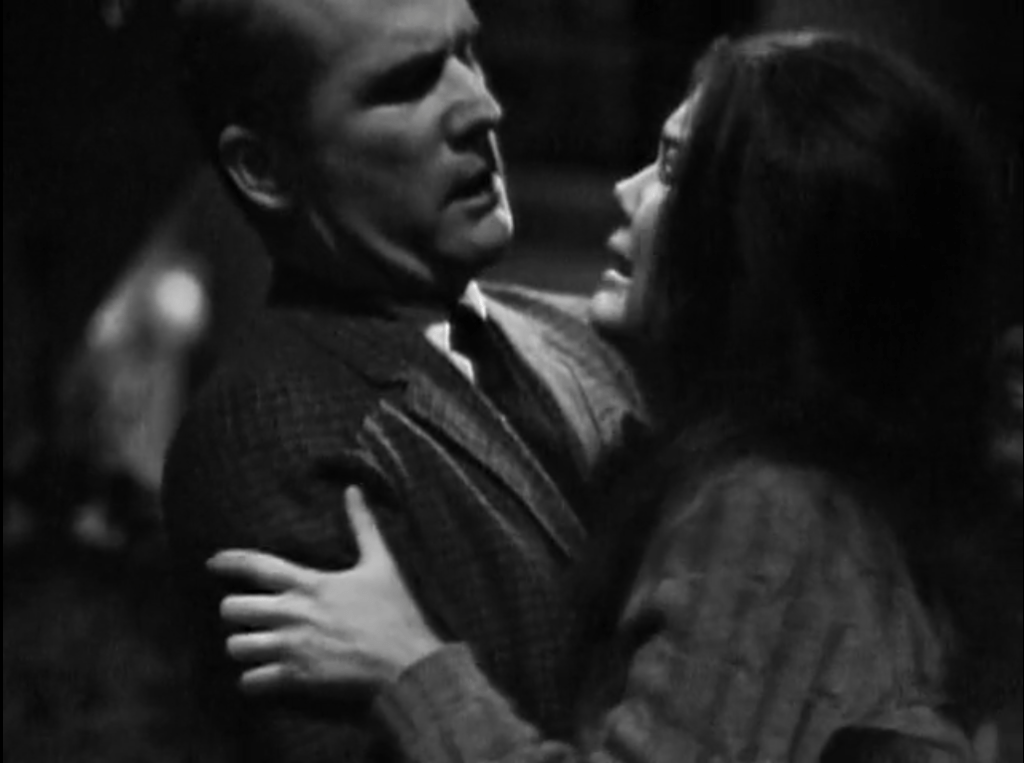
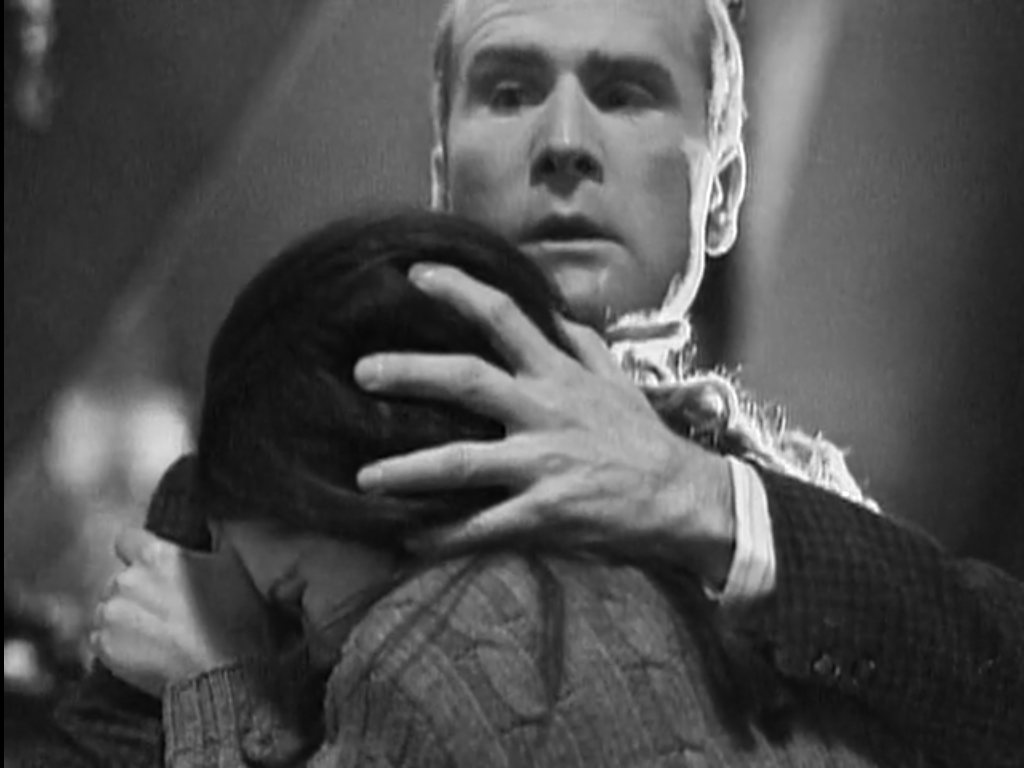
Barnabas is giving a costume party for his distant cousins, the living members of the Collins family. He has invited well-meaning governess Vicki to attend and to wear the dress of the legendary Josette Collins. In the first 39 weeks of Dark Shadows, Vicki had developed a close friendship with Josette’s ghost, so she is excited about this. For his part, Barnabas has borrowed an evil scheme from the 1932 film The Mummy. He will erase Vicki’s personality and replace it with Josette’s, then kill her so that she will rise as a vampiric Josette. So he is glad she likes the dress.
Barnabas asks Vicki to come to his house and help him pick out the antique clothes that the family will wear at the party. She enthusiastically agrees, saying that she loves to go through trunks full of old clothes. The clothes are in a trunk in Josette’s old room, which Barnabas has restored.
In the room, we see the ghost of Barnabas’ 9 year old sister Sarah sitting on the trunk. She vanishes a second before Barnabas and Vicki enter. Both of them have a strong feeling that someone just left the room. Barnabas tries to dismiss the sensation as nervousness, but Vicki has had too much experience with ghosts to be put off so easily.
Vicki has been our point of view character for most of the series. At first, that was because she was a newcomer to the great estate of Collinwood and the nearby town of Collinsport, and so we would learn everything we needed to know as we listened to people explain things to her. Later, it was because she was the key protagonist in the stories, so that the action got going once she knew what was going on. So when Barnabas equals Vicki’s sensitivity to Sarah’s presence, he is presented to us as another possible point of view character.
Barnabas keeps talking about the Collinses’ eighteenth century ancestors in terms that make it obvious that he knew them, so that he more than once has to clean up after himself with remarks like “I would imagine.” He does alarm Vicki when he blurts out something about what will happen to her should she “become Josette.” He hastens to say that he means that Vicki will become her for the duration of the party.

Vicki goes back to the great house and talks with Liz about the party. Liz smiles happily, the first time we’ve seen this expression on her face in the whole run of the series.

Vicki goes on about Barnabas’ connection to the past, saying that he gives the impression of someone who really is misplaced in time. She has the feeling that he needs to recreate a bygone era, and that he is doomed to be unhappy because of the impossibility of traveling backward in time. Vicki does not know what Barnabas’ plans for her are, but she understands his motives perfectly and empathizes with him deeply. That Vicki, Barnabas’ intended victim, can feel this way suggests that we can, too.
Back in Barnabas’ house, Sarah reappears in Josette’s room and sees her blue dress. She is excited to find it. She looks at her reflection in the mirror and smiles. Her good cheer is emphasized when her musical cue, an excerpt from “London Bridge,” is for the first time played in a major key.

The minor key was appropriate during Sarah’s previous appearances. The first several times we saw her, Sarah was associated with Barnabas’ imprisonment of Maggie Evans, The Nicest Girl in Town. Maggie was the victim of Barnabas’ first mad attempt at Josettery, and Sarah intervened just in time to keep Barnabas from killing her. The other day, Barnabas killed Jason, and we saw Sarah when Barnabas was forcing Willie to help him hide his old friend’s corpse. Barnabas isn’t killing anyone today, so Sarah can be a bit more cheerful.
Sarah helps to establish Barnabas as a comic villain. As the ghostly sister who returned to the upper world when Barnabas was loosed to prey upon the living, Sarah and he are part of the same eruption from Dark Shadows‘ supernatural back-world into its main continuity. Perhaps she personifies his conscience, certainly she gives him an occasion to make schmaltzy speeches about his days as a human. More important than either of these, when we see that Barnabas’ 9 year old sister is his most powerful adversary, we begin to wonder just how seriously we should take him.
Closing Miscellany
Yesterday and today, Alexandra Moltke Isles delivered the recorded voiceover monologue at the beginning of the episode. The first 270 times she did this, it was in character as Vicki. Now, they’ve given up the idea that Vicki or any other one character will eventually find out about everything that we see on screen, so the openings are delivered by whatever actress is available as a nameless external narrator.
In those first 270 outings, Mrs Isles sounded like Vicki. She adopted Vicki’s distinctive way of speaking, carefully articulating one word at a time and often ending sentences with surprising little inflections- a curl of uncertainty here, a touch of breathy optimism there, a falling note of despair in another place. The voiceovers were usually remarks about the weather or the sea that were supposed to involve some vague metaphor for events in the story, so that it is open to question whether it was really worth Mrs Isles’ time to put so much effort into creating a character with them. But I guess a pro is a pro, and it was a matter of course that she would do her best no matter how little she had to work with.
In these last two, she has used a relatively flat voice, with none of Vicki’s particular vocal traits. The pacing has been structured, not around sentences, but around an attempt to convey an overall sense of urgency. They sound very much like The Narrator. I wonder what Mrs Isles would have made of The Narrator if the voiceover passages had extended beyond the opening moments and run through the episodes.
There is a famous production error under the closing credits, when a stagehand shows up in the window, realizes he’s on camera, and makes himself all the more conspicuous when he tries to escape from his predicament.



 Dark Shadows Commentary