
Episode 61: A sandwich for a lonely man

My wife, Mrs Acilius, pointed out that my post about episode 60 was unfair. She objected to the sentence “The Friday cliffhanger is Burke asking if he may join the Evanses and Vicki for dinner.” As she explained, that moment actually is an effective cliffhanger. I hadn’t mentioned that the sheriff had called drunken artist Sam Evans to warn him that dashing action hero Burke Devlin might be coming to his house, that he urged Sam to call back if Burke did come, and that actor David Ford played Sam’s reaction to this call with a convincing display of terror.
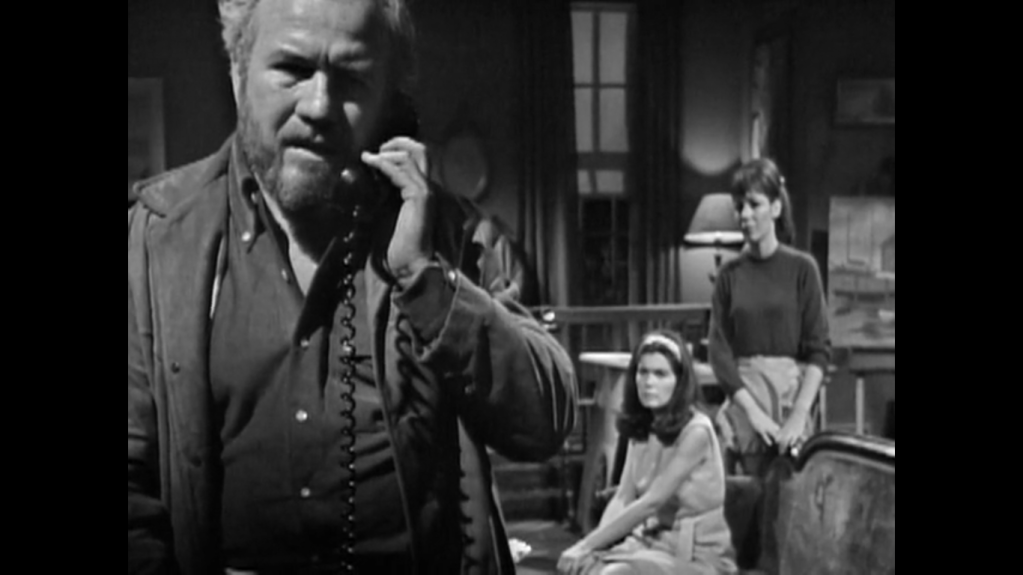
Sam on the phone
Sam trying to conceal his fear from the women behind him and the man on the other end of the call

I also failed to mention the shot when Burke enters the room. Before Sam can get the words out to tell his daughter Maggie not to open the door, Burke has burst in. The scenes in the Evans cottage have been dimly lit, with all three figures moving before dark backgrounds. When the light colored door swings open, its relative brightness feels for a second like a flash, and when he stands in front of it Burke cuts a stark figure. We see him in contrast with Maggie, who stands against a dark background, wearing a dark top and a stunned expression:
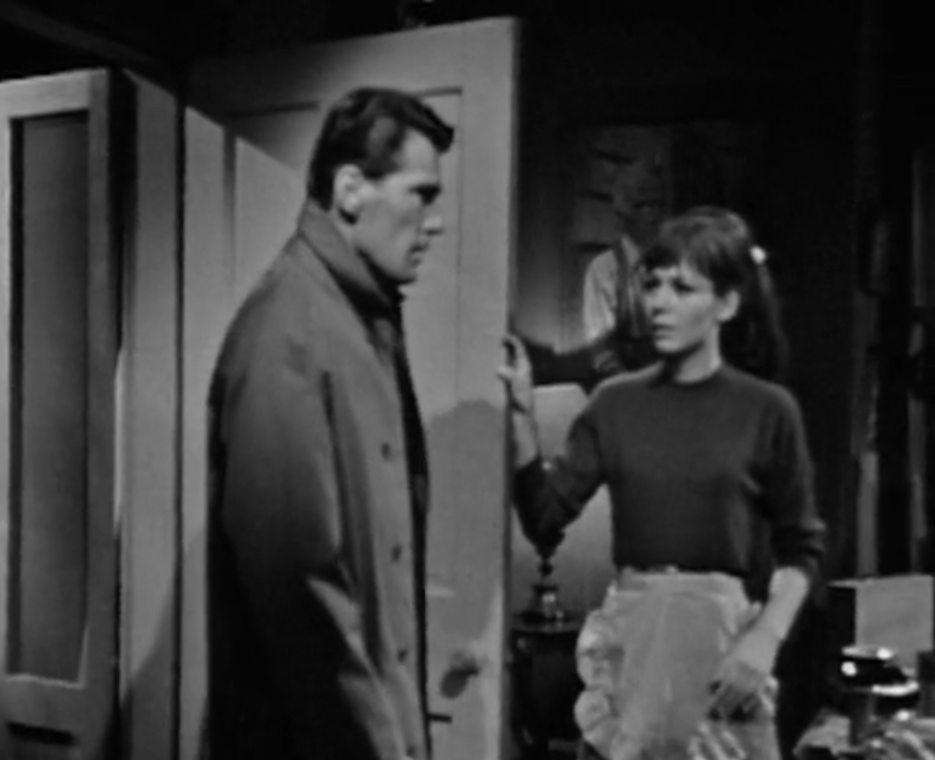
Burke enters
Burke enters the Evans cottage

Throughout the episode, Sam had failed repeatedly to exercise any measure of control even in a social situation in his own home where the only other people are his daughter Maggie and well-meaning governess Vicki, the two kindliest characters on the show. The irruption of Burke into that setting is indeed a formidable moment for Sam.

So yes, that was a more plausible Friday cliffhanger than I allowed. Perhaps I was prejudiced against it because I remembered this episode. The purpose of a cliffhanger is to bring the audience back for the next installment. Typically, the next installment will begin by resolving the cliffhanger as quickly and unceremoniously as possible. But today, Burke’s intrusion into the Evans cottage drags on and on. In the process, it does serious harm to Burke’s character.

After rushing into the Evans cottage, Burke defies Sam and Maggie to say that he isn’t welcome. Maggie, unaware of the sheriff’s call urging Sam to let him know if Burke shows up, breaks down and says that of course Burke is welcome. Burke then tries to order Vicki and Maggie into the kitchen so that he can be alone with Sam. Neither woman is at all meek, however, and they stand up to Burke’s browbeating admirably.

Not so Sam. He takes the first opportunity to run away. We know that Sam has his guilty secrets, but he is a likable character, and it is hurts to imagine the pain that will await him the rest of his life whenever he remembers the night he left his daughter and her sweet young friend to face an angry man alone in his house. Sam doesn’t even call the sheriff. Instead, in his panic he goes to the hotel to try to retrieve a sealed envelope he had Maggie leave in the safe there. That gives us a scene with Conrad Bain as hotel manager Mr Wells. Bain is always a delight, and his little business about the envelope is certainly the most pleasant part of the episode. At the end of the episode, Sam will meet Burke at the hotel and ask to talk with him alone in his room, leaving us with the image of him trying to redeem himself in his own eyes.

Before that end comes, however, we have much, much more of Burke trying to bully the young women in the cottage. He won’t let them eat dinner. He harangues them about his manslaughter conviction. In the course of that harangue, it becomes clear that he isn’t thinking at all clearly. “I was drunk and don’t remember too much about that night, but I do remember Roger Collins taking over the wheel.” That’s just delicious- he was hopelessly drunk, blacked out in fact, but he’s pretty sure he remembers giving the keys to someone else before the fatal collision. The fact that his substitute driver was just as drunk as he was doesn’t seem to occur to him as a flaw in his “defense,” nor does the fact that this one convenient piece of information is the only thing to surface from his alcoholic stupor. That sort of thinking runs at such an oblique angle to reality that there would be nothing to say to Burke even if he were willing to listen to you. He goes on to suggest to Maggie that her father may have killed their old friend Bill Malloy, and refuses to leave the house when Maggie tells him to do so.

Burke’s abuse of Sam, Maggie, and Vicki makes it hard for us to like Burke as much as the show needs us to like him. We’re supposed to perk up when he’s on screen, not only because we don’t know what he might do next, but also because we don’t know whether we will approve of whatever surprising thing he makes happen. Even when he is trying to destroy the family to which our point of view character, Vicki, owes her loyalty, we’re supposed to want to see more of him. But when we see him treat Vicki and Maggie the way he does here, the image of him as a grinning thug sticks in the mind, and it is hard to want more of that.

All the more so, perhaps, because of his ineffectiveness as a thug. Our first concern with the show is that it should tell an interesting story, and Burke earns our attention by providing exciting story points. We can like even a very evil character who makes exciting things happen, but someone who simply shows up at your house when you’re about to eat, keeps you from your dinner, rambles on with a lot of nonsense, insults your father, and refuses to leave is just testing your patience for bad conduct.

We can compare Burke as the villain of this episode to another, more interesting villain. Throughout 1966, Mitch Ryan was not only playing Burke on Dark Shadows, but was also on Broadway in Wait Until Dark. In that play, he was one of the con men who, under the control of a mysterious figure calling himself Harry Roat, junior (and senior, but that’s another matter,) talk their way into a blind woman’s apartment and try, at first by trickery and then by threats of murder, to get her to hand over something valuable that she hadn’t realized she had in her possession. Like Maggie and Vicki, the heroine of the play stands up to Ryan’s character and the other villains. She ultimately triumphs over them. Unlike Burke, who is simply indulging on rage for its own sake and boring everyone as he does so, Roat has devised a brilliantly clever scheme to trick his victim, a scheme which fails only because she is his equal in brilliance and his superior in other ways. Wait Until Dark was a major hit in that original Broadway run, as was the movie version the next year and as many revivals of it have been in the years since. If Roat’s activities were as pointless in the play as Burke’s are in this episode, I very much doubt it would have been produced at all.

Episode 34: You amaze me, Miss Winters

Everyone who is going to know that David tried to kill his father now knows it, and Liz has decreed that the incident will have no consequences. So we’re back to the basic story elements laid out in week one, as modified in subsequent episodes to make sure everyone had plenty of people to talk to.

Vicki is at the Blue Whale. Harvey Keitel is gone, but Burke is still there, so she sits with him. He asks her why she joined him. She looks off into space and says “Inches, feet, miles.” He tells her she reminds him of a drink that fizzes and foams, but he isn’t sure what kind. He asks what she’d like to have for dinner. She replies “I’d rather go to your hotel room.” He flashes the same dopey grin any fellow would in this situation, and says “You amaze me, Miss Winters.”

Vicki is supposed to be a street kid from NYC, so we can assume she knows how to go about finding inches when she wants them, and that she’s no stranger to feet, either. Miles may be in short supply in the city, but she’s willing to learn. It turns out that all she wants from Burke is a look at the report his private investigator prepared about her. In the hotel room, she tells him what the audience knows about her origins and about Liz’s refusal to give a straight answer to the question of why she hired her. She looks through the report, and says it doesn’t tell her anything she didn’t already know. He orders two steak dinners from the hotel restaurant.

A knock comes on the door. It isn’t room service; it’s Joe, come to repay Burke for settling his bar tab. Joe is about to tell Burke he still doesn’t like him, when Vicki comes out of the bathroom. Joe excuses himself, startled to see her. Vicki goes a moment later, leaving Burke alone, waiting for two steak dinners.

I summed up my reaction to this episode in a comment on John and Christine Scoleri’s Dark Shadows Before I Die:

“Miss Winters, you amaze me.” Me too! Any woman as young and attractive as Vicki in a town as small and gossipy as Collinsport would be the scandal of the month if she went unchaperoned to a bachelor’s hotel room. When the woman lives with and works for the richest family in town and the bachelor is their sworn enemy, “indiscreet” isn’t any fraction of the word needed to describe her boldness.

Burke has time and again talked about how gossipy Collinsport is. For example, in episode 27, he seemed almost unhinged as he told his associate Bronson about how deeply secretive his investigations of the Collins family holdings would have to be, since anything that happens in or near the town of Collinsport is immediately known to everyone there. So we have to assume that he plans to get everyone talking about his evening with Vicki.

At this point in the show, we usually have to guess what Burke’s plans are, and even when they are revealed we can’t decide whether they are good or evil. In the case of his attempt to get rumors going about himself and Vicki, I think it’s a little more straightforward. He keeps telling her she should get away from the Collinses and leave town. If the Collinses think she’s involved with Burke, Vicki is very likely to find herself on a train back to New York. Maybe not to the Hammond Foundling Home- Burke might have a little apartment in the East Village where Vicki can stay until she finds something…

Episode 30: What monsters we create

Thunder rumbles. The lights go out at Collinwood. Alone in the drawing room, Vicki lights a candle. The doors swing open, and a darkened figure stands in shadow. Vicki calls to the figure. It does not respond. The lights come back on. The figure has vanished. Roger happens by; he is the only other person in the house, but he is too tall to have been the figure.

This is the second occurrence in the series that is either a supernatural manifestation or an elaborate Scooby Doo-esque prank on Vicki. The first time, in episode 14, happened when David had taken the bleeder valve from the braking system on his father’s car, an event that would have dire consequences. We can assume that this second occurrence is telling us that we are about to see events that will stir up the supernatural back-world of Josette, the Widows, and heaven knows who else.

David had planted the bleeder valve in Burke’s room, trying to frame the family’s enemy for his own crime. When he spends a few minutes with Burke and takes a liking to him, he tries to retrieve the valve, not knowing that Burke has already found it and that he is carrying it in his pocket. In Burke’s car on the way to Collinwood, he pleads with Burke to go back to the hotel. He can’t give an explanation for his plea, and Burke refuses to turn back without one.

Vicki tells Roger that she had found the bleeder valve in David’s room, and Roger quickly accepts that his son had tried to murder him. When Burke brings David home, Roger takes David into the drawing room and demands he confess to his crime. Burke refuses to leave the house. Roger calls Vicki into the room; Burke insists on joining them. David calls Vicki a liar, Roger continues to browbeat him. We see a reaction shot of Burke in profile, standing in the doorway, watching the scene intently. Roger mentions the bleeder valve; Burke steps forward, and with a flourish produces the valve from his pocket. David’s face crumbles into absolute dejection.

Has Burke really betrayed David? Or is he playing some other game? We have to tune in next time to find out.

So, we begin with an indication that what follows will stir up the back-worlds, and then see an episode about the relationship between Burke and David. Roger describes Burke and David as “the two people I dislike the most.” Something Burke and David have in common, something that Roger cannot forgive, is going to bring the ghosts out of the woodwork and into the foreground.

Episode 29: The Burke Devlin Special

Today’s exercise in the Art Wallace school of compare-and-contrast juxtaposes Burke Devlin’s hotel room with the interiors of Collinwood. Burke is a bouncy, cheerful host to an unannounced visitor, David Collins; after a short time, David is happy and exuberant, the first time we’ve seen him smile about something other than hatred and murder. Vicki, Carolyn, and Liz are thoroughly miserable.

Liz still refuses to believe that David could be the one who sabotaged his father’s car, at one point suggesting that Vicki might have done it. That idea crumbles immediately in the face of Carolyn’s disbelief, and Liz offers Vicki an apology. But she still clings to the thought that David might somehow be innocent. Her refusal to face facts takes a depressing situation and robs it of all hope for improvement.

David has gone to Burke’s room to hide the incriminating bleeder valve there. He had originally set out a few episodes before, after Vicki found the valve in his own room but before the sheriff had searched Burke’s room. He was caught trying to sneak into Burke’s room before the sheriff got there, so it’s really too late for his plan to work. He goes ahead with it anyway, but tries to retrieve the valve from the cushion after Burke wins him over. That attempt fails as well- unknown to David, Burke has already found the valve and has it in his pocket.

I suppose a definition of “dashing” is a fellow capable of great charm who makes things happen, things which we cannot predict and of which, even when they have happened, we can’t be sure whether we approve. By that definition, Burke is at his most dashing in this episode and the next.