A while back, Tumblr user “marcycaa” posted this cartoon summarizing the relationships well-meaning governess Vicki has with strange and troubled boy David and flighty heiress Carolyn in the 1966 episodes of Dark Shadows:
Art by marcycaa
Today, Vicki is being held prisoner by the fugitive Matthew, and Carolyn and David are off their leashes. Carolyn telephones dashing action hero Burke to complain that her mother and uncle don’t want her to see him. Burke reacts with disbelief that Carolyn is nattering on about that when Vicki is missing and might be dead.
David is the only one who knows where Matthew is. He is taking food and cigarettes to him. He has begun to suspect that Matthew has Vicki, and is afraid that he will kill her. This fear contends with his fear that he will go to jail for harboring a fugitive. He sneaks off to see Burke to seek reassurance. When Burke asks him what he wants, he says that he wants Burke to tell him that Matthew is innocent and that his hated father, high-born ne’er-do-well Roger, is responsible for everything Matthew has been accused of. When Burke can’t do that, David slips away.
Back in his hiding place in the Old House on the estate of Collinwood, Matthew lies down on a mattress next to the chair to which he has bound Vicki. Before he can get to sleep, he hears voices calling his name. The portrait of Josette Collins glows, eerie music plays, and one of the voices identifies itself as Josette. Vicki can hear none of this and tells Matthew that he must be dreaming. He wants to agree with her, fearing that the only alternative explanation is that he is going mad.
The audience knows that the ghosts are real, but we don’t know whether they mean anyone well. Matthew’s first action upon hearing the voices is to leap up and hold a knife at Vicki’s throat, so it doesn’t seem that they are protecting her. David considers them his friends, but nothing they have done for him has so far led him anywhere but deeper into his constant agony. The last time Vicki was locked up, the ghost of beloved local man Bill Malloy came and told her she would be killed unless she got away soon, but then vanished, leaving her trapped. While it seems likely the voices represent a power that will destroy Matthew, it is by no means clear they will do so before he kills Vicki. For all we can see, they may be about to drive him to do precisely that.
Vicki is our point of view character, but we’ve known Matthew since the second week of the show. As Carolyn tells David today, he’s always been gruff, but has seemed basically well-intentioned. Reclusive matriarch Liz seems to think that Matthew has some sort of cognitive impairment that would make it difficult for him to function in the world at large, and the sheriff’s manner of ordering him about when they have come into contact would suggest that he has the same idea. Matthew’s killing of Bill Malloy and crimes against Vicki have been desperate acts, committed with displays of reluctance and confusion. The idea that Matthew will end as the victim of a malign force that also spells doom for Vicki is therefore logically satisfying and dramatically compelling.
Well-meaning governess Vicki is the prisoner of the fugitive Matthew. Matthew is keeping Vicki in a hidden chamber inside the long-abandoned Old House on the great estate of Collinwood. Today, Vicki tries to reason with Matthew, telling him that it is unlikely anyone realizes she is missing now, but that they will figure it out very soon. So, while the coast is probably clear for him to make his escape now, if he waits for any length of time the place will be crawling with police.
In the great house on the estate, reclusive matriarch Liz is sharing her worries about Vicki with hardworking young fisherman Joe and dashing action hero Burke. They telephone the sheriff and ask him to come with several deputies. Liz tells Joe and Burke that Vicki was going to look for her wallet in the Old House when last she saw her; they pick up some shotguns and flashlights and head that way.
Back in the Old House, Matthew seems to be considering Vicki’s arguments. He tells her that he will indeed make a run for the spot in the woods where he has hidden his car and drive off. He also tells her that he will take her with him so as to discourage the police from shooting at him. She objects to this part of the plan, but he is too strong, and she is too frightened, for her to prevent it.
They reach the front door just as Burke calls to her from the other side of it. Matthew covers Vicki’s mouth and hustles her back to the hidden chamber. He clutches her while Joe and Burke search just outside.
The search goes on for quite some time. After a commercial break, Burke describes the house as “huge,” and says that they’ve searched most of it. He then sends Joe back to the great house to ask Liz about any parts of the Old House they may have overlooked. When they were on their way to the Old House, Joe had said they still had a quarter of a mile to go, so the total distance of a round trip between the two houses must be over a half mile.* Joe goes there, talks to Liz, and comes back. He did that over rough terrain, in the dark, while carrying a loaded weapon and looking for a lost person, so we can be sure he didn’t move particularly quickly. When he gets back to the Old House, Burke tells him that while he was away he found the storm cellar, broke the lock on its entrance, and searched it. They also remark that the sheriff and his men must be at the great house by now. So I think we can assume that Burke was in the Old House for at least an hour altogether.
During all that time, Matthew is gripping Vicki and listening to Joe and Burke. He is frozen in place, and her attempts to struggle against him achieve only a glacier’s pace of movement. We wonder how long he can stay so still, and whether she can find a way to break free. That adds up to considerable suspense.
Only when Joe and Burke are gone does Matthew relax his grip sufficiently that Vicki can let out a shriek. He throws her to the floor and tells her that it was a dumb thing to do. The episode ends with a closeup of her shattered reaction to this.
There are a couple of moments when Joe and Burke are supposed to be elsewhere, but we see the front parlor of the Old House anyway. In those two moments, we see something we’ve seen twice before- the portrait of Josette Collins hanging over the mantelpiece glows with an unearthly light while spooky music swells on the soundtrack. On those previous occasions, Josette’s ghost had emerged from the portrait and become visible to us. This time, it only glows. The glow stops when one of the men comes into the room. So Josette may not be ready to manifest herself to either of them, but she’s around, and we can expect her to come out of the supernatural back-world that the show has hinted at and implied into the foreground, where it will intervene in the action. Vicki didn’t know how right she was when she told Matthew he was missing his last chance to get away. Not only has his shilly-shallying brought Joe, Burke, and the sheriff’s department to the scene, but his defilement of the Old House has stirred up the ghosts who haunt it.
* In this episode- there are other episodes where the distance is much longer or much shorter.
A deluxe episode today- multiple location inserts, three sets, six credited actors, several extras, music we haven’t heard before, and a special effect. By Dark Shadows standards, that’s a spectacular.
At the end of yesterday’s episode, high-born ne’er-do-well Roger Collins had sneaked up on well-meaning governess Vicki from behind, seized her, covered her mouth with his hands, and ordered her to be silent. Since Vicki is convinced Roger is a murderer and is afraid he will murder her to protect his secrets, that was quite a cliffhanger.
As we open today, Roger makes Vicki promise she won’t scream if he lets her go. He explains that when he decided to forcibly silence her, Maggie, keeper of the Collinsport restaurant and The Nicest Girl in Town, might still have been within earshot of a scream. So he “had to do that.” Otherwise, Maggie, to whom he contemptuously refers as “that little countergirl,” might have intruded on their private conversation. Now, they are all alone in the house.
Vicki does not find Roger’s explanation of his assault on her any more satisfactory than we might expect. She moves about the room keeping her eyes on him, her weight on her toes, and a clear line between her and the exit. Roger asks if she thinks he killed beloved local man Bill Malloy. She answers “I don’t think anything.” He asks her to listen to the whole story. She hears him out, but doesn’t let her guard down for a second.
Roger admits that he did see Bill the night he died. That involves admitting that he tricked Vicki into thinking he left home later than he in fact did, and thereby into giving him a false alibi in a statement to the sheriff. Roger ignores Vicki’s shocked reaction to this, and goes on to explain that Bill was already dead when he saw him. They had arranged to meet atop Lookout Point, but when Roger arrived he saw a body face-down on the beach below. He hurried down, and saw that it was Bill. Vicki asks if he looked like he’d been dead long. Not long, Roger says; he must have fallen off the cliff, been knocked unconscious, and drowned in the two or three feet of water on the beach just moments before.
Roger says he left Bill without calling for help or reporting the accident because he was afraid people would think he murdered him. “After all, I had motive, as they say.” Roger’s motive would be that Bill was trying to prove that he, not dashing action hero Burke Devlin, was responsible for a fatal hit-and-run accident ten years before. “Even you don’t believe me, do you?” he asks Vicki. Vicki says she doesn’t know what to believe, and edges closer to the door.
Returning viewers know that Roger is Dark Shadows’ most clearly defined villain, and have seen him frantically trying to conceal or destroy evidence relating to Bill’s death. Any story the makers of the show want us to consider accepting will have to give him some share of guilt. In this story, he is admitting to leaving the scene of a fatal accident. That is the very crime Bill was trying to prove that he, not Burke, committed ten years before. Since Roger is not a doctor, he is not competent to make a determination as to whether an unresponsive person is dead. For all he knows, Bill might have been saved had he gone for help. If we’ve been paying attention to the “Revenge of Burke Devlin” story, we should be wondering whether the account Roger has given Vicki will itself be enough to send him to prison. If so, we will wonder what Roger has up his sleeve to keep her quiet.
At the long-abandoned Old House, Roger’s son, strange and troubled boy David Collins, is talking to the portrait of his ancestor Josette. He asks Josette why she won’t “come down like you usually do” and talk to him. We don’t hear an answer, but David says “Well, I suppose you know what’s best.”
David tells the portrait that his governess Vicki knows that his father murdered Bill Malloy. He asks Josette if Bill’s ghost is with her and the other ghosts. Apparently she doesn’t answer him. He says that if his father finds out what Vicki knows, he will murder her, and then probably go on to murder him as well. David hears sounds outside the Old House. He puts out his candle and hides behind a chair.
Gruff caretaker Matthew enters. He announces to the dark room that he saw a light through the window, so there’s no point hiding. David comes out from behind the chair. He tells Matthew that he is visiting his friends- the ghost of Josette, of another woman similar to her, and of a younger woman, one about Vicki’s age. Matthew dismisses the topic of ghosts. David tells him that Vicki knows who killed Bill Malloy. As he has done each time Bill’s death has been mentioned, Matthew becomes agitated.
This time, Matthew’s agitation takes the form of a solicitous curiosity. David declares that his father is the murderer. “Did Miss Winters say that?” Matthew asks. No, David allows, but that’s what she meant. He asks Matthew to help him protect Vicki from Roger. Matthew mutters that he wouldn’t want any harm to come to Vicki.
Matthew’s agitation redirects our attention to the opening voiceover. Each episode starts with a brief monologue. For the first 55 weeks, all of these are delivered by Alexandra Moltke Isles in character as Vicki. Usually, they are not very informative. They are more about setting a vaguely anxious mood than about giving us specific facts about what’s going on in the story. Usually, whatever factual claims they do make are true. The only clear exception we’ve seen to that pattern so far came in #15, when Vicki says in the opening voiceover that she has made friends with David, a claim utterly belied by all the events that follow. Today, Vicki says in the opening that Roger is “the one person I have reason to fear.” That may also be false. Early on, reclusive matriarch Liz warned her that Matthew is a “strange and violent man,” and his unease about the death of Bill suggests that she might do well to keep an eye on him.
After David and Matthew have left the house, we see a replay of a bit of video from episode 70. The portrait of Josette glows, and her transparent figure walks down invisible stairs from the mantelpiece to the floor, then turns and looks back at the portrait. When David asked Josette to “come down like you usually do,” evidently he was referring to this manifestation.
Josette’s apparition has a different resonance for viewers today than it would have had for most viewers in 1966. The devices on which we see the show now have bigger screens and far clearer pictures than almost anyone would have had in those days. So it is easy for us to recognize a fact of which almost no members of the original audience would have been aware- the ghost of Josette is played by Kathryn Leigh Scott, the same actress who plays the Maggie whom Roger disdained as “that little countergirl.” Social class is a major concern of the show in the first 42 weeks, and the contrast between high-status and low-status characters is especially vivid today. That a character whose station is so lowly Roger cannot even bring himself to mention her name is played by the same person who plays a personage so lofty that she has a mansion to herself more than a century after her death gives a special punch to that contrast.
Meanwhile, flighty heiress Carolyn is on a date with Burke in the local tavern, The Blue Whale. Carolyn and Burke are well-dressed, as are the several extras at the other tables. They have china plates in front of them, and there is a more upscale type of background music playing than we usually hear at The Blue Whale. The show is at pains to establish that the tavern is a place for a nice date, rather than the waterfront dive it often appears to be. If that isn’t enough to set up an expectation that Burke and Carolyn’s date will be an important one, he says he plans to take her to another, even nicer, place later on for dancing and drinks.
Carolyn tells Burke she thinks that Vicki and Roger are becoming a couple. He is surprised. As she is explaining what has led her to this theory, she mentions that she told Roger something which Burke knows will reveal that Vicki suspects him of killing Bill. Burke excuses himself, saying that he is supposed to telephone his lawyer. He calls Vicki, and tells her he’s sending a taxi to take her away from Roger. She agrees to meet it.
Back at the table, Burke abruptly terminates the date. He explains to Carolyn that he has an urgent business meeting in ten minutes. She takes the news with uncharacteristically good humor.
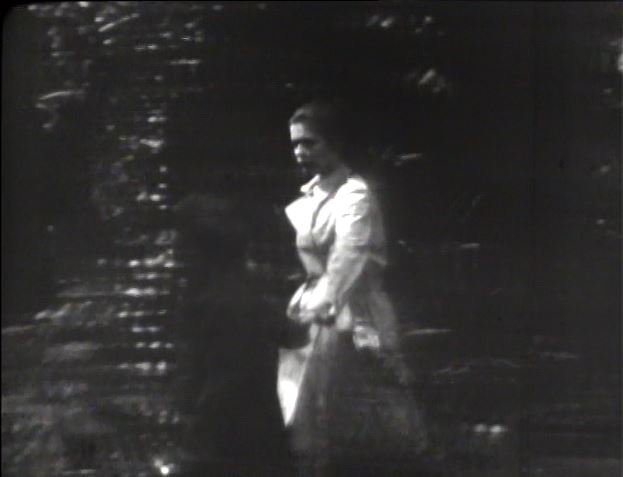
Vicki slips out the back door of the house. The episode closes with a new location insert, a shot of her outdoors in the dark.
This may sound like a lot of talk, much of it recapping, but when you watch it the whole thing feels like it’s packed with high-stakes action. The actors are all in good form today, and, as usual, Francis Swann’s script gives them the opportunity to show what they can do. It is strong from beginning to end, well worth the extra expenditures they devoted to it.
Reclusive matriarch Liz calls well-meaning governess Vicki into the drawing room in the great house at Collinwood. She asks Vicki where her charge, problem child David, is. When she tells her David is upstairs in his room, she asks Vicki to close the drawing room doors, explaining that she does not want their conversation overheard.
Of course David comes downstairs and puts his ear to the doors as soon as they are closed. Liz starts talking with her about some recent plot developments, and we hear a commotion outside the doors. Tightly-wound caretaker Matthew has caught David eavesdropping. Liz sends Vicki and David away, and talks to Matthew about events we saw several days ago.
David starts telling Vicki about the ghosts who haunt Collinwood, and shows her a drawing he made of one of them. Vicki is impressed with the drawing, and shows it to Matthew. Matthew accuses David of going to the Old House and copying the portrait hanging there. Vicki has never heard of the Old House- nor has the audience, it’s the first reference to it. David denies Matthew’s accusation, and says that it is a drawing of a ghost he has seen.
Vicki takes the drawing to Liz, who immediately recognizes it as Josette Collins. She opens the family history to the page featuring a portrait of Josette, and asks David if he copied that portrait. Again David insists it is a drawing of an actual ghost he has seen. The day before yesterday, in episode 68, we saw David studying that page, so it is quite plausible that he did copy it. Still, regular viewers will remember that in episode 52 the book opened itself to that same page when no one but the audience could see, so we might also wonder if David is telling the truth.
Flighty heiress Carolyn tries to talk her mother into hiring a housekeeper. When she mentions that one thing a housekeeper might relieve Liz of is her loneliness, she answers wryly, “You forget, dear, I have all of David’s ghosts.” In this reply, we return to the ambiguity of the first weeks of the show, when, in conversations with Vicki, one character after another would use the word “ghost” in a metaphorical sense, to refer to present difficulties resulting from unresolved conflicts in the past. Vicki would invariably respond with some line like “Surely you don’t believe in ghosts!,” as if they were talking about literal ghosts. And each time, the response would be that they did indeed believe in literal ghosts, and that if she stayed in the old dark house on the hill for any length of time she would believe in them too. Aside from the book opening itself in #52, the ghostly manifestations we have seen so far have been equivocal, possibly hoaxes, possibly tricks of the light. Even the incident of the book was small and symbolic. The ghosts could still dissolve into the atmosphere and into mere metaphor.
Determined to befriend David, Vicki agrees to go to the Old House with him to look for ghosts. We are treated to 90 seconds of location footage of Vicki and David walking through the woods to the Old House. This is by far the longest exterior sequence in the entire series, and it is done with extraordinary ambition. Most of Dark Shadows’ exterior shots are not only extremely brief, but are accompanied only by music. In this one, the actors’ voices are dubbed throughout, and multiple sound effects are added.
Vicki and David enter the Old House. As they do so, David shines his flashlight directly into the camera and creates a halo effect. This would not seem desirable, but it will be done dozens of times in episodes to come. It’s probably a mistake here- maybe a mistake most of the time- but they do it so often, there must have been some kind of intentionality behind it.
The first flashlight halo
Vicki and David examine the portrait of Josette hanging above the mantle. Vicki is impressed with its likeness to David’s drawing. David tells her that he has been through every part of the Old House, but denies that the portrait was his model. He tells Vicki of the legend that Josette’s ghost is trapped at Collinwood until another girl falls to her death from Widow’s Hill, and goes on and on about his hope that Vicki will be that girl.
This charming conversation is interrupted when the door suddenly opens. Frightened, David breaks off in the middle of telling Vicki that he wants her to die and clutches at her for safety.
I want you to die! Please save me!
In a moment like this, we can understand why Vicki keeps believing she can reach David. She knows that he is deeply disturbed, and that his violence may well turn against her. But she can also see inside him an awareness that he needs a friend. She has decided to risk his worst in hopes that his sense of that need will eventually break through his rage.
It is Matthew at the door. He scolds Vicki and David for visiting the Old House after he had told them how dangerous it is. The three of them talk a bit about the legends, then Matthew insists on leaving. Vicki turns to David, apparently willing to stay there with him. David looks bitterly at Matthew, and says that there is no point in staying. Josette won’t appear when Matthew is around, because she doesn’t like him. When Matthew says the place should be torn down, David becomes upset and says that he will tell Josette to kill him if he tries it.
The three of them do leave. Then something happens…
We see the vacant parlor of the Old House. The portrait of Josette begins to glow. A figure takes shape, and walks down from the portrait to the floor. It vanishes from the parlor, and reappears outside. It dances among the columns surrounding the house, glowing an unearthly white. Josette has come all the way out of the back-world into the foreground. We can expect her to stick around. Perhaps others will follow where she has led.
Evidently, Johnson and Crock had access to much of the original paperwork generated by the makers of the show. Today’s closing credits are truncated by a technical fault. The only writing credit shown is Art Wallace’s story creator tag. Fandom has jumped to the conclusion that Art Wallace wrote the episode, but the documents show that Francis Swann did. That makes sense- the two of them have been swapping weeks, with Wallace writing five episodes, then Swann writing five. Swann wrote the other four episodes this week, and Wallace wrote next week’s five, so it would be a deviation from the pattern if Wallace wrote this one as well. Since the episode is such a watershed in the development of the show it is tempting to attribute it to the original writer. But clearly, it is Swann who gave us our first looks at the Old House and at Josette.
We intercut between two contrasting scenes: in the mansion at Collinwood, Vicki the governess and Carolyn the heiress pour their hearts out to each other, while in the Evans cottage drunken artist Sam refuses to answer any of the questions his adult daughter Maggie puts to him.
The disappearance of doughty plant manager Bill Malloy looms over both conversations. Vicki and Carolyn can’t avoid the conclusion that the body they saw face-down on the beach at the end of Friday’s episode was Malloy’s. Sam tells Maggie that the reason he can’t sleep is that he’s worried about Malloy.
The two settings connect when Sam telephones Collinwood in hopes the dastardly Roger will answer. The call prompts Vicki and Carolyn to break up their slumber party in Vicki’s room and come to the telephone outside the drawing room.
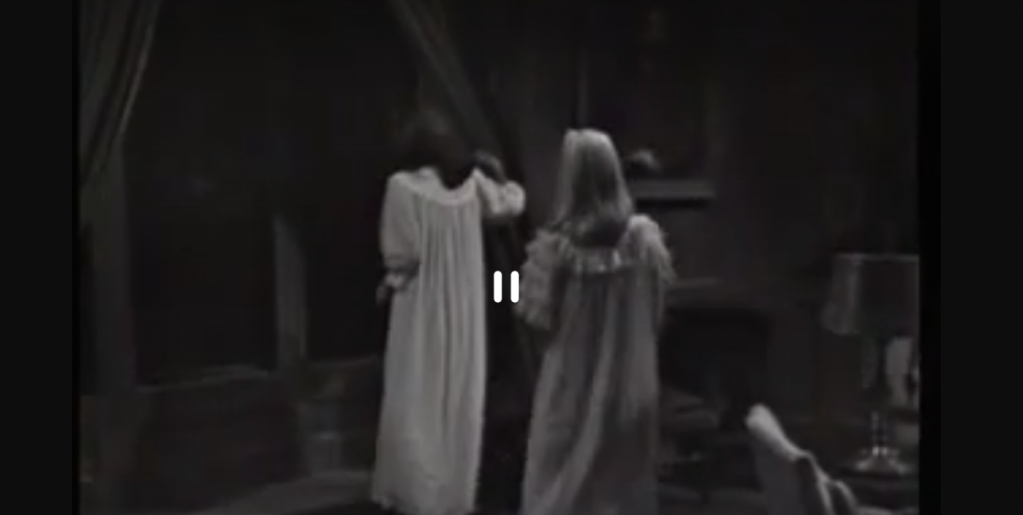
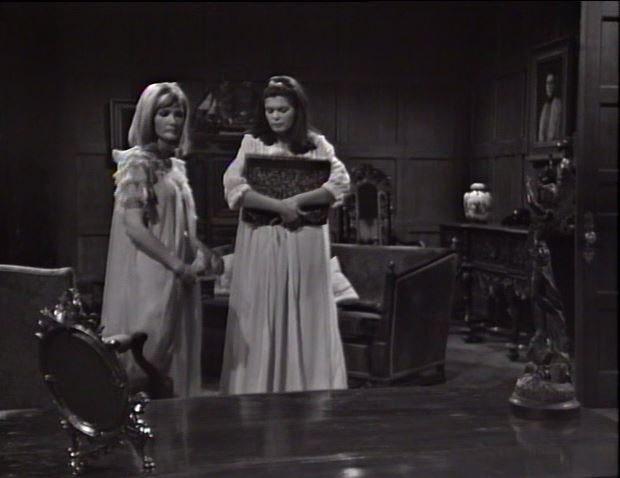
Vicki answers the telephone. Sam says “Collins,” Vicki asks to whom she is speaking, he hangs up. They then hear a noise from inside the drawing room. They go in and search to see if anyone is hiding there. Vicki goes directly to the window and pays special attention to the area behind the curtain on her right, a spot that will become a frequent hiding place much later in the series. I suppose it makes sense that people would eventually start hiding there- the camera has a great angle on it. Smart of Vicki to know that’s the first place to look.
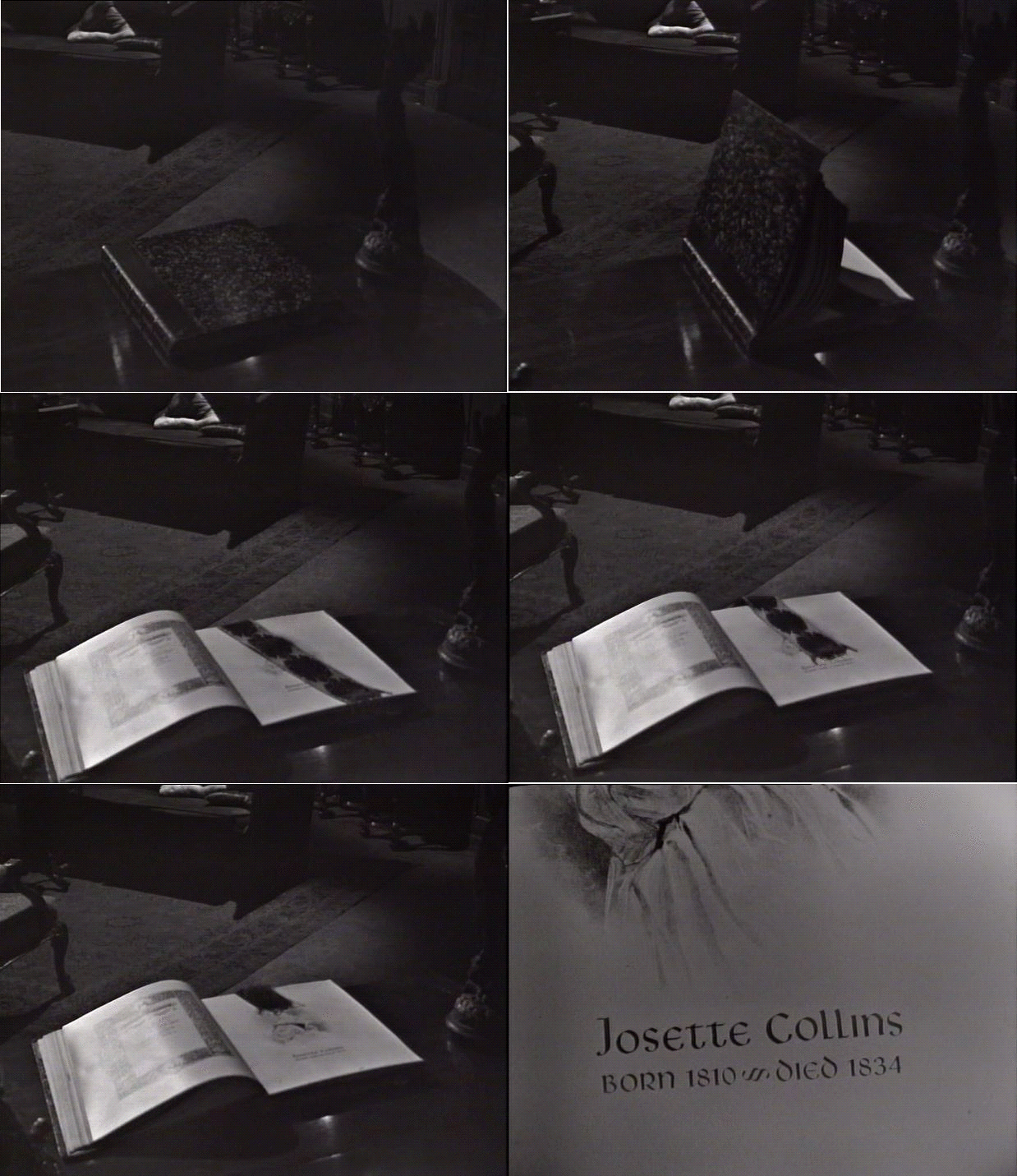
The girls find a book open on the floor. Vicki demonstrates that the noise they heard was the sound of the book falling, but she cannot explain how it moved several feet from the table where it was kept to the spot where she and Carolyn found it. Carolyn insists that they consider the possibility that a ghost put it there. Since they had heard the same sound at least once while they were still in Vicki’s room, it would make sense to consider that someone or something must have been involved in picking it up and dropping it again.
Vicki and Carolyn leave the drawing room, and we see the book reopen itself to the same page. The camera zooms in, and we see that the page bears the name and likeness of Josette Collins. This is the first supernatural manifestation that the audience sees when no character is looking. We’ve been hearing about the ghost of Josette Collins from week one; we have to assume that she is leaving us her carte de visite.
Each of the previous supernatural manifestations had marked a moment when off-screen events were stirring up the spirits that inhabit the back-world behind the universe the characters inhabit. When troubled rich boy David had tampered with the brakes on his father Roger’s car in an attempt at patricide, reclusive matriarch Liz was asleep and ghosts were trying to reach her in her dreams. That same night, Vicki saw a door open and close itself inexplicably, and saw a shrouded figure on the threshold of the drawing room. At the beginning of this episode, Carolyn admitted to Vicki that while Collinwood has always been a strange place, it was only when she and Burke came to town that the really weird stuff started happening. So we have to take it that Vicki’s presence in the house is itself a matter of concern to Josette and the other ghosts, and that what is happening off-screen in connection with the body on the beach and the secrets Sam refuses to share with Maggie are going to bring the phantoms out of the back-world into the foreground.
It’s also interesting that the first character we see after the ghost of Josette announces herself is Maggie. At this point and for some months to come, the show will be developing a connection between Vicki and the ghost of Josette. But later on, both Maggie the character and Kathryn Leigh Scott the actress will be very much involved with Josette. The series involved very little advance planning, nothing at all like daytime serials of the present day that have their stories sketched out in detail months in advance, so that is probably just something you’d expect to happen when you only have four actors in the studio. Still it’s an eldritch moment for repeat viewers.
Within the context of the show as it actually was at this period, I think there is a point to the juxtaposition of the ghost of Josette with the scene between Maggie and Sam in the Evans cottage. Vicki and Carolyn are girls at a slumber party scaring each other with ghost stories. Even when the slumber party takes place in a mansion on a great estate belonging to the family that gave the town its name, that’s a silly situation. When the ghost stories turn out to be true, though, you’re suddenly vaulted into an elevated realm of fantasy. Turn to a small house where the adult child of an alcoholic is wearing her late mother’s night-gown and trying fruitlessly to prise some useful information out of her drunken parent, and you land back in the real world with a thud. Nothing here seems to be either silly or fantastic. Sam’s association with Roger’s secret, and therefore with the unknown events that are roiling the supernatural world, suggests that the mundane struggles of the Evanses and the fantastic doings at Collinwood will sooner or later collapse into each other.
I should mention Marc Masse’s post about this episode on his always intriguing, usually inaccessible blog Dark Shadows from the Beginning. Masse meticulously demonstrates the influence of the 1944 film The Uninvited on the show in general and this episode in particular with close analysis and multiple screenshots, and then does the same thing with an episode of Alfred Hitchcock Presents called “The Gentleman from America.” It’s a very impressive and thoroughly convincing work of scholarship.
Masse’s blog is infamous among many Dark Shadows fans because of what he presents as transcripts of conversations between director Lela Swift, executive producer Dan Curtis, and others that he claims were picked up by the control room microphone and that he has recovered by some more or less magical technique unknown to other audio technicians. In this one he includes such a “transcript,” in which Swift (who didn’t direct this episode, but is supposed to be in the control room anyway) tells Curtis that she thinks it’s a terrible idea to do a ghost story or a Hitchcock story on daytime TV.
That installment of “The Dan and Lela Show” is pretty tedious to read, but in a way it’s a relief. In previous posts Masse has presented Swift as maniacally driven by lust for the female cast members, a presentation that her husband and their children might have found surprising. His post for episode 48 brings that presentation to a sort of crescendo. Since this one includes two shots of Vicki and Carolyn in bed together, I braced myself for Masse to outdo himself in that line, but there isn’t a bit of it there.
In 281 of the posts that follow, I link to comments I made on Danny Horn’s blog, “Dark Shadows Every Day.”
I added most of these comments in the months between the shutdown of live theater in March of 2020 and the completion of the blog in April of 2021. But I have added some since.
In the last few days, I’ve added four. They all discuss on the way the show shifts its focus, once the vampire story becomes a hit, in the direction that will come to define it as the months and years go on. The first three of these comments are on posts discussing episodes where Barnabas the vampire is holding Maggie the lovable girl prisoner and trying to brainwash her into becoming his late love Josette, so that he can kill her and turn her into a vampire. This comment is on the post for episode 253, in which the boy David has broken into Barnabas’ house and had a shouting match with Barnabas’ servant Willie:
The scene between David and Willie marks a definitive break from the pre-Barnabas show. David’s great concern is that Barnabas and Willie are “hurting Josette.” By which he means that he can no longer sense the presence of the ghost of Josette. On the contrary, the name “Josette” now refers to something horrible and that horrible thing is a part of Barnabas’ story.
In the first 42 weeks, the ghost of Josette had been the principal supernatural element in the show. Serene, mysterious, uncanny, the ghost fit perfectly into that series, which was something like 99% atmosphere and 1% story. And Josette came out of the background at two key moments, leading the rescue of Vicki from Matthew in 126 and informing the family of the danger Laura represents to David in 149 and 170. And of course when Barnabas first meets David in 212, David tells him that Josette protects the family.
So when Barnabas starts his rampage, regular viewers would at first be waiting for the ghost of Josette to make its move and stop him. By the time David sees the Josette-ified Maggie in 240 and 241, we know that the imperturbable Josette of the first 42 weeks is not coming back. If we do see Josette’s ghost again after we’ve seen Maggie in her wedding dress, it could not have the lightly amused smile in its voice with which it told Vicki not to be afraid of Matthew; it could return only as a terrifying spirit of vengeance. By the time David and Willie finish their confrontation in this episode, the show has told us that the protecting ghost won’t return at all.
This one is on the post for 255, in response to a comment from someone wondering what Barnabas was planning to do if he had succeeded in his evil plan for Maggie. How could he have gone on presenting himself to the rich Collinses as their long-lost cousin from England?:
I think we have to assume that all the “cousin from England” stuff would have gone by the boards if Barnabas had succeeded with Maggie. When they revisited Barnabas’ Josettifying project in HOUSE OF DARK SHADOWS, they had to ask what would come next, and the answer was “He kills everyone and turns the estate into an impenetrable outpost of Hell.”
Some time after they came back from making that movie, the show would send Barnabas and Julia on a two-week visit to the future, to the far-off year 1995, where they find that most of the family is dead, the rest of them are hopelessly insane, and no one dares go to the estate, all because of hideous supernatural doings that took place there a quarter century before. Those two weeks are sensational, the last genuinely great phase of the show, and part of what makes them so great is that they are a logical sequel to the part of the show everyone remembers most clearly.
This one is on the post for 256. In that episode, the hapless Maggie has seen a mysterious little girl playing outside the cell in which Barnabas keeps her. The girl’s name turns out to be Sarah:
I’d say Sarah’s introduction is the single most important moment in the whole show, more important than Barnabas coming out of the box, more important even than Barnabas’ first decision not to kill Julia.
From the beginning they’d been playing with the idea that there was another cast of characters hidden behind the characters we’ve been watching, supernatural characters who can make their influence felt at certain moments. The most prominent of these was the ghost of Josette…
So the show has discarded the old supernatural realm of Josette and the widows, a realm that was, as you say, never more than slightly accessible. With Sarah’s appearance, we are introduced to an entirely new part of the show. Once again we have a set of characters hidden in the supernatural background, but they can interact with the characters from the main continuity more directly and at greater length than Josette and the widows ever could.
The puzzle of Sarah’s connection to Barnabas, and her talk about looking for the members of her family, indicates that this new order of supernatural beings have complex and unsettled relationships with each other, and that characters from the main continuity can have an influence on those relationships. We will have to figure those relationships out in the weeks and months to come, but as soon as Sarah demands Maggie not tell her big brother that she saw her, we know that they might come to enmesh the living beings. Every scene with Sarah, then, is a step leading directly to the time-travel and parallel universe storylines that will come to define the show.
This one, on the post for 279, sums up the major points of the three comments above. It regards an episode in which Barnabas and Willie are planning to host a costume party in which members of the present-day Collins family will come dressed as their forebears from Barnabas’ time, the late eighteenth century. Barnabas has rather surprisingly claimed that this party will be “the most important night of [his] life”:
‘Dude… you rose from the dead. I think the prize for “most important night of my life” is pretty much taken.’
I think he has a point, though. While it is undoubtedly true that the writers, producers, and other creatives never had an elaborate plan that they had agreed on and that they would stick to regarding the future storylines of the show, they did have some memory of the storylines they had already developed. They spent the first 25 weeks building up the ghosts of Josette and of The Widows as presences in the show, a whole second cast of characters existing in a back-world behind the one in which the events we see take place…
Once the vampire story gets going, Josette and the Widows can’t come back. Their distant, mysterious, impassive qualities suited the slow, atmospheric early months of the show, but once you have a ghoul rampaging about sucking people’s blood there’s no place for remote and uncanny presences. To hold the stage while that’s going on, you need to be a dynamic character…
So the old supernatural order of Josette and the Widows is gone. But the idea of a second cast of characters, mostly invisible to us, properly associated with the distant past, but still wielding powerful influence over the events on screen. is stronger than ever. Barnabas had been hidden away, he belongs dead, yet he has irrupted into the present and taken over the story. Sarah is a denizen of the same back-world, she has broken through with Barnabas, and is steadily pulling aside the curtain that conceals their realm from that in which the established characters live and which the audience sees. The audience is going to have to be introduced to more characters from Barnabas and Sarah’s world, and the party is going to serve that function.
Once we’ve learned their names and how they relate to each other, the back-world characters and their time will have to become a concrete part of the show in a way that Josette and the Widows never could. In retrospect, the only way that could end is with an extended flashback. So the party does turn out to be a solid candidate for ‘the most important night of Barnabas’ life’, in that it is a major step towards the time-travel and parallel-universe stories that would come to define the show.
The time-travel and parallel-universe stories put the back-worlds into the foreground and the usual continuity into the background. Those reversal may not have been the only way to resolve the crisis they created by introducing Barnabas and Sarah, but certainly some kind of radical change in the relationship of back-world and usual continuity was unavoidable.
I’d like to say one more thing about a point I make in that final comment. “While it is undoubtedly true that the writers, producers, and other creatives never had an elaborate plan that they had agreed on and that they would stick to regarding the future storylines of the show, they did have some memory of the storylines they had already developed.” Throughout the blog, Danny repeatedly claims never to have seen most of the episodes from the first 42 weeks of the show. At times this claim seems like it must be an exaggeration- for example, at one point he catalogs all 21 episodes (between #42 and #108) which revolve around the questions of what kind of physical contact had with Burke Devlin’s pen and where Burke’s pen is, a catalog that could only have been made by someone who had seen all of those episodes and all those between. Be that as it may, he does vociferously disclaim any interest in the show as it was before the vampire comes along. Which is his privilege, Dark Shadows was a very different show pre-Barnabas and post-Barnabas and there is no reason to assume that a person who likes one of those shows will like the other.
He also stresses the point that there was no advance planning in the writing of the show, that they were making it all up from week to week, often dropping one story abruptly and expanding another just as abruptly as soon as the ratings came in. That should be obvious to anyone who watches the show for any length of time.
However, it can be misleading to stress the impromptu nature of the stories while ignoring the first 42 weeks, especially when you’re considering the period of the show immediately after those weeks. No one knew what was coming, but the producers, the directors, most of the writers, and many of the actors had been with the show from the beginning and knew exactly where they had been. So the idea of a ghostly back-world and the difficulties that come when you have to define the relationship of back-world to main world were very familiar to them, and it would have been clear that redefining that relationship would have major implications for the future of the show.
Another weakness of Danny’s is a tendency to both emphasize intentionality (a fine thing in itself!) and to reduce intentionality to what “the writers” had in mind. In my comments I usually play along with the focus on intentions, even though I don’t tend to favor that myself. -If it were just me, I wouldn’t be so concerned with proving that anyone associated with the show was thinking about the relationship of back-world to main-world in the summer of 1967- it would be enough that the logic of the show leaves them nowhere else to go. But Dark Shadows Every Day is Danny’s blog, so when I’m there I want to play his game as much as possible.
Where I can’t follow is with his tendency to reduce “intentionality” to “the writers.” A TV series has lots of creators- in addition to writers, there are producers, directors, actors, set designers, costumers, camera people, executives representing networks, executives representing studios, etc, etc. Each of those people has to make contributions, and each has a whole bunch of things to think about at any given time. So there’s always a multitude of intentions, and many levels of intentionality, to be considered.





 Dark Shadows Commentary